
Key Takeaways
- Vector search retrieves information by semantic similarity, allowing related concepts to match even when exact query terms are absent.
- Embedding models convert text, images, audio, products, or other data into numerical vectors "positioned" within multidimensional embedding spaces.
- Search systems index content vectors, compare query vectors using similarity or distance measures, and often rerank retrieved results before presenting them.
- Hybrid search combines vector retrieval with keyword matching, while RAG systems use retrieved passages as context for generating answers rather than generating answers through retrieval alone.
Vector search is a data retrieval method that finds information based on semantic similarity rather than relying only on exact keyword matches. It represents queries and searchable content as numerical vectors, allowing systems to retrieve items that are similar in meaning even when they use different words.
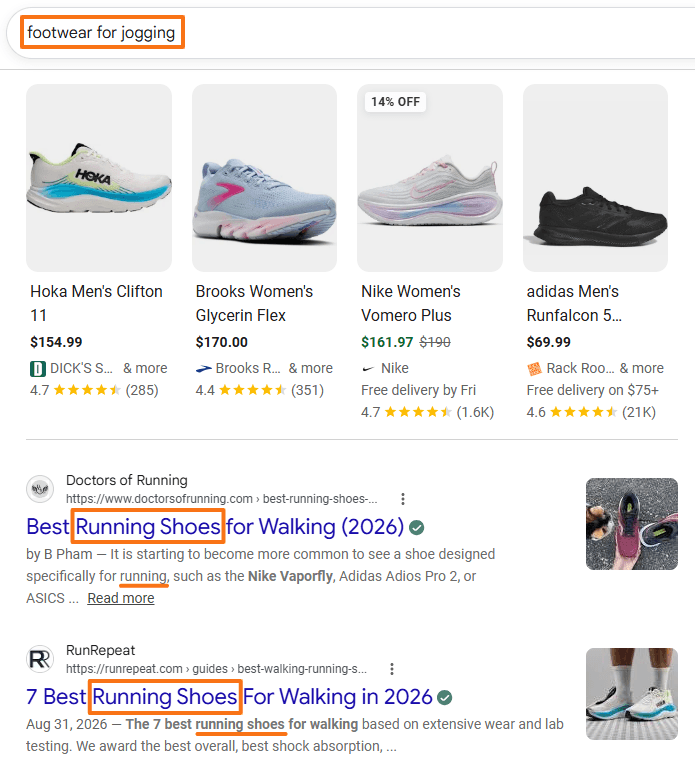
Traditional keyword search relies heavily on matching words or terms that appear in both the query and the indexed content. Vector search can retrieve semantically related content even when the same words are not present. For example, a search for “automobile maintenance” may retrieve content about “car servicing” even when the exact word “automobile” is absent. This allows systems to find information based on similarity in meaning rather than exact wording, making it important for AI search and recommendation systems.
In vector searches, words, sentences, images, and documents are represented as numerical vectors. Modern search engines combine lexical matching with semantic and machine-learning systems. Google, for example, publicly describes neural matching as a system that helps understand representations of concepts in queries and webpages.
Vector retrieval is also widely used in generative-AI applications, especially retrieval-augmented generation (RAG) systems that retrieve relevant documents or passages before producing an answer. For example, OpenAI documents embeddings as a technology used for semantic search and knowledge retrieval.
Vector representations are also widely used in recommendation systems, where systems can represent users, products, songs, movies, or other items in mathematical spaces and compare them for similarity.
What Are Vectors and Embeddings?
A vector is an ordered list of numbers. In machine learning, an embedding is a vector created to represent information such as text, an image, audio, a product, or another data item. A text embedding can be thought of as a numerical representation of the meaning and characteristics captured by an embedding model.
Modern systems rely on high-dimensional mapping, in which text, images, or audio are translated into coordinates within a dense, multidimensional space. Embedding vectors can contain hundreds or thousands of numerical values, depending on the model. The meaning of an embedding is generally distributed across the full vector rather than assigned to one clearly interpretable concept per dimension.
Embedding Vectors, Embedding Layers, and Embedding Spaces
An embedding is a numerical representation of data created so that useful relationships between items can be captured mathematically. Google describes an embedding as a vector representation of data in an embedding space.
An embedding vector is the actual ordered list of numbers that represents one item. For example, a sentence may be converted into a vector containing hundreds or thousands of numerical values. Those values work together to represent characteristics learned by the embedding model.
An embedding layer is a component inside some machine-learning models that learns how to represent input data as embedding vectors. During training, the model adjusts these numerical representations so that items with useful similarities can be represented more closely.
An embedding space is the multi-dimensional mathematical space in which those vectors exist. Items with similar learned characteristics tend to occupy nearby regions, while unrelated items tend to be farther apart. Vector search uses these relative positions to find similar information.
Similar concepts → nearby vectors
Different concept → farther away
The Key Distinction: An embedding is the numerical representation, an embedding vector is the actual list of numbers containing that representation, an embedding layer can learn how items should be represented, and an embedding space is where the resulting vectors are compared.
The individual numbers in an embedding usually do not represent simple labels such as “vehicle,” “family,” or “food.” Meaning is distributed across the complete vector, and individual dimensions may not have a clear human-readable interpretation.
Example: Suppose an embedding model stores three sentences for semantic search using three-dimensional vectors:
- A: “Best SUVs for large families”
- B: “Minivans with seven seats”
- C: “How to bake sourdough bread”
An embedding model processes each sentence and produces a simplified three-number embedding vector:
- A →
[0.88, 0.79, 0.16] - B →
[0.84, 0.82, 0.19] - C →
[0.10, 0.14, 0.91]
Here, each list of numbers is an embedding vector. These numbers are not percentages or ratings and should not be interpreted individually as fixed labels such as “vehicle,” “family,” or “food.” Their importance comes from the complete numerical pattern. Because A and B discuss closely related ideas, their vectors are similar (0.88 and 0.84 are closer to each other than either is to 0.10) and therefore occupy nearby positions in the embedding space. In this simplified example, Articles A and B would occupy nearby positions because their vectors are similar, while Article C would appear much farther away.
Now suppose the search query is “vehicle for a family of six”.
The same embedding model converts the query into another vector, for example:
Query → [0.86, 0.80, 0.17]
The search system compares this query vector with the stored vectors. Because it lies much closer to A and B than to C, the system can retrieve the SUV and minivan content even though the query does not contain the exact words SUV or minivan.
During model training, an embedding layer may adjust the learned representations so that related concepts such as SUV, minivan, family, seating, and vehicle are represented in useful nearby regions of the embedding space. The exact values can change as the model learns; they are not permanent human-assigned ratings.
The complete flow is therefore:
How Vector Search Works
Embedding models place related items in nearby regions of a mathematical vector space. Similarity can then be estimated by comparing the positions of their vectors. For example, a search for “vehicles for moving families” might retrieve content about minivans or large SUVs even if those exact vehicle names were not used in the query.
Before searching can occur, the content in a searchable collection is usually processed by an embedding model and stored as vectors in an index. However, comparing a query against billions of stored vectors can be computationally expensive. Therefore, large vector indexes often use approximate nearest neighbor (ANN) techniques to find likely matches quickly instead of comparing a query against every stored vector. Examples include HNSW and Google’s ScaNN algorithm.
After the user enters the query, the embedding model converts the user query into a mathematical vector. The system maps it to the vector index and measures mathematical similarity or distance between the query point and surrounding content points using mathematical equations like cosine similarity (for evaluating the angle between vectors), dot product, or Euclidean distance (for measuring straight-line distance). Common comparison methods include cosine similarity, dot product, and Euclidean distance.
Finally, the retrieved matches are reranked using additional relevance signals and the highest-scoring results are returned in their final order.
The four-step execution loop broadly works like this:
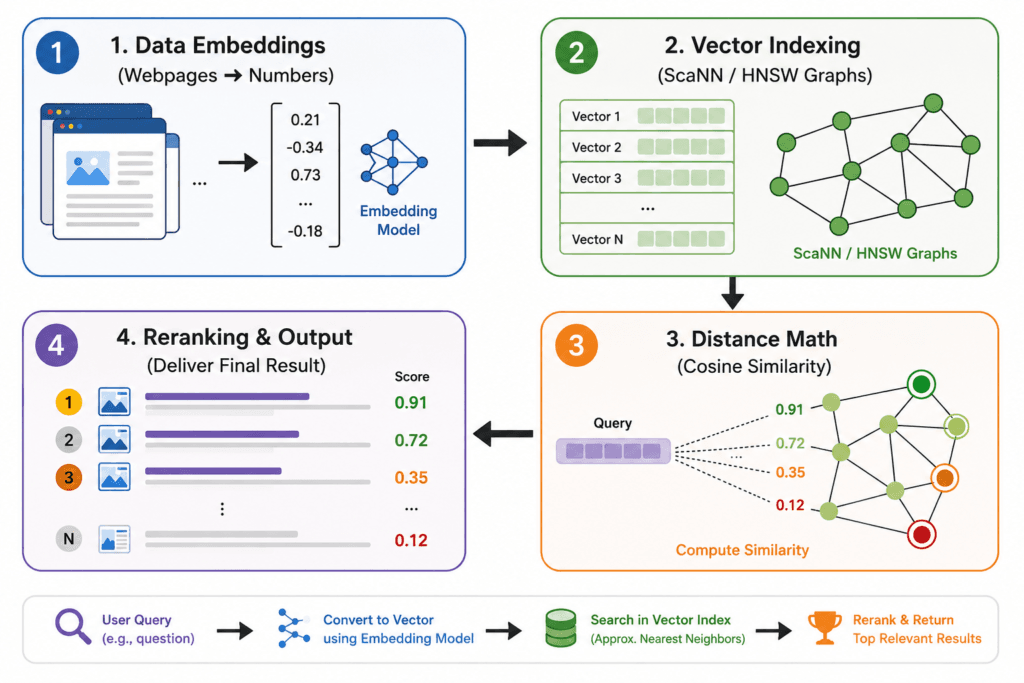
This way, the system can retrieve the indexed vectors that are most similar to the query vector. In a retrieval-augmented generation system, selected passages can then be supplied to a large language model as supporting context for generating an answer. Retrieval can improve grounding, but it does not guarantee that the final answer will be accurate or cited correctly.
Vector Search vs Retrieval-Augmented Generation System (RAG)
Vector search retrieves related information but does not generate the final answer by itself. In a RAG system, vector search may find relevant passages, while a large language model uses those passages as context when generating a response.
AI-powered search and answer systems can combine several retrieval methods. Apart from vector search, they may also use keyword search, filters, reranking models, web search, and knowledge graphs.
Keyword search matches words and textual patterns, while vector search retrieves content based on semantic similarity. Hybrid search combines lexical and vector retrieval so a system can benefit from both exact matches and semantic relationships. Some hybrid systems use rank-fusion or reranking techniques to combine results, but implementations vary.
Lexical Search
Keyword search is essentially a form of lexical search, which primarily involves matching the actual words in indexed content with the terms used in a query, rather than relying only on their broader meaning. For example, a lexical search for “error 110” is effective when a document contains that exact phrase, while a semantically related passage that never uses those words may be less likely to match.
Vectors and the Future of Search
Google’s core semantic infrastructure includes its open-source ScaNN (Scalable Nearest Neighbors) algorithm, which provides high-accuracy vector matching globally in a few milliseconds. According to Weaviate’s Core Architecture Guide, vector databases use ANN algorithms to intentionally trade a fraction of a percent of algebraic accuracy for massive gains in query response speeds.
Vector search reduces dependence on exact keyword matching because semantic similarity can connect related concepts expressed with different wording. However, keywords still matter in many retrieval systems, particularly in hybrid search, where semantic and keyword-based retrieval are combined.
It is therefore important for content creators to:
- Write Clearly About the Topic: Semantic systems can better connect content with related queries when concepts and relationships are expressed clearly.
- Use Natural Terminology and Relevant Variations: Avoid forcing one exact phrase repeatedly when related language is more appropriate.
- Provide Self-contained Passages: Clear definitions and focused explanations make individual sections easier to understand and retrieve.
- Use Descriptive Headings: Headings help organize topics and make passages easier for both readers and retrieval systems to interpret.
- Add Useful Original Information: Examples, evidence, comparisons, and first-hand insights improve the informational value of content.
- Cite Factual Claims: Reliable sources strengthen usefulness and allow readers to verify important information.
Frequently Asked Questions
What is vector search?
Vector search finds information by comparing numerical representations called embeddings, allowing it to retrieve items with similar meanings even when they use different words.
How is vector search different from keyword search?
Keyword search primarily matches words and phrases, while vector search focuses on semantic similarity between the query and stored content.
Where is vector search commonly used?
Vector search is commonly used in semantic search, recommendation systems, image and product discovery, and retrieval systems that support generative AI applications.