
Key Takeaways
- Query expansion broadens or reformulates searches with related terms, synonyms, variants, or contextual information to overcome vocabulary mismatches.
- It supports short, incomplete, ambiguous, or differently worded queries by connecting search language with terminology used in relevant documents.
- Expansion can use dictionaries, thesauri, query logs, retrieved documents, pseudo-relevance feedback, or language models to generate alternative terms.
- Unlike semantic search or fuzzy search, query expansion adds or modifies query terms, while poor expansion can cause query drift and reduce precision.
Query expansion is an information retrieval technique that broadens or modifies a user’s original search query by adding synonyms and related terms, synonyms, variants, or contextual information. Its main purpose is to help a search system retrieve relevant content even when the searcher and the content use different words to describe the same idea.
For example, someone may search for “automobile repairs,” while a useful document discusses “car repair,” “vehicle maintenance,” or “auto mechanics.” A strict exact-match system could miss that document because the vocabulary is different. Query expansion helps bridge this vocabulary mismatch by allowing the search to cover appropriate alternative terms. Differences in vocabulary, including the use of synonyms, often make query expansion or reformulation necessary.
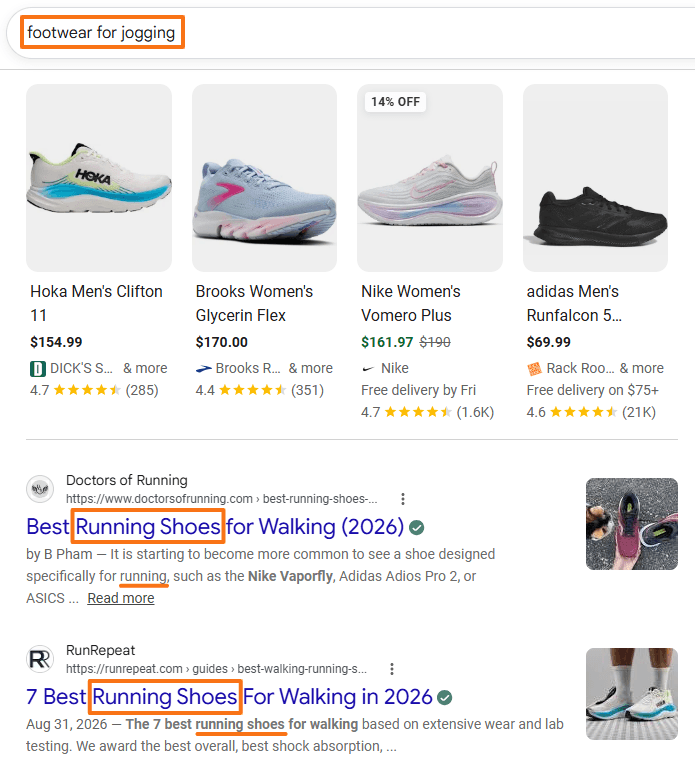
Query expansion can also help when queries are short, incomplete, ambiguous, or expressed differently from the terminology used in the information being searched. Modern approaches range from predefined synonym lists to AI systems that create alternative versions of a query.
Query Expansion vs. Semantic Search vs. Fuzzy Search
Query expansion modifies or broadens the query by introducing additional terms. Semantic search tries to match content according to meaning and context, even when the exact words differ. Fuzzy search allows approximate text matches and is particularly useful for spelling mistakes and small character-level variations.
Query Problems Solved by Query Expansion
Query expansion is especially useful when the words entered by the searcher do not perfectly match the vocabulary contained in relevant documents.
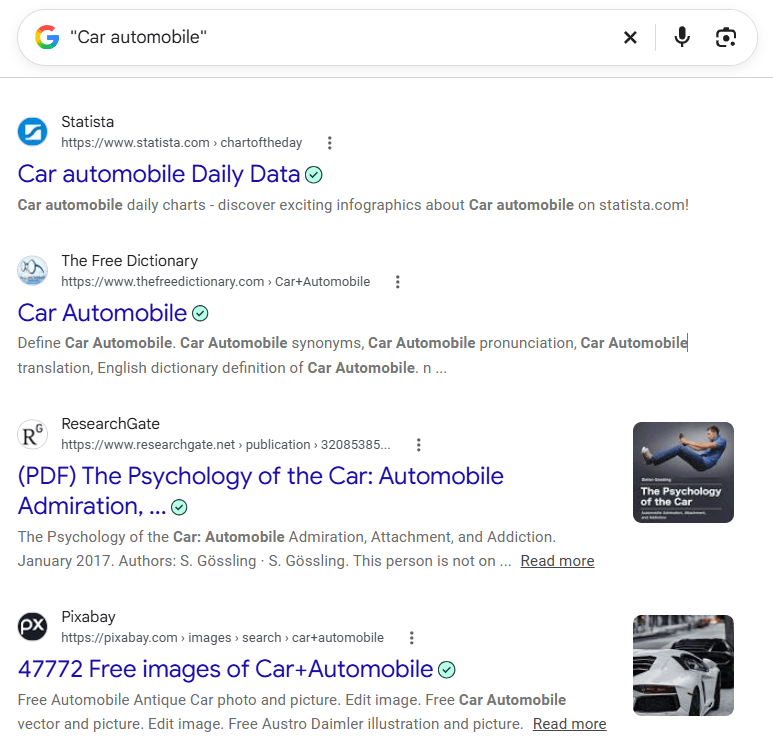
- Vocabulary Mismatch: The same concept may be expressed with different words. A search for automobile might need to retrieve pages containing car or vehicle. Google Programmable Search Engine, for example, allows predefined synonyms to automatically expand searches to equivalent terms. Quoted searches illustrate the opposite approach: they can restrict results to exact wording, while query expansion broadens the vocabulary considered by the search system.
- Short Queries: Searches containing only one or two words provide little context. Adding closely related terms can give the retrieval system more ways to find useful information.
- Incomplete Queries: A query such as remote developer may need to match documents containing phrases such as remote software engineer or work-from-home developer.
- Ambiguous Terms: Words such as jaguar, apple, or python can have several meanings. When the intended meaning can be identified from context, expansion can introduce terms related to that particular meaning rather than every possible interpretation.
- Different Terminology: Beginners, specialists, industries, and geographic regions may use different language for the same subject. Query expansion helps bridge those differences.
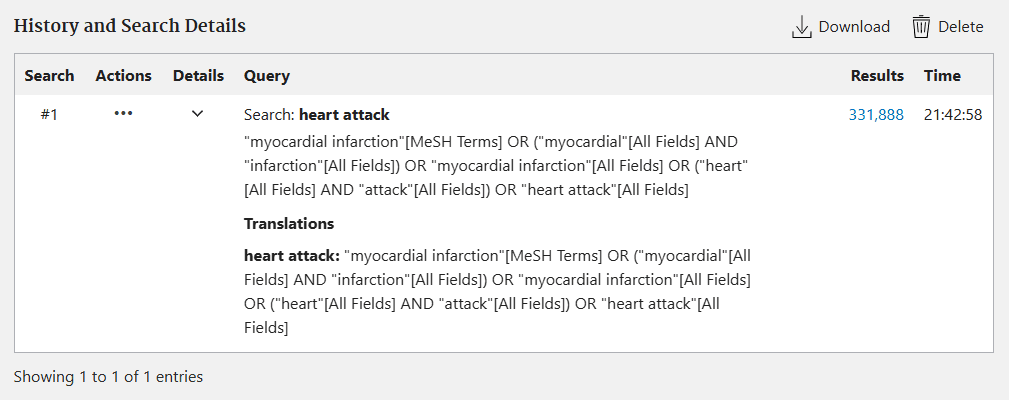
- Spelling and Word Variants: Search systems may also account for misspellings, abbreviations, singular and plural forms, or related word forms. However, spelling correction and fuzzy matching are separate retrieval techniques rather than forms of query expansion in every system. Spelling correction is often used alongside query expansion and other vocabulary-based techniques.
How Query Expansion Works
There is no single method for expanding every query. Search systems can draw expansion terms from dictionaries, documents, previous searches, or AI models depending on the application.
1. Global Analysis
Global analysis uses information available independently of the results returned for the current query. The system may use dictionaries, thesauri, ontologies, knowledge bases, or relationships learned from a larger collection to identify useful alternative terms. These resources can help a system identify whether the terms belong to the same subject or represent related concepts. For example:
Original query: automobile repairs
Possible expanded query: automobile repairs/car repair/vehicle maintenance/auto mechanic
The expansion does not need to treat every term equally. Search systems can give different terms different weights depending on how closely they represent the original query.
Classic global query-expansion methods include thesaurus-based expansion and resources such as WordNet.
2. Local Analysis and Pseudo-Relevance Feedback
Local analysis uses the documents returned for the current search to discover additional useful vocabulary.
One common method is pseudo-relevance feedback. The system performs an initial search and assumes that several highly ranked documents are likely to be relevant. It then examines those documents for useful terms and uses the new information to refine the search.
A simplified process is:
It is called pseudo-relevance feedback because no person has actually confirmed that those initial documents are relevant. The system makes that assumption automatically.
The number of documents examined is not fixed. Different systems can use different candidate sets and methods for deciding which terms should influence the revised query.
automobile repairs
Ontologies · Knowledge Bases
car repair · vehicle maintenance · auto mechanic
automobile repairs
3. LLM-Driven Query Expansion and Rewriting
Modern search and Retrieval-Augmented Generation (RAG) applications can use large language models (LLMs) to create alternative versions of a query. For example:
Original query: How does remote work affect productivity and employee retention?
An AI system could generate searches such as:
- remote work productivity studies
- remote work employee retention
- work from home turnover rates
These searches can be run separately and their results combined. Depending on the implementation, this may be described as query rewriting, multi-query retrieval, or LLM-driven query expansion.
LLMs are particularly useful when a query contains several ideas because they can separate those ideas into more focused searches. Recent research on modern query expansion describes LLMs as being used for contextual disambiguation, multiple-query generation, and RAG retrieval.
4. Query Log Analysis
A search system can also learn useful relationships from query logs, which are records of searches and associated interactions collected by a search service.
For example, if many people search for one phrase and then reformulate it using another phrase, the system may learn that the two expressions are closely related. Similar relationships can sometimes be inferred when users consistently select results containing particular terminology.
Historical search behavior can therefore provide another source of possible expansion terms. Search logs, clicked results, and other interaction signals can reveal terms and concepts associated with a query.
Types of Query Expansion
Query expansion can take different forms depending on how a search system broadens the original query. Based on linguistic relationships and semantic analysis, three important types are synonym expansion, morphological expansion, and semantic expansion.
Synonym Expansion
Synonym expansion adds words or phrases with the same or very similar meaning to the original query. For example, a search for car repair might also consider automobile repair or vehicle repair. This helps retrieve relevant documents that use different wording from the searcher’s original terms. Synonym expansion can rely on dictionaries, manually defined synonym lists, or machine-learning systems that identify equivalent expressions. It is one of the simplest forms of query expansion because the added terms remain closely tied to the original meaning.
Morphological Expansion
Morphological expansion adds grammatical or inflectional variants of a word. A query containing run, for example, may also be matched with forms such as running or runs, helping the system retrieve documents that use a different grammatical form of the same term.
Semantic Expansion
Semantic expansion broadens a query using related meanings, concepts, or entities rather than only direct word variants. A search for electric cars, for example, might also consider related concepts such as EVs, battery electric vehicles, or relevant vehicle models when the context supports that relationship.
Why Query Expansion Matters for Search Systems
Query expansion can improve retrieval by reducing the dependence on the exact words entered by the user.
- Improves Recall: Recall describes how many of the relevant documents available in a collection are successfully retrieved. Expansion can increase recall by finding useful documents that use different terminology. Stanford’s IR text notes that query expansion is often effective at increasing recall.
- Reduces Search Friction: Users do not always know the exact terminology used in technical documentation, product catalogs, research databases, or professional records. Query expansion can connect everyday language with specialist vocabulary.
- Adds Context to Weak Queries: Short or incomplete searches may become more useful when the system can introduce closely related terms without changing the underlying intent.
- Supports Conversational Search: Longer natural-language questions often contain several information needs. Query rewriting can turn them into smaller, more focused searches that are easier for a retrieval system to process.
- Improves Candidate Retrieval: Query expansion can help more relevant documents enter the initial candidate pool. Ranking or reranking systems can then determine which of those candidates deserve the highest positions.
Query Expansion and Query Drift
Adding more terms does not automatically produce better results. Query drift occurs when expansion introduces concepts that move the search away from the user’s original intent. For example, expanding an ambiguous word with terms related to the wrong meaning can increase the number of retrieved documents while reducing their relevance.
Query-expansion systems therefore need to balance recall with precision, which measures the proportion of retrieved results that are relevant. Poor expansion can significantly reduce precision.
Practical Applications of Query Expansion
Query expansion is useful wherever the terminology used by searchers may differ from the language contained in webpages, products, records, or documents. The examples below illustrate possible expansions rather than the exact queries used by any particular platform.
In ecommerce, expansion can connect everyday product names with synonyms used in a catalog. In enterprise search, it can help employees find internal documents even when departments use different terminology.
The technique is also valuable in legal, medical, and academic retrieval, where specialist terminology may differ considerably from the words used by non-specialists.
Frequently Asked Questions
How is query expansion different from semantic search if both can find related terms?
Query expansion changes or broadens a query by adding or generating related terms, synonyms, variants, or alternative formulations. Semantic search instead tries to retrieve content according to its meaning and context, even when the system does not explicitly add those alternative words to the query.
The two approaches can also be combined. A system might generate several expanded queries and then use semantic or vector search to retrieve results for them.
What is the difference between query expansion and query suggestion?
Query expansion usually happens inside the retrieval system to improve the results returned for the current search. The user may never see the expanded terms.
Query suggestions are alternatives shown to the user, such as autocomplete phrases or related searches. The user chooses whether to submit one of those suggestions.
Can query expansion accidentally lower search accuracy?
Yes. Expansion can introduce irrelevant or ambiguous terms that cause the search to move away from the intended subject. This is known as query drift.
Good expansion systems therefore select and weight additional terms carefully rather than simply adding every possible synonym. The goal is to retrieve more relevant material without introducing so much unrelated content that precision falls.