
Key Takeaways
- The Rich Results Test checks whether structured data meets Google’s requirements for supported rich-result features in Search.
- It can test published URLs or pasted code, including JavaScript-generated structured data that appears after a page loads.
- Errors can block eligibility, while warnings typically identify recommended information that could make markup more complete.
- Passing confirms technical eligibility, not guaranteed display, because Google determines appearances using its systems, policies, query, device, and location.
The Rich Results Test is a free Google tool that checks whether structured data on a webpage or in a code snippet is valid for rich-result features supported by Google Search. Structured data gives search engines machine-readable information about elements such as products, recipes, events, organizations, articles, and reviews.
Rich results are enhanced search listings that can display additional information beyond a conventional text result. Depending on the supported feature, this can include ratings, prices, availability, event dates, recipe details, job information, images, or other structured elements.
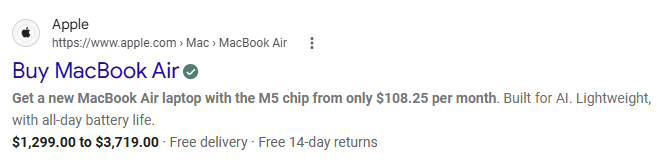
The Rich Results Test can identify supported markup, report errors and warnings, determine whether an item is technically eligible for an available rich-result feature, and provide previews for some Search appearances.
Passing the test does not guarantee that Google will display a rich result. Correct markup can qualify the page for consideration, but Google ultimately determines whether and how an eligible result appears based on its systems, Search policies, the query, device, location, and other factors.
Rich Results Test vs. Schema Markup Validator
The Schema Markup Validator checks Schema.org markup broadly, including its structure, vocabulary, and syntax. The Rich Results Test checks whether supported structured data meets Google’s specific requirements for Search features. Markup can therefore be completely valid according to Schema.org while still not qualifying for a rich-result feature in Google Search.
The Schema Markup Validator can be used for broad schema validation, while the Rich Results Test can be used to check Google Search eligibility.
How the Rich Results Test Works
The Rich Results Test can evaluate either a published webpage or structured-data code before it is deployed. It can render a webpage and process structured data generated through JavaScript rather than examining only the original HTML downloaded from the server.
In simple terms, some websites do not place all their structured data directly into the initial page code. JavaScript may add it after the page begins loading. The Rich Results Test renders the page so it can examine markup created during that process.
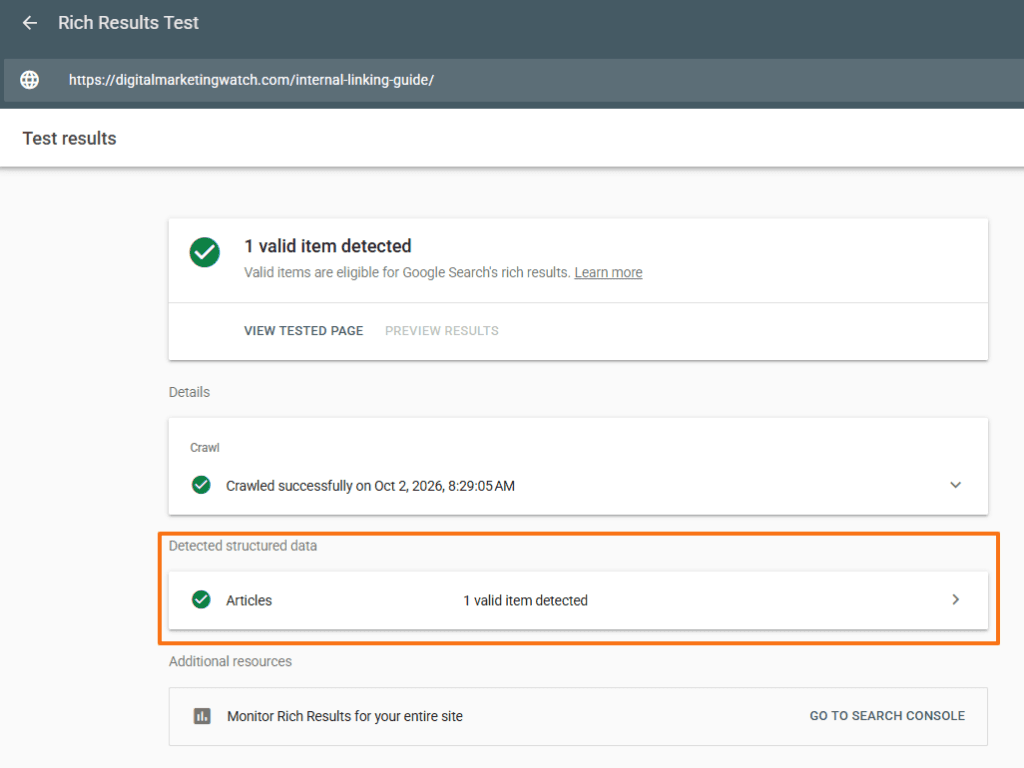
Google recommends testing the actual URL when JavaScript generates structured data because URL testing more closely reflects how the rendered page is processed.
The test performs several useful checks:
- Structured Data Detection: Identifies supported structured data found on the page or within the submitted code.
- Eligibility Testing: Checks whether the markup satisfies Google’s requirements for the corresponding rich-result feature.
- Error and Warning Reporting: Flags missing required properties, invalid values, syntax problems, and recommended properties.
- Rendered Page Inspection: Allows the rendered HTML to be examined when testing a live URL.
- Search Preview: Provides previews for supported rich-result types where available.
After deployment, applicable rich-result reports in Google Search Console can be used to monitor structured-data validity across indexed pages.
Two Ways to Run the Test
The Rich Results Test can be run in two ways, depending on whether the page is already published or the structured data is still being developed.
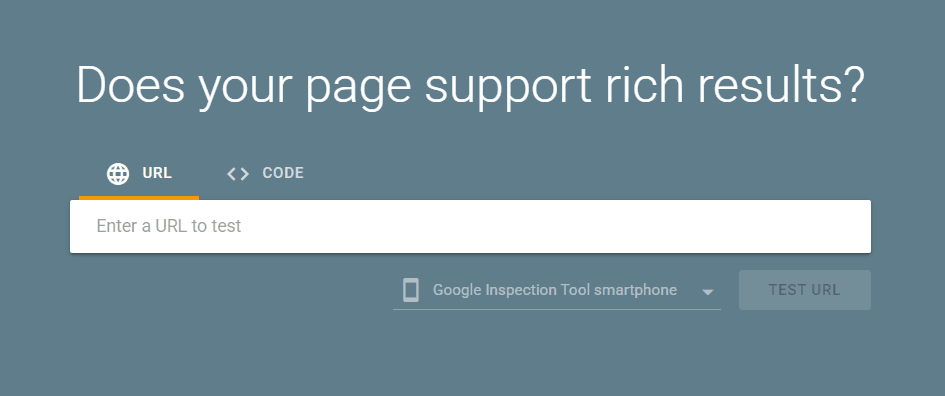
By Live URL: Enter a publicly accessible webpage URL. Google retrieves and renders the page before evaluating its structured data.
By Code: Paste HTML or structured-data code directly into the tool. This is particularly useful during development before the page is publicly available.
How Rich Results Can Support Search Optimization
Structured data and rich results do not directly guarantee higher rankings, but they can make eligible Search listings more informative and visually distinctive.
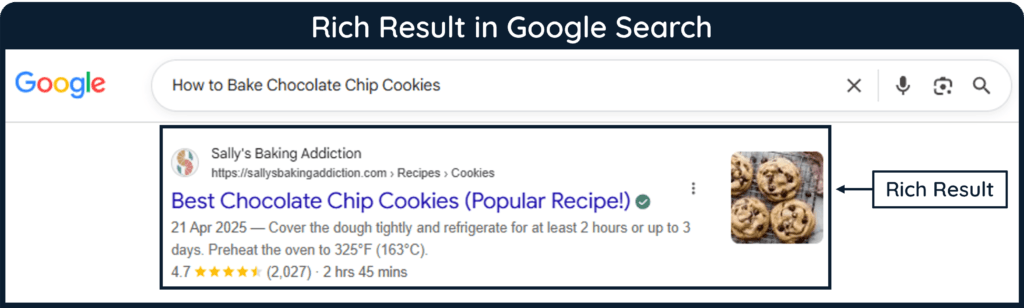
Rich results can support search performance by:
- Increasing SERP Prominence: Additional visual elements can make an eligible result stand out from standard text listings.
- Providing Information Before the Click: Details such as price, availability, ratings, dates, or recipe information help users evaluate a result before visiting.
- Attracting More Relevant Visitors: Additional context can help users determine whether a page genuinely matches their needs.
- Clarifying Page Information: Structured data explicitly identifies important entities, attributes, and relationships in a machine-readable form.
- Differentiating Eligible Listings: Rich-result enhancements can visually distinguish a result from surrounding standard listings.
- Supporting User Confidence: Accurate ratings, availability, business information, or other useful details can make a listing more informative.
Google has published structured data case studies in which individual organizations reported increases in metrics such as clicks, traffic, or engagement after implementation. These results are examples rather than guaranteed outcomes.
How to Become Eligible for Rich Results
- Choose a structured-data type supported by Google.
- Make sure the visible page content genuinely matches that type.
- Add the appropriate structured data.
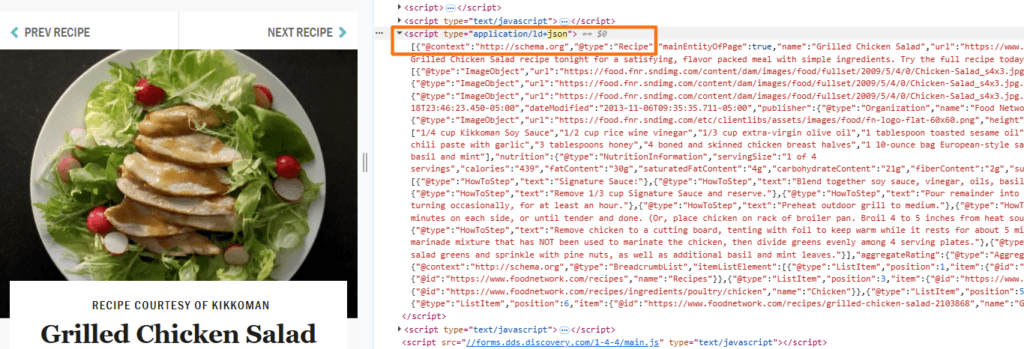
- Use JSON-LD where practical; Google also supports Microdata and RDFa.
- Include all required properties.
- Add useful recommended properties where appropriate.
- Keep structured data consistent with visible page content.
- Keep the page crawlable and indexable.
- Validate the markup before and after publishing.
There is no special structured data required specifically for AI Overviews or AI Mode.
Common Structured Data Types Tested for Google Search Features
Common structured-data types supported by Google include:
- Product: Can provide information such as price, availability, ratings, shipping, and merchant details.
- Article: Identifies article information including headline, author, publication date, and images.
- Local Business: Describes details such as business type, address, opening hours, and contact information.
- Recipe: Provides recipe information including images, preparation time, ingredients, nutrition, and instructions.
- Review Snippet: Marks up individual or aggregate ratings that may become eligible for supported review displays.
- Job Posting: Describes job information such as employer, location, employment type, salary, and application details.
- Course List: Identifies eligible educational courses and their providers.
- Event: Provides information such as dates, venues, ticket offers, and event status.
- Breadcrumb: Describes a page’s position within the website hierarchy and can help Google understand its navigational structure.
- Organization: Helps Google understand an organization through properties such as its name, logo, URL, contact information, and identifiers.
Rich Results vs. Other SERP Features
Knowledge Panels, People Also Ask results, and Featured Snippets can also appear alongside traditional blue-link results in Google Search. However, they are commonly categorized as SERP features rather than rich results.
How to Interpret Rich Results Test Results
The Rich Results Test reports whether supported structured data is eligible and identifies problems that should be reviewed.
Eligible for Rich Results
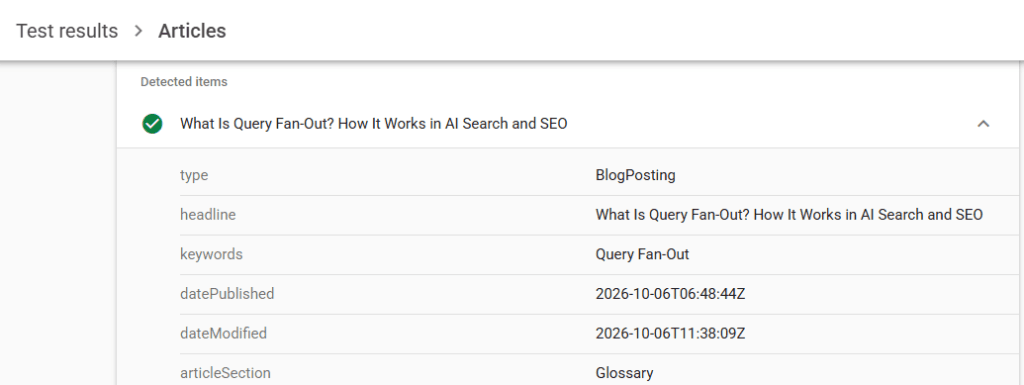
If the markup meets Google’s required technical conditions, the tool can report that the item is eligible for rich results.
Eligibility means the page can qualify. It does not mean Google will necessarily display the enhancement in Search.
Critical Errors
An error indicates a problem that can prevent the affected item from being eligible for a particular rich-result feature. Common causes include missing required properties, invalid values, malformed structured data, and incorrect property combinations.
The error should be corrected and the page tested again.
Warnings and Non-Critical Issues
Non-critical issues generally involve recommended rather than required properties. The item may remain eligible, but adding applicable recommended information can make the structured data more complete.
Rich Results Test vs. Bing Structured Markup Testing
Bing provides related structured-markup inspection through Bing Webmaster Tools, particularly within its URL Inspection workflow.
Bing’s markup inspection helps verify which structured-data formats Bing can detect and interpret on a live URL, making it useful as a secondary validation step after checking broader Schema.org validity and Google’s rich-result eligibility.
A useful validation workflow is:
The first checks broader Schema.org validity, while the latter two show how the major search engines interpret the implementation.
Frequently Asked Questions
Does passing the Rich Results Test guarantee the site will display a rich result?
No, passing means the markup is technically eligible for the supported Search feature, but Google does not guarantee that the rich result will be displayed.
What is the difference between a critical error and a warning?
A critical error can prevent rich-result eligibility. A warning generally relates to recommended information that is not mandatory for eligibility.
Can the Rich Results Test be used before a page goes live?
Yes, raw HTML or structured-data code can be pasted directly into the tool, allowing markup to be tested before deployment.
Why can mobile and desktop previews differ?
Google Search layouts and available screen space can differ across devices, so supported rich-result presentations may also vary.
What is the difference between the Rich Results Test and Schema Markup Validator?
The Rich Results Test checks Google-supported rich-result requirements, while Schema Markup Validator checks Schema.org markup more broadly.
How long does it take for rich results to appear after the errors are fixed?
There is no fixed time. Google must recrawl and reprocess the page, which can take several days, and successful validation still does not guarantee display.
Are Knowledge Panels, People Also Ask, and Featured Snippets rich results?
They are all SERP features, but they are not all rich results generated through structured data. Rich results are specifically enhanced Search appearances associated with supported structured-data features.