
Key Takeaways
- Rich results enhance conventional Google Search listings with visual or interactive details such as ratings, prices, availability, images, or cooking times.
- Structured data explicitly describes page content, Schema.org supplies the vocabulary, and JSON-LD, Microdata, or RDFa provide implementation formats.
- Valid structured data can make content eligible for supported rich results, but Google may still display a standard result instead.
- Rich results can improve visibility and provide useful information before clicks, but structured data is not a generic ranking factor.
A rich result is an enhanced result in Google Search that can display additional visual or interactive information beyond a conventional title, URL, and description. Depending on the content type, a rich result may include ratings, prices, availability, images, cooking times, event information, job details, breadcrumbs, or other useful attributes. Google previously used terms such as rich snippet and rich card, but rich result is now its standard terminology.
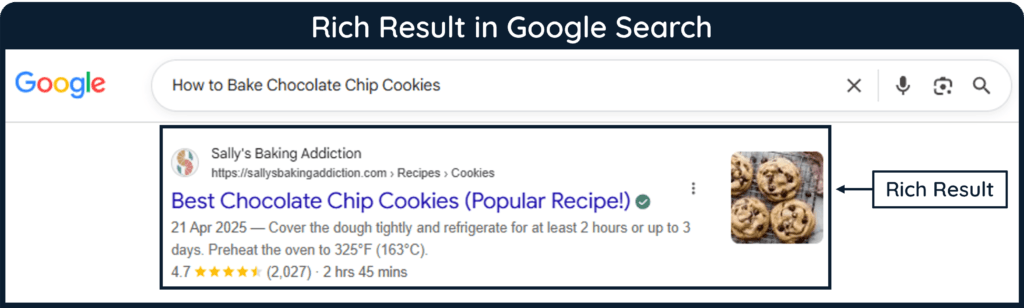
Rich results are closely connected with structured data, schema markup, and JSON-LD, but these terms describe different parts of the process:
- Structured data is standardized, machine-readable information added to a webpage to explicitly describe its content. For example, instead of leaving Google to infer that “45 minutes” refers to cooking time, structured data can label that value as the recipe’s cooking time.
- Schema markup commonly refers to structured data that uses the vocabulary provided by Schema.org. This vocabulary contains types such as
Recipe,Product,Person, andOrganization, along with properties such asname,price, andratingValue. - JSON-LD, Microdata, and RDFa are formats that can be used to add structured data to a webpage. Google supports all three and generally recommends JSON-LD because it is easier to implement and maintain at scale.
- A rich result is one possible search appearance that Google may create after understanding eligible structured data.
The relationship can be summarized as:
For example, JSON-LD for a recipe may look like this:
<script type="application/ld+json">
{
  "@context": "https://schema.org",
  "@type": "Recipe",
  "name": "Chocolate Chip Cookies",
  "cookTime": "PT45M"
}
</script>
Here, Recipe identifies the type of content, while name and cookTime describe specific properties. Google says structured data provides explicit clues about the meaning of a page and can make content eligible for richer Search appearances. However, correct markup does not guarantee that a rich result will be displayed.
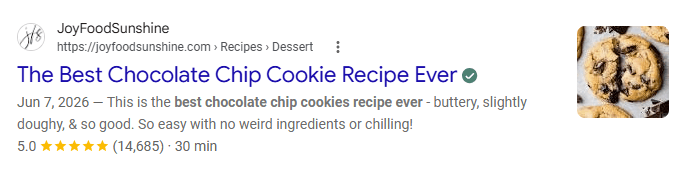
Standard Result vs. Rich Result
Using a recipe as an example, a standard result and a rich result might differ as follows:
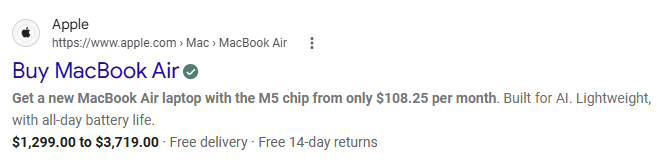
A standard result mainly identifies the webpage and summarizes its content. A rich result can expose specific information directly in the SERP, allowing users to evaluate the result before clicking.
Rich Results, Rich Snippets, SERP Features, and Featured Snippets
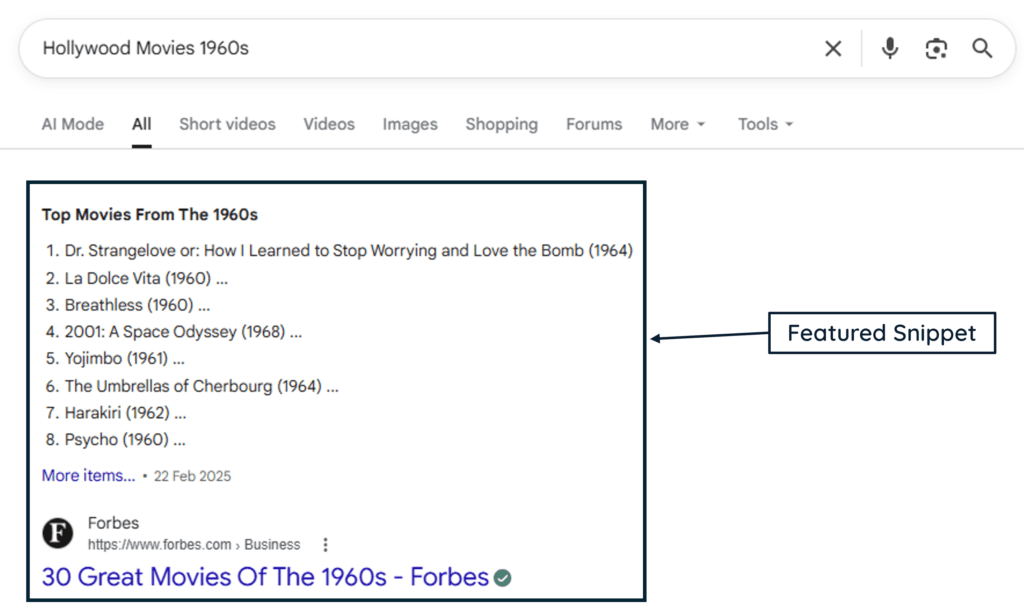
A rich result is an enhanced organic result, often enabled by structured data, such as a product showing its price or a recipe showing a rating. Rich snippet is an older term commonly used for these enhancements. A SERP feature is a broader category and includes rich results, Local Packs, image results, Featured Snippets, and other special Search elements. A Featured Snippet prominently presents information extracted or summarized from a webpage to answer a query.
Answer box is an informal term that may refer to direct-answer features shown by a search engine. These features can look similar but are produced through different mechanisms.
Types of Rich Results
Google supports structured data for a range of Search experiences. Schema.org itself contains many more types and properties, so valid schema markup does not automatically mean that Google offers a corresponding rich result.
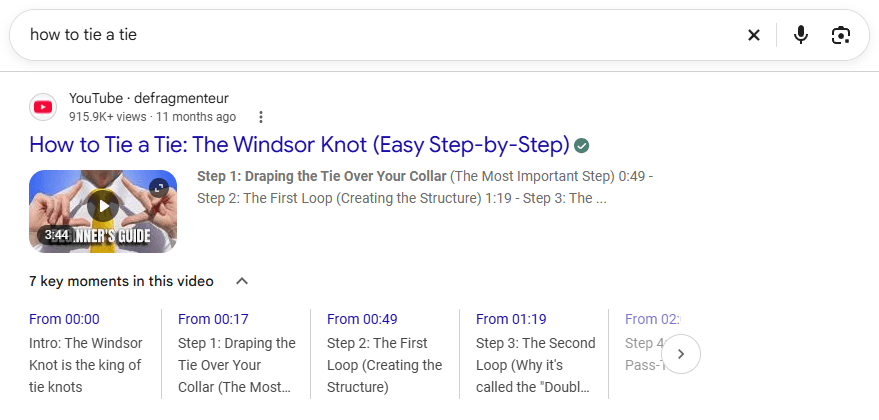
Google recommends following its structured-data documentation when implementing markup specifically for Search.
Google’s current structured-data gallery includes these and additional specialized features. Product markup, for example, can support information such as price, availability, ratings, shipping details, and return information.

Deprecated and Retired Rich Results
Rich-result support changes over time, so older SEO guides may recommend markup that no longer produces a special Google Search appearance.
Google stopped showing How-To rich results in 2023. It also stopped showing FAQ rich results on May 7, 2026, after previously limiting them mainly to authoritative government and health sites.
In 2025, Google also announced the phaseout of several lesser-used structured-data Search features such as Book Actions, Claim Review, Estimated Salary, Learning Video, Special Announcement, and Vehicle Listing. Google also retired Course Info, but Course List remains a supported Google structured-data feature.
Google said removing these Search enhancements did not affect page rankings, and the underlying structured data may still be useful outside Google Search.
Why Rich Results Are Important for SEO
Rich results can make an organic result more visually informative and may help it stand out from conventional text listings. A user comparing products, for example, may be able to see price and availability before clicking, while someone searching for a recipe might see its rating or cooking time.
This can support SEO by:
- Increasing visual prominence in the SERP
- Giving users more information before they click
- Potentially attracting more relevant or qualified visits
- Helping search engines understand explicitly marked information
- Differentiating eligible results from basic text listings
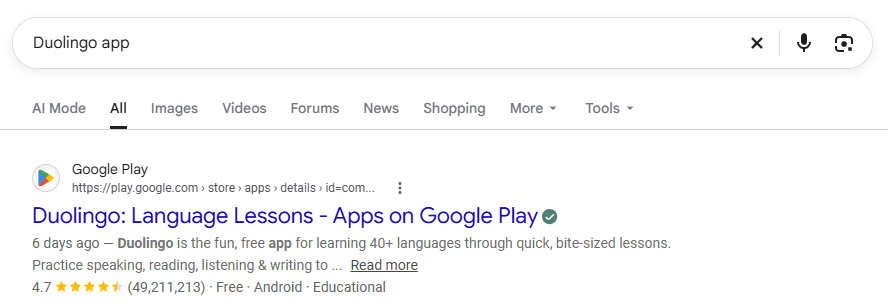
Google has published case studies in which websites reported higher CTR, visits, or engagement after implementing structured data. However, structured data itself is not a generic ranking factor and those results should not be treated as universal outcomes. Its direct SEO value is primarily improved understanding and eligibility for additional Search experiences rather than an automatic ranking increase.
How to Become Eligible for Rich Results
A webpage should first match a rich-result type that Google currently supports. Adding Product markup to a page that is not actually about a product, for example, would not be an appropriate implementation.
The general process is:
- Choose a supported rich-result type.
- Make sure the visible page content matches that type.
- Add the appropriate structured data.
- Use JSON-LD where practical, although Microdata and RDFa are also supported.
- Include all required properties specified by Google.
- Add useful recommended properties where appropriate.
- Ensure the structured data accurately represents visible content.
- Keep the page crawlable and indexable.
- Validate the markup before and after publishing.
- Allow Google to recrawl the page and monitor its Search appearance.
Google requires structured data to follow both its general guidelines and the rules for the individual feature. However, even markup that passes technical validation is not guaranteed to produce a rich result.
Adding Schema Markup Through a CMS
Website owners do not always need to write JSON-LD manually. Content management systems and ecommerce platforms may generate structured data automatically, while WordPress plugins such as Rank Math and Yoast SEO can create schema markup based on selected content types.
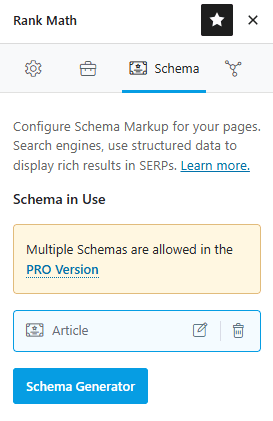
Custom JSON-LD can also be added through templates, themes, plugins, or code. Whatever method is used, the resulting markup should still be validated because automated implementations can contain missing properties, duplicate schema, or incorrect content types.
How to Test, Validate, and Monitor Rich Results
The Google Rich Results Test is Google’s dedicated tool for checking whether a page contains structured data that can support Google rich results. It can test either a live URL or a code snippet and identify detected types, errors, and suggestions.
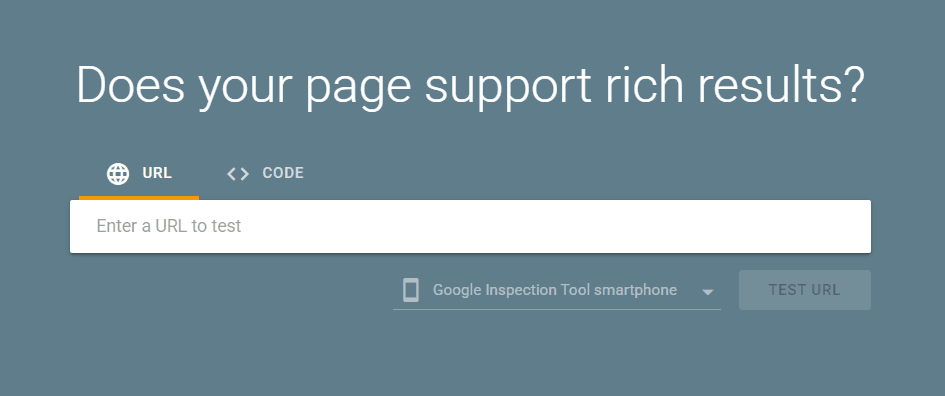
The Schema Markup Validator serves a different purpose. It checks Schema.org markup more broadly, without focusing specifically on Google’s rich-result requirements. A page can therefore contain valid Schema.org markup while having no corresponding Google rich result.
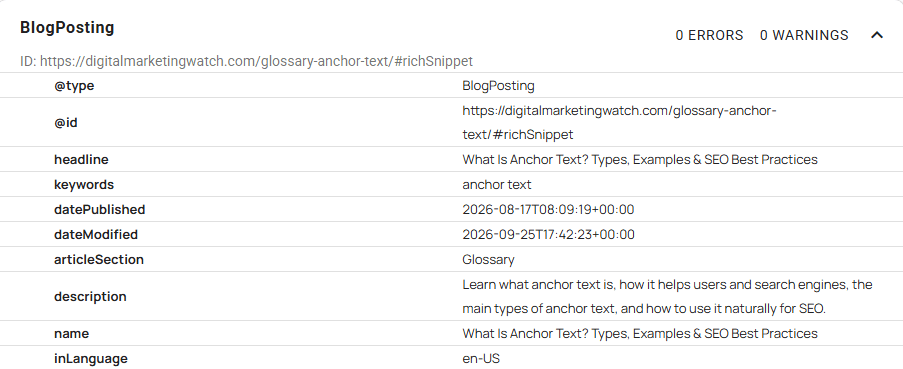
Structured data can also be checked manually in a browser. Using View Page Source or Inspect / Developer Tools, search for terms such as:
application/ld+json
schema.org
"@type"
This can confirm whether a CMS, Rank Math, Yoast, or another system has actually generated the expected JSON-LD. It should supplement, rather than replace, formal validation.
After Google has crawled the page, Google Search Console can help monitor rich-result implementation. Its rich result reports can show valid and invalid structured-data items for supported types, while URL Inspection can provide details about rich results detected on an individual page.
For larger websites, crawling tools such as Screaming Frog can help audit schema implementation across many URLs. Ecommerce websites may also use Google Merchant Center diagnostics for relevant product information.
Frequently Asked Questions
Is a rich result the same as a rich snippet?
They generally refer to the same broad idea, but rich result is Google’s current terminology. Rich snippet is an older term that remains widely used in SEO.
Does schema markup guarantee a rich result?
No. Correct schema markup makes eligible content capable of receiving supported Search enhancements, but Google decides whether a rich result is appropriate for each search.
Does structured data improve Google rankings?
Structured data is not a generic ranking factor by itself. It can help Google understand page content and make eligible pages available for additional Search experiences.
Is JSON-LD required for rich results?
No. Google supports JSON-LD, Microdata, and RDFa, although it generally recommends JSON-LD because it is easier to implement and maintain.
Can I check schema markup using Inspect Element?
Yes. Browser developer tools can confirm that structured data is present in the rendered page, particularly JSON-LD. The Rich Results Test or Schema Markup Validator should still be used to determine whether the implementation is valid.
Why is my page eligible for a rich result but not showing one?
Eligibility does not guarantee appearance. Google may choose a standard text result instead based on the query, device, location, Search experience, page quality, structured-data guidelines, and other factors.