
Key Takeaways
- A featured snippet is a highlighted organic result that provides a direct answer with a link to the source page.
- “Position Zero” is an informal term, not an official Google ranking position or separate Search Console slot.
- Featured snippets can appear as paragraphs, lists, tables, or related-question answers, depending on query intent and available content.
- Optimization improves eligibility through concise answers, suitable formats, relevant questions, and strong existing rankings, but cannot guarantee selection.
A featured snippet is a highlighted organic search result that appears prominently near the top of Google’s search results and provides a quick, direct answer to a query.
Historically described as “Position Zero” because of its prominent placement above traditional organic listings, a featured snippet can provide an immediate answer while linking users to the source page for further information.
Position Zero
“Position Zero” is an informal SEO term traditionally used for featured snippets appearing above standard organic listings. It does not represent an official Google ranking position or a separate numbered slot in Search Console. Search Console reports the top search position as position 1 rather than position 0.
Anatomy of a Featured Snippet
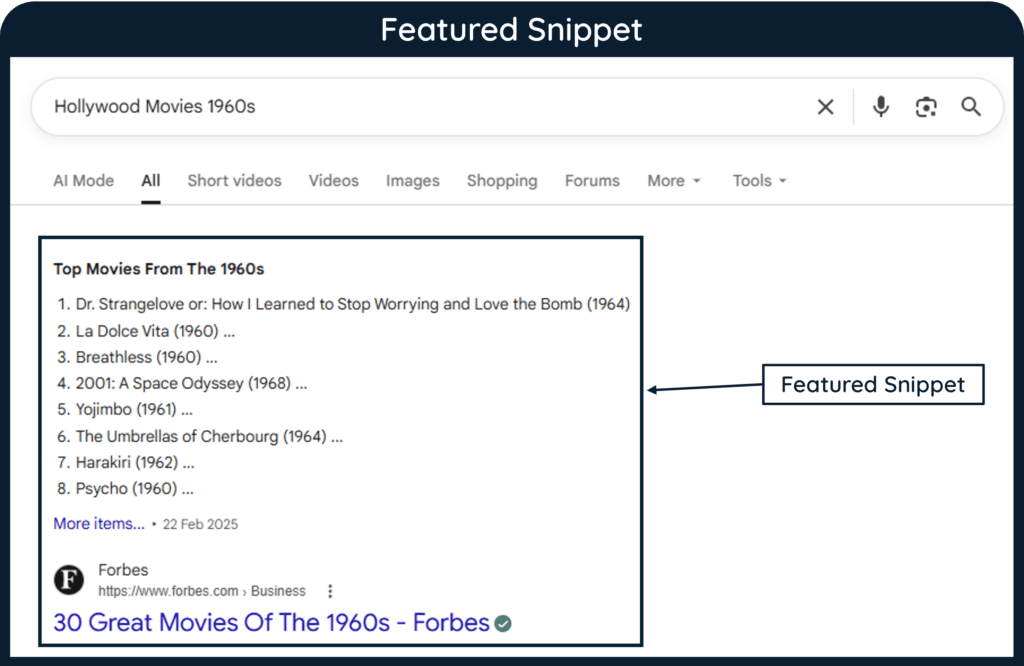
A featured snippet is generated automatically from webpage content and commonly includes the following elements:
- Content Excerpt: A short paragraph, list, table, or other passage extracted from the source page to answer the search query directly.
- Title Link: A clickable title link that identifies the source page and allows users to visit it.
- Source Attribution: Information identifying the website, such as its name, favicon, domain, or visible URL.
Where Do Featured Snippets Appear?
- Prominently in Search Results: Featured snippets commonly appear near the top of Google’s organic results, although their exact position can vary depending on advertisements and other search features.
- People Also Ask: Featured snippets may also appear in expanded questions in the People Also Ask section, providing short answers to related queries.
- Side Panels: They may also be placed next to Knowledge Graph data blocks on the side of the screen.
Types of Featured Snippets
Google may display a featured snippet in different formats depending on the query, available content, and the type of answer that best satisfies the search intent.
- Paragraph Snippets: These display a short block of text that directly explains a concept or answers a question. They commonly appear for queries beginning with phrases such as “What is,” “Why does,” or “Definition of.”
- List and Step Snippets: These present information as numbered steps or bullet points. They are often used for tutorials, recipes, checklists, rankings, and queries beginning with “How to.”
- Table Snippets: These organize information into rows and columns, making comparisons easier to understand. They may appear for pricing comparisons, measurement conversions, schedules, specifications, and size charts.
Video results and Key Moments can also provide prominent answers in Google Search, but Google documents them separately from featured snippets.
How Featured Snippets Can Support SEO
Featured snippets can support SEO by increasing search visibility, attracting relevant clicks, and directing users to specific answers within a webpage.
- Increase Search Visibility and Clicks: Featured snippets occupy prominent space in search results and can attract meaningful traffic. A 2022 study of more than 3,500 Google users reported a 35.1% click share for featured snippets, although actual click behavior varies by query, layout, and competing search features.
- Take Users to the Relevant Passage: When a featured snippet is clicked, Google may take the visitor directly to the section of the page containing the extracted answer.
- Support Concise Answer Formats: The short, direct structure of featured snippets can also suit queries performed through conversational or voice-based search, although voice assistants may use several information sources.
How to Optimize for a Featured Snippet
Featured snippets cannot be purchased or manually requested as Google’s automated systems determine whether a webpage provides a suitable answer. In other words, optimization can improve eligibility but cannot guarantee selection.
- Answer the Question Directly: Place a concise, self-contained answer immediately below a descriptive heading, followed by supporting details where necessary.
- Prioritize Existing Rankings: Focus first on queries for which the page already ranks prominently. A large 2017 Ahrefs study found that almost all featured snippets in its dataset came from pages already ranking within the top ten. This is useful evidence, although it is not a fixed Google eligibility rule.
- Target Relevant Long-Tail Queries: Address specific informational searches, including questions beginning with phrases such as “What is,” “How to,” and “Why.” Ahrefs found that many featured snippets were triggered by long-tail queries, including queries that were not written as direct questions.
- Match the Appropriate Format: Present definitions as clear paragraphs, procedures as ordered lists, supporting points as bullet lists, and comparisons as genuine HTML tables. The format should reflect the information rather than being added only to influence search results.
- Cover Related Questions: Include relevant subquestions that help complete the topic, including useful questions identified in People Also Ask results. Google may display featured snippets within these related-question sections.
- Use Helpful Visuals When Relevant: Images and videos can improve the page’s explanation when they genuinely help users understand the answer, but they should support rather than replace clear written content.
- Follow Google’s Content Policies: Content that violates Google Search or search-feature policies—including dangerous, deceptive, hateful, harassing, sexually explicit, violent, manipulated, terrorist, or excessively vulgar material—may be excluded from featured snippets.
FAQs on Featured Snippets
Are AI Overviews the Same as Featured Snippets?
No, featured snippets and AI Overviews are different search features. A featured snippet generally extracts an answer from a single webpage, while an AI Overview uses Google’s AI systems to generate a broader response that can draw on multiple web sources.
However, the two features can overlap in terms of source selection. Research suggests that pages already optimized for featured snippets may also have a greater chance of being cited within AI Overviews. At the same time, this does not mean that earning a featured snippet guarantees inclusion in an AI Overview.
Can a Brand-New Website Earn a Featured Snippet?
Technically, yes. Google does not document a minimum website age requirement for featured snippets; its automated systems determine which pages provide suitable answers. However, earning one is uncommon for a new website because research indicates that featured snippets are usually drawn from pages already ranking within the top ten organic results. A new website is therefore generally more likely to earn a featured snippet after establishing relevance, indexing, content quality, and competitive organic rankings.
How Are Featured Snippets Tracked?
Google Search Console does not provide a dedicated featured-snippet filter, so changes in clicks, impressions, CTR, and position can indicate a possible gain or loss but do not confirm it by themselves. Featured snippets can be monitored through live SERP checks or dedicated tools such as Semrush Position Tracking and Ahrefs’ SERP Features filters.
Do Other Search Engines Have Featured Snippets?
Yes. Bing also provides prominent answers and AI-powered search experiences, including Copilot Search. However, these should not be treated as identical to Google featured snippets because their formats, technologies, and selection systems differ.
Can Publishers Prevent Featured Snippets?
Yes. Publishers can use nosnippet to prevent all regular and featured snippets, while data-nosnippet excludes selected sections of a page from appearing in either type of snippet. The max-snippet directive limits the amount of text Google may display. Setting a lower value can reduce the likelihood of appearing as a featured snippet, but it does not guarantee exclusion. Google suggests experimenting with lower max-snippet values when regular snippets should remain available.