A search engine is a system that discovers, organizes and retrieves online information in response to a user’s query. Major web search engines do not normally scan the entire internet from scratch when someone submits a query. Instead, they primarily retrieve information from previously built indexes, and select results that appear relevant, useful and suitable for that particular query.
For a business, this process determines whether potential customers can find its website while researching a problem, comparing providers or looking for a product. However, appearing in search is not automatic. A page must first be accessible to crawlers, eligible for indexing and competitive enough to be selected from other relevant pages.
Google Search generally works through three stages: crawling, indexing and serving search results. It also states that meeting its technical requirements does not guarantee that every page will be crawled, indexed or shown. Therefore, search visibility depends on both technical accessibility and the value a page provides.
Table of Contents
What Is a Search Engine? Understanding How Search Works
A search engine helps people find webpages, images, videos, local businesses, products and other online resources. Google, Bing, Yahoo, DuckDuckGo, Baidu and Yandex are familiar examples, although they can rely on different combinations of indexes, data sources, interfaces and ranking systems.
A useful analogy is a very large digital library. The internet contains the books, while crawlers discover them and the search index acts as the catalog. When a user asks a question, ranking systems select and arrange the catalog entries that appear most likely to satisfy the request.
The comparison is not exact because search results can change according to the wording of the query, the user’s language, location, device and the features available for that search. A request for coffee shops near me, for example, is likely to produce local results, whereas how coffee is roasted is more likely to produce educational pages and videos. Google Search Central confirms that location, language and device are among the contextual factors that can affect which results are served.
Search engines matter to businesses because people use them throughout the customer journey. Someone may search for an explanation, compare several solutions and later look for a nearby provider. A visible business can therefore attract relevant traffic without needing to reach every user through advertising.
Search engine optimization, or SEO, is the process of improving a website so that search engines can access and understand its content and users can find useful pages. In other words, SEO helps connect genuine audience demand with relevant website information.
How Search Engines Work
Search engines use many technologies, but the basic process can be explained through crawling, indexing and serving results.
Note
Although major web search engines follow broadly similar discovery and retrieval principles, the examples in this article primarily use Google because its search documentation is publicly available in greater detail.
Crawling: Discovering Pages
Crawling is the process of finding pages and downloading their content. Automated programs called crawlers, bots or spiders follow links between pages and revisit known URLs to identify changes.
Google Search Central states that most pages in Google’s results are discovered automatically rather than manually submitted. Google may find a new URL through a link on a known page or through an XML sitemap submitted by the website owner.
Internal links are therefore important. When a new article is connected to a category page and other relevant resources, crawlers have clear paths to reach it. A sitemap provides an additional list of important URLs, but it does not replace a navigable website structure.
Crawling can be blocked or disrupted by robots.txt rules, server problems, inaccessible login requirements or links that crawlers cannot follow. However, discovery alone does not mean that the page will appear in search.
Indexing: Understanding and Storing Information
After crawling a page, the search engine processes its text, images, videos, title and other signals to understand what the page contains. It may also determine whether the URL is the main version of the content or a duplicate of another page.
The selected information may then be stored in the search index. Google Search Central confirms that indexing is not guaranteed and that content quality, noindex directives and website design can affect whether a processed page is indexed.
Crawling and indexing therefore describe different stages:
| Process | Role in Search | Simple Example |
|---|---|---|
| Crawling | Discovering and accessing a page | Googlebot finds a new article through an internal link |
| Indexing | Processing and potentially storing the page | Google analyzes the article and adds an eligible version to its index |
| Serving | Selecting information for a query | The article appears when Google considers it relevant and useful |
A page can be crawled without being indexed. It can also be indexed without ranking prominently for the searches a business expects.
Serving and Ranking Search Results
When a person searches, the engine looks through its index for matching information and arranges the results. This stage is commonly called serving, although ranking determines the order and presentation of the selected information.
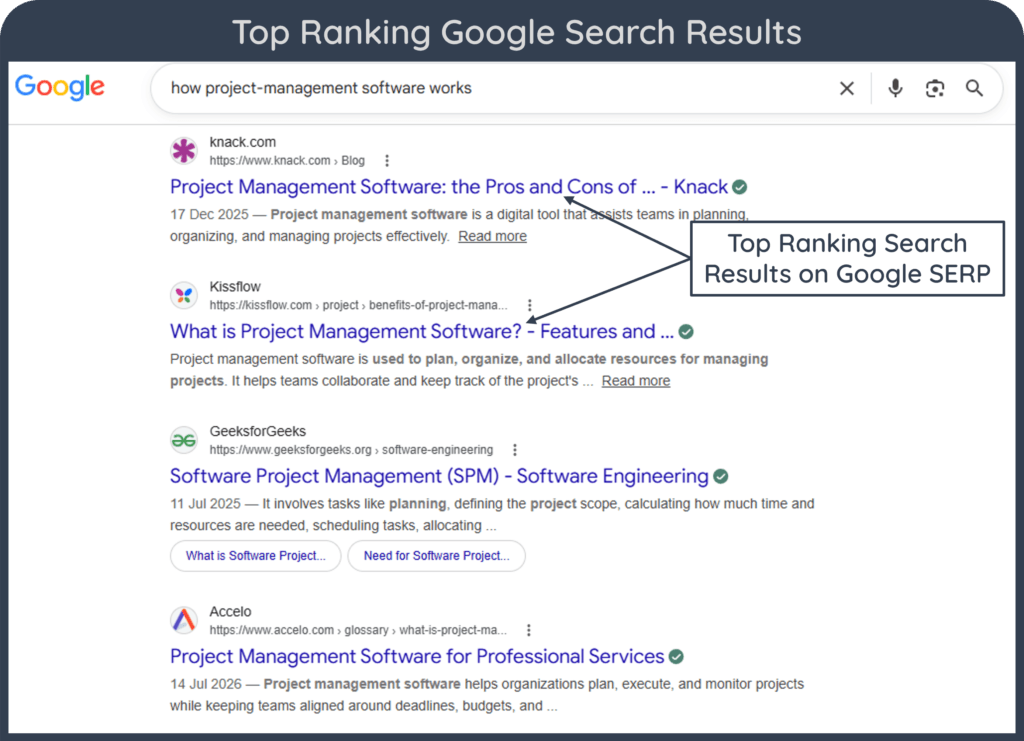
The search engine results page, or SERP, may include ordinary organic listings, advertisements, maps, images, videos, featured snippets, shopping results and AI-generated responses. Therefore, search visibility is now broader than holding one traditional blue-link position.
A website may fail to appear because the page has not been discovered, crawling is blocked, indexing is restricted, the content duplicates another URL or the page does not appear sufficiently relevant and useful for the query.
The URL Inspection tool in Google Search Console can show the current index status of a page, test a live URL and provide information about how Google accessed it.
How Search Algorithms Decide What Users See
Search algorithms are systems that evaluate indexed information and select results for a query. Their purpose is not merely to find pages containing the same words. They must interpret what the user means and which results are most likely to help.
Google’s automated ranking systems examine many factors and signals across hundreds of billions of webpages and other indexed content. These systems work primarily at page level, although some site-wide signals also contribute.
Relevance and Search Intent
Search intent is the purpose behind a query. A person searching best laptops for graphic design probably wants comparisons and recommendations, not a basic definition of a laptop. A page can therefore include the correct words and still perform poorly when its format or information does not match the expected need.
Modern systems also interpret language context. BERT, for example, helps Google understand how combinations of words express different meanings and intentions. Therefore, pages do not need to repeat every exact keyword variation when they explain a topic clearly and naturally.
Usefulness, Quality and Trust
A relevant page must still provide a useful answer. Its information should be clear, accurate, sufficiently complete and appropriate for the subject. Trust, expertise and authority become particularly important when content can affect a person’s health, finances or safety.
However, quality is not created by length alone. A concise service page may satisfy a local transactional query better than a lengthy educational article. It is therefore important to provide the right amount and type of information for the user’s purpose.
Links and Authority
Links help crawlers discover pages and can also provide information about relationships and reputation. The original Google research paper, The Anatomy of a Large-Scale Hypertextual Web Search Engine, described how the early search engine used web structure and hyperlinks alongside text-based information.
Modern ranking is far more complex than the original PageRank model, although PageRank still forms part of Google’s core ranking systems. Therefore, backlinks should not be treated as simple votes that automatically produce rankings. Relevance, quality and the context of a link matter, while manipulative link-building practices can create risks instead of sustainable authority.
Context and Technical Eligibility
The same query may produce different results according to location, language and device. Google gives the example that a search for bicycle repair shops can return different information to users in Paris and Hong Kong.
Technical accessibility also matters. Search engines cannot properly evaluate important information they cannot access or render. A technically sound page does not guarantee high rankings, but serious crawling, indexing or rendering problems can prevent strong content from competing at all.
Organic Search vs Paid Search
Organic and paid search are not mutually exclusive. Businesses often use both, with SEO supporting longer-term visibility and paid search providing faster, more controllable exposure.
| Feature | Organic Search | Paid Search |
|---|---|---|
| How visibility is gained | SEO and relevance to the query | Participation in an advertising auction |
| Direct payment for each click | No | Commonly yes |
| Speed | Usually develops gradually | Can begin after a campaign becomes active and eligible |
| Duration | Can continue while the page remains competitive | Depends on campaign activity and available budget |
| Control | Limited control over exact position and appearance | Greater control over targeting, bids and advertisement copy |
| Best suited to | Sustainable discovery and topic authority | Immediate, targeted campaign exposure |
Organic ranking cannot be purchased. Google Search Central explicitly states that Google does not accept payment to crawl a website more frequently or rank its pages higher.
Paid search uses a separate advertising system. In Google SERPs, advertisements are labeled and may appear around free results. Their eligibility and position depend on Ad Rank, which considers factors including the bid, advertisement and landing-page quality, auction competition and the context of the search.
Search engine marketing, or SEM, commonly refers to paid search campaigns, while SEO focuses on organic visibility. SEM has also been used more broadly to include both paid search and SEO. The two approaches can work together: advertising can create immediate exposure, while SEO builds discoverability across useful pages over time.
How Businesses Can Improve Search Engine Visibility
Businesses improve search visibility by making their websites accessible, relevant and genuinely useful.
First, publish content that answers real customer questions and matches search intent. Educational searches may require guides, commercial searches may need comparisons, and transactional searches may be better served by product or service pages.
Second, create a clear website structure. Important pages should be reachable through menus, categories and descriptive internal links. Appropriate internal anchor text helps both people and Google understand connected pages and find other content on a website.
Third, make page titles, headings and copy descriptive. Keywords help communicate the subject, but unnatural repetition does not create usefulness. Google recommends using the words people would use to find the content in prominent locations such as the title, main heading, alt text and link text.
Fourth, maintain technical health. Businesses should monitor indexing, mobile usability, security, page loading and structured data where relevant. Search Console’s Performance report can show clicks, impressions, queries and page-level search data, while its indexing and inspection tools help diagnose accessibility problems.
Finally, build credibility over time. This may involve transparent authorship, accurate business information, useful customer resources and editorially earned links from relevant websites.
Several misconceptions should also be avoided. Rankings are not permanent because search results and competing pages change. More keyword repetition does not guarantee higher positions. Furthermore, a smaller business may compete by addressing a specific audience, local need or underserved question more effectively than a broad website.
The Future of Search Engines: AI Search and Changing Search Behavior
Search is expanding beyond lists of links. AI Overviews, AI Mode and other generative search experiences can provide synthesized responses while presenting links that support further exploration.
Users can also ask longer, more conversational questions. Instead of searching SEO tools, a person may ask, Which SEO tools are suitable for a small ecommerce website with a limited budget? Such a query contains a topic, business type, use case and constraint.
Google Search Central explains that AI Overviews and AI Mode may use query fan-out, issuing several related searches across subtopics and data sources before forming a response. It also states that a page must be indexed and eligible to appear in ordinary Google Search to be used as a supporting link.
However, businesses do not need a special AI file or unique schema markup to become eligible. Established SEO fundamentals still apply, including crawlability, internal linking, useful textual content, page experience and structured data that matches the visible page.
In short, AI-powered search changes how answers may be assembled and displayed, but it does not remove the need for accessible, accurate and useful webpages. Businesses should create content that answers the main question clearly, covers relevant supporting concepts and gives readers a reason to visit the original source.
Conclusion
Search engines discover webpages through crawling, process eligible information through indexing and select results through automated ranking systems. Businesses improve their chances of visibility by matching search intent, publishing useful content, maintaining a crawlable website and building trust over time.
However, no single keyword, backlink or technical score guarantees a ranking. Organic results compete within changing search pages that may also contain advertisements, local listings, images, videos and AI-generated answers.
To sum up, SEO is not about tricking an algorithm. It is the practical work of making valuable information accessible, understandable and useful so that search systems can connect it with the right audience.
Frequently Asked Questions
What is a search engine?
A search engine is a system that discovers, organizes and retrieves online information in response to queries. It uses crawlers, an index and ranking systems to present webpages and other search features.
How do search engines find new webpages?
Search engines commonly discover pages by following links from known URLs and processing submitted sitemaps. Clear internal links therefore make important pages easier for both crawlers and users to reach.
What is the difference between crawling and indexing?
Crawling means discovering and accessing a page. Indexing means processing its content and potentially storing an eligible version in the search index. A crawled page is not guaranteed to be indexed.
How do search engines rank websites?
Search engines evaluate many signals related to relevance, usefulness, links and search context, including language and location. A page must also meet the necessary technical requirements to be eligible to appear. However, no single factor guarantees a position.
Why is my website not appearing in Google Search?
The page may be undiscovered, blocked from crawling, excluded from indexing, duplicated, technically inaccessible or insufficiently relevant for the query. Google Search Console’s URL Inspection tool can help identify the page’s current status.
What is the difference between organic and paid search?
Organic results are selected by search-ranking systems and cannot be purchased. Paid results are advertisements shown through an auction system and are clearly labeled as ads.
Can a business pay Google for higher organic rankings?
No. A business can purchase advertising through Google Ads, but Google states that payment does not increase crawling frequency or organic ranking position.
How do AI-powered search engines find and present information?
Google’s AI Overviews and AI Mode may conduct several related searches through query fan-out before generating a response with supporting links. To be eligible as a supporting link, a page must be indexed and eligible to appear in Google Search.