On-page SEO is the process of improving the content, structure and visible elements of an individual webpage so that search engines can understand it and visitors can use it effectively. It includes content quality, search intent, keywords, title tags, meta descriptions, headings, URLs, internal links, images and page experience.
For example, an article targeting best email marketing tools should not provide only a definition of email marketing. It should compare suitable tools, explain important differences and help readers choose an option. Every major page element should reinforce the same search need, from the title and section structure to the information provided and the next action offered to the reader.
On-page SEO therefore connects three objectives: making the page understandable to search systems, satisfying the visitor’s need and guiding the visitor toward an appropriate next step.
Google’s SEO Starter Guide describes search engine optimization as helping search engines understand content while helping users find a site and decide whether to visit it. However, Google also makes it clear that no optimization technique automatically guarantees a first-place ranking.
Table of Contents
What Is On-Page SEO? Understanding Page Optimization
On-page SEO covers the improvements made directly to a webpage to clarify its subject and improve its usefulness and visibility in search. These improvements range from writing a descriptive title to organizing the content logically and connecting it with relevant internal pages.
A webpage can be compared with a physical store. The sign outside should explain what the store offers, the aisles should be organized and customers should be able to find what they need. Similarly, a webpage needs a clear title, understandable headings, useful information and logical navigation.
Search Engine Land describes on-page SEO as making webpages relevant, useful and easy to understand for people and search-engine crawlers. The process commonly includes on-page SEO elements like keyword optimization, title tags, meta descriptions, alt text and website structure.
On-Page SEO vs Off-Page SEO
On-page SEO, off-page SEO and technical SEO support different parts of search performance in search engine optimization.
| SEO Category | Main Focus | Key Elements |
|---|---|---|
| On-page SEO | Elements controlled on the webpage | Content, titles, headings, images and internal links |
| Off-page SEO | External authority and reputation | Backlinks, coverage and brand mentions |
| Technical SEO | Website access and performance | Crawling, indexing, rendering, security and speed |
The categories can overlap. Page speed, for example, is usually treated as technical SEO but directly affects a visitor’s experience on the page. In short, on-page SEO improves the page itself, off-page SEO contributes external reputation and authority signals, and technical SEO helps keep the page accessible and functional for users and search engines.
How Search Engines Evaluate Pages and On-Page SEO Factors
Search engines do not rank a page merely because it contains a particular keyword. They evaluate whether the page appears relevant to the query, matches the probable intent and provides useful information.
Search Intent and Relevance
Search intent is the purpose behind a query. A user may want to learn, compare options, complete an action or reach a specific destination.
Consider these searches:
- What is email automation? requires an educational explanation.
- Best email automation platforms requires a comparison.
- Start an email automation free trial requires a conversion-focused landing page.
The subject is similar, but the expected page is different. Therefore, the first stage of on-page optimization is determining which need the page must satisfy.
It is recommended to review the current search results to identify common page formats, content patterns and user expectations. A page can be well written and technically sound but still struggle when it does not align with the dominant search intent.
Content Quality, Usefulness and Trust
A strong page should provide accurate information, explain the subject clearly and give the visitor enough information to help them improve their understanding. However, content does not become better merely because it is longer.
For example, a local service page may need prices, locations, service details and a booking method. Adding several thousand words of general history would not necessarily make it more useful.
Google Search Central states that its systems are designed to prioritize helpful and reliable information created primarily for people. It is therefore useful to consider whether the page provides original information, meaningful analysis and enough detail for readers to accomplish their purpose.
Experience, expertise, authoritativeness and trustworthiness, commonly described as E-E-A-T, should not be treated as one numerical ranking factor. Instead, accurate authorship, credible references, original examples and transparent information can help readers evaluate whether a page deserves their confidence.
Structure and Technical Accessibility
Search engines must be able to access the page and interpret its main information, and should not be blocked from crawling or excluded from indexing.
The page should also present its important information in text rather than relying entirely on images, videos or interactive elements. Search systems can process several media formats, but visible explanatory text gives both readers and crawlers essential context.
Content Optimization
Content optimization means improving a page so that it satisfies a clear search need and communicates its subject effectively. Each page should have one primary purpose, supported by relevant keywords, related concepts and useful examples. However, repeating the same keyword throughout the content does not create depth. The page should instead use natural language, original insights, practical examples and supporting evidence.
Readable content also requires logical headings, complete paragraphs and clear transitions. It is therefore important to review published pages regularly and update outdated facts, links, screenshots and recommendations rather than changing only the publication date.
Essential On-Page SEO Elements: Titles, Meta Descriptions, Headings, URLs, Images and Internal Links
The following elements help search engines and readers understand how a page is organized and what it offers.
Title Tags
The title tag is the HTML title assigned to the page. It commonly influences the clickable title displayed in search results, although Google may generate a different title link.
A good title should:
- Describe the page accurately.
- Communicate a clear benefit or purpose.
- Include the primary topic naturally.
- Remain distinct from titles used on other pages.
- Avoid repetition and unnecessary keyword variations.
For example:
Weak Title: SEO, SEO Guide, SEO Tips, SEO Optimization
Improved Title: On-Page SEO Guide: How to Optimize Pages That Rank
Search engines may create title links from several page elements, including the HTML title, visible page title, headings, prominent text and anchor text. Therefore, the title tag and visible H1 should communicate a consistent subject.
It is also better to write a title that matches the reader’s expectations rather than merely inserting a keyword. A useful title should describe the page clearly while giving the intended audience a reason to consider the result.
Meta Descriptions
A meta description is a brief HTML summary that may appear below the title in search results.
It should explain what the page contains and give the right searcher a reason to visit. However, search engines may choose a passage from the page when that text better matches the individual query.
Search snippets are primarily generated from page content, although the supplied meta description may be used when it provides a more accurate summary. The same page may therefore display different snippets for different queries.
Meta descriptions are not direct Google ranking factors, but they can influence how a search result is presented and may affect whether relevant users choose to visit the page. While creating content, it is recommended to expand naturally on the title, match search intent and use concise active language.
Heading Structure
The H1 is normally the page’s principal visible heading. H2 headings divide the main sections, while H3 and deeper levels organize related subsections.
Headings should create a logical hierarchy rather than serve as locations for forced keywords. A page may use one clear H1 followed by several H2 and H3 headings, although the exact number depends on the complexity of the subject.
Clear heading tags support scanability, navigation and content hierarchy. Therefore, each heading should describe the information that follows and help readers locate relevant sections quickly.
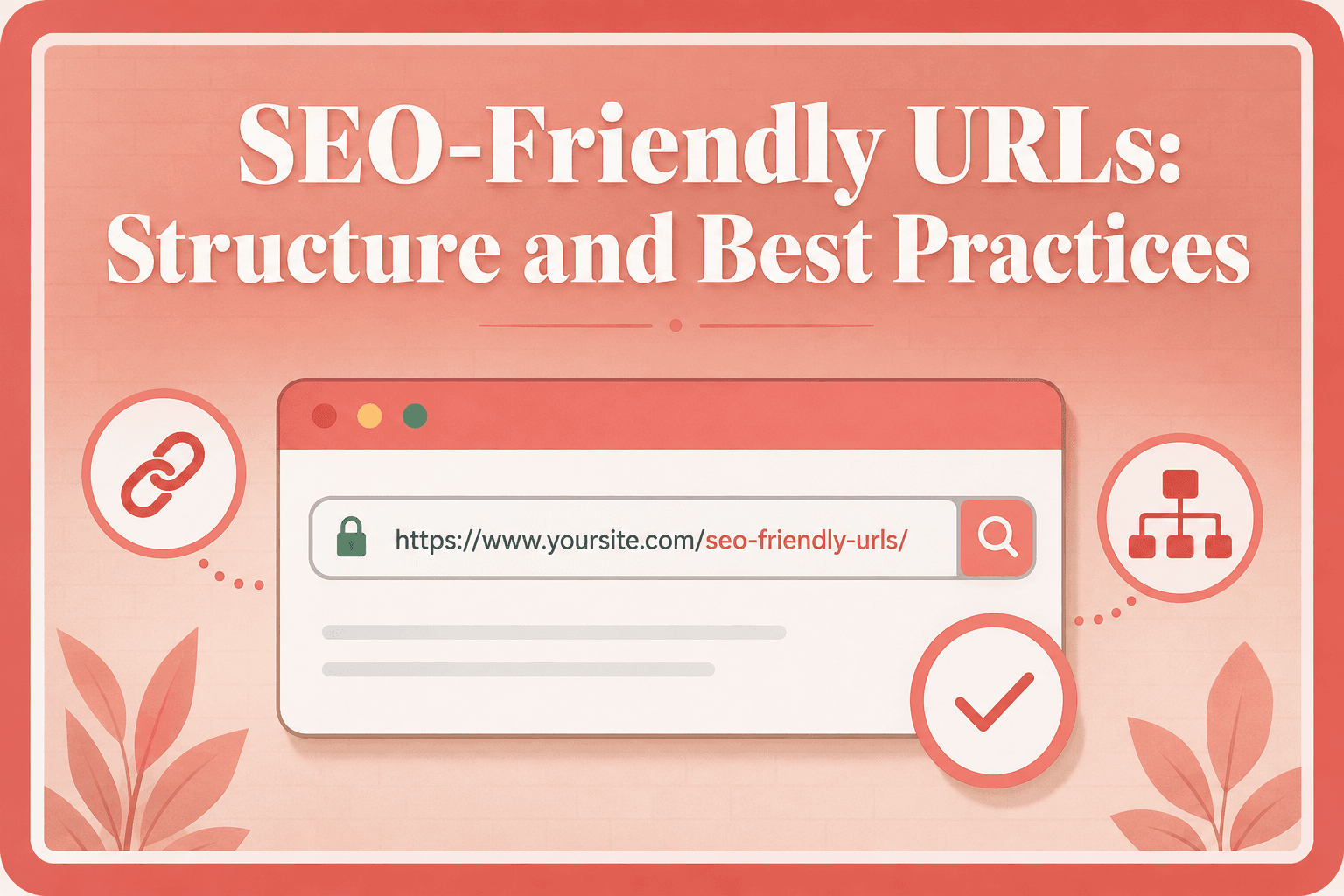
Descriptive URLs
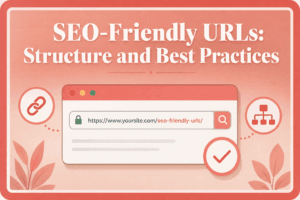
A URL should be readable, stable and descriptive.
Preferred: example.com/on-page-seo-guide/
Less useful: example.com/page?id=45892
The slug does not need every keyword variation. A concise phrase is easier to understand, share and maintain. Dates and numbers should also be avoided when they could make a reusable page appear outdated.
It is better to use short and descriptive URLs containing words that reflect the page topic instead of unnecessary parameters or repeated terms.
Internal Links and Anchor Text
Internal links connect one page with another page on the same website. They help readers continue exploring a subject and give crawlers clear paths through the website.
For example, this guide may link to dedicated articles on content optimization, technical SEO and keyword research.
Anchor text should describe the destination clearly. Phrases such as learn more can be useful when the surrounding context is obvious, but wording such as keyword research guide generally provides more information.
It is recommended to use crawlable links with concise and relevant anchor text. Internal links can also help direct readers toward important supporting resources while giving search engines additional context about relationships between pages.
Images and Alt Text
Images can demonstrate processes, summarize comparisons and make complex information easier to understand. They should be compressed appropriately, displayed at suitable dimensions and placed near relevant text.
Alt text should explain the image’s purpose or relationship to the surrounding content. Purely decorative images generally do not need descriptive alt text and should typically use an empty alt attribute (alt=""), while informative images should receive meaningful alternative text.
Google’s SEO Starter Guide recommends that descriptive alt text helps explain an image and its relationship with the page. It also improves accessibility for visitors who cannot see the image.
User Experience, Page Experience and Conversion Optimization
A page can rank and still perform poorly when visitors struggle to read it or cannot complete the intended action.
Improve the Overall Page Experience
A useful page should display properly on mobile devices, load reliably, use secure connections and avoid intrusive pop-ups that block the main content.
Core Web Vitals assess how quickly a page loads, how responsive it feels, and how stable its layout remains during use. However, one perfect score does not guarantee rankings. It is better to assess page experience as a combination of factors rather than concentrating on a single metric.
Readable typography, sufficient spacing and clearly distinguished main content also reduce friction. Therefore, optimization should improve the experience for actual users rather than chase a technical score with no visible benefit.
Connect the Page with a Conversion Goal
Not every visitor should receive the same call to action.
An informational article may invite readers to explore a related guide or subscribe to a newsletter. A comparison page may direct them to product details, while a service page may encourage a consultation.
Conversion optimization involves making the next step relevant and easy to complete. Clear calls to action, transparent pricing, supporting evidence, simple forms and useful information can reduce uncertainty without turning every paragraph into a sales pitch.
On-Page SEO Checklist, Tools, Common Mistakes and Future Trends
A practical on-page SEO process combines a clear checklist, reliable tools and regular quality reviews. It is therefore important to understand common mistakes and emerging trends so that optimization efforts remain useful, accurate and aligned with changing search behavior.
On-Page SEO Checklist
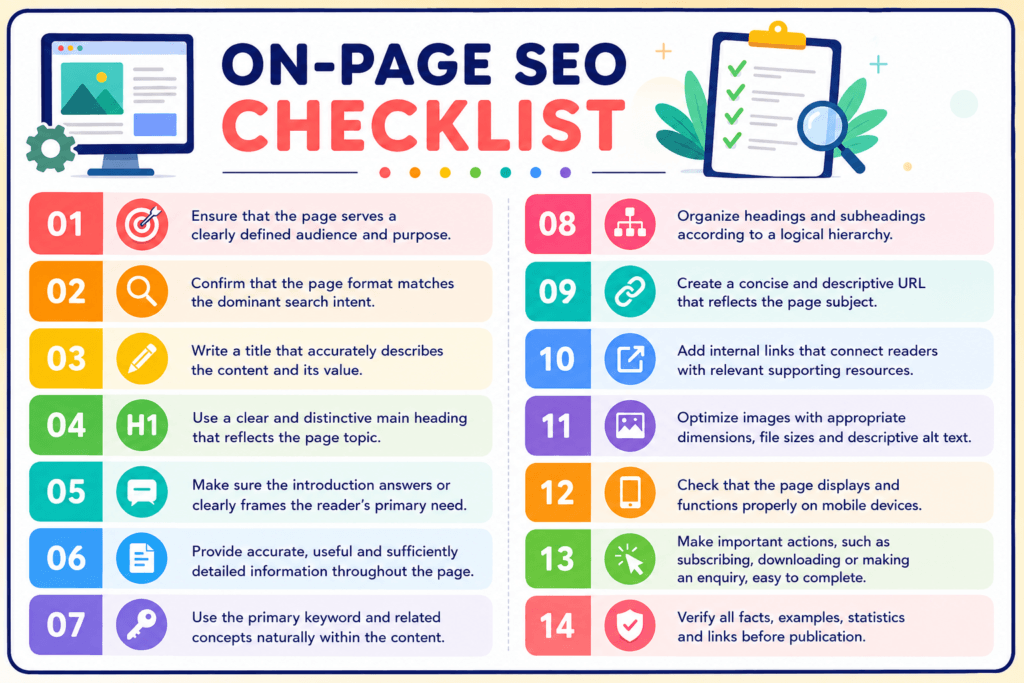
Before publishing or updating a page, confirm the following:
- Ensure that the page serves a clearly defined audience and purpose.
- Confirm that the page format matches the dominant search intent.
- Write a title that accurately describes the content and its value.
- Use a clear and distinctive main heading that reflects the page topic.
- Make sure the introduction answers or clearly frames the reader’s primary need.
- Provide accurate, useful and sufficiently detailed information throughout the page.
- Use the primary keyword and related concepts naturally within the content.
- Organize headings and subheadings according to a logical hierarchy.
- Create a concise and descriptive URL that reflects the page subject.
- Add internal links that connect readers with relevant supporting resources.
- Optimize images with appropriate dimensions, file sizes and descriptive alt text.
- Check that the page displays and functions properly on mobile devices.
- Make important actions, such as subscribing, downloading or making an inquiry, easy to complete.
- Verify all facts, examples, statistics and links before publication.
Useful On-Page SEO Tools
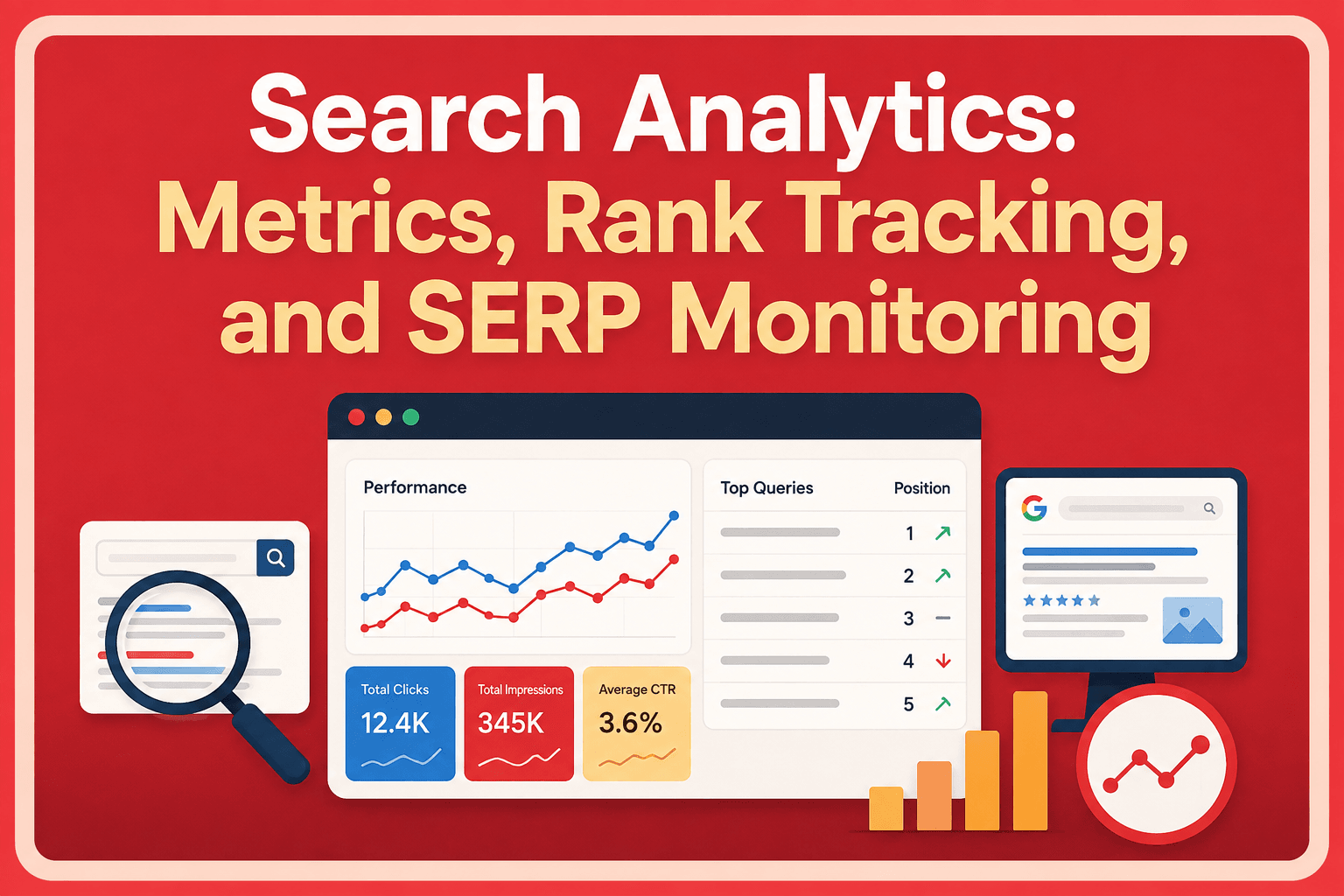
Google Search Console shows impressions, clicks, average position, indexing information and Core Web Vitals reports. PageSpeed Insights evaluates performance and Core Web Vitals, while the Rich Results Test checks supported structured data.
Third-party platforms such as Ahrefs, Semrush, Screaming Frog and on-page content tools can identify missing titles, weak internal links, broken elements and possible topic gaps. However, tool recommendations are not universal rules. A tool cannot determine the page’s real audience purpose as reliably as careful editorial analysis.
Common On-Page SEO Mistakes
Common mistakes include keyword stuffing, unclear titles, duplicate content, weak internal linking, missing image descriptions, poor mobile presentation and publishing content without understanding search intent.
Another mistake is treating an optimization score as the objective. A page can receive a high score from a plugin while providing a weak answer. Conversely, useful content may not satisfy every automated recommendation.
It is better to treat on-page SEO as an ongoing process involving content quality, technical elements, structure, internal links and periodic reviews.
On-Page SEO and AI Search
On-page SEO also supports visibility in AI-powered search. Clear language, crawlable pages, internal links, accurate facts and well-structured content help search systems understand and retrieve information.
Google Search Central states that the established fundamentals of SEO continue to apply to AI Overviews and AI Mode. No special AI file or unique schema is required, but a supporting page must be indexed and eligible to appear in ordinary Google Search.
AI search may also use query fan-out to explore related subtopics. However, this does not mean separate pages should be produced for every possible query variation. Content should answer the main need and cover relevant supporting concepts without creating repetitive pages merely to influence generated responses.
Conclusion
On-page SEO helps search engines understand a webpage while helping visitors find useful information and take an appropriate next step. It combines relevant content, natural keyword use, clear titles, structured headings, internal links, optimized images and a strong page experience.
However, no single element guarantees rankings. To sum up, the best results come from creating a page that matches search intent, contributes genuine value and remains clear, accessible and trustworthy across traditional and AI-powered search.
Frequently Asked Questions
What is on-page SEO?
On-page SEO is the process of optimizing the content and visible elements of an individual webpage. It includes search intent, keywords, title tags, headings, URLs, internal links, images, readability and page experience.
What are the most important on-page SEO elements?
The most important elements include useful content, search-intent alignment, a descriptive title, clear headings, a readable URL, relevant internal links, optimized images and a good mobile experience. Their importance depends on the page’s purpose and audience.
What is the difference between on-page SEO and off-page SEO?
On-page SEO covers improvements made directly to a webpage, such as its content, headings and internal links. Off-page SEO focuses on external signals, including backlinks, publicity and brand mentions.
Do meta descriptions directly affect rankings?
Meta descriptions are not direct Google ranking factors. However, they can provide a useful summary in search results and encourage relevant users to click. Google may replace the supplied description with on-page text that better matches the query.
How many keywords should a single page target?
There is no fixed number. A page should focus on one clear primary subject while naturally answering closely related questions and using relevant concepts. Keywords should support clarity rather than satisfy a numerical density target.
How often should on-page content be updated?
Content should be reviewed when facts, products, regulations, search intent or audience needs change. Fast-moving subjects may require frequent updates, while stable definitions may remain accurate for longer periods.
How can on-page SEO improve conversions?
On-page SEO can connect visitors with pages that match their needs. Clear explanations, relevant calls to action, transparent information and simple navigation can help readers move from discovery to subscription, inquiry or purchase.
Does on-page SEO help content appear in AI search results?
Yes. For Google AI Overviews and AI Mode, supporting pages must be indexed and eligible to appear in Google Search. Other AI platforms use their own retrieval systems, but clear, accessible and well-supported content can also improve its suitability for discovery and retrieval. At the same time, it is important to note that inclusion or citation is never guaranteed.