Off-page SEO is the process of improving a website’s authority, reputation and visibility through activities that take place beyond its own pages. It includes earning backlinks, gaining media coverage, building brand mentions, encouraging reviews, developing partnerships and maintaining a credible public presence.
For example, a digital marketing website may publish a detailed SEO study. If reputed publications reference the research, industry professionals discuss it and relevant websites link to it, those external signals can introduce new audiences and strengthen the website’s reputation.
However, off-page SEO is not simply the collection of as many backlinks as possible. The quality, relevance and context of external recognition matter more than raw numbers. Google Search Central confirms that links can help determine page relevance and assist with discovering new pages, while manipulative link schemes may violate its link spam policies.
In other words, sustainable off-page SEO involves earning genuine recommendations rather than manufacturing the appearance of popularity.
Table of Contents
What Is Off-Page SEO?
Off-page SEO refers to activities performed outside a website to improve its authority, reputation, trust and search visibility.
In simple terms, on-page SEO improves what appears within the website, while off-page SEO strengthens how the business and its content are perceived across the wider internet. Together, they form part of search engine optimization (SEO), which combines on-page, off-page and technical improvements to strengthen a website’s visibility in search results.
A useful analogy is choosing a restaurant. The menu, layout and service represent the restaurant’s internal qualities. However, customer reviews, recommendations, local guides and press coverage shape expectations before a person visits. Off-page SEO works similarly by building confidence through external recognition.
Search Engine Journal uses a broad definition for off-page SEO that extends beyond link acquisition to include press exposure, brand-awareness campaigns and promotional activity on other websites and channels.
Why Does Off-Page SEO Matter?
A website can publish excellent content, but external visibility can help that content reach relevant audiences and establish credibility. When respected publications, specialists or organizations refer to a page, the reference may generate referral traffic, brand awareness and editorial backlinks.
Off-page SEO can help answer practical questions such as:
- Do other relevant websites reference this information?
- Is the brand recognized within its field?
- Do customers recommend the business?
- Has the organization earned media or industry coverage?
- Does its public reputation support its claims?
However, external popularity should not be confused with automatic authority. A large number of mentions or links from irrelevant, low-quality websites may provide little value and can indicate manipulative promotion.
How Off-Page SEO Influences Visibility
Off-page SEO works through several connected signals and outcomes.
Backlinks direct users from one website to another and help search engines discover relationships between pages. The original PageRank paper described how the early Google search engine used the structure of hyperlinks alongside page content. Modern ranking systems are considerably more complex, but links remain relevant to discovery and page relationships.
Note: PageRank
Google’s current ranking-systems documentation also states that PageRank continues to form part of its core ranking systems, although the way it operates has evolved considerably.
Brand mentions occur when a publication, community or user discusses a company, product or person. An unlinked mention does not carry the same function as a backlink, but it can increase awareness, encourage branded searches and create future outreach opportunities.
Reputation signals include reviews, testimonials, professional recognition and public customer experiences. They influence how potential customers evaluate a business and can be particularly important for local companies, ecommerce stores and service providers.
Partnerships and publicity can introduce the brand to new audiences while generating interviews, recommendations, referral traffic and editorial coverage.
It is therefore better to view off-page SEO as reputation building across multiple channels rather than as a backlink-only activity.
On-Page SEO vs Off-Page SEO
On-page SEO and off-page SEO support different aspects of search performance, but neither should operate in isolation.
| SEO Category | Main Focus | Key Elements |
|---|---|---|
| On-page SEO | Relevance and usability within the website | Content, headings, titles, images and internal links |
| Off-page SEO | Authority and recognition outside the website | Backlinks, coverage, reviews and brand mentions |
What Is On-Page SEO?
On-page SEO improves elements directly controlled within a website. It helps clarify what a page covers and whether it satisfies the visitor’s need.
Examples include:
- Creating helpful content
- Matching search intent
- Using descriptive titles
- Organizing headings
- Adding internal links
- Optimizing images
- Improving readability
What Is Off-Page SEO?
Off-page SEO focuses on how a website, brand or content asset is recognized elsewhere.
Examples include:
- Editorial backlinks
- Digital PR coverage
- Reviews and testimonials
- Industry citations
- Collaborations
- Brand discussions
- Expert contributions
Why You Need Both
A useful article with weak page structure may be difficult to understand, while a perfectly optimized page may remain unnoticed when nobody discovers or recommends it.
On-page SEO supports relevance, usability and content quality. Off-page SEO helps distribute that work, build recognition and earn external validation.
In short, strong search performance usually requires accessible pages, useful content and a credible reputation beyond the website.
Backlinks and Link Building: The Foundation of Off-Page SEO
A backlink is a link from another website to a page on a different domain. For example, an industry publication may refer to a marketing report and link to the original research.
The backlink allows readers to visit the source and provides search engines with information about the relationship between the two pages.
Why Are Backlinks Important?
Backlinks can support:
- Page discovery
- Referral traffic
- Brand exposure
- Relationships between related resources
- Recognition from relevant publishers
- Distribution of original information
However, links should not be treated as identical votes. A contextual editorial link from a respected website in the same industry generally provides more meaningful recognition than numerous links from unrelated directories.
Quality vs Quantity of Backlinks
Backlink quality should be evaluated through relevance, editorial context and the credibility of the referring page.
A useful backlink usually:
- Comes from a relevant website or page.
- Appears naturally within useful content.
- Provides value to the reader.
- Uses reasonable anchor text.
- Points to a page that supports the reference.
- Was not placed solely to manipulate rankings.
Ahrefs recommends tactics such as digital PR, data journalism, statistics pages and relationship-based outreach when pursuing high-quality backlink tactics. These approaches attempt to earn editorial attention by contributing information that publishers genuinely want to reference.
Types of Valuable Backlinks
Editorial Backlinks
Editorial backlinks are earned when a writer independently references a useful source. A news publication might link to original research, while an industry blog may cite a detailed guide.
These links are valuable because the publisher chooses to include them for the reader’s benefit.
Guest Contribution Links
Guest posting involves contributing original material to another publication. It can support visibility, relationships and qualified referral traffic.
However, the main purpose should be to serve the publication’s audience. Repetitive guest posting across low-quality websites solely for keyword-rich links can become manipulative.
Resource Page Links
Resource pages collect useful tools, guides, organizations or educational materials. A distinctive template, calculator, directory or research report may earn inclusion when it improves the resource.
Digital PR Links
Digital PR uses newsworthy stories, data and expertise to earn online coverage. Businesses may promote original studies, expert commentary, industry forecasts or useful public resources.
The strongest digital PR campaigns combine genuine news value with information journalists can verify and present to their audiences.
Unlinked Mention Opportunities
A website may mention a company, product or study without linking to the source. When a link would improve attribution or help readers verify the information, the business can contact the publisher politely.
A practical mention outreach process should focus on adding value rather than assuming every mention deserves a link.
The Skyscraper Technique
Popularized by Brian Dean of Backlinko, the Skyscraper Technique is a content-led link-building method built around three steps:
- Identify a resource that has earned links.
- Create a meaningfully stronger or more current resource.
- Contact relevant publishers who may find the improved material useful.
For example, instead of copying an article titled 10 SEO Tips, a website could publish an evidence-based SEO checklist with original examples, downloadable templates and current recommendations.
However, making an article longer does not automatically make it better. The new resource should improve accuracy, usefulness, presentation or originality.
Link-Building Practices to Avoid
Some link-building methods can create unnecessary risk, weaken trust, or violate search-engine spam policies when they are used primarily to manipulate rankings.
- Buying links intended to influence rankings
- Using automated link schemes
- Joining unrelated link networks
- Publishing low-quality guest posts at scale
- Exchanging links excessively
- Creating misleading scholarship or award links
- Placing keyword-rich links in unrelated content
Paid, sponsored and user-generated links should be qualified appropriately. Manipulative linking practices can lead to lower visibility or exclusion under the search spam policies.
Off-Page SEO Strategies for Businesses and Creators
Different organizations should select off-page strategies according to their audience, expertise and available resources.
1. Guest Posting
Contribute useful, original articles to reputable publications that serve a relevant audience. The objective should be relationship building and audience value, with links included only where they support the discussion.
2. Partnerships and Collaborations
Complementary businesses can create joint webinars, research projects, guides, interviews or events. Such collaborations can expand distribution while allowing both organizations to contribute distinct expertise.
3. Expert and Creator Collaborations
Experts, creators and industry professionals can participate in interviews, reviews, roundups, demonstrations and educational campaigns. The collaboration should be transparent and suited to the audience rather than based only on follower counts.
4. Reviews and Testimonials
Encourage genuine customers to leave feedback on platforms relevant to the business. Reviews should never be fabricated or rewarded in ways that violate platform policies.
It is also important to respond professionally to criticism. Reputation management involves demonstrating that customer concerns are acknowledged, not attempting to suppress every negative comment.
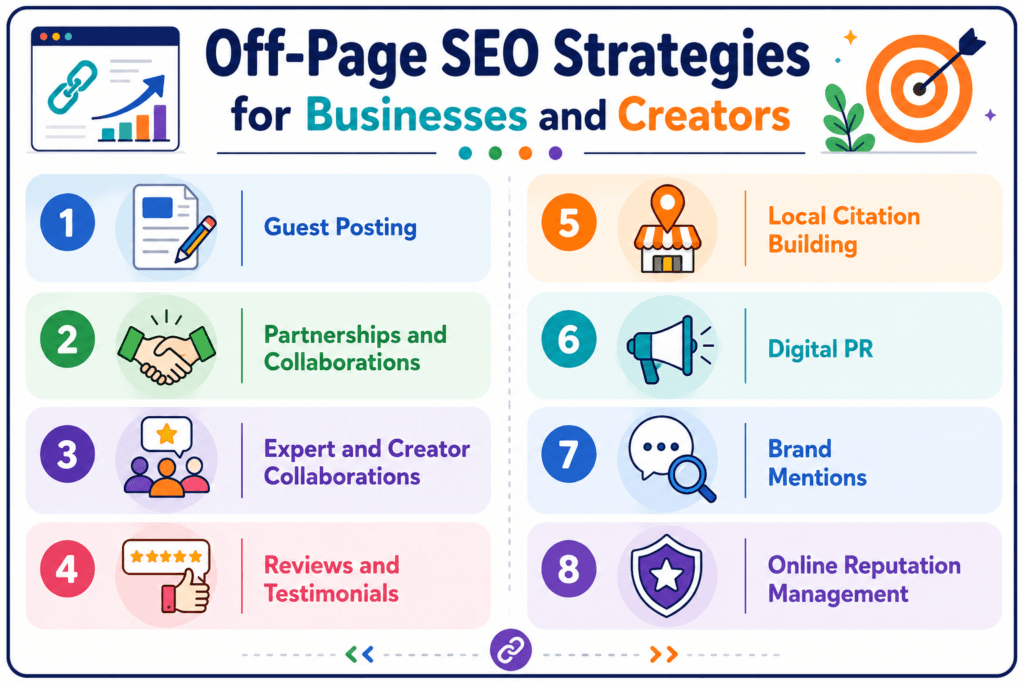
5. Local Citation Building
Local citations list business information such as the business name, address, phone number and website. The information should remain consistent across relevant directories, professional associations and local platforms.
Listing the business on hundreds of low-quality directories is unnecessary. Relevance and accuracy matter more than volume.
6. Digital PR
Digital PR can generate coverage through original statistics, surveys, expert reactions, newsworthy initiatives and useful public information. A marketing agency, for example, might publish research into changing advertising costs and provide journalists with clear findings and methodology.
7. Brand Mentions
Monitor where the company, products, executives or research are discussed. Mentions can reveal customer concerns, outreach opportunities and subjects that attract public interest.
They can also strengthen recognition, although an unlinked brand mention should not automatically be described as equivalent to a backlink.
8. Online Reputation Management
Track reviews, customer feedback and public discussions across the platforms that influence the target audience. Respond accurately, correct genuine problems and avoid argumentative or automated replies.
A credible reputation develops through genuine customer experiences. It cannot be created only through promotional messaging.
Complete Off-Page SEO Checklist
A complete off-page SEO checklist helps organize the activities required to build authority, trust and visibility beyond a website. It is therefore useful for evaluating link-building efforts, digital PR, brand mentions, reviews, partnerships and overall reputation in a consistent way.
Use this checklist to build a sustainable off-page SEO strategy:
- Define clear authority and visibility goals before beginning outreach.
- Identify the audience and the external platforms it genuinely uses.
- Review competitor backlinks to discover relevant publishers and content patterns.
- Evaluate each linking website for relevance, credibility and editorial quality.
- Create resources that deserve references, shares and recommendations.
- Publish original data, research or observations when suitable.
- Develop detailed guides that other publishers can cite confidently.
- Contribute guest content only to relevant and reputable publications.
- Build long-term relationships with editors, journalists and industry websites.
- Promote valuable content through appropriate communities without spamming them.
- Monitor brand mentions and identify useful attribution opportunities.
- Encourage genuine customer reviews on relevant platforms.
- Respond professionally to both positive and negative customer feedback.
- Keep local business citations accurate and consistent.
- Partner with complementary businesses on mutually useful initiatives.
- Collaborate with credible experts and creators serving the right audience.
- Produce shareable tools, templates, visuals and research resources.
- Monitor backlink relevance and referral value, not only backlink counts.
- Review suspicious links without assuming that every unusual link is harmful.
- Use the disavow tool only when its strict conditions apply.
- Measure referral traffic and engagement from external websites.
- Review competitor promotion and digital PR activity periodically.
- Maintain consistent outreach instead of relying on one-time campaigns.
- Prioritize relationships, credibility and long-term value over shortcuts.
Off-Page SEO Tools, Common Mistakes, and Best Practices
The right tools, careful quality checks and proven best practices help strengthen off-page SEO while avoiding ineffective or manipulative tactics.
Useful Off-Page SEO Tools
Google Search Console’s Link report provides a sample of backlinks Google has found pointing to your site, along with internal-link data.
Ahrefs and Semrush can support backlink analysis, link prospecting, competitor research and referring-domain monitoring. Similarly, the Backlinks report in Bing Webmaster Tools can compare a website’s backlink profile with up to two other sites and display information about referring domains and anchor text.
Mention-monitoring platforms, media databases and alerts can support digital PR and reputation tracking. However, tools provide data rather than relationships. Human evaluation is still required to judge whether an opportunity is relevant, credible and appropriate.
Common Off-Page SEO Mistakes
Focusing Only on Quantity
A large backlink count can look impressive but reveal little about relevance or value. One strong editorial reference may attract better traffic and recognition than hundreds of automated links.
Ignoring Relevance
Links from websites with no meaningful relationship to the subject may offer limited audience value. Relevance should therefore guide prospect selection.
Using Manipulative Tactics
Paid link networks, automated outreach and deceptive placements may produce temporary numbers but create long-term risks.
Forgetting Brand Building
Off-page SEO is broader than links. A recognizable brand can earn direct searches, media interest, reviews, recommendations and repeat visitors.
Measuring Only Domain Metrics
Third-party authority scores can be useful for comparison, but they are not search-engine metrics. Evaluate referral traffic, page relevance, audience quality, conversions and editorial credibility alongside numerical scores.
Off-Page SEO Best Practices
The most sustainable approach is to create useful information, build genuine relationships and earn recognition from appropriate sources.
It is better to:
- Personalize outreach.
- Explain why the resource suits the publisher.
- Respect editorial decisions.
- Provide clear evidence and sources.
- Track outcomes over time.
- Maintain relationships after publication.
- Measure business impact as well as backlinks.
In short, effective off-page SEO resembles public relations and reputation development more than mechanical link collection.
Conclusion
Off-page SEO builds authority and trust beyond a website through backlinks, digital PR, partnerships, reviews, brand mentions and public reputation. These activities can expand reach, generate referral traffic and help valuable content earn recognition.
However, sustainable authority cannot be manufactured through link volume alone. The strongest results come from original resources, credible expertise, positive customer experiences and long-term relationships with relevant publishers and communities.
Off-page signals may also support visibility in AI-powered search by increasing the chances that a brand and its information are discussed across credible sources. However, backlinks or mentions do not guarantee inclusion in generated answers.
Google Search Central confirms that pages used as supporting links in AI Overviews and AI Mode must still be indexed and eligible for ordinary search results. Established SEO fundamentals therefore remain important.
To sum up, the objective is not merely to collect links. It is to become a source that customers, publishers, search engines and AI systems have legitimate reasons to recognize and reference.
Frequently Asked Questions
What is off-page SEO?
Off-page SEO includes activities outside a website that build authority, visibility and reputation. Common examples include backlinks, digital PR, reviews, partnerships, brand mentions and relevant business citations.
What is the difference between on-page and off-page SEO?
On-page SEO improves content and page elements within a website. Off-page SEO focuses on recognition and authority earned through external websites, publications, platforms and communities.
What are the main components of off-page SEO?
The main components include link building, digital PR, brand mentions, online reviews, reputation management, local citations, partnerships and expert collaborations.
Why are backlinks important?
Backlinks can help users and search engines discover useful pages. Relevant editorial links may also provide referral traffic and indicate that another publisher considers the linked resource worth referencing.
What is digital PR?
Digital PR is the process of earning online media coverage through newsworthy stories, research, expert commentary and useful public information. It can generate brand awareness, referral traffic and editorial backlinks.
What are the best off-page SEO tools?
Useful tools include Google Search Console, Bing Webmaster Tools, Ahrefs, Semrush and brand-monitoring platforms. The right combination depends on whether the goal involves backlink analysis, outreach, reputation tracking or competitor research.
How can beginners start off-page SEO?
Beginners can create a genuinely useful resource, promote it to relevant communities, build relationships with smaller industry publications and monitor brand mentions. It is better to earn a few credible references than pursue large quantities of weak links.
Does off-page SEO affect AI search visibility?
It can contribute indirectly. Strong coverage, expert references and credible brand mentions may increase recognition across sources used by search and AI systems. However, no backlink or publicity campaign can guarantee that a brand will be cited in an AI-generated answer.