
Key Takeaways
- Average position is a Google Search Console metric showing the average topmost Search position across recorded impressions.
- Lower numbers represent stronger positions, but the metric reflects aggregated impressions across varying queries, locations, devices, contexts, and times.
- Google excludes paid advertisements from Search positions, while AI Overviews, carousels, and other compound features may assign one position to multiple links.
- Interpret average position as a trend indicator, analyzing query, page, device, country, and time-period data rather than relying on one sitewide number.
Average position is a Google Search Console metric that shows the average topmost position occupied by a website or webpage across the Google Search impressions included in a report. A lower number represents a higher placement, so an average position of 3 indicates a higher average position than 12.
A webpage rarely holds exactly the same position for every search. Rankings can vary according to factors such as query, location, device, search context, and time, so Search Console combines the recorded positions from many impressions into an average rather than presenting one permanent ranking number. Google describes “average position” as the average search position of the top-ranking result from a site across the impressions being analyzed.
Suppose a page records one impression each at positions 2, 5, and 8, its average position across those impressions is: (2 + 5 + 8) ÷ 3 = 5.
In Search Console, the chart shows the average position of the top-result from the entire site, while the table shows average position for the specific dimension selected, such as a page, query, country, or device.
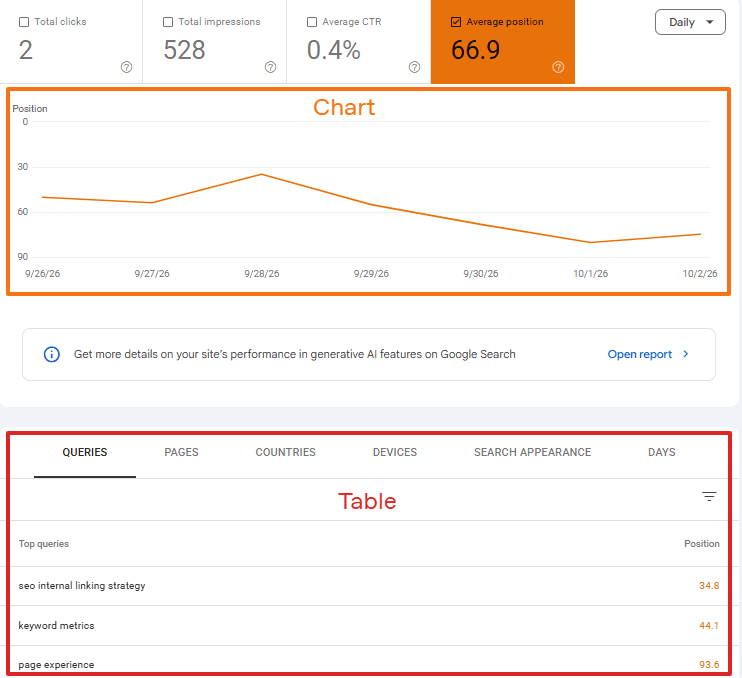
The calculation becomes more nuanced when several URLs from the same website appear for the same query, because Search Console can aggregate data differently at property and page level.
Bing Webmaster Tools
Bing Webmaster Tools also provides an average position metric in its Search Performance report. Bing defines it as the average of the different positions at which pages from a website appeared in Bing results, although its methodology should not be assumed to be identical to Google’s.
How Google Search Console Calculates Average Position
Google Search Console calculates average position from the positions associated with recorded search impressions rather than from a permanent ranking assigned to each webpage.
Position Is Recorded for an Impression
A position contributes to the metric only when the result receives an impression according to Google’s counting rules.
For example, if a result never generates an impression for a particular search, no position is recorded for that occurrence. Visibility requirements differ between result types, so it is not necessary that every standard result must always be physically scrolled into view before a position can be recorded.
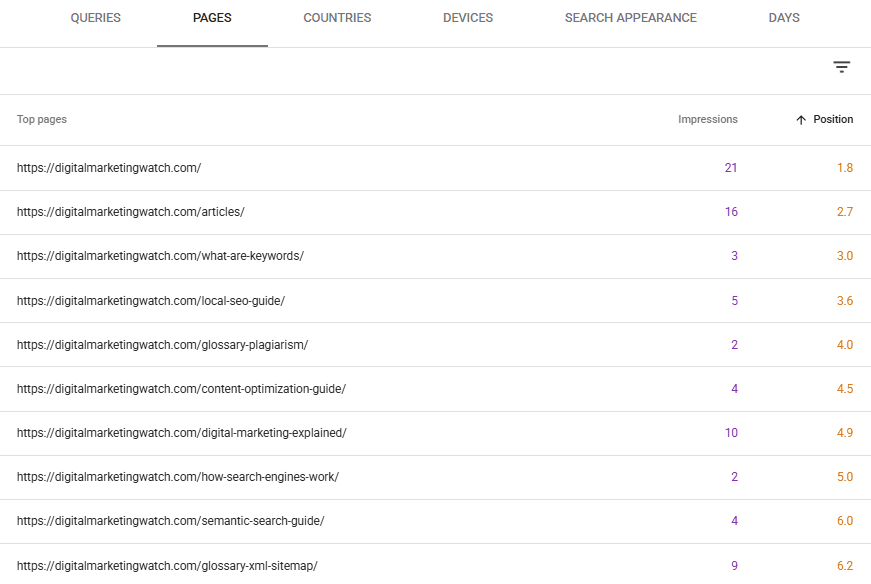
The Topmost Result Is Used
When several results from the same Search Console property appear for one search, Google uses the highest-ranking result when data is aggregated at property level.
For example, suppose one property appears at Position 2, Position 4, and Position 7.
The property-level position recorded for that search is 2. When performance is instead grouped by individual page, Google reports the topmost position of that particular URL.
Paid Ads Do Not Count as Search Positions
Google Ads appearing above an organic result do not increase its Search Console position number. For example, if a website owns the first organic position but three advertisements appear above it, Search Console can still record the organic result at position 1 because Google states that ads do not occupy Search positions.
SERP Elements Can Share a Position
Search Console assigns positions to search-result elements, and one element can sometimes contain several links. For example, Google documents that an AI Overview occupies one search position, with all links contained within it receiving that same position. Carousels and some other compound search features can work similarly.
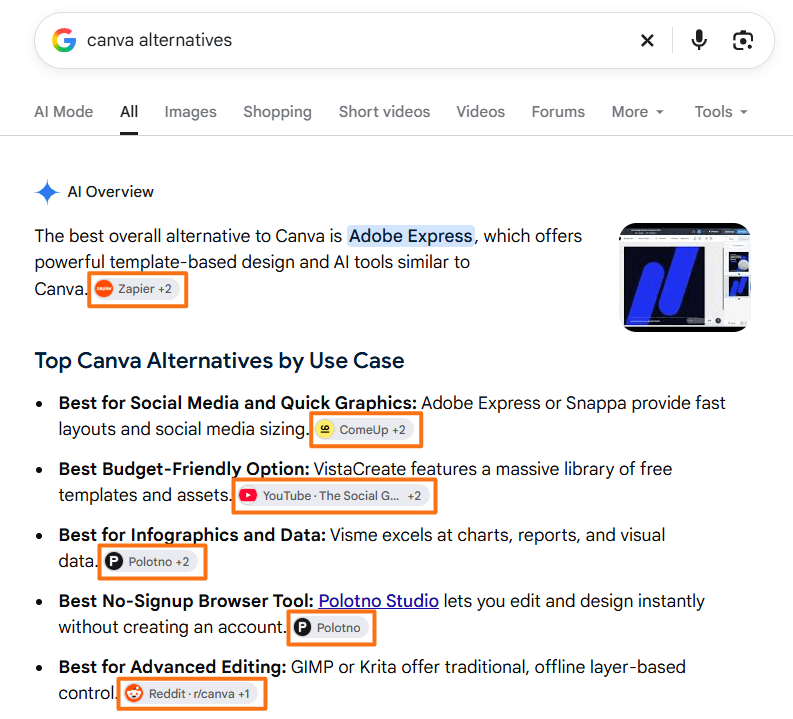
This is why average position should be understood as an approximation of relative placement within Search, rather than a precise measurement of how many pixels a result sits from the top of the screen.
Why Average Position Can Be Misleading
Average position is useful for identifying trends, but the number can change even when important pages have not actually lost their strongest rankings.
- New Query Expansion: Publishing new content can cause a website to begin receiving impressions for many additional queries at relatively low positions. These new rankings can worsen the site’s overall average position even while total search visibility is expanding. This is a mathematical averaging effect, not a Google penalty.
- Branded Query Influence: Branded searches commonly rank more strongly than difficult non-branded queries. A large volume of branded impressions at position 1 can therefore make the site’s overall average position look stronger than its non-branded SEO performance.
- SERP Layout Is Not Fully Reflected: A recorded position does not tell exactly how prominent the result looks on the screen. Paid advertisements do not occupy Search positions, while AI Overviews, carousels, and other features follow their own position rules. A result recorded as position 1 may therefore not necessarily be the first visible element a user encounters.

- Aggregation Changes the Number: Property-level reporting uses the site’s topmost result, while page-level reporting treats individual URLs separately. Average position can therefore differ depending on how the Search Console report is grouped. When the Performance report is grouped by Pages, the table is aggregated by page, while the chart continues to show property-level aggregated data.
- Search Context Varies: A manual search may show a page at position 8 while Search Console reports an average position of 5. The Search Console figure combines many real impressions, while the manual search represents only one particular search context. Google specifically notes that factors such as location and search history can produce differences.
Google therefore recommends looking at changes in position over time, especially significant movements, rather than treating one average position number as a complete measure of SEO performance.
What Is a Good Average Position?
Because average position represents ranking order, a lower number is generally better.
For example:
- Position 1: Highest recorded position.
- Position 3: The third position-bearing Search element.
- Position 10: Around the tenth position-bearing element.
- Position 25: Considerably lower in the results.
However, there is no universal average position that automatically counts as good. Its importance depends on several factors:
- Keyword Value: Position 4 for a commercially valuable query may matter more than position 1 for an irrelevant or very low-value search.
- Search Demand: Higher positions for frequently searched terms can create more opportunities for impressions and clicks.
- Competition: Some industries and keywords are considerably more difficult to rank for than others.
- Search Intent: Branded, informational, transactional, and local searches behave differently.
- SERP Features: AI Overviews, local packs, featured snippets, images, videos, and other elements can affect actual visibility and click opportunity.
Average position is therefore most useful when examined at the query and page level rather than using one sitewide number to judge the success of an entire SEO strategy.
How to Monitor Average Position in Google Search Console
Average position can be analyzed directly in the Search Console Performance report.
Navigate to Google Search Console → Performance → Search results.
Select Average Position above the performance chart. Google Search Console also allows the report to be grouped and filtered in several useful ways.
Analyze Individual Queries
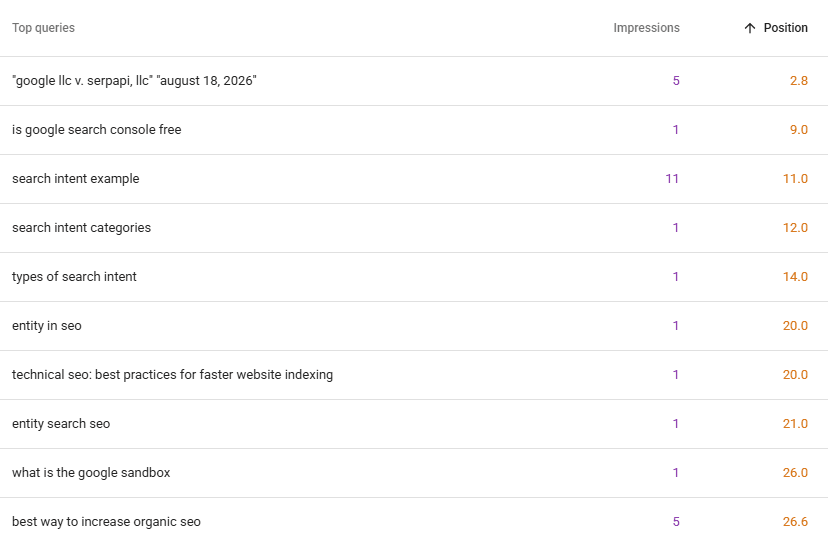
Open the Queries tab to see the searches for which the website received impressions and the average position associated with each query.
This makes it possible to distinguish, for example, a query averaging position 4 from another averaging position 28 instead of relying on the site’s combined average.
Analyze Individual Pages
Open Pages to examine the average position of individual URLs.
Page-level analysis is particularly useful when monitoring articles, product pages, landing pages, or other important content separately.
Compare Countries and Devices
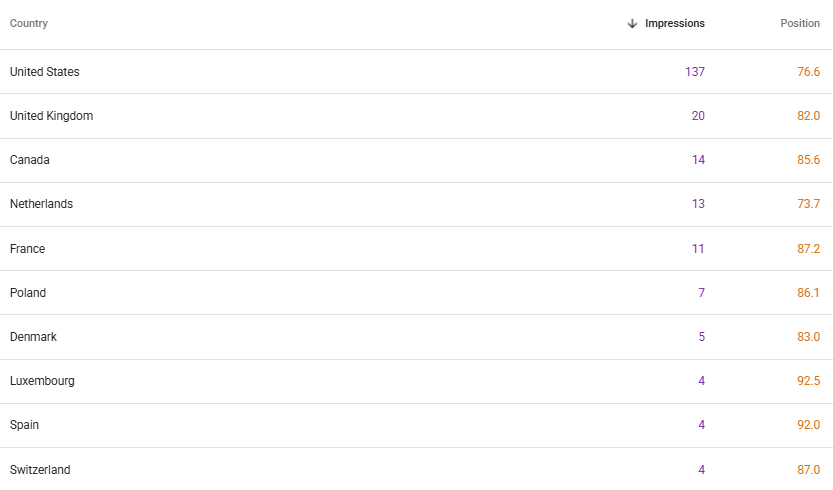
Use the Countries and Devices dimensions to investigate whether performance differs across markets or between mobile and desktop searches.
Compare Different Time Periods
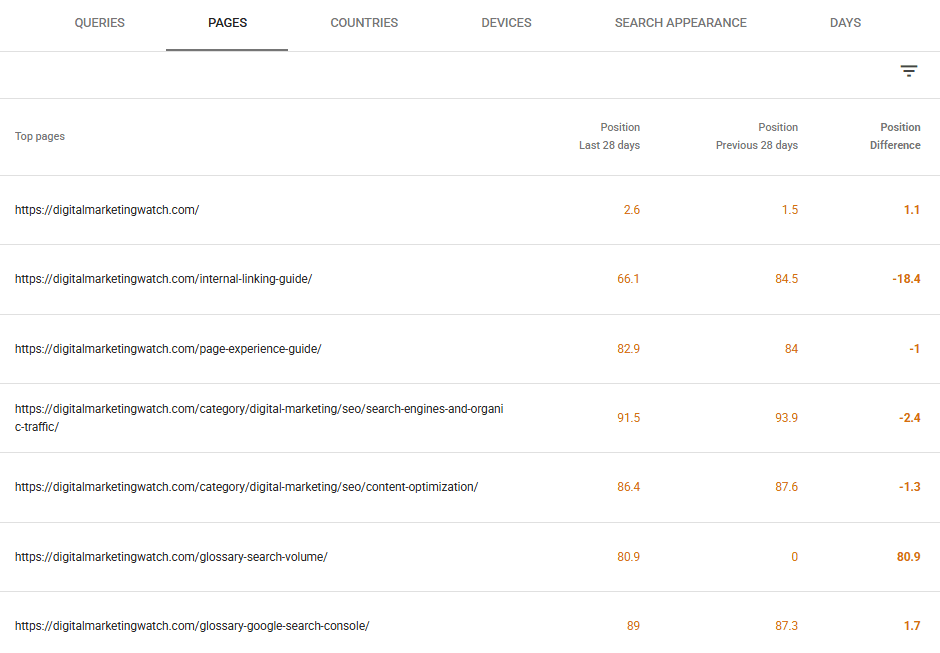
Use the Date filter to examine ranking trends over different periods or compare two equivalent date ranges.
For example: Last 28 days vs. previous 28 days
This helps distinguish persistent movement from short-term fluctuations.
Filter Queries and URLs
Search Console supports filters for queries and pages, including conditions such as contains and does not contain. Multiple dimensions can also be combined, such as analyzing one query group only on mobile devices in a particular country.
The more precisely the data is filtered by query, page, device, country, and period, the more meaningful average position generally becomes.
Diagnosing a Rapid Decline in Average Positions
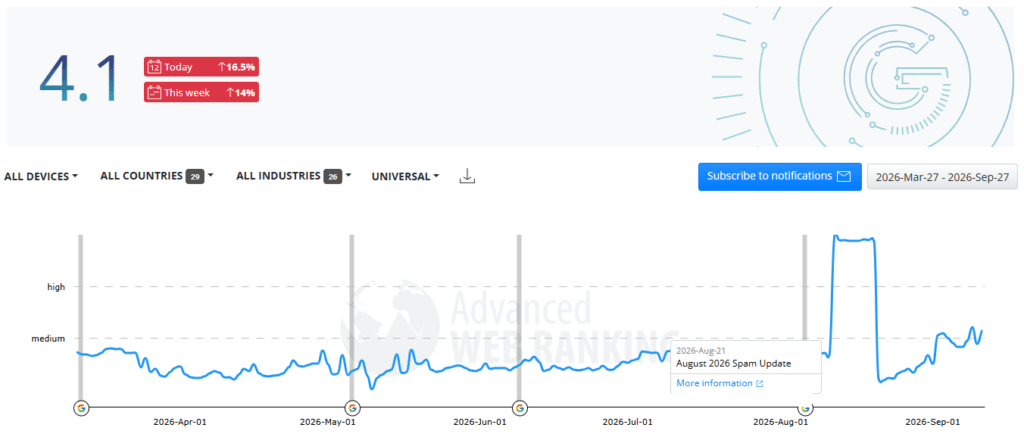
Check for broader ranking volatility before diagnosing a site-specific problem. If positions for many pages and queries are declining (for example, from position 5 to position 38) at the same time, the change may reflect a wider Google ranking update or unusually volatile SERPs rather than an issue affecting only one page or website.
Third-party volatility tools can help compare a ranking drop with broader search-result fluctuations, but correlation with an update does not by itself prove causation.
Average Position vs. Third-Party Rank Trackers
Google Search Console and dedicated rank-tracking platforms both report search positions, but they measure them in different ways.
Google Search Console
Search Console uses actual Google Search impressions from real searches. Its average position metric therefore combines recorded appearances from different searches, devices, locations, queries, and other contexts. The metric represents the average topmost position across those qualifying impressions.
Third-Party Rank Trackers
Platforms such as Semrush, Ahrefs, Moz Pro, and AccuRanker monitor selected keywords under defined tracking conditions.
For example, a rank tracker can answer: “Where did this URL rank today for this keyword on mobile in this city?”
Ahrefs supports separate desktop and mobile rankings and location tracking from country level down to city and ZIP code.
Semrush Position Tracking similarly reports positions, average position, visibility, ranking distribution, and competitor performance for the keywords included in a tracking campaign.
The key distinction is:
⇒ Search Console average position represents aggregated real-world Google performance, while a third-party rank tracker records controlled ranking observations for a selected set of keywords.
Frequently Asked Questions
Does Google Search Console include paid results in average position?
No. Google states that advertisements do not occupy Search positions. A website can therefore have an average position of 1 even when paid advertisements are displayed above its organic result.
Why can my average position drop after I publish new content?
New pages can begin receiving impressions for additional queries while initially ranking in lower positions. Those new ranking values can lower or worsen the site’s overall average even though the website is actually gaining broader search visibility.
What is the difference between Search Console average position and a third-party rank tracker’s position?
Search Console averages positions from actual Google Search impressions, while a rank tracker normally checks selected keywords under controlled conditions such as a particular location and device. Search Console therefore reflects aggregated real-world performance, while a tracker provides a more controlled ranking snapshot.
How does Google calculate average position if my site has two links in the same search results?
At property level, Google reports the topmost position occupied by the property. When data is grouped by page, each URL is treated separately and receives its own topmost recorded position.
Why do I have a high average position but very few clicks?
A strong average position does not guarantee traffic. Low search demand, a weak click-through rate, competing SERP features, AI answers, advertisements, search intent, title links, and snippets can all influence how often an impression becomes a click.