
Key Takeaways
- Google's Helpful Content System promoted original, useful, people-first content and demoted material created mainly to attract search traffic.
- Its machine-learning classifier operated sitewide, which means substantial unhelpful content could affect other pages across the same website.
- In March 2024, Google incorporated its helpful-content approach into broader core ranking systems using multiple signals, systems, and approaches.
- Helpful content should demonstrate original value, first-hand expertise, complete answers, trustworthy presentation, and a genuine purpose of satisfying readers.
The Helpful Content System was a Google ranking system introduced in 2022 to promote original, useful, people-first content and demote unoriginal, search engine-first content created mainly to attract search traffic. In March 2024, the standalone system was retired as its approach to identifying helpful content became part of the search engine’s broader core ranking systems, which use multiple signals.
The helpful content updates influenced SEO by changing how Google evaluated the helpfulness of content. Earlier search-focused publishing practices often placed excessive emphasis on keyword use, fixed word-count targets, and high content volume. The helpful content updates reinforced the importance of people-first purpose, original value, first-hand expertise, and satisfying answers.
The standalone Helpful Content System used a machine-learning classifier rather than functioning only as a recommendation framework. It evaluated content through an automated, sitewide signal, meaning that a substantial amount of unhelpful content could affect the performance of other pages across the website.
AI and Helpful Content
Google does not consider content unhelpful merely because AI assisted in its creation. Its generative AI guidance focuses on the quality, originality, and purpose of the resulting content. However, using AI or other methods to generate large numbers of low-value pages primarily to manipulate rankings may violate Google’s scaled content abuse policy.
Timeline and Evolution
The Helpful Content System evolved through several updates between 2022 and 2023 before its approach to identifying helpful content was incorporated into Google’s core ranking systems in March 2024.
- August 2022 (The Initial Launch): Google officially rolled out the first Helpful Content Update on August 25, 2022. This launched a site-wide signal targeting English searches globally to downgrade “search-engine first” materials.
- December 5, 2022 (Global Expansion): The December 2022 update improved the classifier and expanded the system to content globally in all languages.
- September 2023 (Final Standalone Update): Google began the September 2023 helpful content update on September 14, improving the system’s classifier. It became the last separately announced Helpful Content Update before the system was incorporated into Google’s core ranking systems in March 2024.
- March 2024 (Core Integration): With the March 2024 core update, Google incorporated the former Helpful Content System into its broader core ranking systems. Google now uses multiple systems, signals, and approaches to identify helpful content rather than relying on one dedicated helpful-content system.
What Google Looks for in Helpful Content
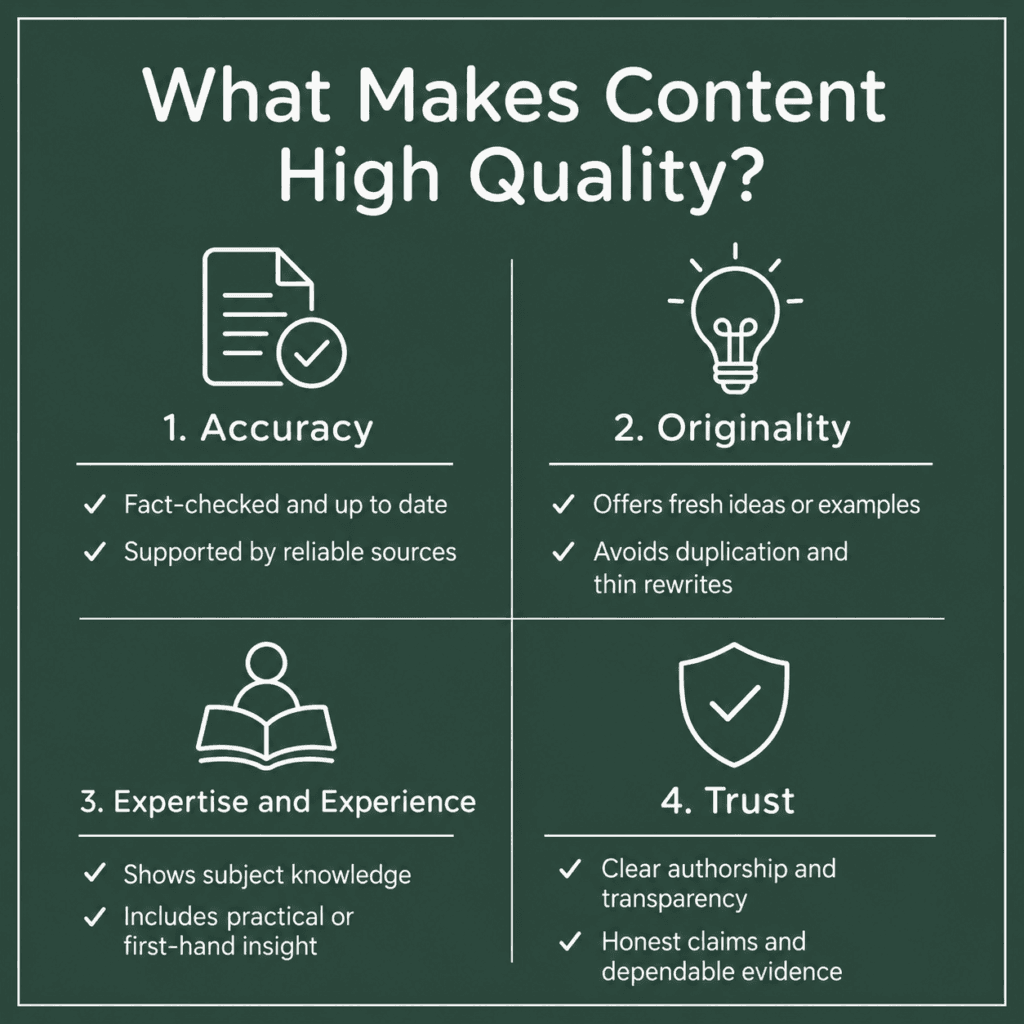
Google’s helpful content guidance focuses on whether a page is genuinely useful, original, trustworthy, and created primarily to satisfy readers rather than search engines.
- Original Information: Content should provide original reporting, research, analysis, examples, or insights that extend beyond obvious information.
- Complete Coverage: The subject should be explained substantially enough to help readers understand the topic and achieve their intended goal.
- Relevant First-Hand Experience: Content should demonstrate genuine knowledge, experience, testing, or informed familiarity with the subject.
- Substantial Added Value: Information drawn from other sources should be interpreted, expanded, or placed into context rather than simply copied or rewritten.
- Clear and Accurate Presentation: Titles should describe the content honestly, while the page should be carefully written, edited, and produced without exaggeration or avoidable errors.
- Trustworthy and Useful Content: Clear sourcing, identifiable authorship, factual accuracy, and meaningful usefulness should make the page worth bookmarking, sharing, or recommending.
Practices Google Advises Against
Google advises against practices that prioritize search visibility over genuine user value, especially when content is produced primarily to attract traffic rather than satisfy readers.
- Search-Engine-First Content: Content created mainly to attract search traffic rather than provide genuine value may be less likely to perform well.
- Unfocused Topic Production: Publishing large amounts of content across unrelated or trending subjects merely to capture rankings can weaken the site’s purpose and usefulness.
- Low-Value Automation: Extensive automation or mass production becomes problematic when it produces shallow, repetitive, or poorly reviewed pages.
- Unoriginal Summaries: Content that mainly restates information from other sources without adding meaningful analysis, evidence, or insight provides limited value.
- Incomplete Answers: Pages that fail to satisfy the query and leave readers needing to search elsewhere may indicate that the content has not fully met their needs.
- Artificial Optimization: Fixed word-count targets, unsupported claims, content produced without relevant expertise, and date changes made only to appear fresh are warning signs of search-engine-first publishing.
Helpful Content Checklist: What Creators Must Keep in Mind
The principles introduced through the Helpful Content System remain highly relevant because Google now evaluates helpfulness through multiple core ranking systems. Creators can use Google’s people-first guidance to evaluate whether their content is genuinely useful, original, trustworthy, and created primarily for readers.
- Audience Focus: Ensure the content matches the website’s subject and addresses the needs of its intended readers. The final page should solve a genuine problem and leave readers with useful knowledge or a clear next step.
- Original Content: Add first-hand experience, data, transparent authorship, proprietary case studies, expert insight, research, examples, or information not readily available elsewhere. The content should clearly show why the author or publisher is qualified to cover the subject.
- “Who, How, and Why”: Google recommends assessing content through the Who, How, and Why framework: who created it, how it was produced, and why it was published. This helps determine whether the content demonstrates clear authorship, responsible production, and a genuine people-first purpose.
- Avoid Fixed Word Counts: Google states that it has no preferred word count, so content should be as long as necessary to answer the topic clearly and completely without unnecessary filler.
- Trust and Accuracy: Verify facts, cite reliable sources, show relevant expertise, and review all AI-assisted content carefully.
- Page Quality: Maintain natural keyword use, mobile usability, stable layouts, accessible navigation, and an uncluttered reading experience.
- Maintain a Clear Site Focus: Avoid publishing unrelated or trending topics solely to capture search traffic. In other words, content should remain relevant to the website’s primary purpose.
Frequently Asked Questions
Was the Helpful Content System a site-wide signal?
The original system included a site-wide classifier that could affect how content from a site performed when a relatively high amount of its content was considered unhelpful. Google’s current guidance emphasizes that its ranking systems primarily work at the page level while also using some site-wide signals and classifiers.
What type of content does Google consider helpful?
Google recommends creating people-first content that provides original information or analysis, substantially answers the topic, serves a clear audience, and leaves readers feeling that they have learned enough to achieve their goal. Content created mainly to attract search traffic, extensively automated content with little added value, and summaries that add little beyond existing sources are among the warning signs Google highlights.
Can a website recover after losing visibility related to unhelpful content?
Improvement generally requires addressing the underlying content quality rather than making isolated SEO changes. Google recommends reviewing affected pages, comparing them against its people-first content guidance, and making meaningful improvements; changes in visibility may not be immediate because ranking systems reassess content over time.