
E-E-A-T, or Experience, Expertise, Authoritativeness, and Trustworthiness, is a set of quality concepts used in Google’s Search Quality Rater Guidelines to evaluate whether content and its creators appear trustworthy and suitable for their purpose.
E-E-A-T is not a single ranking factor, algorithm, or numerical score. Instead, Google’s automated ranking systems use many different factors and signals, some of which can help identify qualities associated with strong E-E-A-T.
In simple words, there is no public E-E-A-T score or a dedicated E-E-A-T algorithm maintained by Google. Qualities associated with strong E-E-A-T can be supported by real experience, accurate information, credible sourcing, transparent authorship, and a trustworthy reputation.
The framework helps Google evaluate whether changes to its search systems are producing helpful and trustworthy results. E-E-A-T is particularly important for Your Money or Your Life (YMYL) topics, where inaccurate information could significantly affect a person’s health, financial stability, safety, or societal well-being. Google says its systems give greater weight to strong E-E-A-T for these topics.
According to Google’s Search Quality Rater Guidelines, trustworthiness is the most important element of the framework. In other words, experience, expertise, and authoritativeness exist entirely to build this foundational layer of user trust.
E-E-A-T and Other Search Engines
E-E-A-T is a framework associated specifically with Google and its Search Quality Rater Guidelines. Other search engines do not necessarily use the E-E-A-T name or an identical four-part framework, but many evaluate similar qualities such as content quality, expertise, authority, originality, evidence, and trust. For example, Microsoft Bing recommends demonstrating subject expertise and supporting claims with examples, data, and cited sources. As a result, improving the underlying qualities represented by E-E-A-T can support content quality beyond Google, even though other search engines may evaluate those qualities through different systems and signals.
How E-E-A-T Evolved Over Time
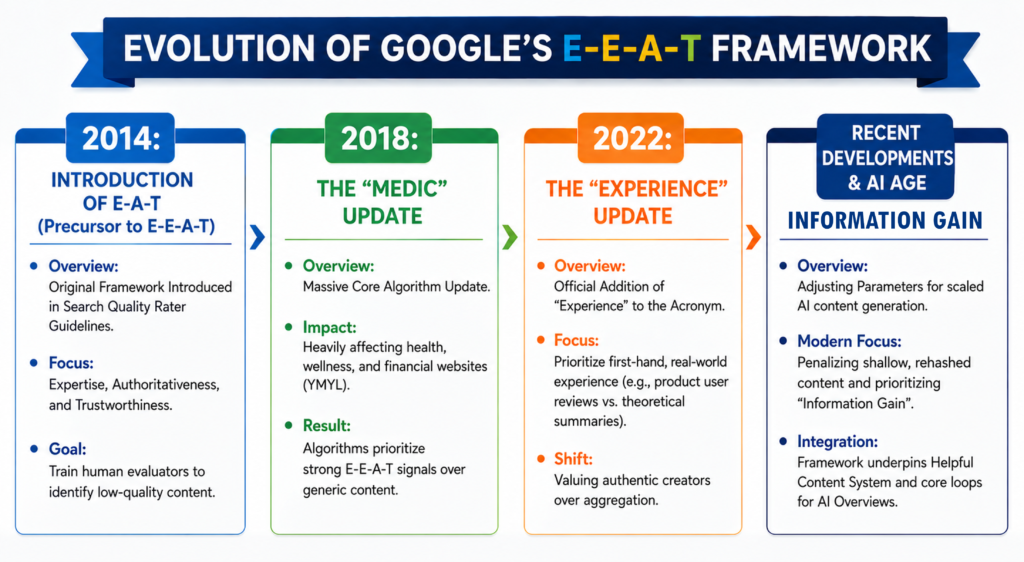
The framework has systematically transitioned from a set of basic guidelines for human review into a core driver of modern algorithmic search
- 2014 (Introduction of E-A-T): In 2014, Google first introduced the original E-A-T framework in its Search Quality Rater Guidelines. It focused purely on Expertise, Authoritativeness and Trustworthiness to train human evaluators to identify low-quality content.
- 2018 (The “Medic” Update): Google rolled out a massive Core Algorithm Update, heavily impacting health, wellness and financial websites. Nicknamed the “Medic Update” by the SEO industry, the update led to increased industry attention on E-A-T and YMYL content quality.
- 2022 (E-A-T Becomes E-E-A-T): Google updated its Search Quality Rater Guidelines in December 2022 by adding Experience as a fourth consideration. The addition highlighted the importance of first-hand or life experience when it is relevant to the topic. For example, a first-hand product review can demonstrate experience that a summary of manufacturer information may not.
- Recent Developments: Google’s guidance increasingly emphasizes original, helpful, people-first content, including content that demonstrates unique expertise or first-hand experience. The former Helpful Content System became part of Google’s core ranking systems in March 2024. Google’s guidance for AI search features similarly recommends useful, non-commodity content that offers unique expert or experienced perspectives.
Elements of E-E-A-T
The four parts of E-E-A-T overlap, but they describe different qualities. Google emphasizes that the amount and type of experience or expertise needed depends on the topic and purpose of the page.
Experience
Experience refers to first-hand or life experience with the subject. A product reviewer who has actually used a product, a traveler who has visited a destination, or a marketer showing results from a campaign can demonstrate experience directly. Google specifically uses first-hand product use as an example of experience.
Experience can be demonstrated through:
- original screenshots, photographs, videos, tests, and demonstrations;
- first-hand observations and practical examples;
- original case studies and experiments;
- descriptions of how a product, process, or service was actually used;
- author biographies explaining relevant hands-on background.
An author bio or profile can make that experience easier for readers to verify, but the bio itself does not create experience. The content should demonstrate it.
Expertise
Expertise refers to the knowledge or skill needed for the topic. Google notes that different subjects require different kinds and levels of expertise; for example, electrical rewiring advice calls for professional skill rather than simply an interest in old houses.
Expertise can be demonstrated through:
- relevant education, qualifications, training, or certifications where appropriate;
- professional experience and specialist roles;
- accurate, detailed explanations;
- appropriate use of primary and authoritative sources;
- technically correct terminology and methodology;
- expert review for sensitive or specialized topics.
Authoritativeness
Authoritativeness refers to whether the creator or website is recognized as a go-to source for the topic. Google’s guidelines explicitly describe authority in terms of being known as a reliable or official source.
It can be supported by:
- independent mentions and references from reputable sources;
- citations of the site’s research or expertise;
- reputable backlinks and editorial coverage;
- industry recognition, awards, speaking engagements, or published research;
- a consistent body of high-quality work within a specific subject area;
- official status where applicable.
In simple terms, expertise concerns what a creator knows, while authoritativeness concerns whether others recognize the creator or website as a trusted source on that topic.
Trustworthiness
Trustworthiness concerns whether the page and website are accurate, honest, safe, and reliable. Google places trust at the center of E-E-A-T.
Trust can be supported through:
- accurate and verifiable information;
- transparent authorship and editorial responsibility;
- clear correction and update policies;
- secure website practices;
- accessible contact and customer-service information where appropriate;
- clear disclosures for advertising, affiliate relationships, and sponsorships;
- reliable sourcing;
- a transparent About Us page describing who operates the website.
Note
Experience, expertise, and authoritativeness cannot compensate for a lack of trust. Google’s guidelines state that an untrustworthy page has low E-E-A-T regardless of how experienced, expert, or authoritative its creator may appear.
Why E-E-A-T Matters for SEO
E-E-A-T provides a useful framework for evaluating whether content is likely to appear helpful, reliable, and trustworthy to users. Google says its automated systems use a mix of factors that can identify qualities associated with E-E-A-T, with stronger emphasis on these qualities for YMYL topics.
- Supports people-first content: Evaluating experience, expertise, authority, and trust can help identify weaknesses in content quality, sourcing, and authorship.
- Matters more for sensitive topics: Strong E-E-A-T is particularly important for health, finance, safety, and other YMYL subjects.
- Helps establish credibility: Clear authorship, accurate sourcing, relevant experience, and a strong reputation make it easier for users and quality evaluators to understand why a source should be trusted.
- Aligns with Google’s quality guidance: Google’s current guidance for both traditional and AI-assisted search emphasizes original, helpful, reliable, people-first content.
Strategies for E-E-A-T Optimization
- Make Authorship Clear: Add visible bylines, author biographies, and dedicated author pages where appropriate. Article structured data can also identify the author and link to an author profile, helping Google understand authorship information.
- Detail the Verification Process: Explain research, testing, review, and fact-checking methods when they are relevant to the content. This helps readers understand how information was produced and evaluated.
- Use Screenshots of Tools/Platforms: Use original screenshots, photographs, test results, or demonstrations when they genuinely document first-hand use or experience.
- Maintain Strict Editorial Standards: Establish documented requirements for sourcing, fact-checking, plagiarism checks, expert review, updates, corrections, disclosures, and AI-assisted content. Apply the standards consistently so published content remains accurate, transparent, and accountable.
- Use Strong Primary and Authoritative Sources: Cite high-quality primary and authoritative sources where appropriate, particularly for factual, scientific, medical, or technical claims. Accurate sourcing can strengthen the reliability of the content.
- Regularly Publish Original Research or Case Studies: Publish original research, experiments, case studies, or first-party data where useful. Original material can provide unique value that is unavailable from generic summaries.
- Maintain Detailed Author and About Us Pages: Provide relevant author credentials, professional backgrounds, site ownership information, contact details, editorial responsibilities, and other information that helps readers understand who creates and operates the website.
- Leverage Authentic User-Generated Content: Authentic user reviews, discussions, and case studies can add first-hand perspectives when they are relevant and appropriately moderated.
- Source External Subject-Matter Experts: Involve subject-matter experts when a topic requires specialist knowledge, and clearly identify whether they contributed as an author, reviewer, or expert source.
- Acquire Contextually Relevant Backlinks: Earn genuine editorial mentions, citations, and links from reputable sources within the relevant field. Independent references can contribute to a site’s wider reputation and perceived authority.
- Monitor Brand and Author Reputation: Track credible reviews, independent mentions, customer feedback, and public reputation. Respond transparently to legitimate complaints or corrections.