
Key Takeaways
- A topic cluster organizes related subtopic pages around a comprehensive pillar page, connecting them through contextual internal links.
- Effective clusters contain three components: a pillar page, focused cluster pages, and interlinks that connect the content architecture.
- Cluster size should reflect distinct questions, search intents, user needs, search demand, and genuinely useful content—not a fixed article count.
- Topic clusters can strengthen topical coverage, content discovery, and internal linking, but quality, accuracy, and distinct page purposes remain essential.
A topic cluster is an SEO and content-organization strategy that groups related subtopic pages around a central pillar page covering the broader subject. Instead of publishing related articles as isolated posts, a topic cluster organizes them around a broader parent topic and connects them through internal links.
For a new website, it is often more practical to build a small number of topic clusters thoroughly rather than opening many incomplete subject areas at once. The appropriate number of supporting pages depends on the breadth of the topic, search demand, user needs, and the amount of genuinely useful content available.
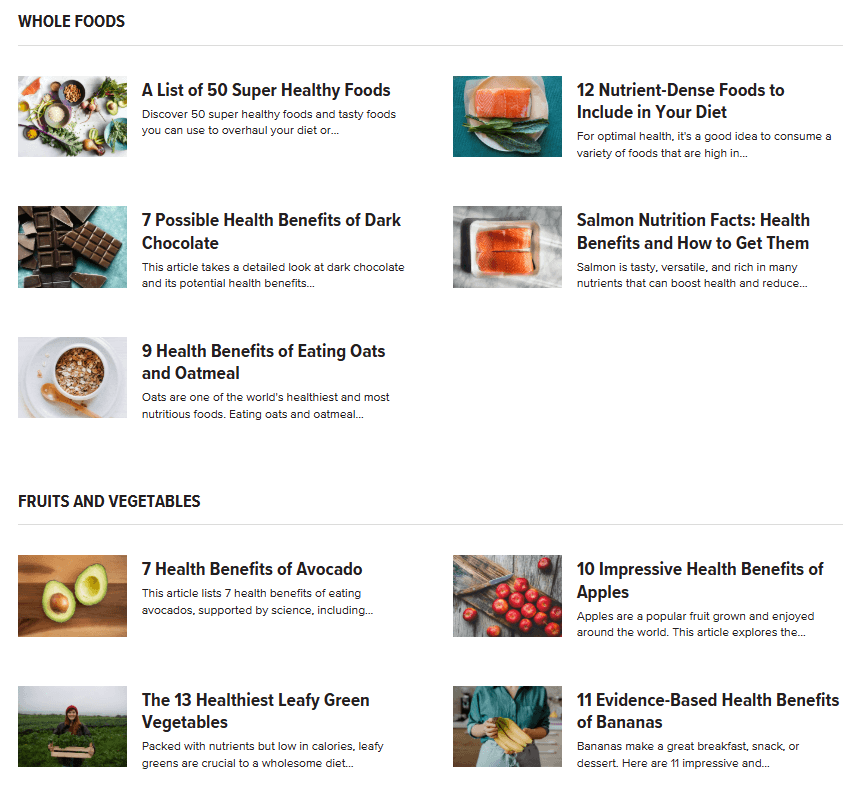
Note
A topic cluster does not require a fixed number of supporting articles. The appropriate size depends on how many distinct questions, search intents, and useful subtopics exist within the broader subject.
Search Engines and Topic Clusters
Modern search engines do not rely only on exact keyword matching. Google uses systems that can understand concepts, context, and relationships between queries and webpages. For example, its current ranking-systems documentation describes neural matching as an AI system that understands representations of concepts in queries and pages and matches them to one another.
Earlier Google systems also contributed to more contextual language understanding. BERT improved Google’s ability to interpret words in relation to the surrounding words in a query, while RankBrain helped Google understand how words relate to concepts. Similarly, MUM extended Google’s ability to understand and generate information across different formats and languages.
Topic clusters fit naturally into this environment because they encourage a website to cover a subject through related concepts rather than repeating one exact keyword. A well-developed cluster may naturally include synonyms, entities, questions, subtopics, examples, and related terminology while linking these pages together in a logical structure.
Internal linking also helps search engines understand relationships between pages. Google says it uses links both to discover new pages and as a relevance signal, and its ecommerce documentation notes that navigation and cross-page links can influence how Google understands site structure.
Three Components of a Topic Cluster
The structural blueprint of an effective topic cluster relies on three specific components:
- The Pillar Page: A comprehensive overview page that covers the broad topic and answers foundational questions related to its main search intents.
- The Cluster Pages: Focused supporting articles that explore individual subtopics or questions in greater depth than the pillar page.
- The Interlinks: Interlinks connect or weave the entire content architecture together by linking the pillar page to the cluster pages and vice versa. Cluster pages should usually link contextually to the pillar page and to other relevant cluster pages where useful. The pillar page should also link to important supporting content so users and search engines can move naturally through the topic. Google recommends descriptive, crawlable internal links that help it discover pages and understand how the pages relate to one another.
Example of a Pillar and Cluster Content Model
For a website focused heavily on stationery products, a standard architectural layout could be structured as follows:
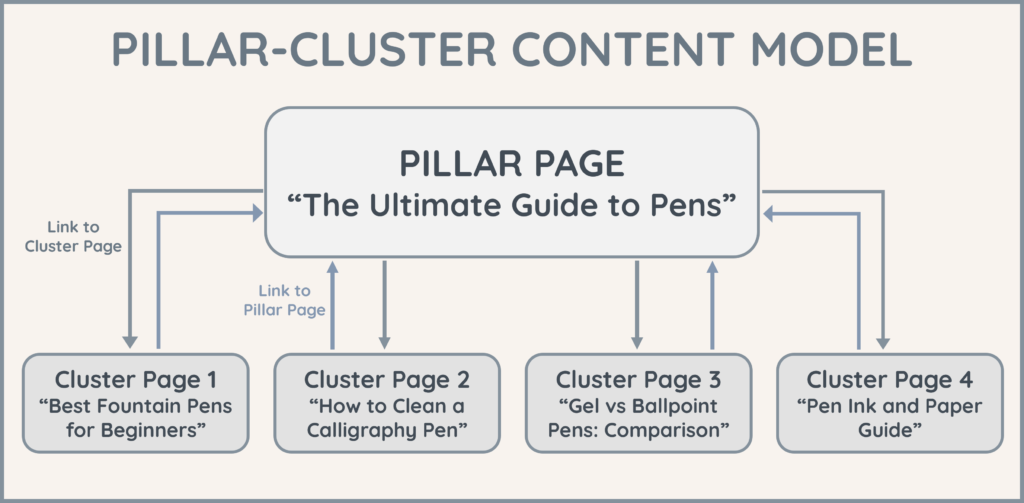
- The Broad Pillar Page: For the website, the pillar page on “pens” could be a comprehensive guide such as “The Ultimate Guide to Pens”. It covers the overarching ideas such as types of pens, materials, maintenance, pricing, and common uses.
- Cluster Pages: The supporting cluster pages dive deep into highly specific subtopics introduced briefly on the main pillar page. For example, separate articles exploring ink types, pen prices, fountain pen features, cleaning calligraphy nibs, and differences between gel and ballpoint pens. This granular coverage extends across multiple contextually linked subtopics.

Creating a Topic Cluster
Building a topic cluster requires a structured approach to planning, creating, and internally linking related content.
- Identify a Core Topic: Choose a broad subject that is relevant to the website’s audience, expertise, products, or business goals and is large enough to support several useful subtopics.
- Conduct Subtopic Keyword Research: Use keyword research, SERP analysis, audience questions, and existing content data to identify distinct subtopics and search intents within the broader theme.
- Write or Restructure Content: Create or improve the pillar page so it provides a useful overview of the core topic, then develop focused supporting pages for subjects that deserve deeper coverage.
- Interlink Everything Thoroughly: Add descriptive contextual links from the pillar page to relevant cluster pages. Cluster pages should also link back to the pillar page and to other closely related pages where those links genuinely help the reader.
- Monitor Internal Links: Link Whisper can provide reports showing inbound and outbound internal links across WordPress content. Similarly, Rank Math offers internal-linking features. Rank Math PRO, its premium version, includes AI Link Genius, which can identify internal-linking opportunities, audit links, and help manage internal links from within WordPress. Another plugin, Internal Link Juicer, can automate or semi-automate contextual internal linking based on configured keywords and content relationships.

Tools for Building Topic Clusters
Different tools can help with topic discovery, keyword grouping, content gaps, and internal linking:
- Google Search Console: Shows queries and pages already receiving impressions, which can reveal related subjects and gaps in existing coverage.
- Google Keyword Planner: Helps identify related search terms and demand around a broad topic.
- Semrush and Ahrefs: Can be used for keyword research, competitor analysis, content gaps, and related-topic discovery.
- Keyword clustering tools: Group semantically related search terms into potential page or subtopic groups.
- Screaming Frog: Helps audit internal links, orphaned pages, crawl depth, and site architecture.
- WordPress internal-linking plugins: Rank Math, Link Whisper, and similar tools can assist with identifying or creating contextual links.
How Topic Clusters Improve SEO
A well-planned topic cluster can improve content organization, internal linking, topical coverage, and content discovery for both users and search engines.
- They Strengthen Topical Coverage: Covering a subject through well-connected, useful pages can make the site more comprehensive for users and help search engines understand the relationships among related content.
- They Can Reduce Keyword Cannibalization: Assigning distinct search intents and subtopics to separate pages can reduce unnecessary overlap between pages targeting the same query. Poorly planned clusters can still create cannibalization, so page roles need to remain distinct.
- They Distribute Internal Link Equity: Internal links connect related pages and help distribute the value associated with links throughout the site’s internal structure. They also provide additional paths for search engines to discover and crawl content.
- They Improve Content Discovery for Users: Relevant contextual links make it easier for visitors to continue exploring related questions without returning to navigation or search results.
Topic Cluster, E-E-A-T and AI Search
Topic clusters can support some of the qualities associated with E-E-A-T, but the structure itself does not prove experience, expertise, authoritativeness, or trustworthiness. A cluster becomes more valuable when its individual pages contain accurate information, clear authorship, first-hand examples, credible sourcing, and genuinely useful depth.
For example, a website with a broad pillar guide on technical SEO and supporting articles on crawling, indexing, robots.txt, canonicalization, XML sitemaps, redirects, and structured data can demonstrate broad subject coverage. However, the usefulness of that cluster still depends on the accuracy and quality of each page rather than the number of articles alone.
Topic clusters may also be useful in AI-assisted search because they encourage publishers to create clear, self-contained explanations across related questions and concepts. Google’s current guidance for AI search continues to emphasize helpful, reliable, people-first content rather than a separate optimization method for AI features.
For AI search, topic clusters are best treated as an organizational framework rather than a ranking or citation shortcut. They can improve coverage, context, and content discovery, but individual pages still need clear answers, original value, reliable evidence, and enough context to stand on their own.
Frequently Asked Questions
What is a topic cluster?
A topic cluster is a group of closely related pages organized around a broader central topic, usually with a pillar page linking to more specific supporting content.
How do topic clusters help SEO?
Topic clusters can improve site organization, strengthen internal linking, and make it easier for users and search engines to understand how related pages fit together.
What is the difference between a pillar page and a topic cluster?
A pillar page is the main broad resource covering the central subject, while a topic cluster includes that pillar page plus the supporting pages that explore narrower subtopics.