
Key Takeaways
- Plagiarism involves presenting another person’s words, ideas, data, creative work, or original expression as one’s own without appropriate acknowledgment.
- It can involve direct copying, close paraphrasing, mosaic plagiarism, self-plagiarism, source misuse, or unintentional citation errors.
- Proper source use includes clearly attributed quotations, genuinely independent paraphrasing, accurate summaries, and compliance with applicable editorial, academic, or professional standards.
- Plagiarism and copyright infringement can overlap, but attribution concerns differ from copyright law governing reproduction of protected expression.
Plagiarism is the act of presenting another person’s words, ideas, research, creative work, or original expression as one’s own without proper acknowledgment. It may involve direct copying, close paraphrasing, uncredited reuse of data, or presenting another person’s images, designs, code, or other intellectual material without appropriate acknowledgment.
Plagiarism is primarily an issue of attribution and academic, professional, or editorial integrity. It may occur intentionally or unintentionally, and either form can damage credibility or lead to academic, professional, or editorial consequences. In some cases, the same conduct may also involve copyright infringement or other legal issues.
What Is Plagiarism?
Plagiarism occurs when material created by another person or organization is used without clearly identifying where it originated. The copied material does not need to be an entire article, report, or publication. A sentence, paragraph, statistic, argument, image, or distinctive idea may be plagiarized when it is presented without suitable credit.
Common forms of plagiarism include:
- Direct plagiarism: Copying text word for word without any attribution or quotation marks.
- Paraphrasing plagiarism: Rewriting another source too closely while preserving much of its wording, structure, or distinctive expression without appropriate acknowledgment.
- Mosaic plagiarism: Combining copied phrases or ideas from several sources into new content without adequate citation.
- Self-plagiarism: Reusing previously published content without making it clear that the material has been used before.
- Citation or source misuse: Misrepresenting, omitting, or inventing sources in a way that conceals where information originated.
- Accidental plagiarism: Failing to cite a source because of poor note-taking, misunderstanding, or oversight.
Plagiarism is not limited to written content. It may also involve photographs, illustrations, videos, music, software code, charts, research findings, presentations, and website content.
How Plagiarism Occurs
Plagiarism often occurs during research, writing, editing, or content production. Material may be copied directly from a source, lightly rewritten, or incorporated into a document without recording the original reference.
A passage may also become plagiarized when several words are replaced with synonyms but the sentence structure and central expression remain almost identical to the source. Proper paraphrasing requires the information to be expressed independently in the writer’s own wording and structure while still citing the source when the underlying idea or information requires attribution.
Plagiarism detection tools compare submitted text against webpages, academic papers, books, databases, and previously published documents. These tools identify textual similarities, but a similarity match does not automatically prove plagiarism. Quotations, references, technical phrases, and commonly used expressions may also produce matches. Human review is therefore necessary.
Example of Plagiarism
- Original source: Search engines use automated systems to discover, analyze, and organize webpages.
- Plagiarized version: Search engines use automated systems to discover, analyze, and organize web pages.
The second version changes only minor formatting while retaining essentially the same wording and sentence structure.
- Acceptable paraphrase: Search engines rely on automated technology to locate webpages, process their information, and organize that information for search.
The source should still be cited when the underlying explanation, finding, or idea was obtained from another publication.
Plagiarism Standards in Academic and Professional Writing
There is no universal word count or similarity percentage that automatically determines plagiarism. Academic institutions, publishers, employers, and editorial organizations may establish their own citation and originality requirements.
For example, Princeton’s academic-integrity guidance uses examples to distinguish direct copying, inadequate paraphrasing, and properly acknowledged source use rather than defining plagiarism through a fixed number of copied words.
Similarly, a plagiarism checker can identify matching text without determining whether plagiarism or other misconduct has occurred. Quotations, references, common terminology, and properly cited passages can all increase a similarity score. Turnitin explains that similarity must be evaluated in context.
What Is Acceptable Source Use?
Using another source is not automatically plagiarism. Writers may quote, summarize, paraphrase, discuss, or build upon existing material when they provide appropriate acknowledgment and follow the relevant academic, editorial, or professional standards.
Common acceptable practices include:
- Direct quotation: Reproducing exact wording inside quotation marks or another appropriate quotation format and citing the source.
- Paraphrasing: Restating information substantially in one’s own wording and sentence structure while acknowledging the source when attribution is required.
- Summarizing: Condensing a larger argument, study, or publication into a shorter explanation while identifying its source.
- Using common knowledge: Widely established facts generally do not require citation, although standards may vary by context.
- Using licensed or permitted material: Images, data, or other protected works may be used when the applicable license, permission, or legal exception allows it.
Citation does not automatically make every use legally permissible. Attribution addresses source acknowledgment, while copyright law separately governs whether protected expression may be reproduced or adapted.
Plagiarism vs. Copyright Infringement
Plagiarism and copyright infringement are related but different concepts. Plagiarism primarily concerns whether another person’s work or ideas are presented without appropriate acknowledgment. Copyright infringement concerns whether legally protected expression has been used in a way that violates the copyright owner’s rights.
The two can overlap, but not always. A writer could plagiarize an uncopyrighted idea by presenting it as original, while another person could credit an author yet still infringe copyright by reproducing protected material without permission or another legal basis.
Important Points and Best Practices
Original writing does not require every concept to be completely new. It requires a clear distinction between the writer’s own analysis and information drawn from other sources.
Important practices include:
- Cite borrowed ideas, data, quotations, and research findings when they are not common knowledge.
- Place exact copied wording inside quotation marks where appropriate.
- Paraphrase ideas using genuinely independent wording and sentence structure.
- Maintain accurate research notes and record source details during writing.
- Use primary and authoritative sources whenever possible.
- Obtain permission before using protected images, graphics, or other copyrighted material when required.
- Review similarity reports manually rather than relying only on a percentage score.
- Avoid copying material from competitors and making only minor wording changes.
- Disclose reused or republished material when editorial standards require it.
Plagiarism concerns ethical attribution, while copyright infringement concerns the unauthorized use of legally protected work. Content may be plagiarized without infringing copyright, and copyrighted material may be infringed even when the creator is credited.
AI and Plagiarism
Using AI-generated material is not automatically plagiarism, but submitting AI-assisted or AI-generated work in violation of an institution’s, publisher’s, or employer’s disclosure or authorship rules may breach academic or editorial standards. Writers should follow the applicable policy and verify any sources, quotations, facts, or citations produced by an AI system.
Popular Plagiarism Checking Tools
Plagiarism checkers serve different audiences and compare content against different source collections. No tool can determine plagiarism solely from a similarity percentage, so reported matches should always be reviewed manually.
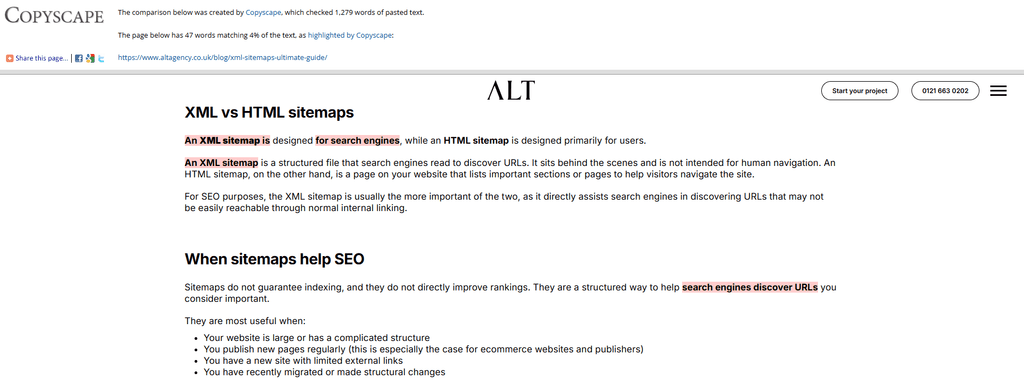
- Copyscape: Well suited to website owners, publishers, and content teams checking whether web content appears elsewhere online. Copyscape Premium also supports pasted text, document uploads, batch searches, and API-based checks.
- Turnitin: Primarily associated with education and academic-integrity workflows. Its Similarity Report identifies matching text across comparison sources but does not itself decide whether plagiarism occurred.
- Scribbr: Primarily designed for students and academic writing, with similarity checking and source-matching features.
- Copyleaks: Supports plagiarism checking across web content, academic material, documents, and source code, with products for education and business use.
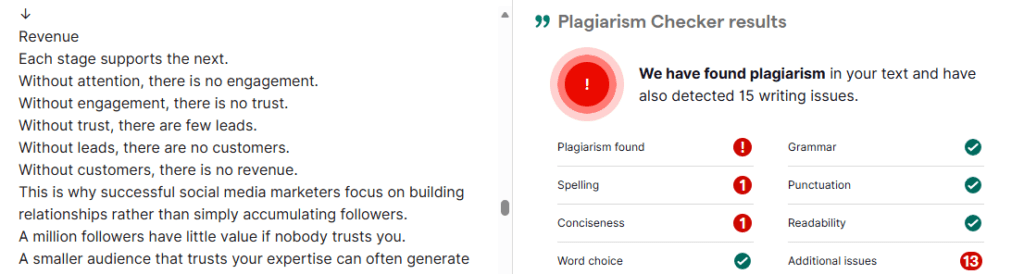
- Grammarly: Combines plagiarism checking with grammar and writing assistance and compares submitted writing against websites, academic papers, and published material.
Frequently Asked Questions
What is plagiarism?
Plagiarism is the use of another person’s words, ideas, or work without appropriate attribution or with presentation that makes the material appear original.
Is paraphrasing considered plagiarism?
Paraphrasing is not plagiarism when the source idea is genuinely rewritten in substantially different language and structure and is cited when attribution is required.
Can plagiarism happen accidentally?
Yes. Accidental plagiarism can result from poor note-taking, missing citations, copied wording left in a draft, or paraphrasing that remains too close to the original source.