Key Takeaways
- Domain Authority is Moz’s proprietary SEO metric predicting a domain’s ranking potential (1-100) relative to other domains.
- DA is not a Google ranking factor or direct measure of PageRank, so it should not be treated as an absolute website-quality grade.
- Because DA relies heavily on link data and a proprietary scoring system, scores can change when Moz updates its link index or adjusts how the metric is calculated.
- DA is most useful for comparing similar competitors and evaluating link prospects alongside relevance, page quality, traffic, indexability, and editorial placement.
Domain Authority (DA) is a proprietary SEO metric created by Moz to estimate a domain’s relative ability to rank in search results. DA scores range from 1 to 100 and are intended for comparison with other domains rather than as a real measure of search performance. Since it is a third-party metric, it is not used by Google as a ranking factor; instead, it serves as a benchmark for comparing the overall ranking potential of websites.
Moz calculates DA mainly from link-related signals processed through its proprietary scoring system. Because the metric is recalculated over time, a website’s score can change even when no obvious change has occurred on the website itself.
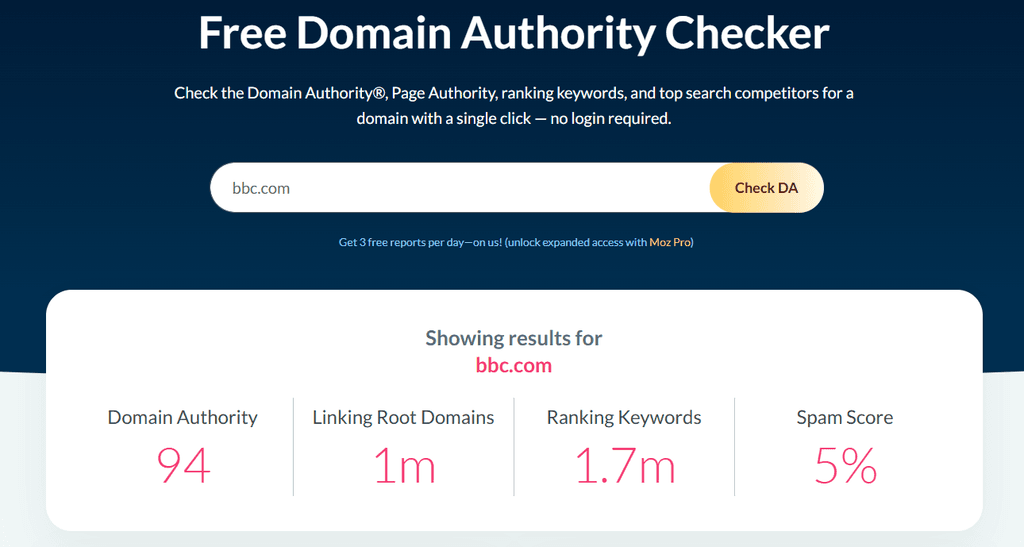
The DA score is relative rather than absolute, which makes it more useful for comparing domains with similar competitors. One can check any domain using the Moz Free Domain Authority Checker or by installing the free MozBar browser extension to view authority metrics for search results. Free access, however, may be subject to account or usage limits.
Calculation Methodology
Moz calculates Domain Authority using multiple backlink-related signals from its Link Explorer index. The resulting DA score ranges between 1 and 100, but the progression is not linear: gaining additional points becomes increasingly difficult as a domain moves toward the higher end of the range.
- Logarithmic Scale: Increasing a DA score becomes progressively more difficult at higher levels. For example, moving from 10 to 20 is generally easier than going from 70 to 80, but no fixed number of backlinks guarantees a particular increase.
- Machine-Learning Inputs: Moz combines multiple link-related signals, including the number of distinct linking domains and the site’s overall backlink count, into a single predictive score. The exact weighting is proprietary and may change when Moz updates its index or retrains the model.
Because DA is relative, a score may change when Moz updates its link index or recalibrates its model. DA should therefore be used to compare similar competitors rather than treated as an absolute grade of website quality.
What Is an Ideal Domain Authority Score?
Because DA is a relative metric, there is no single “good” or “ideal” score. A useful benchmark is a score comparable to or higher than those of direct competitors operating in the same niche, market, and stage of development.
Platforms with the Highest DA Scores
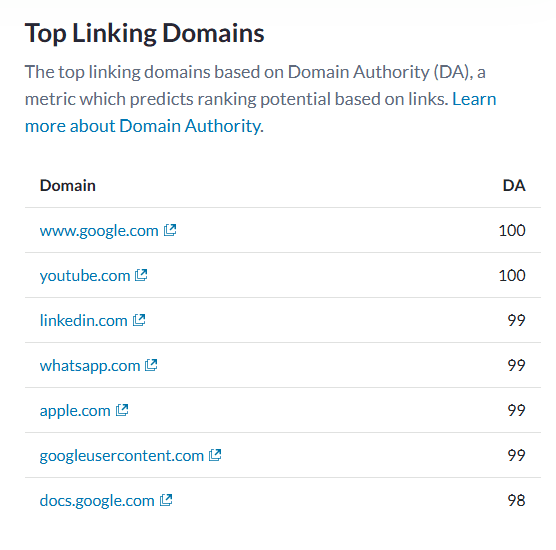
At the time of writing, the highest tiers in Moz’s current Top 500 list are dominated by internet infrastructure giants and top social networks, including Google (100), YouTube (100), Blogger (100), LinkedIn (99), and WhatsApp (99).
Domain Authority vs. Page Authority
Domain Authority and Page Authority are both predictive SEO metrics developed by Moz. Although they use the same 1–100 scoring scale, they estimate ranking potential at different levels.
- Domain Authority (DA): Estimates the relative ranking potential of a domain compared with other sites.
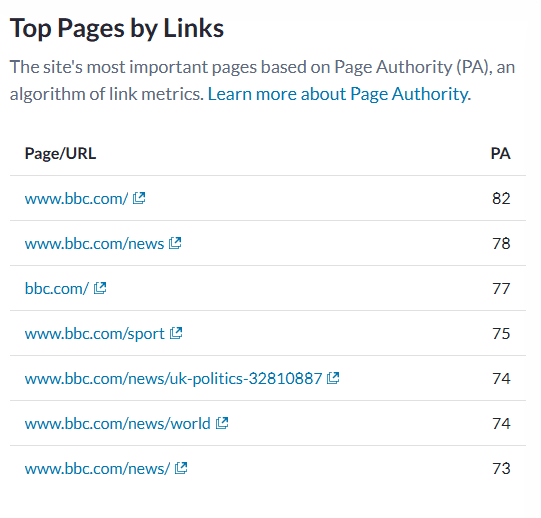
- Page Authority (PA): Estimates the relative ranking strength of an individual webpage or URL compared with other pages. A homepage often has a higher PA score than a newly published article because it typically has accumulated more internal and external links, although this is not always the case.
Competitor Metrics: Ahrefs and Semrush
Other major SEO platforms like Ahrefs and Semrush also provide their own comparable proprietary scores using slightly different calculation models:
- Domain Rating (DR) by Ahrefs: Ahrefs’ Domain Rating measures the overall quality of a domain’s backlink profile on a logarithmic scale from 0 to 100. Its calculation considers referring domains, the DR of those domains, and how many other websites they link to.
- Authority Score (AS) by Semrush: Semrush’s Authority Score is a compound metric scored from 1 to 100 based on link power, estimated organic traffic, and spam-related Natural Profile signals.
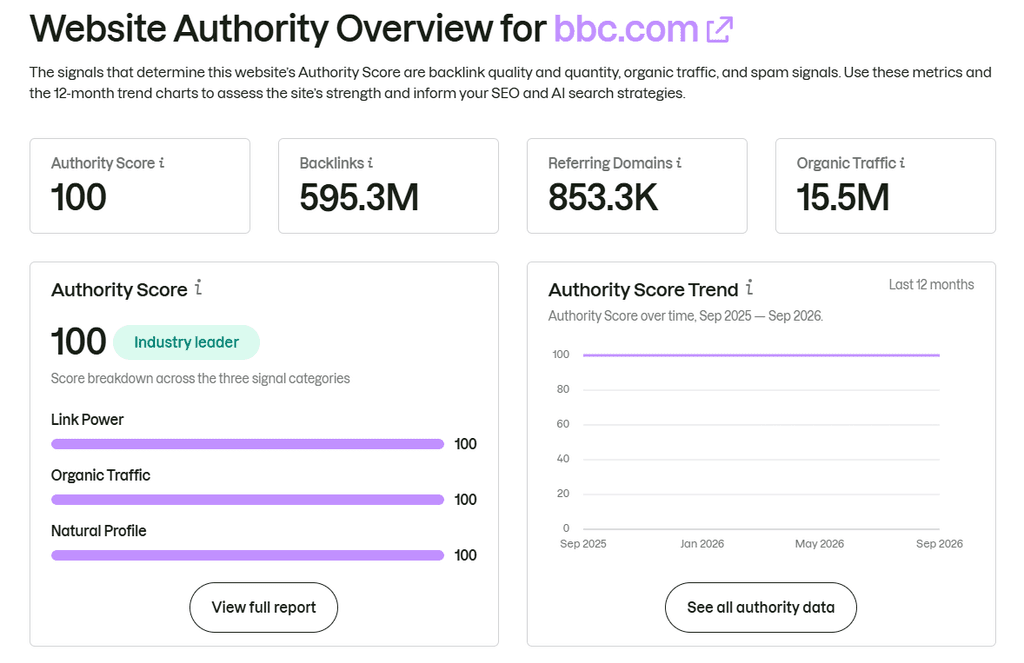
DA, DR, and Authority Score are not directly interchangeable because all three providers use a different index and calculation method. A DA of 50 should not be treated as equivalent to a DR or Authority Score of 50.
Importance for SEO
Google’s search systems do not use Moz’s DA, Ahrefs’ DR, or Semrush’s Authority Score as ranking signals. However, these metrics remain useful for competitor benchmarking and initial link-prospect evaluation because they summarize information about backlink profiles.
Domain Authority can be useful as an initial comparison metric when evaluating competitors or potential link opportunities. However, DA does not measure Google’s PageRank or reveal how much ranking value a specific backlink may provide. Google uses its own link-analysis systems, including PageRank, alongside many other ranking signals.
Websites with higher-quality backlink profiles often compete more effectively for difficult keywords, which is why higher DA commonly correlates with stronger search performance. However, DA does not reproduce Google’s algorithms or measure PageRank directly.
Well-linked websites may be discovered and crawled more readily because Google uses links to find new pages. A strong link ecosystem may provide some resilience during algorithm changes, although this should not be treated as protection against ranking losses. Google’s core-update guidance emphasizes broader content quality, relevance, and sustainable improvements rather than any single authority metric.
Overall, DA or other proprietary metrics should not be used as the only criterion when evaluating a backlink opportunity. Topical relevance, page quality, organic traffic, editorial placement, indexability, and the referring page’s outbound links should also be considered.
Factors That Influence the DA Score
Moz does not disclose every signal or weighting used in the calculation. However, it explains that Domain Authority is generated from a proprietary predictive system that analyzes multiple link-based signals to estimate a domain’s relative ranking strength.
- Linking Root Domains: The number of unique websites linking to a domain is one of the link-related inputs considered by Moz’s model. Links from a wider range of established linking domains can strengthen the overall backlink profile.
- Spam and Link Patterns: Moz’s DA model considers Spam Score and patterns in link data intended to make the metric more resistant to manipulation. The exact weighting of these signals is proprietary.
- Moz Index and Relative Changes: A DA score may rise or fall even when no major website changes have occurred. This happens when Moz discovers new links, removes lost links, updates its link index or retrains its calculation model.
How to Increase a Website’s DA Score
Improving Domain Authority should be treated as a possible result of building a stronger backlink profile rather than as an SEO goal by itself. This is because a higher DA does not directly lead to higher Google rankings.
A DA score may improve as Moz detects a stronger and more diverse backlink profile. However, because Domain Authority is relative, no individual action guarantees a particular score increase. To improve the website’s DA score, it is important to:
- Earn Quality Backlinks: Seek genuine links from reputable and relevant publications, professional communities, partners, journalists, and other credible websites.
- Create Link-Worthy Resources: Publish original research, detailed guides, templates, calculators, and tools that provide a genuine reason for other sites to link.
- Diversify Referring Domains: Earn links from a broader range of relevant websites instead of repeatedly obtaining links from the same sources.
- Recover Valuable Backlinks: Restore or appropriately redirect relevant broken pages that have already earned external links.
- Avoid Manipulative Link Building: Do not purchase bulk backlinks, participate in link networks, or use automated schemes intended only to inflate domain authority metrics.
Frequently Asked Questions
Is Domain Authority a Google ranking factor?
No, Domain Authority not used directly by Google to rank webpages. It is best treated as a relative SEO metric rather than a measure of guaranteed search performance.
What is considered a good Domain Authority score?
There is no “good” or “ideal” Domain Authority score as expectations vary by industry and competitive landscape. A more useful approach is to compare a website’s DA with similar competitors and track how the score changes over time.