
Key Takeaways
- Search volume estimates how often a keyword or query is searched during a specified period, commonly as average monthly searches for a location.
- It indicates demand, but does not necessarily represent organic traffic, clicks, unique searchers, revenue, or search intent.
- Estimates vary among tools because providers use different datasets, geographic settings, close-variant treatments, time periods, and modeling methods.
- Effective keyword decisions combine volume with intent, relevance, competition, seasonality, clicks, and business value rather than treating volume as a standalone priority score.
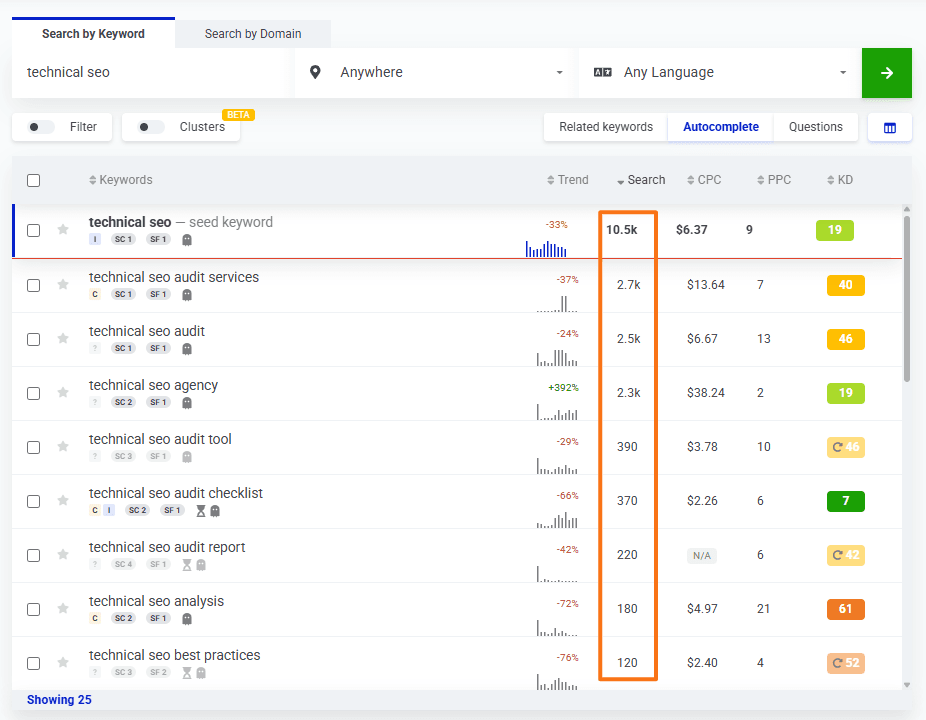
Search volume is the estimated number of times a keyword or search query is searched during a given period, usually expressed as average monthly searches within a particular country or location. For example, if a keyword has a monthly search volume of 5,000 in the United States, the figure suggests roughly 5,000 searches per month—not necessarily 5,000 different people, because the same person can search more than once.
Search volume helps reveal what people are looking for, how much demand exists around a topic, and how that demand changes over time. It is widely used in keyword research, content planning, competitor analysis, paid advertising, and broader marketing decisions.
However, search volume is not the same as organic traffic. A search can produce an organic click, an ad click, several clicks, or no click at all. Similarly, featured snippets, Knowledge Panels, local results, AI Overviews, AI Mode, and other search features may answer part or all of a query directly within the search experience. Google describes AI Overviews and AI Mode as experiences that can provide an AI-generated response while also offering links for further exploration.
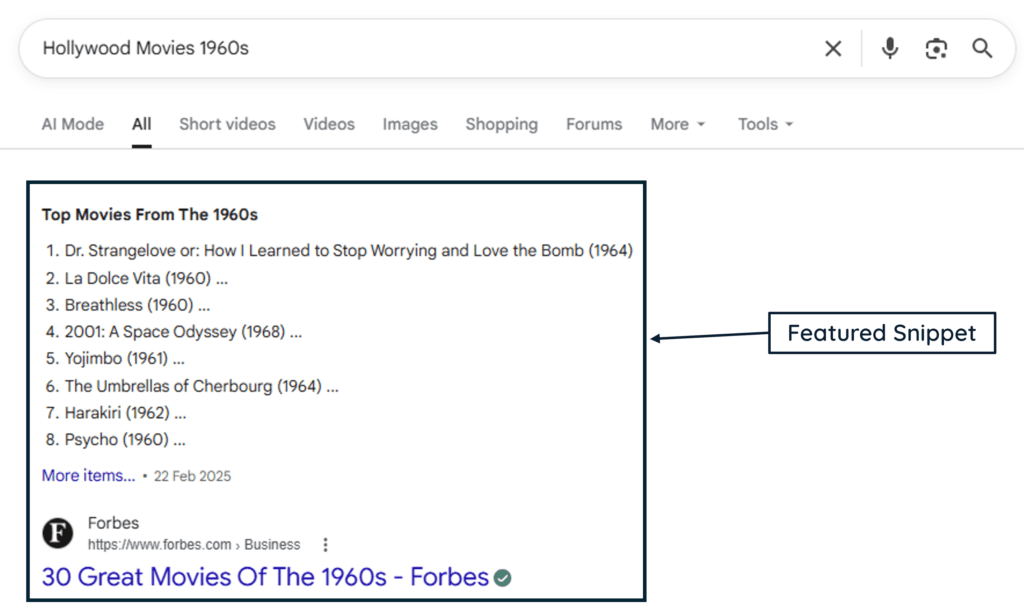
For this reason, a keyword with high search volume does not automatically represent a large traffic or revenue opportunity. Search intent, clicks, competition, relevance, and business value matter alongside volume.
How Is Search Volume Calculated?
Search volume is usually an estimate of how often a particular query is searched each month, rather than a precise public count of every search.
Many major keyword-research tools use a 12-month average of monthly searches. Google Keyword Planner, for example, calculates Average Monthly Searches from the selected period, location, Search Network settings, and close variants; its default period is 12 months. Semrush likewise calculates its standard monthly volume by dividing searches during the previous 12 months by 12, while Ahrefs Keywords Explorer currently uses a 12-month average.
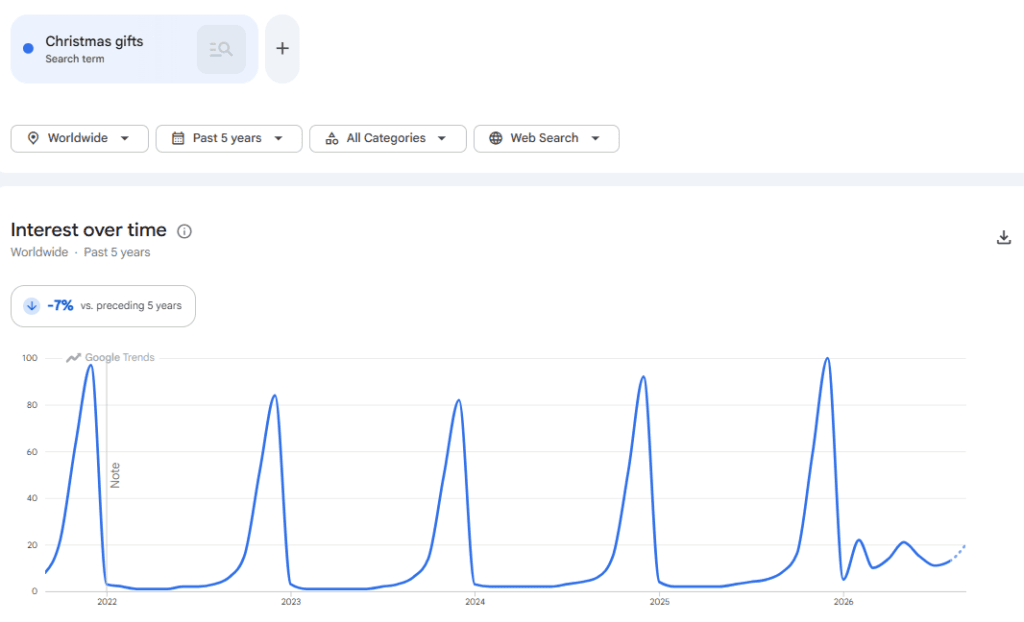
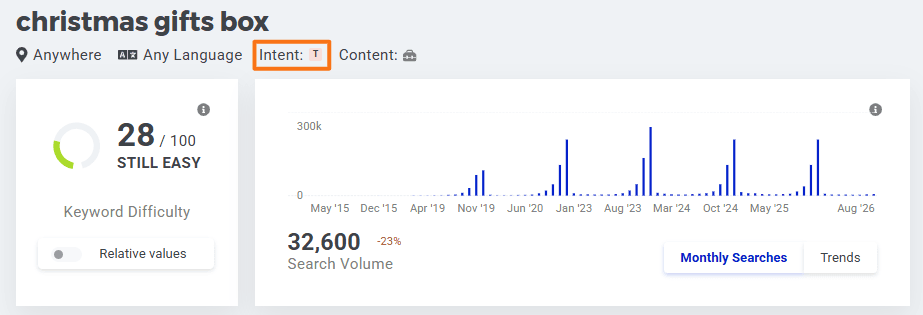
This averaging is useful for stable keywords but can hide large seasonal differences. A search such as “Christmas gifts” may have relatively little demand for much of the year and rise sharply near December.
Search Volume Data Sources
Different tools use different data sources and modeling methods, which is one reason their numbers rarely match exactly.
Semrush provides a relatively detailed explanation of its methodology, stating that third-party and historical clickstream data are processed through machine-learning models.
Ahrefs also explains that its estimates combine Google Keyword Planner, Google Trends, and other third-party sources. It further notes that Keyword Planner groups some closely related keywords together, so Ahrefs attempts to refine or separate those estimates.
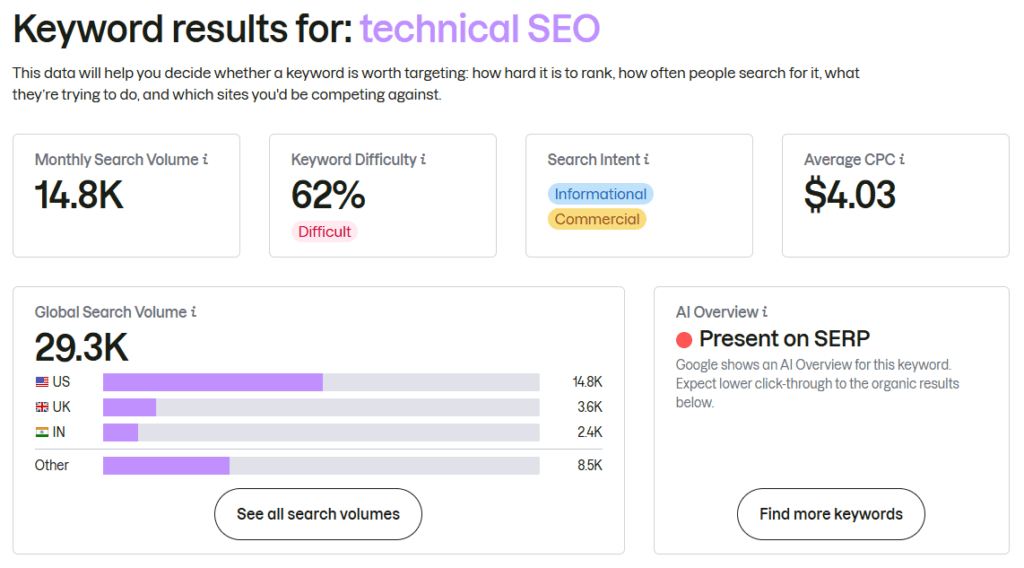
Mangools similarly explains that keyword tools commonly work with Google data and clickstream data, then process those sources differently. As a result, a keyword showing 10,000 searches in one tool and 11,500 in another does not necessarily indicate that either tool is malfunctioning.
Does Search Volume Include Every Search Engine?
In SEO tools, search volume often refers to Google Search unless another platform is specified. Some platforms provide separate datasets for other search engines or platforms, including Bing and YouTube. These should be treated separately rather than added to Google volume as though they were one universal search metric.
A Google search volume of 10,000 therefore does not mean the term received 10,000 combined searches across Google, Bing, YouTube, Amazon, social media platforms, and AI systems.
Core Characteristics of Search Volume
Several characteristics are important when interpreting the metric:
- Location-Specific: Search volume can differ substantially by country, state, region, or city. Semrush, Ahrefs, Keyword Planner, and other tools provide location-specific targeting or databases.
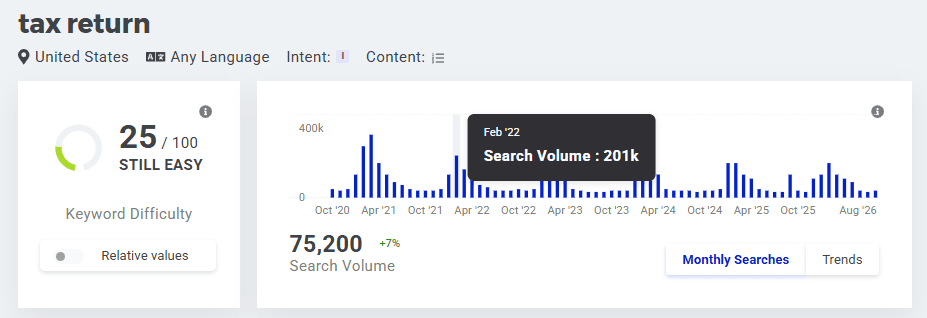
- Seasonally Variable: Searches related to holidays, sports, taxes, elections, travel seasons, or product launches can rise and fall dramatically throughout the year. A 12-month average can hide these peaks.
- Not Equal to Clicks: Search volume measures searches rather than visits to websites. Ahrefs maintains a separate Clicks metric because many searches produce no click at all.
- Not Equal to Search Intent: Two keywords with similar volume can represent completely different needs. “Project management” has broad and uncertain intent, while “project management software for construction companies” reveals a much more specific requirement.
- Not Equal to Revenue: A popular informational keyword may attract a large audience without producing many customers, while a much smaller commercial query can have greater business value.
- An Estimate, Not an Absolute Fact: Search-volume figures provided by SEO tools are estimates rather than exact search counts. Ahrefs, for example, explicitly describes search-volume figures as estimates and advises against treating them as exact counts.
Search Volume and Keyword Research
Search volume helps show how much demand exists, but it should not decide keyword priorities on its own.
High-Volume vs. Low-Volume Keywords
A broad keyword such as “CRM software” may attract substantial search demand but also broad intent and strong competition.
On the other hand, a long-tail query such as “CRM software for small dental clinics” may have far fewer searches but describe the user’s requirement much more clearly.
Low search volume therefore does not mean low value. Branded keywords, local queries, specialized B2B searches, technical terms, and bottom-of-funnel keywords can attract relatively few searches while reaching highly relevant audiences.
Search volume should also be separated from keyword difficulty. Volume estimates demand; keyword-difficulty metrics attempt to estimate how difficult it may be to compete in organic search. A high-volume keyword is often competitive, but this relationship is not guaranteed.
Search Volume ≠ Search Console Impressions
Search volume estimates how often a query is searched across a market, while Search Console impressions measure how often a link to your own site was shown in Google.
Search Volume vs. Search Intent
Search intent explains why the query is being made, while search volume estimates how often it is made. Common SEO intent categories include informational, commercial, transactional, and navigational searches.
Each marketing funnel stage can contain keywords with very different volume and commercial significance. For example, a smaller comparison or purchase query may be far more valuable than a much larger informational term.
How Search Volume Supports SEO and Marketing Strategy
Search-volume data can support much more than basic keyword selection.
- Content Strategy: Search demand can help prioritize articles, landing pages, FAQs, product content, and supporting resources.
- Keyword Strategy: Volume helps balance broad, high-demand terms with niche, long-tail, local, and branded keywords.
- Competitor and Industry Analysis: Combined with competitor keyword data, search volume can help reveal major market topics, emerging opportunities, and areas competitors are targeting.
- Distribution Strategy: Seasonal and trending search patterns can inform when related content, email campaigns, social posts, or promotions may receive greater interest.
- Internal Linking Strategy: Important high-demand topics may warrant substantial supporting coverage and clear internal pathways, although volume alone should never determine website architecture.
- Funnel Analysis: Search volume across informational, commercial, transactional, navigational, and branded queries can help show where different types of demand exist across the customer journey.
- Business Planning: Search demand can contribute to market research, traffic projections, paid-search planning, and opportunity estimates when combined with conversion rates, competition, and other business data.
Search volume is therefore best treated as a demand signal rather than a decision-making score.
Tools for Finding Search Volume
Both free and paid tools can provide useful search-volume information.
Free and Limited-Access Tools
Free and limited-access keyword tools can provide useful search-volume estimates and keyword ideas for without a full paid subscription, although data depth, history, and daily lookup limits vary by platform.
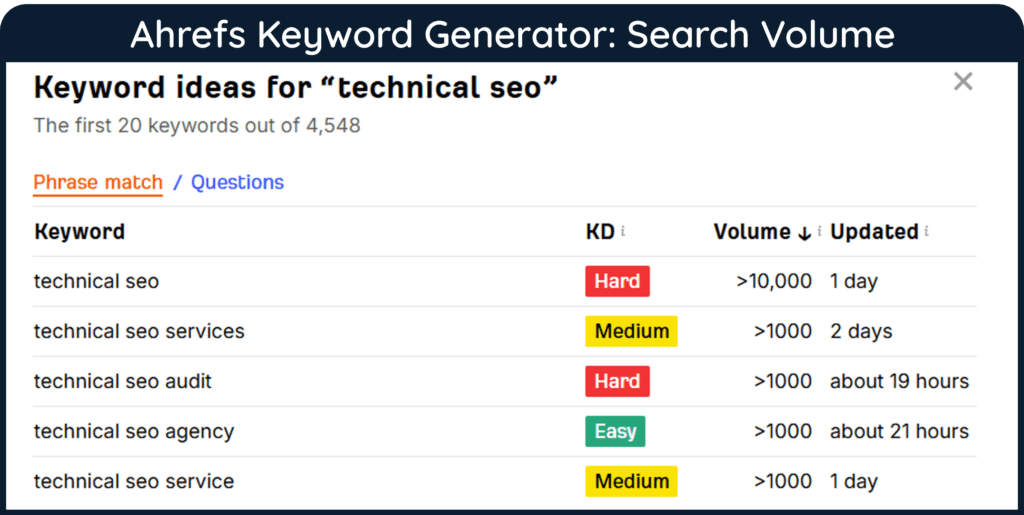
Ahrefs Keyword Generator is one example of a limited-access tool that provides estimated search volume alongside keyword ideas and difficulty data. Its free results can be useful for quick checks, but the figures should be treated as estimates rather than exact search counts.
Google describes Keyword Planner as a tool for discovering keywords and viewing estimates of their monthly searches and advertising costs.
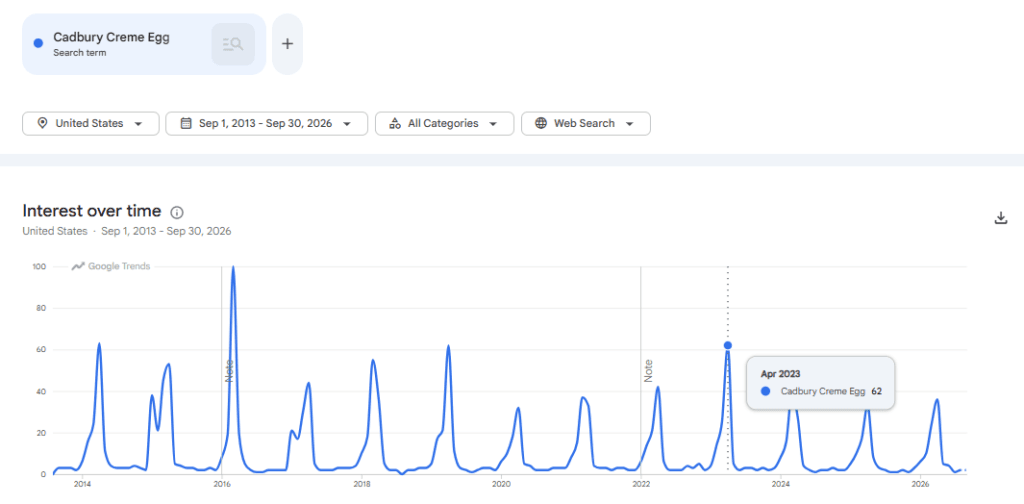
Google Trends is useful for relative popularity and trends, but should not be interpreted as an absolute monthly-search counter.
Paid SEO Platforms
Platforms such as Ahrefs, Semrush, Moz Pro, Mangools/KWFinder, SE Ranking, and Similarweb provide search volume alongside additional metrics such as keyword difficulty, CPC, rankings, SERP features, trends, competitor data, and estimated traffic potential.
The additional metrics matter because volume alone rarely answers whether a keyword is worth targeting.
Frequently Asked Questions
Why is there a large gap between search volume and actual clicks?
Not every search results in a website visit. Ads, featured snippets, AI Overviews, AI Mode, Knowledge Panels, local results, and other SERP features can satisfy or redirect a search without an organic click. Ahrefs therefore separates Search Volume from Clicks when estimating traffic opportunities.
Why do different SEO tools show different search volumes for the same keyword?
Search-volume figures are estimates produced from different datasets and models. Tools can differ in their treatment of close variants, geographic data, clickstream information, historical periods, and proprietary processing, so different numbers for the same keyword are normal.
Do SEO tools provide search volume for YouTube and other platforms?
Some platforms provide separate keyword datasets for YouTube, Bing, marketplaces, or other search environments. These figures are platform-specific and should not be treated as part of Google’s search volume.
Is there a search-volume metric for AI search systems?
There is no single standardized public search-volume metric that is comparable across major AI assistants. Google Search Console now reports site impressions in AI Overviews and AI Mode, while third-party AI-visibility tools may track prompts, mentions, citations, or visibility scores; these metrics are not equivalent to traditional keyword search volume.