How to Build Topical Authority With In-Depth Content
Key Takeaways
- Topical authority is an editorial and SEO outcome built through comprehensive, useful coverage.
- Focused niches, clear taxonomies, topic clusters, and practical and content help websites develop coherent subject expertise and serve related search needs.
- Depth depends on usefulness and coverage rather than word count, while contextual internal links connect ideas and help users and Google navigate related content.
- Measurement involves multiple signals, including broader visibility, coverage depth, internal connections, relevant backlinks, audience trust, and business outcomes.
Topical authority is the degree to which a website becomes a reliable, useful, and well-developed source on a particular subject. It is not created by publishing one long article or repeating the same keyword across dozens of pages. Instead, it develops when a site covers an important subject comprehensively, connects related topics logically, demonstrates real expertise, earns relevant references, and consistently helps readers solve problems within that subject area.
This distinction matters because Google does not describe “topical authority” as a single universal score for ordinary websites. Its ranking systems use many signals and systems to evaluate and rank content. In this broader context, Google’s people-first content guidance specifically asks whether a site has a primary purpose or focus, whether its content demonstrates first-hand expertise and depth of knowledge, and whether readers leave feeling that they have learned enough to achieve their goal.
In other words, topical authority is best understood as an editorial and SEO outcome rather than a metric that can be increased directly. The practical goal is to become increasingly useful and credible across a clearly defined topic.
Table of Contents
Why Topical Authority Matters for SEO
Topical authority matters because individual pages rarely exist in isolation. For example, a reader researching email marketing may first want to understand what email marketing is, and then learn about list building, segmentation, automation, deliverability, open rates, email funnels, tools, and campaign measurement.
A website that can answer these related questions coherently is more useful than one that publishes a single strong article but leaves most of the surrounding topic uncovered.
How Topical Depth Can Strengthen User Trust
Readers are more likely to trust a publication when its content consistently demonstrates accuracy, practical understanding, and subject expertise over time. Trust develops not simply because a site has many pages on a topic, but because those pages provide reliable explanations, useful examples, credible sources, and clear answers to real questions.
For example, a technical SEO site may earn greater reader confidence when its articles explain complex issues accurately, distinguish facts from assumptions, use current documentation, and provide practical guidance that readers can apply. Over time, this consistency can make the publication feel dependable rather than merely comprehensive.
Google’s own content-quality guidance asks whether a site would leave someone with the impression that it is well trusted or widely recognized as an authority on its topic. It also asks whether content is written or reviewed by someone who demonstrably knows the subject.
Therefore, authority is not only a search-engine concept. It can also influence whether users return, subscribe, cite the site, share its content, or consider its commercial recommendations.
Broader Coverage for More Ranking Opportunities
A site that covers a topic in depth naturally creates pages capable of answering a wider range of relevant queries.
For example, a website covering keyword research might eventually rank for queries related to seed keywords, long-tail keywords, keyword difficulty, search volume, keyword clustering, keyword mapping, commercial intent, keyword gaps, and related concepts.
The advantage does not come from publishing more URLs for their own sake. It comes from developing useful pages for distinct search needs and then optimizing content to improve their relevance, clarity, and usefulness within the broader topic.
This also aligns with Google’s warning against producing large amounts of content on unrelated topics simply in the hope that some pages will attract search traffic. Its people-first guidance specifically asks whether a site has a primary purpose or focus.
Note
Topical depth should not be confused with creating a separate page for every keyword variation. When several queries reflect the same underlying intent, one strong page may serve them better than multiple overlapping articles. Therefore, keyword mapping should also identify when related topics should be consolidated to avoid unnecessary duplication and cannibalization.
How Strong Topical Content Can Earn Organic Links
In-depth resources can also become useful reference points for other publishers. Original research, detailed definitions, useful frameworks, statistics pages, practical workflows, tools, charts, and well-supported explanations may be cited naturally when someone else needs evidence or a clearer explanation.
However, the content itself needs to deserve the reference. A generic 2,000-word article that simply rearranges information already available on ten stronger websites is unlikely to become a valuable citation source merely because it is long.
Strengthening Marketing Efforts
A strong body of topical content can support far more than organic search. The same resources can be repurposed across newsletters, social media, sales conversations, lead-nurturing campaigns, webinars, training materials, PR outreach, and internal education, allowing one well-developed knowledge base to strengthen multiple marketing and communication efforts.
For example, a SaaS company that develops a comprehensive body of content around ecommerce analytics can reuse parts of that knowledge in demos, case studies, onboarding material, email campaigns, and social distribution.
In short, deep topical coverage creates an information asset, not merely a collection of SEO pages.
Topical Authority and Algorithm Updates
Well-developed, people-first content may put a site in a stronger long-term position because Google’s core systems are designed to surface helpful and reliable results.
However, topical authority should not be expected to serve as protection against algorithm updates. Google makes broad core updates several times a year, and these updates reassess how its systems identify helpful and reliable results. Even strong websites can experience ranking changes because Search positions are not static and Google’s results continue to change as its systems, user expectations, and the web itself evolve.
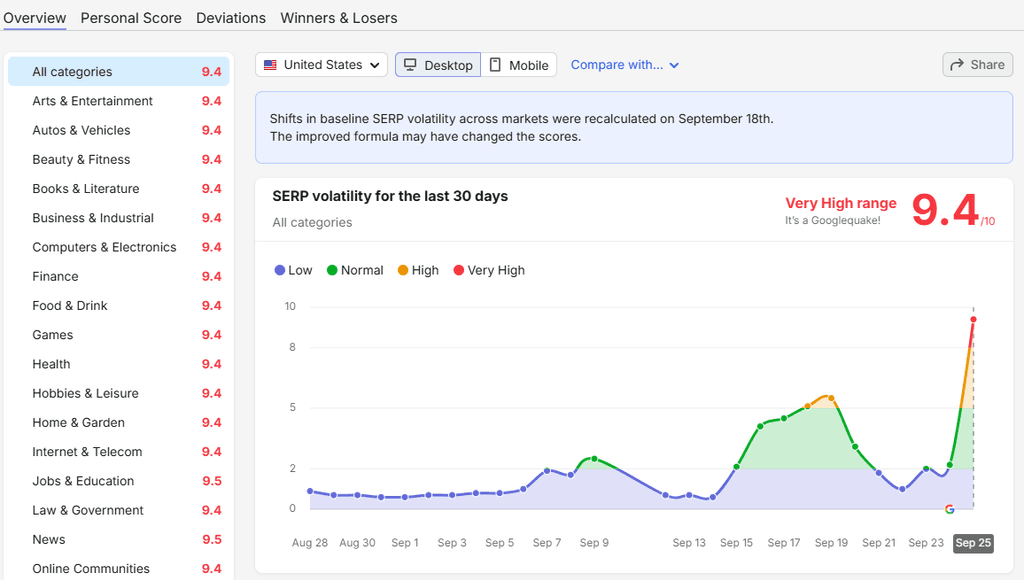
To sum up, topical authority can still strengthen a site’s overall content foundation, but it should be viewed as a long-term quality strategy rather than a safeguard against ranking changes.
How Google Search Has Evolved Toward Deeper Topic Understanding
The importance of topical depth in SEO has developed gradually rather than emerging from a single Google update. Over time, search systems have become increasingly capable of evaluating content quality, meaning, context, relationships between concepts, usefulness, and search intent.
Several major historical changes help explain this development.
Panda and Content Quality
Google announced the Panda system in 2011. It was designed to help ensure that higher-quality and more original content appeared more prominently in search results. Panda later became part of Google’s core ranking systems in 2015.
Panda did not introduce topical authority as a formal ranking score. However, it marked an important stage in Google’s broader effort to distinguish useful, substantial content from weaker or low-value pages.
Hummingbird and Contextual Meaning
Hummingbird was a major improvement to Google’s overall ranking systems introduced in August 2013. Google now lists it among retired systems because later ranking systems have continued to evolve beyond it.
In practical terms, Hummingbird represented a broader move toward interpreting queries by meaning and context rather than relying narrowly on individual keyword matches.
This marked an important shift for content strategy as pages no longer needed to revolve narrowly around one exact-match phrase. It led to the use of related concepts, questions, synonyms, entities, and subtopics to help explain the broader subject. This broader emphasis on meaning and context continued in later search systems. For example, Google introduced BERT in 2019 to help Search better understand how combinations of words express different meanings and intent.
In short, Hummingbird helped move search further toward query meaning and context, which is one reason topical coverage today should focus on the subject as a whole rather than a single keyword.
The Helpful Content Update
Google announced the Helpful Content Update in 2022. The system was designed to prioritize original and useful content created primarily for people rather than content created mainly to attract search-engine traffic.
Its guidance specifically encouraged publishers to consider whether they had an intended audience, whether they demonstrated first-hand expertise and depth of knowledge, and whether their sites had a primary purpose or focus.
These ideas are closely aligned with a sound topical-authority strategy. A site that develops deep expertise around one subject usually has a clearer reason for publishing than a site that produces disconnected articles solely because individual keywords appear attractive.
Integration of the Helpful Content System Into Google’s Core Ranking Systems
The standalone helpful content system did not remain separate indefinitely. In March 2024, Google integrated helpfulness signals and approaches into its core ranking systems. This distinction is important because older SEO discussions sometimes still refer to the Helpful Content System as if it operates as a separate named classifier today.
Google now explains that its systems use multiple signals and approaches to identify useful content. Therefore, publishers should focus on the broader quality of their content and websites rather than trying to optimize for a single “helpful content” metric.
Google’s Topic Authority System
Google does use the phrase topic authority, but its publicly documented Topic Authority system is specifically designed for news and news-related queries. It gives greater prominence to publications with demonstrated expertise in specialized areas such as finance, politics, health, or local reporting.
The system should not be treated as proof that every website receives a publicly documented “topical authority score.” For normal SEO strategy, topical authority is better used as a practical framework: define a subject, cover it thoroughly, demonstrate experience and expertise, connect relevant content, maintain quality, and earn recognition from readers and other sites.
How to Build Topical Authority
Topical authority develops from a sequence of connected decisions. Publishing more articles is only one part of the process.
1. Start With a Clear Niche
The first step is determining what the site is actually trying to become known for.
A website attempting to cover SEO, personal finance, fitness, cryptocurrency, travel, home renovation, and artificial intelligence without a clear relationship between them may struggle to establish a coherent identity. By contrast, a site focused on digital marketing can reasonably cover SEO, paid advertising, analytics, social media, email marketing, ecommerce, and related marketing concepts because those areas belong to the same broader field.
A niche therefore establishes the site’s broad editorial boundary. It does not need to be extremely narrow. The fundamental idea is that the subject should make sense for the audience, business, and long-term content plan.
2. Define the Boundaries With a Taxonomy
Once the niche is clear, build a taxonomy that defines how the subject breaks into categories, clusters, and subtopics.
For example, an SEO publication might divide its coverage into keyword research, content optimization, search and traffic, on-page SEO, off-page SEO, technical SEO, local SEO, YouTube SEO, and entity SEO. Each area can then be divided into narrower subtopics.
A taxonomy is useful because it prevents two common problems. The first is random publishing, where topics are selected independently based only on keyword volume. The second is uncontrolled expansion, where the site gradually drifts into subjects that do not support its main purpose.
The taxonomy should therefore establish coverage boundaries, not simply produce a list of pages that must all be published.
3. Build Pillars, Clusters, and Supporting Content
Once the taxonomy is established, map the information into different levels of depth.
A broad pillar page might explain technical SEO as a whole. Supporting cluster pages could cover crawling, indexing, site architecture, page speed, and structured data. More specific articles could then address robots.txt, crawl budget, XML sitemaps, canonical tags, HTTP status codes, and individual Core Web Vitals.
This creates a hierarchy in which broad pages introduce subjects and narrower pages expand them.
However, every cluster does not need the same number of articles. Some subjects naturally require twenty useful pages, while another may need only four. The objective is sufficient coverage, not symmetry.
4. Perform Topic-Based Keyword Research
Keyword research should come after the broad topical structure is understood, not before.
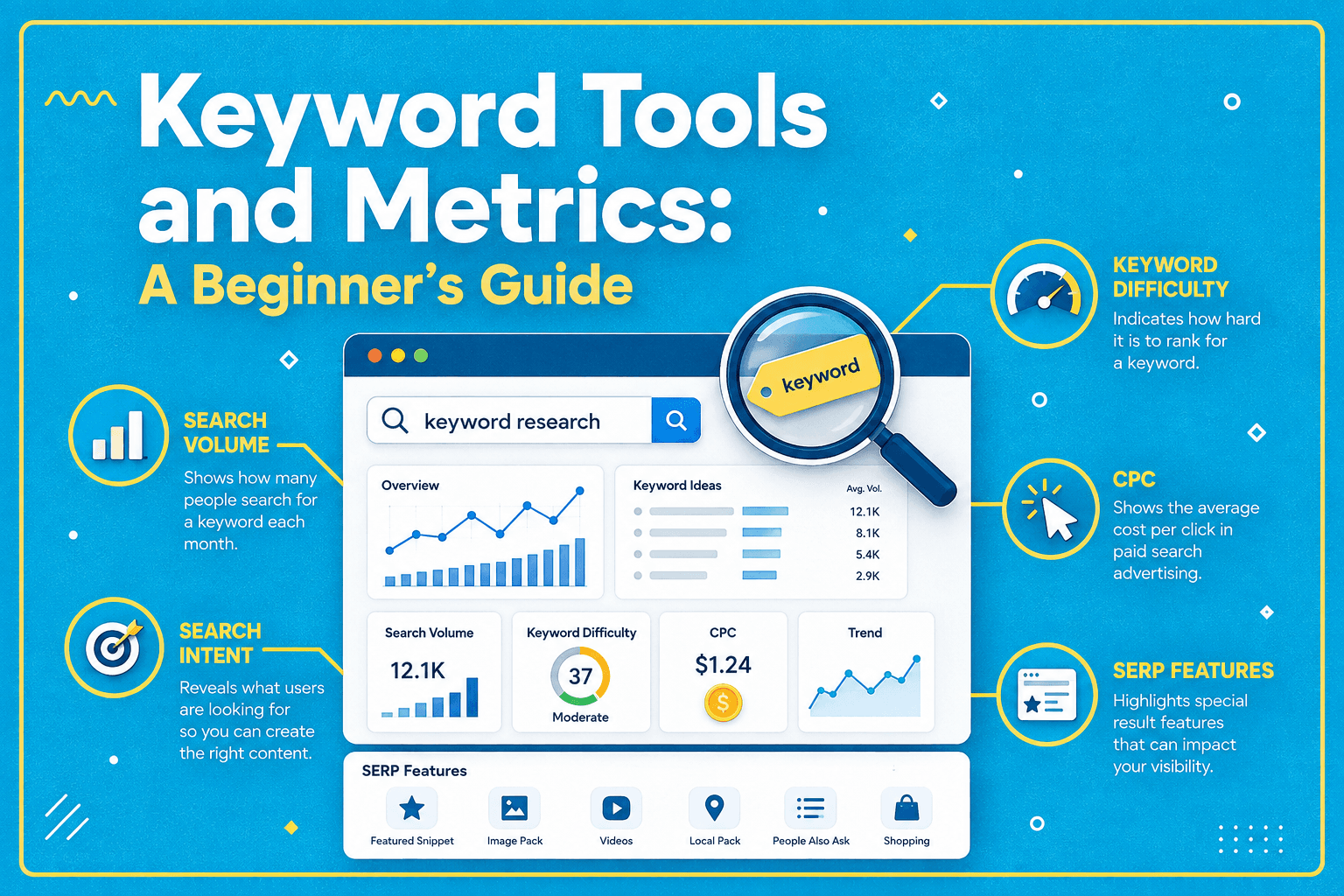
Begin with seed terms representing the major areas of the taxonomy. Then identify primary keywords, variations, related questions, long-tail queries, commercial queries, problem-based searches, comparison searches, and terminology used by the audience.
Google’s Search Essentials recommends using words that people would use to search for the content and placing them in descriptive locations such as titles, headings, alt text, and link text.
The purpose of keyword research is therefore not merely to find the highest-volume phrases. It is to reveal how people express different needs within the topic.
For example, researching “technical SEO” might reveal separate needs around crawlability, indexing, sitemap errors, robots directives, redirects, JavaScript SEO, canonicalization, and site speed. Those search needs can then be mapped back to the taxonomy.
5. Cover Important Topics in Depth
A site is unlikely to demonstrate meaningful topical depth if it opens dozens of subject areas but develops none of them properly.
It is therefore important to build a meaningful foundation around one cluster before spreading resources across every possible category. This does not mean every article needs to be extremely long. Depth depends on the problem.
A 600-word article can fully answer a narrow question, while a 4,000-word guide can still be shallow if it repeats generic statements. In other words, depth should come from coverage and value rather than word count.
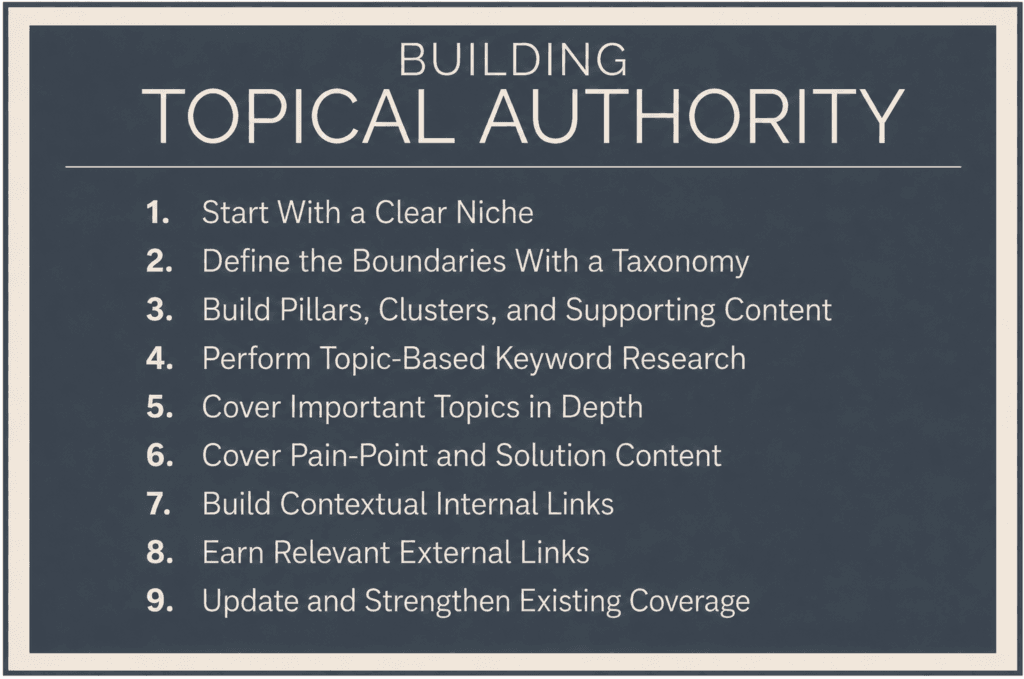
6. Cover Pain-Point and Solution Content
Taxonomies and keyword databases can become abstract if they are not connected to real audience problems. A strong topical strategy should therefore identify the questions, frustrations, obstacles, and decisions readers face.
For example, instead of publishing only a generic article about XML sitemaps, a technical SEO site could also address problems such as a sitemap not being discovered, URLs appearing in a sitemap but not being indexed, incorrect sitemap locations, or whether images and videos require separate sitemaps.
This type of content demonstrates practical understanding because it addresses situations that readers actually encounter. It can also expose valuable long-tail topics that conventional keyword research may underrepresent.
7. Build Contextual Internal Links
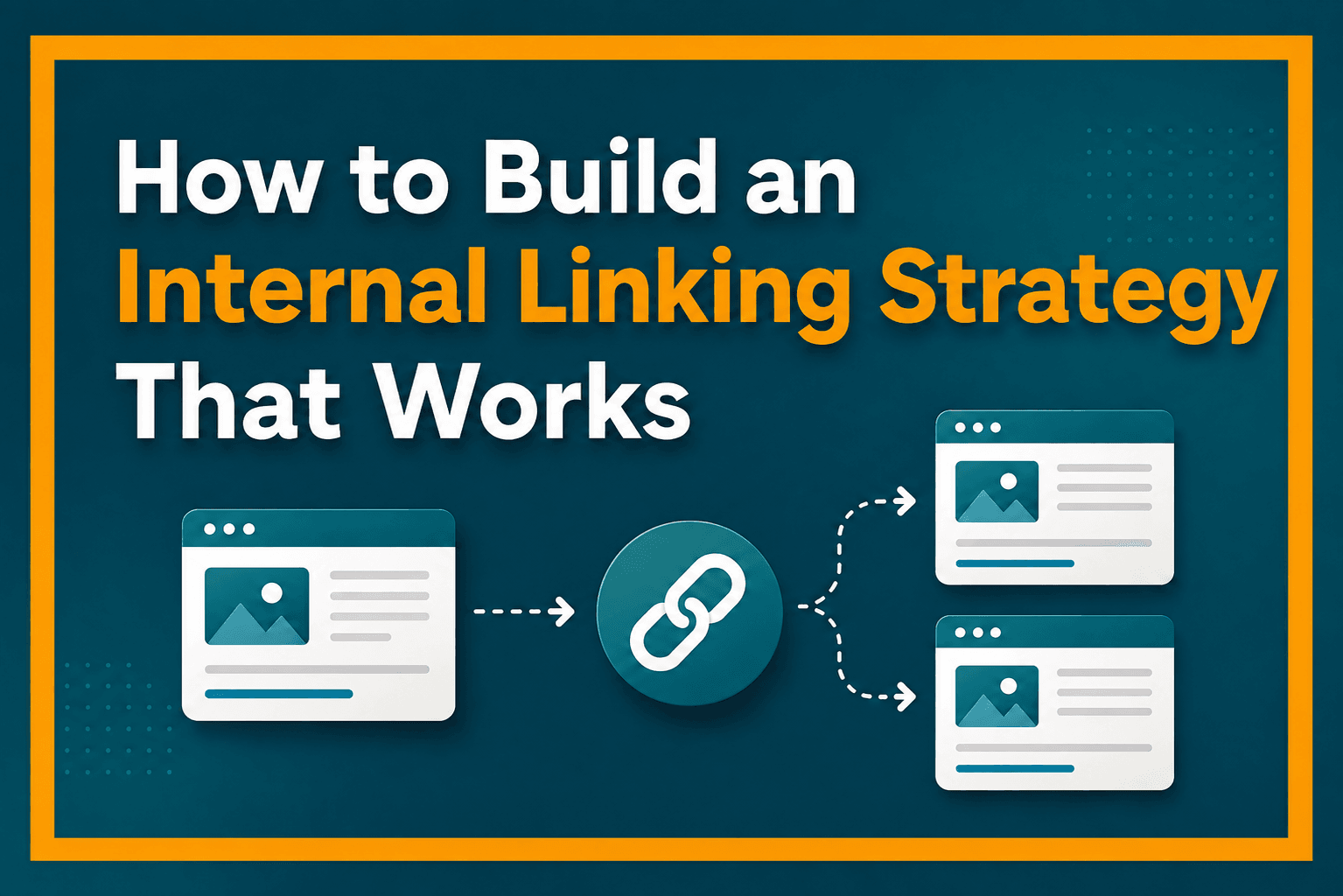
Internal linking connects the topical structure. A broad guide should link naturally to deeper articles when a subtopic deserves more explanation, while specific articles can link back to parent resources or related concepts.
Google’s document on internal linking says internal links help both users and Google understand a site and find related pages. It also recommends descriptive, concise, and relevant anchor text.
For example, an article about keyword difficulty could naturally link to separate resources on search volume, search intent, competitor analysis, and keyword research tools.
Internal links should therefore represent meaningful relationships between ideas rather than being inserted merely to increase a numeric link count.
8. Earn Relevant External Links
External references can strengthen recognition of a site’s work, particularly when respected publishers cite original research, data, tools, definitions, studies, or useful explanations.
Outreach can help expose strong resources to journalists, bloggers, researchers, and industry publishers who may find them useful. Broken-link building can also be legitimate when a publisher identifies a dead resource and offers a genuinely relevant replacement.
However, the objective should be to earn editorial links rather than manufacture them. Google explicitly treats manipulative link schemes and attempts to influence rankings through spammy links as violations of its spam policies.
Therefore, link building should begin with having something worth citing.
9. Update and Strengthen Existing Coverage
Topical authority is not a one-time publishing project. Information changes, search behavior evolves, products develop, statistics become outdated, and new subtopics emerge. Therefore, older pages may need fresh examples, corrected facts, stronger sources, new internal links, improved visuals, or more practical explanations.
At the same time, updating should be purposeful. Google specifically warns against changing dates or adding and removing content primarily to make a site appear artificially fresh.
The goal is to improve usefulness, not simulate freshness.
How to Measure Topical Authority
There is no official Google “topical authority score” that publishers can view in Search Console. Measurement therefore requires several indicators rather than one number.
A useful starting point is topic-level search visibility. Group queries and pages by cluster and track whether the site is gaining impressions, clicks, and rankings across a broader range of relevant searches.
For example, if a technical SEO cluster begins ranking for crawling, indexing, robots.txt, sitemaps, redirects, canonicalization, and related questions, that suggests broader topical visibility than ranking for a single term.
Next, examine coverage depth. Compare the taxonomy with the content already published and identify missing foundational topics, weak subclusters, duplicated pages, and areas where one article is carrying too much of the subject.
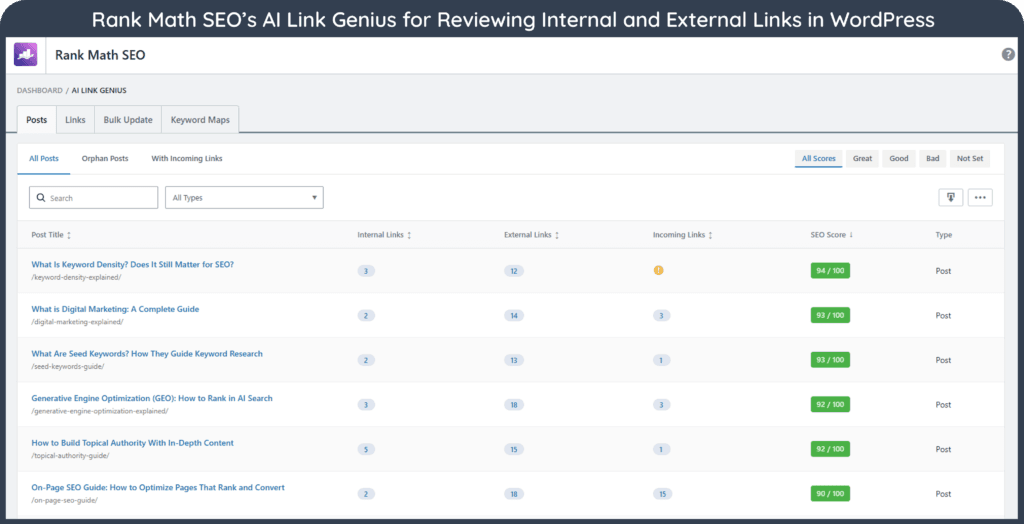
Internal linking can also be reviewed through free tools. For example, Rank Math’s free plugin can help review internal linking by showing internal, external, and incoming link counts for posts. This makes it easier to identify important pages that may need additional contextual internal links.
External recognition provides another useful signal. Relevant backlinks, citations, mentions, expert references, and links to original research can indicate that other publishers consider the site useful within the subject.
Finally, look at user behavior and business outcomes where appropriate. Returning visitors, newsletter subscriptions, branded searches, resource downloads, leads, assisted conversions, and engagement with deeper cluster content may show that readers increasingly recognize the site’s expertise.
No single metric proves topical authority. In short, the strongest evidence is a pattern: broader relevant visibility, deeper coverage, stronger internal connections, external recognition, and increasing audience trust within the same subject.
Conclusion
Topical authority is built by becoming genuinely useful across a defined subject, not by publishing a predetermined number of articles or targeting every keyword variation. A clear taxonomy, focused topic coverage, strong content quality, practical expertise, contextual internal links, relevant external recognition, and ongoing content maintenance work together to create that depth.
For SEO, the goal should therefore be to develop a coherent body of content that serves related audience needs over time. Topical authority is best viewed as the outcome of that work rather than a separate Google score or shortcut that can be optimized directly.
Frequently Asked Questions
What is topical authority in SEO?
Topical authority describes how strongly a website demonstrates useful, credible, and comprehensive expertise across a particular subject and its related subtopics.
How does Google measure topical authority?
Google does not publish a single topical-authority score for ordinary websites; its ranking systems use many signals and systems to determine which pages are most relevant and useful for a query.
Is topical authority a Google ranking factor?
Google does not document “topical authority” as a single universal ranking factor, although its ranking systems use many signals to understand relevance, usefulness, reliability, links, and other characteristics of pages and sites.
How long does it take to build topical authority?
There is no fixed timeline because progress depends on the competitiveness of the subject, content quality, existing site strength, publishing depth, links, and how quickly search engines discover and reassess the site’s content.
Do backlinks help build topical authority?
Relevant editorial backlinks can strengthen a site’s recognition and visibility, but they work best alongside useful, original content and should not be acquired through manipulative link schemes.
How many articles are needed to build topical authority?
There is no required article count because some topics can be covered thoroughly with a small number of strong pages, while broad subjects may require dozens or hundreds of useful resources.
Are pillar pages and topic clusters required?
No, but pillar-and-cluster structures can be useful for organizing broad subjects, distributing depth across multiple pages, and creating logical internal links between related content.
Can a new website build topical authority?
Yes, a new site can develop topical authority over time by maintaining a clear focus, publishing useful and original content, building logical topic coverage, and earning recognition within its field.