
Key Takeaways
- “LSI keywords” is an informal, technically inaccurate label for terms related to a topic, including entities, attributes, subtopics, and questions.
- Latent Semantic Indexing is a statistical, matrix-based retrieval method that identifies associations between terms and documents within a defined collection.
- Google has not identified “LSI keywords” as a ranking factor, and the term should not be presented as a Google ranking technology.
- Related terminology can improve topical coverage, natural language, and query variation when it genuinely supports contextual understanding and search intent.
In SEO, “LSI keywords” is an informal and technically inaccurate label sometimes used for words and phrases related to a topic. For example, if the primary keyword is “Apple,” terms such as iPhone, iOS, Mac, Apple Watch, and App Store can help indicate that the content concerns the technology company rather than the fruit.
In these cases, related terms are not always synonyms; they can also include entities, attributes, subtopics, and commonly associated questions.
What Is Latent Semantic Indexing?
Latent Semantic Indexing (LSI) is a mathematical information-retrieval method developed in the late 1980s. A related U.S. patent application was filed in 1988, while the foundational research paper was published in 1990. LSI analyzes statistical patterns between terms and documents and represents them in a smaller semantic space. This can help a retrieval system find relevant documents even when a query and document do not use exactly the same words.
LSI begins with a term-document matrix that records how often terms appear across a collection of documents. It then uses a mathematical technique called Singular Value Decomposition (SVD) to reduce the matrix while preserving its most important patterns. The resulting associations are statistical and should not be confused with the language understanding of modern AI systems. The original method was described in the 1990 research paper on latent semantic analysis.
Does Google Use LSI Keywords?
Google representatives have rejected “LSI keywords” as an SEO concept. Google’s published descriptions of search instead identify modern systems such as RankBrain, neural matching, and BERT, which help it understand concepts, language, and search intent. Therefore, the popular idea of special “LSI keywords” is misleading.
For modern SEO, the practical approach is to explain topics clearly, use relevant terminology naturally, and satisfy search intent rather than inserting a predetermined list of supposed LSI keywords. The term remains common among marketers, but it should not be presented as a Google ranking technology.
LSI and Google Search
LSI was developed for information retrieval within defined collections of documents and is much simpler than the systems used by modern web search engines. Because Google crawls, indexes, and updates billions of dynamically changing web pages, running an outdated 1980s LSI framework across the entire internet is computationally impractical for web-scale search.
Google uses concepts, entities, and relationships in several ways to understand information. For example, its Knowledge Graph represents many real-world entities—such as people, places, and things—and relationships between them.
Google uses several AI systems and language-understanding technologies for different Search functions, including BERT, neural matching, RankBrain, and MUM:
- BERT: Interprets how combinations of words express meaning and intent.
- Neural Matching: Connects queries with webpages by comparing the broader concepts represented in both.
- RankBrain: Relates words to underlying concepts, helping surface relevant content even when exact query terms are absent.
- MUM: Understands and generates language across multiple formats and languages, although Google states that it is not used for general Search ranking.
- AI Search Models: Google’s AI Overviews and AI Mode use advanced models and techniques to explore complex questions and identify supporting webpages.
LSI and Semantic Search
Search engines use a range of modern information-retrieval and machine-learning technologies to understand searches beyond exact keyword matching.
- Latent Semantic Indexing: A statistical, matrix-based retrieval method that identifies patterns between terms and documents within a defined collection. It can identify statistical associations, but it does not model real-world meaning or user intent in the same way as modern semantic-search systems.
- Semantic Search: A broader approach that seeks to understand the contextual meaning and purpose of a query. It may consider concepts, entities, relationships, and search context to return relevant results even when a page does not contain the exact words entered by the searcher.
Should One Use Related Words and Phrases?
Related words and phrases remain useful because they help explain a subject clearly and naturally. They may include synonyms, entities, attributes, subtopics, and commonly associated questions.
However, their value does not come from an LSI formula or a required list of terms. Related terminology should be included only when it improves meaning, topical coverage, or usefulness for readers.
Benefits of Using Semantically Related Terms
Using semantically related terms can strengthen contextual relevance and help content address a subject more comprehensively without relying on repeated exact-match keywords.
- Improves Topical Coverage: Related concepts and questions can make content more complete and useful.
- Encourages Natural Language: Using varied and relevant terminology reduces unnecessary repetition of the primary keyword.
- Supports More Search Variations: Clear coverage of related concepts may help a page match a wider range of relevant and long-tail searches.
Finding and Using Semantic Phrases
Semantic phrases can be identified from search results, related queries, and SEO tools and then used naturally where they improve topical coverage and reader understanding.
Where and How to Find Them
Semantic phrases can be identified by examining related queries, recurring terminology, and connected concepts that appear across search results and reputable SEO research tools.
- Google Autocomplete & Related Searches: Enter the primary topic into Google and review relevant suggestions or related searches for useful variations and subtopics.
- People Also Ask (PAA) Boxes: Expand relevant questions to identify related concerns that may deserve coverage.
- Keyword and Content Optimization Tools: Platforms such as Semrush and Ahrefs can surface related queries, questions, and subtopics. Content-optimization tools such as Surfer SEO can also analyze competing pages and suggest frequently used terms and topics. These recommendations should be evaluated for relevance rather than inserted automatically.
How to Use Semantic Phrases in Content
Semantic phrases should be incorporated only where they strengthen topical context, clarify meaning, or help address relevant subtopics in a natural and useful way.
- Do Not Keyword Stuff: Do not force unrelated or repetitive phrases into the content.
- Use Meaningful Headings: Include a related phrase in an
<h2>or<h3>heading only when it represents a genuine section of the page. - Write for People First: Detailed content naturally includes relevant terminology. For example, an article about candid photography may discuss shutter speed, prime lenses, lighting conditions, and aperture without forcing those terms into the text.
Frequently Asked Questions
Does Google use LSI keywords as a ranking factor?
Google has not identified “LSI keywords” as a ranking factor. The term is widely used in SEO, but modern search systems rely on broader language understanding, context, entities, and relationships rather than a specific list of LSI keywords.
Are LSI keyword generator tools reliable?
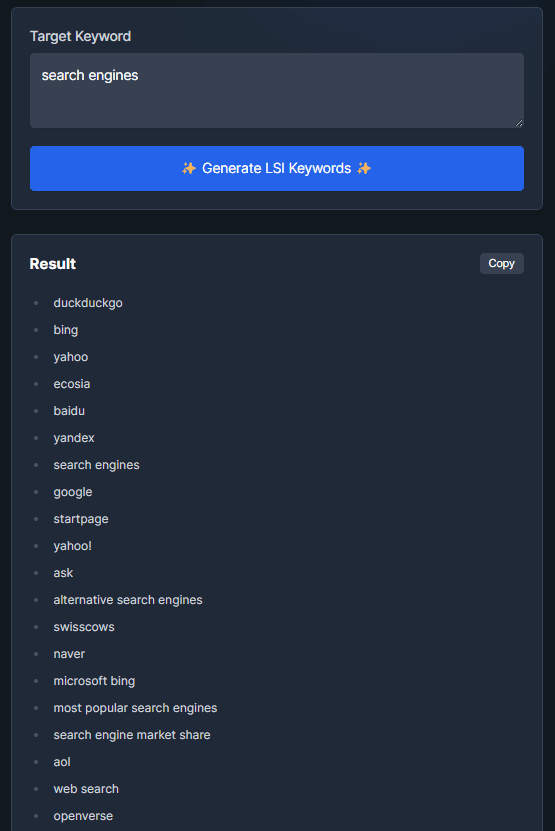
They can be useful for discovering related words, phrases, entities, and subtopics, but their suggestions should not be treated as technically verified LSI terms. Quality varies by tool, so suggestions should be checked for relevance to the page and search intent.
Should LSI keywords be added to content for SEO?
Related terminology can improve topical coverage when it fits naturally, but forcing extra terms into a page is unnecessary. The priority should be comprehensive, useful content that covers the subject in the language readers would reasonably expect.