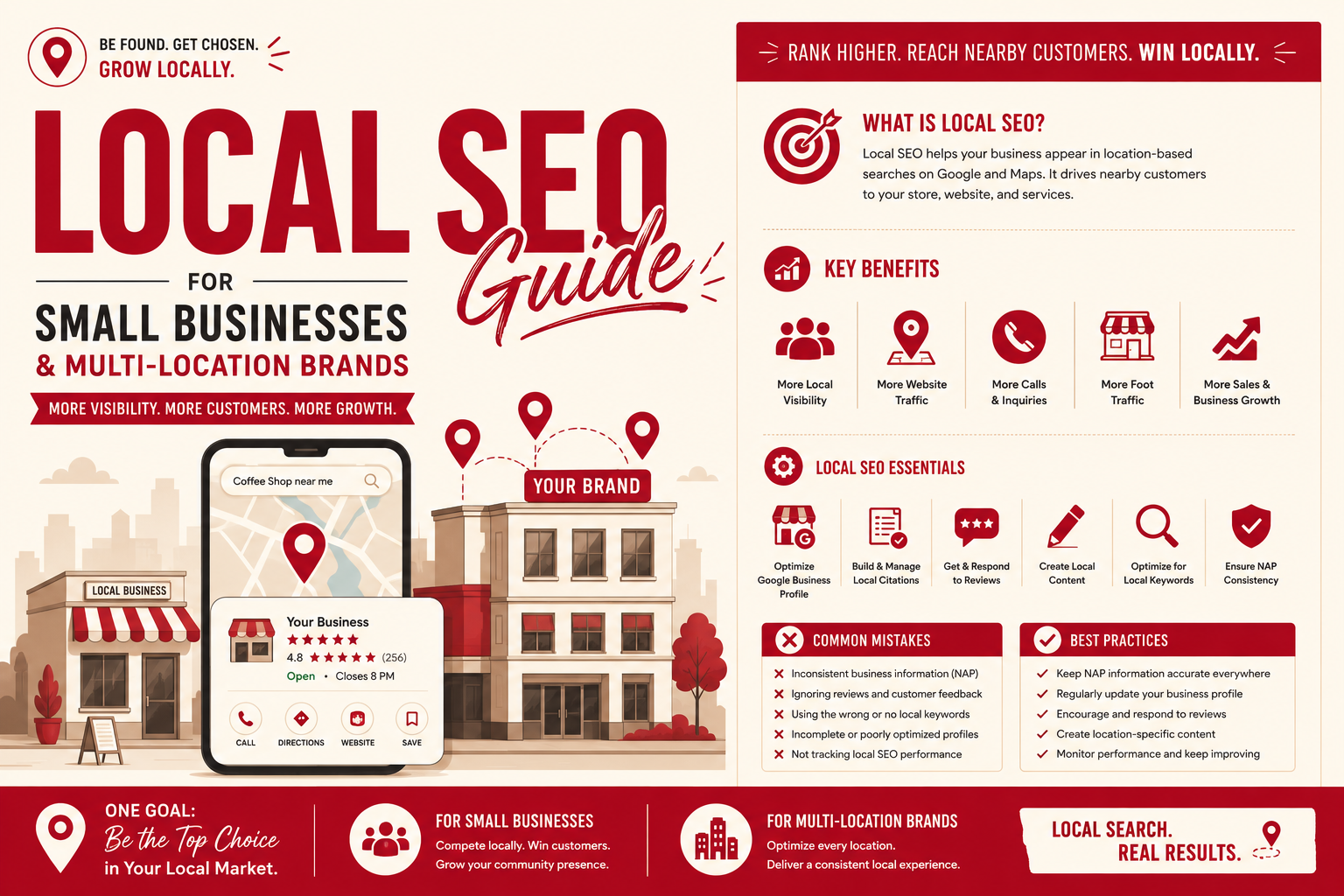
Local SEO is the process of improving a business’s visibility when people search for products, services or companies connected with a specific location. For example, a person searching dentist in New York, coffee shop near me or digital marketing agency in London is looking for a nearby solution rather than general information.
A strong local presence can help a business appear across organic search results, map-based listings and business profiles. However, visibility does not depend on adding city names to every page. It requires accurate business information, a complete profile, useful location pages, genuine reviews, local relevance and a website that supports the customer’s next step.
Google Search Central explains that local results are primarily influenced by relevance, distance and prominence. Therefore, a business should make its services and locations clear, maintain an accurate public presence and build a credible reputation within the communities it serves through the local ranking factors.
Table of Contents
What Is Local SEO and How Is It Different from Traditional SEO?
Local SEO helps businesses become visible to customers searching within a particular city, neighbourhood, region or service area. It is useful for restaurants, retailers, healthcare providers, salons, professional practices, home-service companies, agencies, franchises and other organizations that serve identifiable locations.
A useful analogy is a local restaurant. People may discover it through its street sign, customer recommendations, newspaper coverage, online reviews or a local directory. Local SEO brings these discovery signals together online through the business’s website, profiles, reviews and local mentions.
Traditional SEO and local SEO share many foundations, including helpful content, technical accessibility, keywords, internal links and backlinks. The main difference is the role of location.
| SEO approach | Main objective | Example search |
| Traditional SEO | Reach users regardless of location | best email marketing software |
| Local SEO | Reach users in a specific area | email marketing agency near me |
| Multi-location SEO | Build visibility for several branches | email marketing agency in Sydney |
Traditional SEO generally asks whether a page is a useful answer to a query. Local SEO must also consider whether the business serves the searcher’s area and whether its public information supports that connection.
In other words, a local business still needs a strong website, but it must also communicate where it operates, what it provides and why nearby customers should trust it.
How Businesses Appear in Local Search Results, Google Maps, and Multi-Location Search
Local searches may produce ordinary organic listings, Google Maps results and a map-based group of businesses commonly called the Local Pack. The exact layout can vary according to the query, location, device and available search features.
Three main considerations influence local visibility:
Relevance
Relevance describes how closely a business matches what the person searched for. A bakery is more relevant to birthday cake shop near me when its profile and website clearly describe custom cakes, ordering options and service locations.
Selecting accurate categories and completing important profile fields can help clarify what the business does. It is better to choose the smallest number of categories that accurately represent the core business rather than adding loosely related options, as explained in the business category guidance.
Distance
Distance considers how far the business is from the searcher or the location specified in the query. Businesses cannot optimize away genuine physical distance. Therefore, a company should represent its actual location or service area accurately rather than inserting unrelated city names into its profile.
Prominence
Prominence relates to how well known and credible a business appears. Links, reviews, references and general reputation can contribute to how established a company appears online. However, no single review, citation or backlink guarantees a position.
Multi-Location SEO
A multi-location brand should normally maintain a valid Business Profile and useful website page for each real branch. Every location page should contain information specific to that branch rather than repeating the same template with only the city name changed.
Useful location-specific information may include:
- The correct address and contact details.
- Opening hours and available services.
- Directions, parking or accessibility information.
- Photographs of the location and team.
- Local testimonials or case studies.
- Service areas and nearby landmarks.
- Location-specific frequently asked questions.
Search Engine Land recommends differentiating location pages so that each one provides a genuinely useful experience for local customers. Therefore, templates can support consistency, but the final page should still contain unique branch information.
Google Business Profile Optimization
Google Business Profile allows eligible businesses to manage how their information appears in Google Search and Maps. It acts as a digital storefront by presenting details such as the business name, address, phone number, hours, services, photographs and reviews.
Complete and Verify the Profile
The business name should match the name used in the real world. The address, phone number, website and operating hours should also be accurate.
Businesses should avoid adding keywords, cities or promotional claims to the name unless they form part of the genuine public business name. Google also recommends maintaining one profile for each eligible business location and representing service areas precisely through the profile representation rules.
Choose Accurate Categories
The primary category should describe the business’s main function. Additional categories can support other genuine services, but they should not be used to target unrelated searches.
For example, a dental clinic should choose the most specific appropriate dental category rather than adding several broader medical categories merely to increase exposure.
Add Useful Business Details
Products, services, photographs and descriptions can help customers understand what the company offers before visiting or making contact. Images should represent the actual business rather than rely entirely on generic stock photography.
Opening hours should be updated for public holidays, temporary closures or special schedules. It is therefore important to treat the profile as an active customer resource rather than a listing that is completed once and forgotten.
Manage Customer Interactions
Verified businesses can respond to reviews and manage other profile interactions where those features are available. It is important to ensure that replies should be professional, specific and helpful, particularly when customers raise genuine concerns.
Local Keywords, Location Pages, and Content Optimization
Local keyword research identifies how customers combine a product, service or problem with a geographic need.
Common patterns include:
- Service + city
- Product + neighbourhood
- Profession + near me
- Service + open now
- Problem + local provider
Examples include dentist in Pune, coffee shop near me and website designer in Chennai.
However, a business should not create pages for every location phrase found in a keyword tool. The intended area must be genuinely served, and the page should provide enough unique information to justify its existence.
Create Useful Location Pages
A multi-location company may create pages such as:
- /locations/london/
- /locations/singapore/
- /locations/dubai/
Each page should describe the real branch, its services and its relationship with the local community. It may also link to detailed service pages where those links help visitors continue their journey.
A useful location page structure combines localized service information, customer evidence, clear contact options and relevant internal links.
Publish Local Content Selectively
Local content can support visibility when it answers real community needs. Suitable examples include regional service guides, local case studies, event resources, neighbourhood comparisons and explanations of location-specific regulations.
However, content should not be published merely because a town name can be added to a title. It is better to create fewer useful resources than dozens of nearly identical city pages.
Reviews, Citations, NAP Consistency, Local Links, and Schema Markup
Reviews, listings and local references help customers evaluate a business and verify how to contact it. Academic research has also found that online reviews influence customer decisions and can help distinguish local businesses from competitors.
Reviews and Reputation
Businesses should request genuine reviews from customers who have completed a real transaction or service experience. Reviews should never be purchased, fabricated or generated by employees pretending to be customers.
Responses should thank customers for positive feedback and address negative experiences calmly. A critical review can reveal a genuine operational problem, so reputation management should improve the customer experience rather than focus only on increasing ratings.
Local Citations and NAP
A local citation is an online reference to a business, often including its name, address and phone number. Citations may appear on business directories, industry websites, local publications and association pages.
NAP information should remain accurate and reasonably consistent. Minor formatting differences are less important than ensuring that customers are not given an outdated phone number, incorrect address or closed branch.
It is therefore better to prioritize established, industry-specific and locally relevant platforms instead of submitting the business to hundreds of weak directories. A practical local citation strategy can help identify suitable citation opportunities.
Local Link Building
Local backlinks may come from chambers of commerce, professional associations, community organizations, event websites, local publications, suppliers and complementary businesses.
Useful approaches include sponsoring a genuine event, contributing expertise to a local publication, participating in community projects and creating a resource that local organizations want to reference.
LocalBusiness Schema Markup
LocalBusiness structured data can provide explicit information about a business, including its location, opening hours and departments. It should describe information that is also visible and accurate on the page through LocalBusiness structured data.
However, structured data does not guarantee a rich result or higher local rankings. It creates eligibility for supported search features when the page and markup meet the relevant structured data rules.
Local SEO Checklist, Common Mistakes, and Best Practices
A practical checklist helps small businesses and multi-location brands maintain accurate profiles, useful pages and a credible local reputation. It is therefore useful to review these items regularly rather than waiting until visibility or customer enquiries decline.
Local SEO Checklist
A local SEO checklist helps businesses review the essential actions required to improve local visibility, maintain accurate information and attract more nearby customers. Hence, it is important to:
- Create and verify each eligible Google Business Profile.
- Use the genuine public business name on every profile.
- Confirm that every address and service area is accurate.
- Keep phone numbers, websites and opening hours current.
- Choose the most relevant primary business category.
- Add only categories that describe real services.
- Upload useful photographs of each business location.
- Add accurate products and services where appropriate.
- Respond professionally to genuine customer reviews.
- Update holiday hours and temporary closures promptly.
- Create a clear website page for every real location.
- Add unique information to each location page.
- Explain services available at the specific branch.
- Include clear contact and direction information.
- Use local keywords naturally within relevant pages.
- Publish content that answers genuine local questions.
- Keep essential NAP details accurate across listings.
- Prioritize reputable and relevant business directories.
- Remove or correct outdated duplicate listings.
- Earn references from credible local organizations.
- Build partnerships with complementary nearby businesses.
- Add accurate LocalBusiness structured data where relevant.
- Test location pages on mobile devices.
- Check that important pages load reliably.
- Monitor local search impressions and clicks.
- Track calls, bookings, enquiries and direction requests.
- Compare performance across individual locations.
- Review competitor profiles and location pages responsibly.
- Correct outdated information as soon as it changes.
- Repeat the audit at regular intervals.
Common Local SEO Mistakes
Common mistakes include using an incorrect business name, creating duplicate profiles, choosing irrelevant categories, neglecting reviews and publishing nearly identical location pages.
Businesses also lose trust when directory listings contain obsolete addresses or disconnected telephone numbers. Another mistake is treating local SEO as a profile-only activity while ignoring the website, customer experience and local reputation.
Local SEO Best Practices
It is better to maintain fewer accurate profiles and listings than many neglected ones. Every location should have a clear owner, update process and method for handling reviews and customer questions.
Multi-location brands should maintain consistent standards while giving branches enough flexibility to publish genuine local information. In short, local SEO works best when operational accuracy and customer service support the optimization strategy.
Local SEO Tools
Local SEO tools can help businesses manage listings, monitor rankings, analyze reviews and measure traffic. However, no tool can correct inaccurate business operations or replace thoughtful local content.
| Tool | Main use |
| Google Business Profile | Managing visibility in Google Search and Maps |
| Google Search Console | Monitoring search queries, pages, clicks and impressions |
| Google Analytics | Measuring local traffic, enquiries and conversions |
| Bing Places for Business | Managing business information shown on Bing |
| Semrush Local | Managing listings, reviews and local search performance |
| BrightLocal | Auditing citations and tracking local rankings |
| Whitespark | Researching citations and monitoring local visibility |
| Moz Local | Managing business listings and location data |
| Yext | Distributing and managing listings across multiple platforms |
| Local Falcon | Tracking Google Maps rankings through geo-grid reports |
| Birdeye | Managing customer reviews and online reputation |
| Trustpilot Business | Collecting, monitoring and responding to customer reviews |
| Reputation.com | Managing listings, reviews and reputation across multiple locations |
| ReviewTrackers | Monitoring reviews, customer feedback and reputation performance |
| Podium | Collecting reviews and managing customer messaging and leads |
| Local Viking | Scheduling profile posts, managing reviews and tracking local rankings |
| Grid My Business | Running geo-grid scans and monitoring Google Maps visibility |
| SE Ranking Local Marketing Tool | Tracking local rankings and managing listings, citations and reviews |
| GeoRanker | Tracking rankings by city, postcode and geographic location |
| GMB Everywhere | Auditing Google Business Profiles and researching competitor categories |
| Localo | Auditing and optimizing profiles, rankings, reviews and competitor visibility |
Tools such as Ahrefs and Semrush can also support local keyword, competitor and backlink research. Google Maps should be treated as a customer-facing discovery platform rather than an independent optimization tool.
The most useful toolset depends on the size of the organization. A single-location business may need only free profile, analytics and search tools, while a national brand may require centralized listing management and location-level reporting.
Conclusion
Local SEO helps businesses connect online discovery with real-world customers. It combines accurate business profiles, location pages, reviews, citations, local links, useful content and a reliable website experience.
However, the objective is not simply to appear on a map. To sum up, successful local SEO makes it easier for nearby customers to understand the business, trust its information and complete a meaningful action such as calling, booking, visiting or purchasing.
Frequently Asked Questions
What is local SEO?
Local SEO is the process of improving a business’s visibility for searches connected with a specific location. It supports discovery across search results, maps, profiles and relevant local platforms.
How is local SEO different from regular SEO?
Traditional SEO can target audiences across broad geographic areas. Local SEO adds location-based signals, including business profiles, addresses, service areas, reviews, location pages and local references.
Which businesses need local SEO?
Local SEO is useful for businesses serving identifiable areas, including restaurants, retailers, healthcare practices, home-service providers, agencies, professional firms, franchises and multi-location brands.
What is Google Business Profile?
Google Business Profile is a tool that allows eligible businesses to manage information shown in Google Search and Maps, including contact details, hours, photographs, services and reviews.
How do businesses rank in local search?
Local results are primarily influenced by relevance, distance and prominence. Accurate profiles, useful website content and a credible reputation can strengthen relevance and prominence, but a business cannot control the searcher’s physical distance.
What is NAP consistency?
NAP consistency means maintaining accurate business names, addresses and phone numbers across important online listings. The goal is to prevent customer confusion and outdated information rather than enforce identical punctuation everywhere.
Do reviews improve local SEO?
Reviews can influence customer trust and contribute to a business’s public prominence. However, review volume or rating alone does not guarantee rankings, and businesses should request only genuine customer feedback.
Do local citations still matter?
Relevant citations can help customers discover and verify a business. It is better to focus on reputable, industry-specific and local platforms than submit the same information to large numbers of low-quality directories.
What are the best local SEO tools?
Useful tools include Google Business Profile, Search Console, Analytics, Bing Places, Semrush Local, BrightLocal, Whitespark, Moz Local, Yext, Local Falcon and Birdeye.
How long does local SEO take?
The timeline depends on competition, business location, profile condition, website strength and reputation. Some corrections take effect relatively quickly, while stronger visibility usually develops through consistent improvements over time.