In SEO, keywords are words and phrases used to represent and target the topics, needs and intentions expressed through people’s search queries. Different types of keywords reflect different goals, such as learning, comparing options, completing an action or reaching a specific website. For example, a coffee enthusiast may search how to make cold brew, best espresso machine, buy Arabica coffee beans or Starbucks near me, with each phrase revealing a different need.
These differences matter because one page cannot satisfy every possible intention behind the broad topic coffee. An instructional article may answer how to grind coffee beans, while a product page is better suited to buy dark roast coffee online. Therefore, understanding keyword types helps publishers select the right page, format, message and conversion goal for each search.
Search-intent classification has a long research history. Andrei Broder’s influential paper, A Taxonomy of Web Search, grouped web searches into informational, navigational and transactional intentions. Many researchers and experts continue to use this categorization to analyze large collections of real queries. However, in modern SEO practice, tools such as Semrush and Ahrefs commonly use four categories by separating commercial intent from transactional intent.
Note: Types of Keywords
Keyword classifications are practical SEO frameworks rather than one universal taxonomy. A single keyword can belong to several categories depending on its intent, wording, brand references, location and purpose.
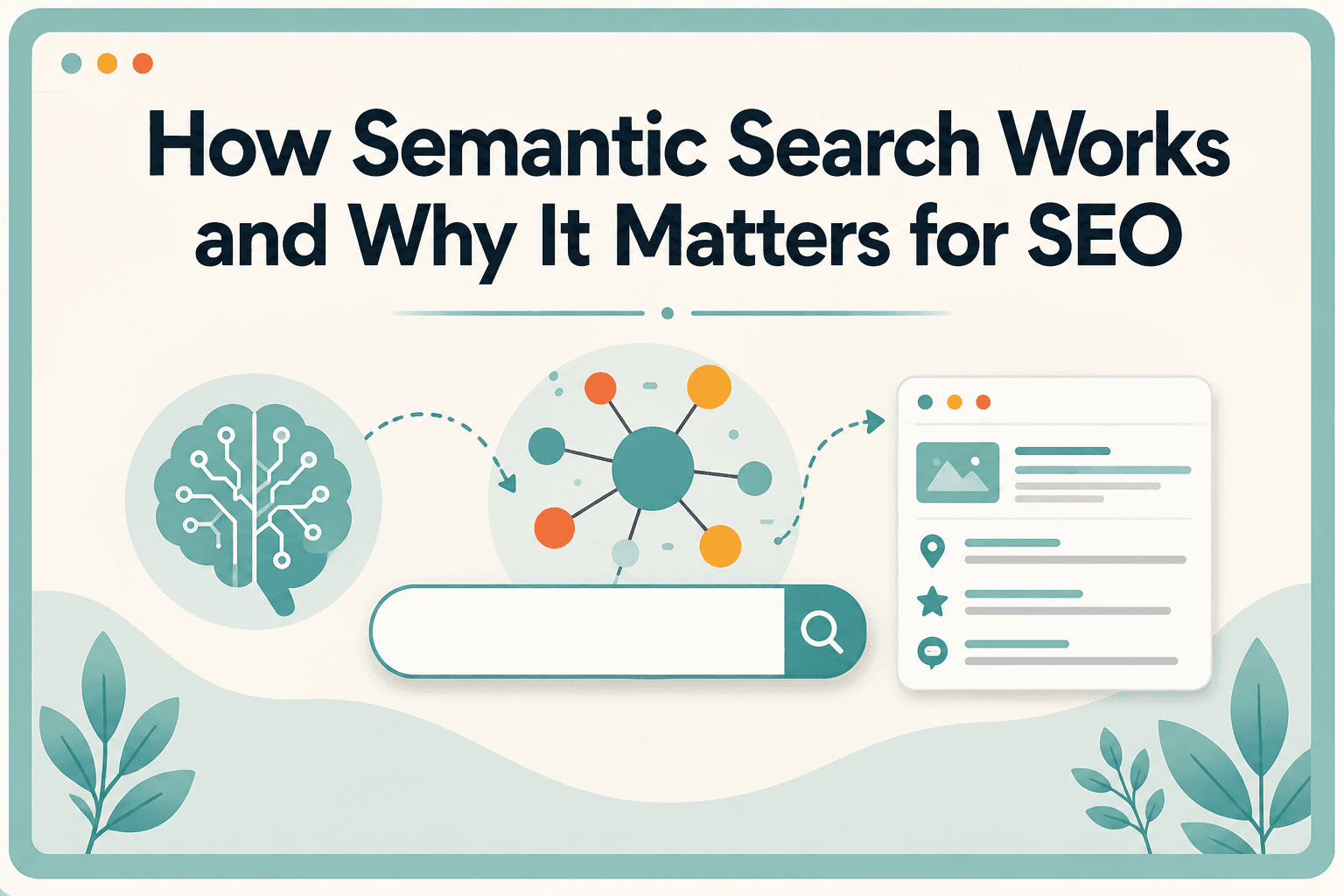
Keywords also remain relevant as search becomes more conversational and AI-assisted. Google’s guidance for AI search explains that users may ask longer, more specific questions and continue with follow-up queries, while its ranking systems use technologies such as neural matching to connect concepts in queries with concepts on webpages. Similarly, ChatGPT Search combines natural-language interaction with current web information and linked sources.
However, keywords should not be treated as isolated strings that must be repeated mechanically. Google recommends using the words people search for in important places such as the page title, main heading, alt text and link text. At the same time, the content should still be written primarily to help readers rather than to manipulate search rankings.
Table of Contents
Four Types of Keywords Based on Search Intent
Search intent describes the outcome a person appears to want from a query. It is therefore one of the most useful ways to classify keywords because it influences both the content format and the page type required.
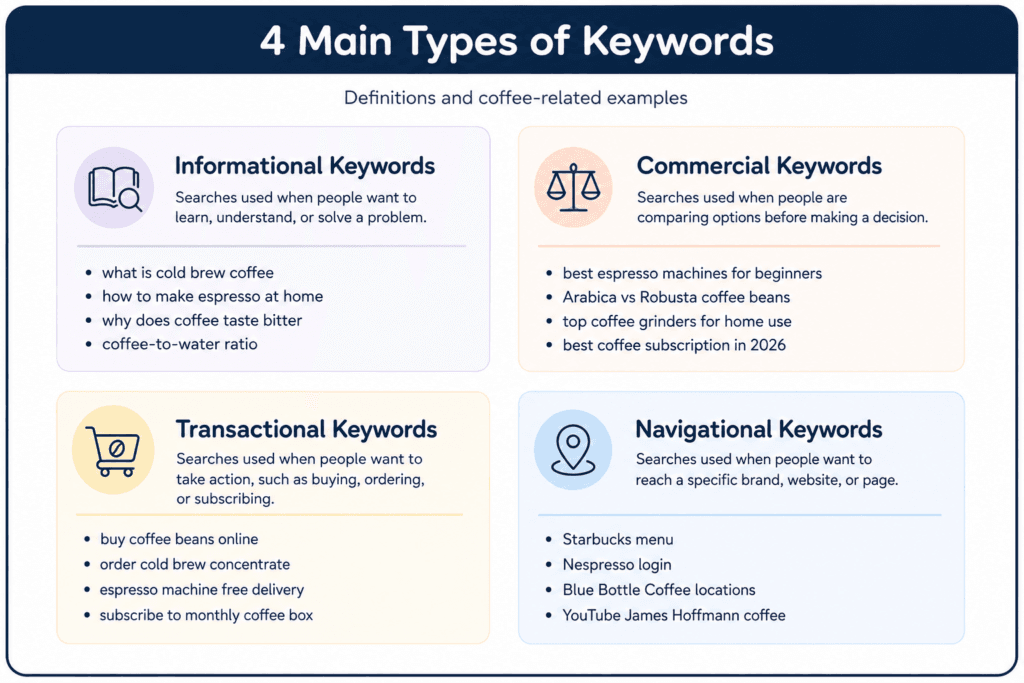
Informational Keywords
Informational keywords indicate that the searcher wants to learn, understand or solve a problem.
Coffee-related examples include:
- what is cold brew coffee;
- how to make espresso at home;
- why does coffee taste bitter;
- coffee-to-water ratio.
These keywords are commonly suitable for guides, tutorials, definitions, explainers and troubleshooting articles. For example, a detailed article would generally serve how to make French press coffee better than a product-category page containing French presses.
However, informational does not always mean commercially unimportant. Someone researching best coffee beans for espresso may later purchase beans, although the immediate query still requires useful guidance rather than an aggressive sales message.
Commercial Keywords
Commercial keywords indicate that the searcher is evaluating available choices before making a decision. These searches commonly include comparisons, reviews, recommendations, features, prices or terms such as best.
Examples include:
- best espresso machines for beginners;
- Arabica vs Robusta coffee beans;
- top coffee grinders for home use;
- best coffee subscription in 2026.
Commercial content may include buying guides, comparisons, product roundups and detailed reviews. The reader is closer to a purchase than someone making a purely informational search; however, they may still need evidence, alternatives and decision criteria.
For example, best coffee grinder should not lead to a general article explaining what a grinder is. It should compare credible options by grinding consistency, settings, ease of cleaning, price and suitability for different brewing methods.
Transactional Keywords
Transactional keywords suggest that the user wants to complete a specific action, such as buying, booking, downloading, subscribing or requesting a quotation.
Examples include:
- buy coffee beans online;
- order cold brew concentrate;
- espresso machine free delivery;
- subscribe to monthly coffee box.
These keywords are usually best served by product pages, category pages, subscription pages, booking forms or other action-oriented landing pages.
It is important to distinguish transactional keywords from commercial ones. Best espresso machine under $500 indicates comparison and evaluation, while buy Breville espresso machine online expresses a much stronger intention to transact.
Navigational Keywords
Navigational keywords are used when the searcher wants to reach a particular brand, website, page or platform.
Examples include:
- Starbucks menu;
- Nespresso login;
- Blue Bottle Coffee locations;
- YouTube James Hoffmann coffee.
A search such as Starbucks menu is not asking for a general guide to coffee menus. The user is trying to reach information associated with a particular brand.
Navigational searches may include a brand name, although branded and navigational keywords are not identical. A query such as Starbucks vs Costa Coffee is branded but primarily commercial because the searcher is comparing two companies.
Types of Keywords Based on Brand, Timing and Query Format
Keywords can also be classified according to whether they mention a brand, depend on time or season, take the form of a question or provide semantic context.
Branded Keywords
Branded keywords contain the name of a company, product line, website or identifiable brand.
Examples include:
- Starbucks coffee beans;
- Nespresso Vertuo review;
- Lavazza espresso price;
- Digital Marketing Watch keyword guide.
Branded searches often indicate existing awareness, although their intent may be informational, commercial, transactional or navigational. For example, Nespresso customer support is navigational, while Nespresso Vertuo review is commercial.
Non-Branded Keywords
Non-branded keywords describe a need without identifying a particular company.
Examples include:
- coffee beans for espresso;
- automatic coffee maker;
- coffee shop near me;
- how to store ground coffee.
These searches are particularly useful for reaching people who know what they need but have not yet selected a brand.
Seasonal Keywords
Seasonal keywords gain or lose interest according to holidays, weather, events or predictable periods.
Coffee examples include:
- pumpkin spice coffee recipes;
- Christmas coffee gift sets;
- iced coffee recipes for summer;
- National Coffee Day deals.
Seasonal content should normally be researched and published before demand reaches its peak. At the same time, the page may be refreshed and reused annually when the subject remains relevant.
Evergreen Keywords
Evergreen keywords represent needs that remain useful throughout the year and are unlikely to depend on a temporary event.
Examples include:
- how to clean a coffee maker;
- best water temperature for coffee;
- how to store coffee beans;
- coffee grinder settings explained.
Evergreen does not mean permanent or maintenance-free. Instructions, products and recommendations can still become outdated and should be reviewed periodically.
Question Keywords
Question keywords directly or indirectly ask for an answer.
Examples include:
- why is my coffee sour;
- how much caffeine is in espresso;
- can coffee beans expire;
- which coffee roast is strongest.
These keywords are useful for FAQs, explainers, tutorials and troubleshooting content. They are also increasingly relevant to conversational and AI-assisted search, where users can ask complete questions and then refine them through follow-ups.
Semantic Keywords
Semantic keywords are terms, entities and related concepts that help establish the complete meaning of a subject. They are not simply alternative phrases to repeat for ranking purposes.
For an article about espresso, useful related concepts may include:
- extraction;
- pressure;
- grind size;
- crema;
- coffee dose;
- water temperature;
- brewing time.
Google explains that neural matching helps its systems understand representations of concepts in queries and webpages. Therefore, a useful espresso guide should cover the concepts readers genuinely need rather than repeat the word espresso unnaturally.
Note: Semantic Keywords
Semantic keyword is an SEO-industry term rather than an official Google keyword classification. It generally refers to terms, entities and concepts that are meaningfully related to the main topic. These terms should appear because they help explain the subject naturally, not because Google requires a predetermined list of semantic keywords.
Types of Keywords Based on Location, Products and Services
Some keywords reveal where the user is located or what specific product or service they need.
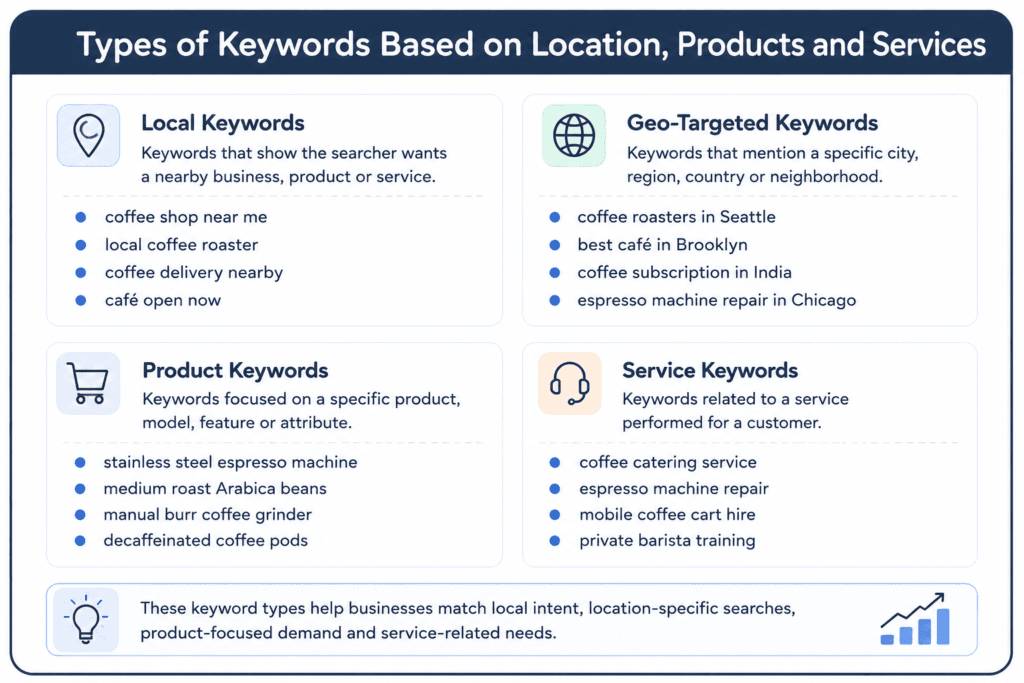
Local Keywords
Local keywords indicate that the searcher wants a nearby place, business, product, service or other location-relevant information.
Examples include:
- coffee shop near me;
- local coffee roaster;
- coffee delivery nearby;
- café open now.
The location may be implied through words such as near me, nearby or open now, even when no city is written.
Geo-Targeted Keywords
Geo-targeted keywords explicitly include a country, region, city or neighborhood.
Examples include:
- coffee roasters in Seattle;
- best café in Brooklyn;
- coffee subscription in India;
- espresso machine repair in Chicago.
Local and geo-targeted keywords overlap; however, local keywords express nearby intent more broadly, while geo-targeted keywords name the location directly.
Product Keywords
Product keywords refer to a particular product, model, category, specification or purchasing attribute.
Examples include:
- stainless steel espresso machine;
- medium roast Arabica beans;
- manual burr coffee grinder;
- decaffeinated coffee pods.
Depending on the wording, a product keyword may be commercial or transactional. Manual coffee grinder reviews is commercial, while buy manual coffee grinder is transactional.
Service Keywords
Service keywords refer to work performed for a customer rather than a physical product.
Coffee-related examples include:
- coffee catering service;
- espresso machine repair;
- mobile coffee cart rental;
- private barista training.
These keywords are commonly targeted through service pages, location pages and inquiry-focused landing pages. Therefore, the page should explain what is included, who the service is for, where it is available and how the customer can proceed.
How to Classify and Use Different Types of Keywords Correctly
A keyword should not be classified from one word alone. The most reliable process is to examine the complete query, the likely user goal and the pages currently appearing in search results.
For example, the word best often suggests commercial intent, while buy usually indicates transactional intent. However, the wording is only a clue. Best way to clean a coffee machine is informational, even though it contains best.
It is also important to recognize that one keyword may belong to several categories simultaneously. Best Starbucks coffee beans for espresso is branded, product-focused and commercial. Similarly, where can I buy coffee beans in Boston? is a question keyword with transactional, local and geo-targeted characteristics.
The main classification mistakes include:
- assuming that every keyword belongs to only one category;
- confusing product research with immediate purchase intent;
- creating separate pages for minor wording variations;
- classifying a keyword without checking the search results;
- forcing an informational keyword onto a product page;
- using semantic terms as a list of phrases to repeat;
- ignoring seasonal changes and local context.
In short, keyword classifications should guide page selection rather than create rigid rules. A business should determine what the searcher needs, select the page type most capable of satisfying that need and then use the keyword naturally in the title, main heading, introduction and other relevant areas.
Conclusion
The four main intent categories—informational, commercial, transactional and navigational—help explain what a searcher wants, while the additional categories provide useful information about brand awareness, timing, question format, location, products and services.
Keywords are most useful when treated not as isolated phrases but as expressions of intent connected with entities, concepts and broader topics. Google states that the foundational practices of SEO continue to apply to its generative AI features because these experiences rely on its core search ranking and quality systems.
Therefore, content should not be written around repeated keyword variations alone. It should answer the main query, anticipate related questions, explain relevant concepts and provide enough context for both readers and search systems to understand the subject.
For a coffee website, this means that an article about how to make espresso should naturally discuss grind size, dose, pressure, water temperature, extraction and common problems. It should not simply repeat make espresso in every heading.
To sum up, understanding different types of keywords is important because they reveal audience needs and guide content decisions. In the age of AI and generative search, their optimal use depends less on exact-match repetition and more on clear intent, topical completeness, credible information and natural language.
Frequently Asked Questions
What are the four main types of keywords?
The four main types based on search intent are informational, commercial, transactional and navigational. They represent learning, comparing, acting and reaching a known destination respectively.
Can one keyword belong to several categories?
Yes. For example, best Starbucks coffee beans is branded, product-focused and commercial. Categories frequently overlap because they describe different characteristics of the same query.
What is the difference between commercial and transactional keywords?
Commercial keywords indicate comparison or evaluation before a decision, while transactional keywords suggest readiness to complete an action. Best espresso machines is commercial, whereas buy espresso machine online is transactional.
Are branded keywords always navigational?
No. Nespresso login is navigational, but Nespresso vs Keurig is commercial and how to clean a Nespresso machine is informational.
What is the difference between local and geo-targeted keywords?
Local keywords indicate nearby intent, as in coffee shop near me. Geo-targeted keywords explicitly name an area, as in coffee shops in Seattle.
How can the search intent of a keyword be identified?
Review the complete wording, likely user goal and current search results. The ranking page types—guides, products, comparisons, maps or brand pages—usually provide useful evidence about dominant intent.
Should different keyword types be targeted on separate pages?
Only when they represent meaningfully different needs. Closely related keywords with matching intent may belong on one page, while informational and transactional searches usually require different page types.
Do keywords still matter for AI search engines?
Yes, because user queries still express topics and intentions. However, Google’s AI search experiences can handle longer and more specific questions, related concepts and follow-up queries, so publishers should focus on complete, well-supported answers rather than exact-match repetition.