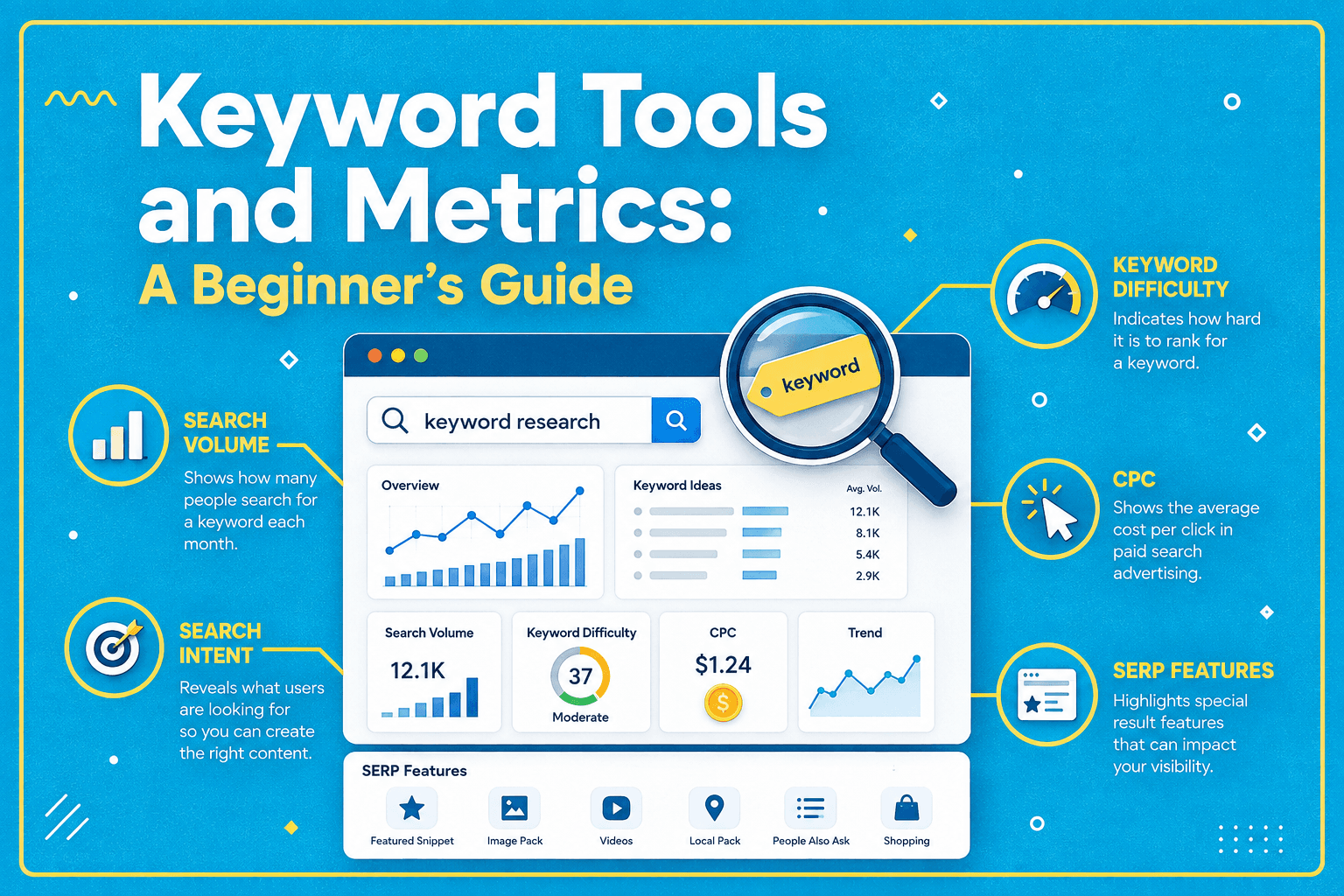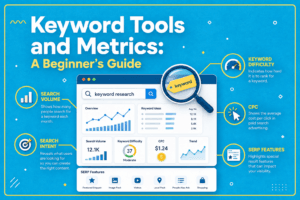
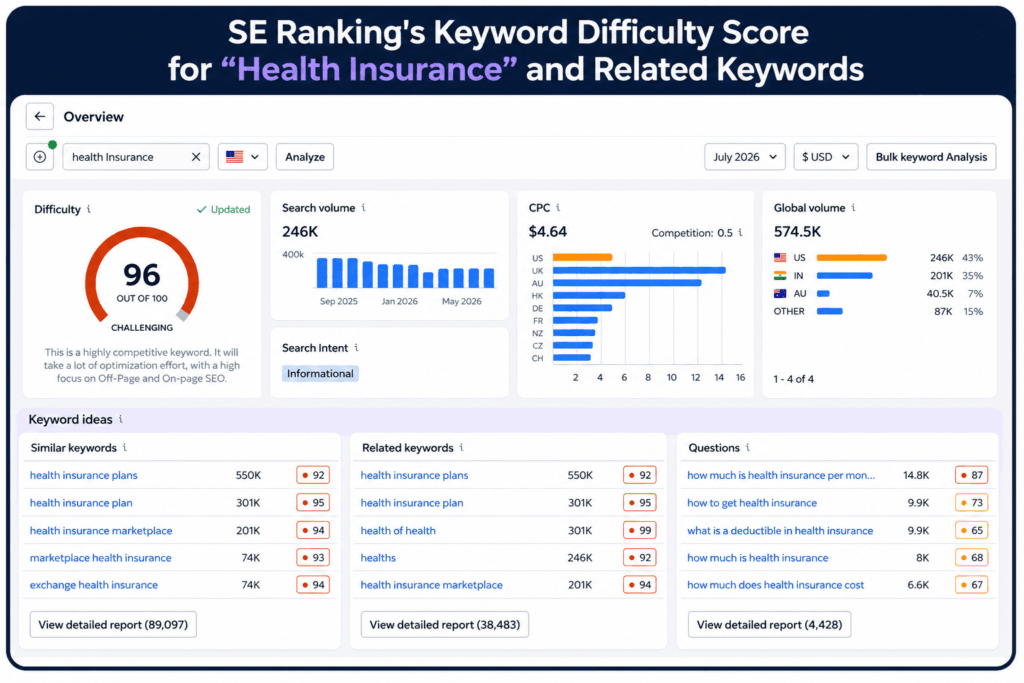
Keyword difficulty is an SEO metric that estimates how challenging it may be to rank prominently for a particular search query. For example, a new insurance website may find health insurance extremely difficult because the results are dominated by government resources, national insurers, comparison platforms and established financial publishers.
Many major SEO tools express keyword difficulty on a scale from 0 to 100, with higher scores indicating greater estimated ranking difficulty. However, keyword difficulty is not a Google metric, and Google does not publish an official difficulty score for individual searches. Google Search Central explains that Google’s ranking systems consider many factors and signals across hundreds of billions of webpages, so no third-party score can represent the complete ranking process.
Keyword difficulty must therefore be considered alongside search intent, search demand, website authority and the actual search results. A keyword may appear rankable but still offer limited click opportunity when ads, AI Overviews, featured snippets or other prominent search features occupy substantial SERP space.
Table of Contents
What Is Keyword Difficulty and Why Does It Matter?
Keyword difficulty is an SEO metric that estimates how difficult it may be for a webpage to rank prominently for a particular search query. In practical terms, it provides an initial indication of ranking competition. The actual effort required also depends on factors such as search intent, content quality, backlinks, website relevance, technical condition and the strength of the pages already ranking.
For the keyword health insurance, publishing a longer article is unlikely to be enough. Competing effectively may require accurate and current information, transparent sourcing and clear evidence of expertise. The page may also need to compete with established websites that already have strong reputations and backlink profiles.
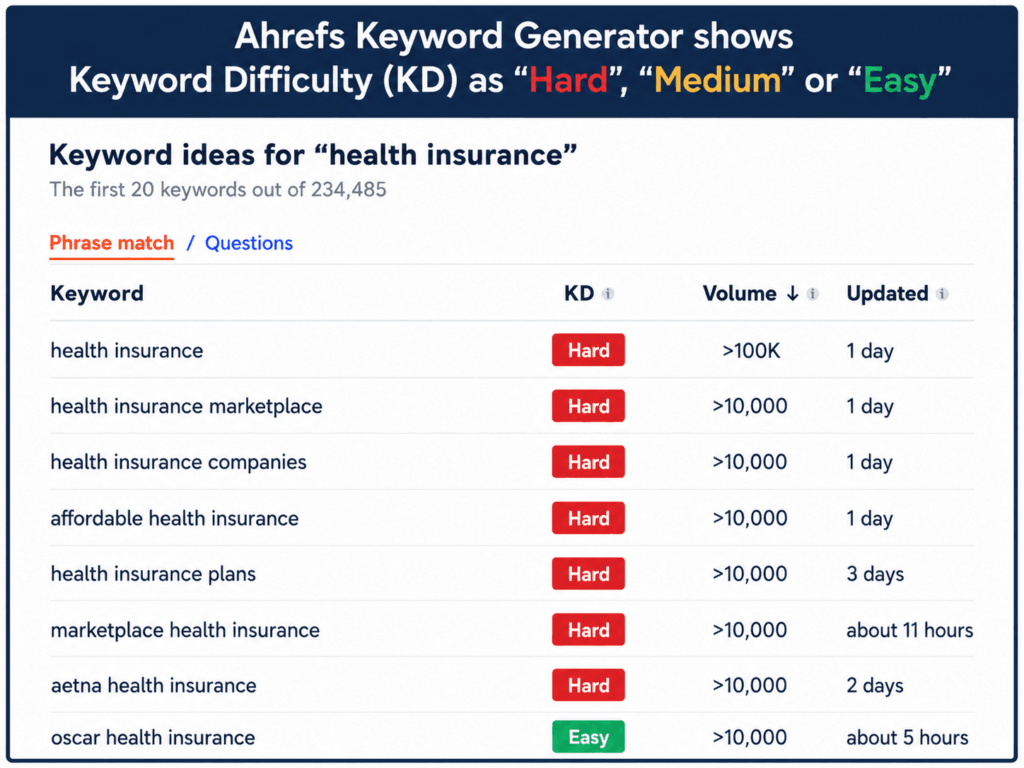
SEO platforms generally use scores between 0 and 100, but their labels and formulas differ. A score of 35 in one tool is not automatically equivalent to 35 in another. More importantly, the practical difficulty is not identical for every website. An established insurance publisher with expert contributors and extensive related content has a different chance of ranking than a newly launched general-interest blog.
Keyword Difficulty and Search Volume
Search volume estimates how often a query is searched, while keyword difficulty estimates how challenging ranking may be. Popular subjects frequently attract stronger competition; however, the two metrics do not always rise together.
A relatively low-volume health-insurance query may still be difficult if government agencies and specialist insurers dominate the results. At the same time, a higher-volume query may offer an opportunity when existing pages are outdated, poorly focused or do not fully satisfy the intent.
Search volume also does not equal potential traffic. A page may rank for several related searches, while SERP features can affect the amount of click opportunity available to conventional organic listings.
Keyword Difficulty and Search Intent
The same subject can produce very different competitive conditions depending on what the user wants.
| Keyword | Likely Intent | Likely Competition |
|---|---|---|
| what does health insurance cover | Informational | Guides and official resources |
| best health insurance plans | Commercial | Insurers and comparison platforms |
| buy health insurance online | Transactional | Insurer landing pages and ads |
| health insurance office near me | Local | Local results and provider pages |
It is therefore important to judge whether the planned page matches the type of content Google currently displays. A detailed educational guide is unlikely to rank for a query dominated by quotation forms and product pages, even when its writing quality is excellent.
How SEO Tools Calculate Keyword Difficulty
SEO platforms use proprietary formulas, which explains why the same keyword can receive different scores.
Ahrefs
Ahrefs defines Keyword Difficulty as an estimate of how hard it would be to rank on Google’s first page. Its score is based on the number of referring domains linking to the top ten organic results, and Ahrefs explicitly states that its calculation does not consider on-page SEO factors.
This makes Ahrefs KD particularly useful for estimating backlink competition. However, it does not directly measure content quality, search-intent alignment, subject expertise or page freshness.
Semrush
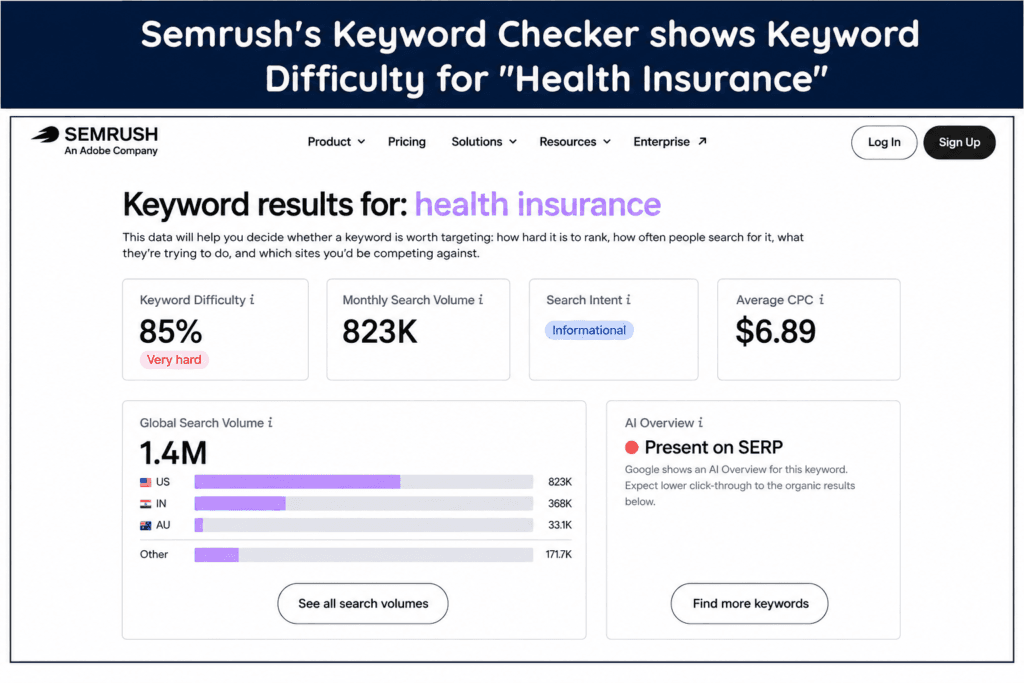
Semrush uses factors including the median number of referring domains pointing to ranking URLs, the balance of followed and nofollowed links, the authority of ranking domains and SERP-related characteristics.
Semrush also offers Personal Keyword Difficulty, which considers the analyzed website’s topical relevance, authority and competitors. In other words, it tries to estimate not only general competition but how difficult the keyword may be for a particular domain.
Why Scores Differ
Tools may use different:
- backlink databases;
- geographic databases;
- update schedules;
- ranking-page samples;
- authority metrics;
- SERP-feature calculations;
- difficulty formulas.
Therefore, scores should usually be compared within the same platform, country and research project. Combining an Ahrefs score for one keyword with a Semrush score for another may create an inconsistent priority list.
Keyword Difficulty vs Google Ads Competition
Keyword difficulty estimates competition in organic search. Google Keyword Planner, by contrast, is designed to research keywords and forecasts for Google Ads Search campaigns. Its competition and bidding data concern paid advertising rather than organic ranking difficulty. For example, a health-insurance query may have high advertising competition because each lead is valuable, but this does not provide a direct measurement of organic SEO difficulty.
How to Assess Keyword Difficulty Manually
A manual analysis begins by searching the keyword in the intended country and examining the results that actually appear.
Confirm the Dominant Search Intent
Identify whether Google mainly displays guides, insurer pages, comparison tools, government resources, local listings or purchase forms.
For example, health insurance eligibility may favor official explanations, while compare health insurance quotes may favor commercial comparison pages. A page that does not match the dominant intent faces an immediate disadvantage.
Examine the Ranking Websites and Individual Pages
Review the types of organizations ranking and the strength of the individual pages. Do not judge competition from domain authority alone. A large website may have a weak or outdated page, while a smaller specialist website may rank because its page is exceptionally relevant.
Ask:
- Are government agencies or nationally recognized insurers present?
- Are smaller specialist websites ranking?
- Do the pages directly answer the query?
- Are the results current and well maintained?
- Is the subject covered by qualified authors or reviewers?
Evaluate Content Quality and Trust
For health insurance, examine whether the pages accurately explain deductibles, exclusions, waiting periods, provider networks, eligibility and policy limitations. Look for transparent sourcing, current dates, author credentials and clear distinctions between general information and professional advice.
Google says its systems aim to prioritize helpful, reliable, people-first information and place additional emphasis on strong E-E-A-T for YMYL topics.
Review Backlinks and Page-Level Authority
Use an SEO tool to examine how many reputable domains link to the ranking pages. A SERP in which nearly every result has extensive authoritative backlinks will usually require more promotional effort.
However, a result page containing several relevant pages with modest link profiles may indicate an opportunity, particularly when the existing content has clear weaknesses.
Check SERP Features and Click Potential
Record whether the page contains:
- AI Overviews;
- paid advertisements;
- featured snippets;
- People Also Ask;
- local results;
- calculators or comparison modules;
- video or image results.
These features do not necessarily make ranking impossible, but they can alter where attention and clicks go.
A useful manual assessment can rate intent match, ranking-page strength, backlinks, trust requirements, freshness and available click opportunity as low, medium or high barriers.
How to Use Keyword Difficulty in an SEO Strategy
A new website should use keyword difficulty as one factor for narrowing down opportunities, not as the only factor that decides which keywords to target. A low difficulty score can help identify potentially easier opportunities, but relevance, search intent, business value and the quality of the current search results still matter. The new website can then begin with highly relevant searches where current results are incomplete, poorly focused or not written for a clearly defined audience.
For a health-insurance website, realistic opportunities might involve regional eligibility questions, terminology explanations or specific consumer problems. However, the content must remain accurate and professionally credible regardless of how low the numerical difficulty score appears.
At the same time, difficult keywords should not always be rejected. A term such as health insurance plans may be central to the business and worth pursuing as a long-term objective. The website can build toward it through supporting guides, original data, specialist contributions, strong internal links and reputable external references.
The factors that affect practical ranking difficulty can also vary by topic and industry. For example, topics that can significantly affect a person’s health, financial stability or safety generally demand particularly strong trust signals because inaccurate information can cause serious harm. Some legal subjects can also fall into this category when the consequences are significant.
Common mistakes include:
- treating a low score as a ranking guarantee;
- selecting irrelevant keywords because they appear easy;
- rejecting strategically important topics only because they are difficult;
- confusing organic difficulty with advertising competition;
- ignoring search intent and page type;
- overlooking SERP features and available clicks;
- comparing scores from unrelated tools;
- assuming that a longer article is automatically more competitive.
The strongest strategy therefore combines achievable near-term opportunities with important long-term topics that require sustained authority building.
Conclusion
Keyword difficulty is an estimate of competitive conditions, not a verdict on whether a webpage will rank. Tool scores can quickly highlight backlink and authority barriers, while manual SERP analysis reveals intent, content quality, trust, freshness and realistic traffic potential.
The same caution applies to AI search. Google states that its generative search features are rooted in its core Search ranking and quality systems and use content available through the Search index. Established SEO fundamentals therefore remain relevant to AI Overviews and AI Mode.
However, conventional keyword-difficulty scores do not measure whether a page will appear as a supporting link in an AI-generated response. Google’s AI guidance instead emphasizes established SEO best practices, including crawlability, index eligibility and helpful, reliable content.
To sum up, the best keyword is not simply the one with the lowest score. It is a relevant search opportunity for which the website can produce a credible, useful and competitive page.
Frequently Asked Questions
What is a good keyword-difficulty score for a new website?
There is no universal threshold because tools use different formulas and websites have different strengths. New sites can begin with lower-scoring terms, but every keyword should still be checked for relevance, intent, ranking quality and business value.
How can a new website drive traffic through less difficult keywords?
It can focus on specific customer problems, regional questions and underserved topics where existing results are incomplete or outdated. These pages should belong to a coherent subject area so that early rankings build relevant authority rather than disconnected traffic.
How can keyword difficulty be assessed manually?
Review the dominant intent, ranking page types, website authority, page quality, backlinks, freshness, trust requirements and SERP features. Then compare those barriers with the website’s current expertise and resources.
Why do SEO tools show different difficulty scores?
Each platform uses its own database, update schedule and formula. Ahrefs emphasizes referring domains to top-ranking pages, while Semrush considers a wider combination of links, authority and SERP characteristics.
Is keyword difficulty the same as Google Ads competition?
No. Keyword difficulty estimates organic-ranking competition, while Google Ads competition relates to advertisers competing in paid-search auctions.
Can a high-difficulty keyword still be worth targeting?
Yes. A difficult keyword may be central to the business and valuable over the long term. It can be supported through expert content, original research, related pages, internal links and authoritative backlinks.
Does website authority change how difficult a keyword is?
Yes. The published score may remain the same, but a trusted specialist website usually faces different practical difficulty from a new or unrelated domain. Personalized difficulty tools attempt to account for this difference.
Does keyword difficulty matter for AI search engines?
For Google’s AI Overviews and AI Mode, keyword difficulty remains indirectly relevant because these features are rooted in Google’s core Search ranking and quality systems. However, standard KD scores do not measure whether a page will be selected as a supporting link in an AI-generated response.