Key Takeaways
- Information retrieval finds information relevant to a user’s need from collections such as webpages, documents, products, emails, or records.
- Lexical retrieval matches textual features, while semantic retrieval uses meaning and context to connect queries with related concepts, synonyms, and paraphrases.
- Most systems index collections, process queries, retrieve promising candidates, and rank results using approaches such as inverted indexes, BM25, vectors, or hybrid retrieval.
- Information retrieval supports web search, ecommerce, research databases, enterprise search, and RAG systems that provide external material as context for generated answers.
Information Retrieval (IR) is the process of finding information that is relevant to a user’s query or information need from a larger collection of documents, webpages, products, emails, records, or other content. Google Research describes information retrieval as the field concerned with developing algorithms that match users’ interests with the best available information.
For example, someone searching a research database for “effects of sleep on memory” is not asking for one predetermined database value. The system must search many documents, identify potentially relevant ones, and determine which results are most useful.

Traditional lexical information retrieval works mainly by matching terms or textual features in a query with those represented in documents. Methods such as TF-IDF and BM25 can then give different weights to those matches. Lexical retrieval is therefore broader than simple exact keyword matching.
Semantic information retrieval attempts to match content based on meaning and context. Modern systems can represent queries and documents as vector embeddings, allowing a search for “car repair near me” to retrieve content about a “local automobile service center” even when few words match exactly.
Information retrieval itself predates computers:
- Earlier — Libraries and Index Cards: Libraries used catalogs, indexes, classification systems, and subject headings to help people locate information.
- 1950s–1960s — Computerized Retrieval: Researchers began developing computerized information-retrieval systems and machine-readable collections. By 1964, the National Library of Medicine’s MEDLARS system was operating as a computerized literature-retrieval system.
- 1990s — Web Search Engines: The growth of the World Wide Web turned information retrieval into an everyday activity for millions of internet users.
- Today — AI-Driven Retrieval: Machine learning, NLP, semantic search, neural models, and vector embeddings increasingly work alongside traditional lexical techniques.
Information Retrieval vs. Data Retrieval
Information retrieval and data retrieval both involve finding stored content, but they differ in what is being searched, how matches are identified, and what kind of result the user expects.
In simple terms, data retrieval asks which record matches specified conditions, while information retrieval asks which available information best satisfies a user’s need.
How an Information Retrieval System Generally Works
The exact architecture varies, but an information retrieval system usually prepares a searchable collection, processes the user’s query, retrieves possible matches, and ranks the results.
1. Indexing and Representing the Collection
A traditional retrieval system commonly creates an inverted index. It works much like the index at the back of a textbook. Instead of examining every document from beginning to end whenever someone searches, the system keeps a structured mapping of terms to the documents containing them.
battery → Document 2
renewable → Document 3
An index can also store information such as how frequently a term appears and, in some systems, where it occurs within a document.
Modern semantic systems may additionally store dense vector representations of documents in indexes designed for similarity search.
2. Processing the Query
When someone enters a query, the system prepares it for retrieval. Depending on the implementation, this may involve tokenization, spelling normalization, stemming or lemmatization, synonyms, entity recognition, or query expansion.
A neural retrieval system may instead, or additionally, convert the query into an embedding that can be compared with document vectors.
3. Matching and Retrieving Candidates
Retrieval systems rarely perform their most expensive analysis against every item in a very large collection. They first identify a set of promising candidates.
- Sparse retrieval traditionally represents queries and documents using a large vocabulary in which most values are zero. BM25 is a widely used lexical ranking function.
- Dense retrieval typically uses compact learned vectors in which many dimensions carry numerical values. Documents whose vectors are close to the query vector can be retrieved based on semantic similarity. Research on dense passage retrieval demonstrated how dual-encoder models can retrieve passages using learned dense representations.
- Hybrid retrieval combines lexical or sparse methods with dense retrieval so that strong keyword matches and semantic relationships can both contribute.
4. Ranking, Re-Ranking, and Displaying Results
Retrieved candidates are scored and ordered according to their estimated relevance. Modern neural systems may use a bi-encoder to encode queries and documents separately. Document representations can be calculated in advance, making candidate retrieval efficient.
A cross-encoder instead examines the query and candidate document together. This is more computationally expensive but can provide a more detailed relevance judgment. A common retrieve-and-rerank approach therefore uses a fast retriever first and a cross-encoder to re-rank the smaller candidate set.
How Google Search Retrieves Information
Google Search operates at far greater scale, but the basic information-retrieval problem remains similar: understand the request, find potentially relevant information, evaluate it, and return useful results.
1. Understanding the Query
Google uses multiple systems to understand what a searcher may mean rather than treating a query as an isolated sequence of exact keywords.
Its current ranking systems documentation explains that BERT helps understand how combinations of words express meaning and intent. Similarly, RankBrain helps relate words to concepts, while neural matching helps match representations of concepts in queries and webpages.
This allows Search to handle wording, concepts, and context that may not correspond perfectly with the text of a relevant page.
2. Searching the Index
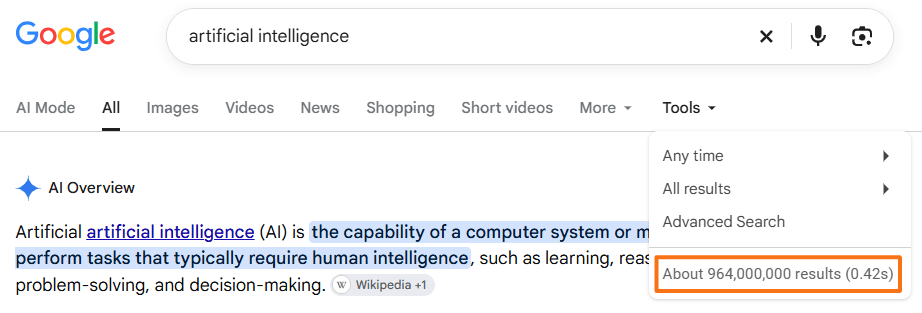
Google crawls pages, analyzes eligible content for indexing, and stores indexed information in its Search index. When someone searches, Google’s systems search that index for matching information. The search engine giant describes its Search index as containing hundreds of billions of webpages and other content.
Google does not publicly document every internal retrieval method, storage tier, or candidate-generation stage. It would therefore be inaccurate to assume that a particular academic retrieval algorithm such as BM25 represents Google’s entire current first-stage retrieval system.
3. Identifying and Scoring Relevant Results
Potential results can be evaluated using many signals and systems. Relevance can depend on many factors, including the query, page content, language, location, and device.
Links also remain important. Google states that PageRank continues to be part of its core ranking systems, although the way it works has evolved substantially since Google’s early years.
4. Ranking and Serving Results
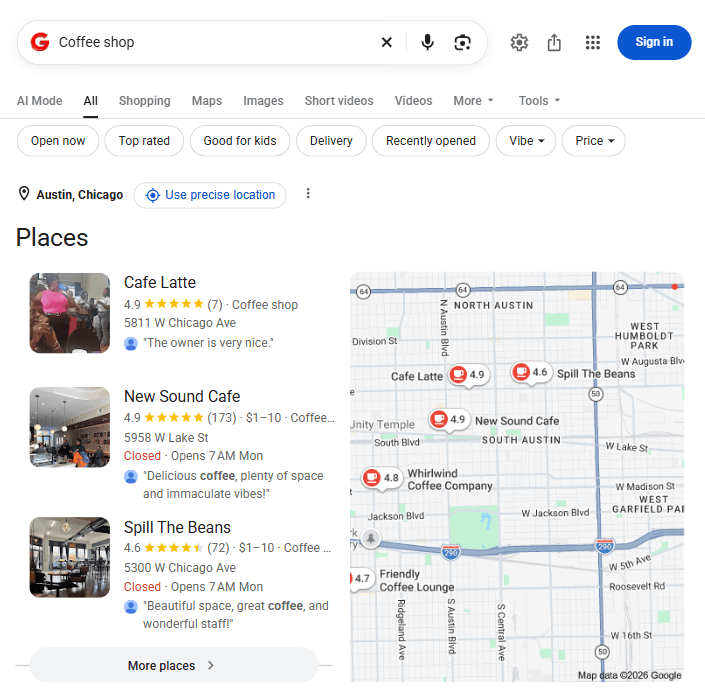
Google then orders and serves results it considers useful and relevant. Different queries can also trigger different result formats, such as local, image, or other search features.
Examples of Information Retrieval Systems
Information retrieval extends well beyond general-purpose web search.
- Web Search Engines: Google, Bing, and other search engines retrieve webpages, images, videos, local information, and other content from large searchable indexes.
- E-Commerce Search: Amazon, eBay, and individual online stores retrieve products according to queries, categories, product attributes, availability, and relevance.
- Academic and Research Databases: Services such as PubMed, Google Scholar, and IEEE Xplore help users retrieve research papers, authors, subjects, citations, and related academic material.
- Desktop, Enterprise, and Email Search: Operating systems, workplace search platforms, and email services retrieve files, messages, contacts, attachments, and other stored information.

The collection changes, but the fundamental goal remains similar: identify the items most useful for a particular information need.
How Information Retrieval Is Evaluated
Information-retrieval systems can be evaluated by comparing retrieved results with information judged to be relevant. Precision measures how many retrieved results are relevant, while recall measures how many of the available relevant results were retrieved.
Ranked systems may also use metrics such as Mean Average Precision (MAP) or Normalized Discounted Cumulative Gain (NDCG) to evaluate how effectively relevant results are ordered.
Information Retrieval and Artificial Intelligence
Information retrieval has become an important component of many modern AI applications because a model can retrieve external information before or while producing a response.
Retrieval-Augmented Generation
Retrieval-Augmented Generation (RAG) combines information retrieval with language generation. Instead of relying only on information represented in a model’s trained parameters, a system retrieves relevant external material and supplies it as context for generating an answer.
A simplified flow is:
The original RAG research paper combined a neural retriever with a language-generation model and an external knowledge source. This approach allows the model to retrieve relevant information first and then use that material as context when generating its response.
Search-Enabled Generative AI
A language model does not automatically search external information simply because it can generate text. Retrieval must be provided as part of the surrounding application or system.
For example, ChatGPT search can search the web for current information and provide links to relevant web sources. OpenAI also explains that search may rewrite a user’s request into one or more targeted search queries.
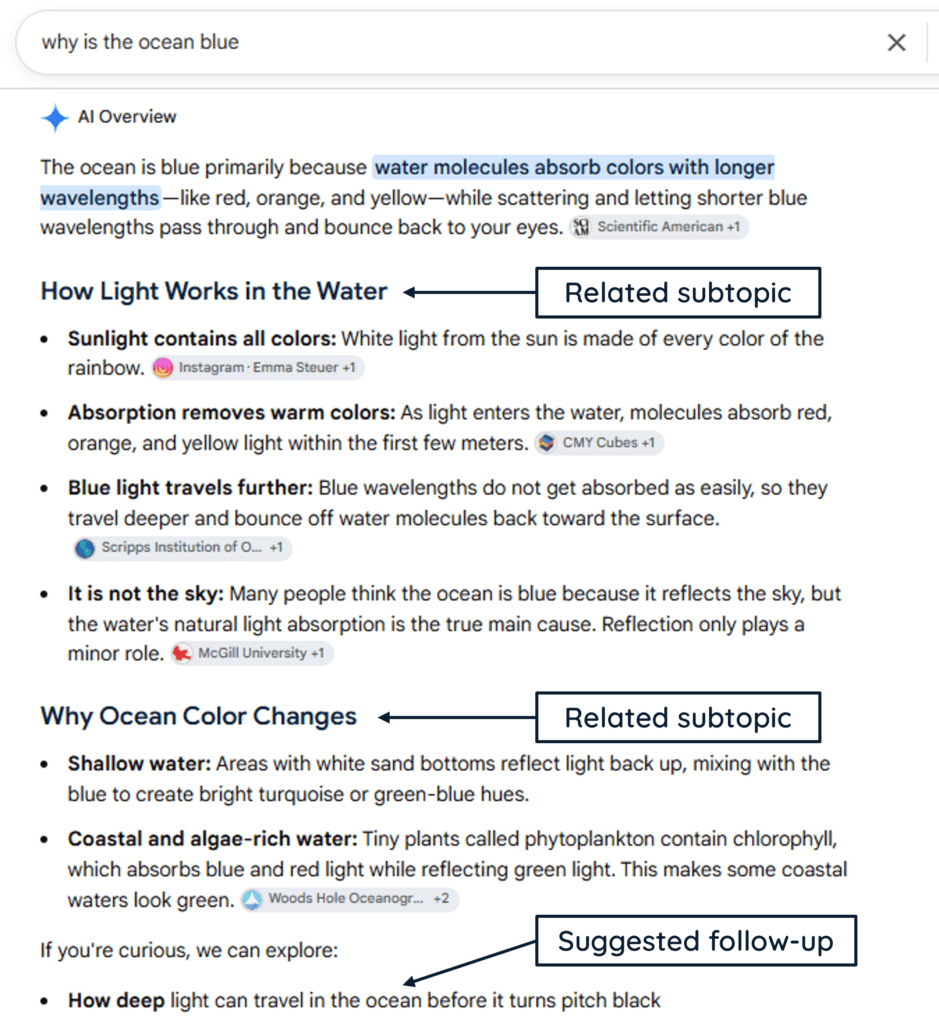
Google’s AI Overviews and AI Mode similarly combine generative AI with information retrieval. These features may use query fan-out, issuing multiple related searches across subtopics and data sources to find supporting information for a response.
Frequently Asked Questions
What is an inverted index?
An inverted index maps terms to the documents in which they occur. This allows a search system to look up relevant documents quickly instead of scanning every document from beginning to end for each query.
How does TF-IDF rank search results?
Term Frequency (TF) measures how frequently a term occurs within a document, while Inverse Document Frequency (IDF) gives less weight to terms that occur across many documents. Combining the two helps distinguish terms that are frequent in a particular document but less common across the collection.
How does vector search solve keyword limitations?
Vector search represents queries and content as embeddings and compares their semantic similarity. It can therefore retrieve related concepts, synonyms, and paraphrases even when the query and document contain different words.
What is BM25, and why is it often preferred over basic TF-IDF?
BM25 is a probabilistic text-ranking method that improves term-based scoring by accounting for factors such as term-frequency saturation and document length. It remains a widely used lexical retrieval baseline.
What is the difference between dense retrieval and sparse retrieval?
Sparse representations contain many zero values and commonly retain strong connections to vocabulary terms. Dense retrieval uses compact learned vectors that capture semantic relationships. Modern systems can combine both approaches.
What are cross-encoders and bi-encoders?
Bi-encoders represent queries and documents separately, making large-scale retrieval efficient. Cross-encoders examine a query and document together, allowing more detailed comparison but requiring more computation. Cross-encoders are therefore often used for re-ranking.
How does RAG connect information retrieval to large language models?
RAG retrieves relevant information from an external source and supplies it to a language model as context. The model can then generate its response using both its learned capabilities and the retrieved material.
How do AI systems retrieve information?
An AI application may retrieve information through lexical search, vector search, hybrid retrieval, databases, APIs, or web search. Retrieval is a capability added to the overall AI system; it is not something every language model automatically performs.