



Creating valuable content is only one part of achieving visibility in search results; search engines also need to understand, evaluate, and categorize that content effectively. On-page SEO helps optimize the elements within a webpage to improve relevance, user experience, and ranking potential.
On-page SEO refers to the practice of optimizing individual webpages to improve their visibility and rankings in search engine results. It focuses on elements such as content quality, keyword usage, headings, title tags, meta descriptions, internal links, URLs, images, and user experience. By helping search engines understand the topic, purpose, and relevance of a webpage, on-page SEO improves the chances of matching content with relevant search queries.
Well-optimized pages provide better value to users by answering their questions clearly and offering a smooth browsing experience. Search engines analyze these signals along with factors like content depth, relevance, and engagement to determine rankings. Effective on-page SEO helps websites attract targeted organic traffic, improve visibility, and build stronger connections between user intent and valuable content.
Table of Contents
- What Is On-Page SEO? Understanding Page Optimization
- How Search Engines Evaluate Web Pages
- On-Page SEO Factors: What Search Engines Look For
- Content Optimization: Creating Pages That Rank and Provide Value
- Essential On-Page SEO Elements: Titles, Headings, URLs, Images, and Internal Links
- User Experience SEO and Conversion Optimization
- On-Page SEO Checklist and Common Mistakes
- On-Page SEO Best Practices, Tools, and Future Trends
- Conclusion
- Frequently Asked Questions
What Is On-Page SEO? Understanding Page Optimization
On-Page SEO refers to the process of optimizing individual webpages to improve their visibility in search engines and provide a better experience for visitors.
In simple words, On-Page SEO means improving everything on a webpage that helps search engines understand the page and helps users find value from it.
This includes elements such as:
- Content
- Keywords
- Title tags
- Meta descriptions
- Headings
- URLs
- Images
- Internal links
- Page structure
- User experience
A simple analogy:
Think of a webpage like a physical store.
Before customers enter a store, the outside sign should clearly explain what the store offers. Inside, products should be organized properly, labels should be clear, and customers should easily find what they need.
On-Page SEO works the same way.
The title tells search engines and users what the page is about.
The headings organize information.
The content answers questions.
The internal links guide visitors to related information.
A well-optimized page is easier for both Google and users to understand.
On-Page SEO vs Off-Page SEOSEO is usually divided into two major areas:
On-Page SEO
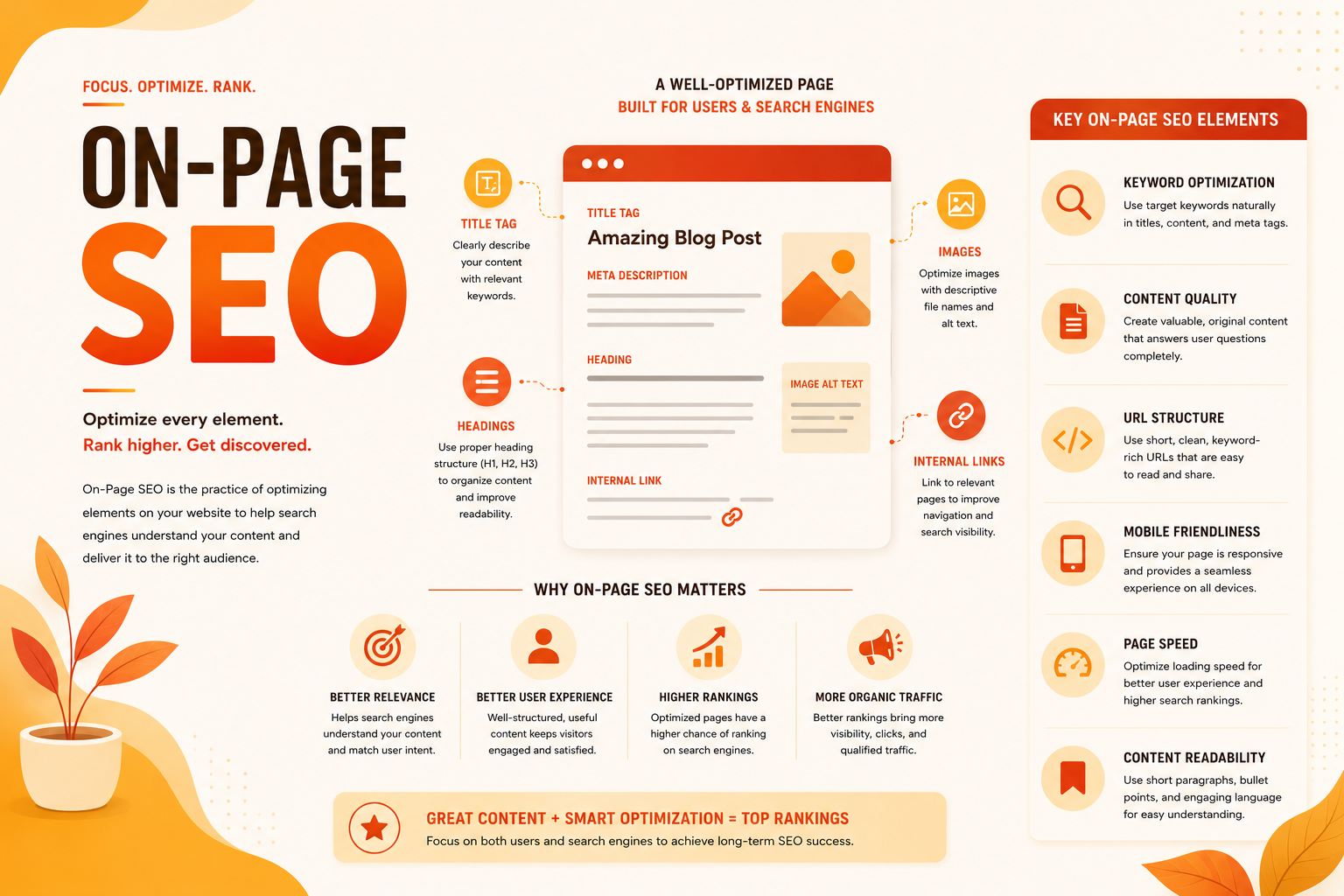
Focuses on improvements made directly on your website.
Examples:
- Improving content
- Optimizing keywords
- Adding internal links
- Improving page structure
Off-Page SEO
Focuses on external signals that influence authority.
Examples:
- Backlinks
- Brand mentions
- Online reputation
Both are important, but On-Page SEO is the foundation.
A website with strong backlinks but poor page optimization may still struggle because search engines and users cannot clearly understand the content.
How Search Engines Evaluate Web Pages
Search engines like Google analyze billions of webpages to determine which results best answer a user’s search.
When someone searches:
“best email marketing tools”
Google does not simply look for pages containing those words.
It evaluates:
- Is this page relevant?
- Does it answer the user’s question?
- Is the information useful?
- Is the website trustworthy?
- Does the page provide a good experience?
This process helps search engines match users with the most valuable content.
Search Intent: Understanding What Users Want
One of the most important parts of On-Page SEO is matching search intent.
Search intent is the reason behind a search.
For example:
Search:
“what is SEO”
The user wants:
- Explanation
- Beginner information
- Learning resources
A product page would not match this intent.
Another search:
“best SEO tools”
The user wants:
- Comparisons
- Reviews
- Recommendations
The content format needs to match what the user expects.
Relevance and Content Understanding
Search engines analyze page content to understand its topic.
They look at:
- Main topic
- Keywords
- Related terms
- Content structure
- Context
For example, a page about “content marketing” may include related concepts like:
- Content strategy
- Blogging
- Audience research
- Lead generation
- Content distribution
These related topics help search engines understand the overall subject.
User Experience Signals
Search engines also consider how users interact with webpages.
Important experience factors include:
- Mobile friendliness
- Page speed
- Easy navigation
- Readability
- Clear structure
A page that provides a poor experience may struggle even if the content is useful.
EEAT
EEAT stands for Experience, Expertise, Authoritativeness, and Trustworthiness, which are key signals used by search engines to evaluate content quality. It focuses on whether content demonstrates real-world experience, accurate knowledge, credible sources, and a reliable brand presence. Strong EEAT helps search engines identify content that provides genuine value and deserves higher visibility in search results. For websites, building EEAT involves creating helpful content, showcasing expertise, earning authority, and maintaining transparency.
On-Page SEO Factors: What Search Engines Look For
On-Page SEO involves multiple factors that help search engines understand and evaluate a page.
These factors can be grouped into four major areas:
- Content quality
- Topic Relevance
- Page structure
- Trust and Authority
- Readability and Content Experience
1. Content Quality and Usefulness
Search engines prioritize content that provides real value.
High-quality content should:
- Answer user questions
- Provide accurate information
- Explain concepts clearly
- Include examples
- Solve problems
A page should not exist only to rank for keywords.
It should exist to help users.
2. Topic Relevance
A webpage should have a clear purpose.
For example:
A page about “Email Marketing Strategy” should focus on:
- Email campaigns
- Automation
- Segmentation
- Performance tracking
Adding unrelated topics weakens the page focus.
3. Page Structure
A good page structure helps both users and search engines.
Important elements include:
- Clear headings
- Logical sections
- Short paragraphs
- Internal navigation
A structured page is easier to understand and scan.
4. Trust and Authority
Search engines want to provide reliable information.
Signals that improve trust include:
- Expert content
- Accurate information
- Author details
- References
- Strong website reputation
For businesses, building topical authority through valuable content can improve search visibility.
5. Readability
Even great information can fail if it is difficult to read.
Improve readability by using:
- Short paragraphs
- Clear headings
- Bullet points
- Examples
- Visual elements
Users should quickly understand the page.
Content Optimization: Creating Pages That Rank and Provide Value
Content is one of the most important parts of On-Page SEO.
A page cannot rank effectively without useful content.
Content optimization means improving content so it satisfies both users and search engines.
Keyword Optimization
Keywords help search engines understand the topic of a page.
However, modern SEO is not about repeating keywords.
Instead, focus on:
- Main keyword
- Related keywords
- Topic coverage
- User questions
Example:
Main keyword:
“keyword research”
Related topics:
- SEO keyword tools
- Search volume
- Keyword difficulty
- Search intent
This creates more complete content.
Creating Content Based on Search Intent
Before creating a page, ask:
“What does someone searching this keyword want?”
Example:
Keyword:
“best laptops for students”
A good page:
- Compares products
- Includes recommendations
- Discusses features
A simple definition article would not satisfy the search.
Content Depth and Topic Coverage
Search engines often prefer content that fully covers a topic.
A strong article usually includes:
- Basic explanation
- Examples
- Practical steps
- Common mistakes
- FAQs
Comprehensive content improves usefulness and authority.
Readability
Readability refers to how easily users can understand and consume the information presented on a webpage. It involves factors such as clear language, short paragraphs, proper headings, sentence structure, formatting, and visual organization. Good readability improves user experience, keeps visitors engaged, and helps search engines recognize content that effectively satisfies user needs.
Content Freshness
Some topics require regular updates.
Examples:
- SEO trends
- Marketing tools
- Software comparisons
Updating content helps maintain accuracy and relevance.
Essential On-Page SEO Elements: Titles, Headings, URLs, Images, and Internal Links
These are the practical elements businesses optimize directly on webpages.
Title Tags
A title tag is the clickable headline that appears in search results.
Example:
SEO Keyword Research Guide: How to Find Keywords
A good title tag should:
- Clearly describe the page
- Include the main keyword naturally
- Encourage clicks
Titles influence both rankings and click-through rates.
Meta Descriptions
A meta description is a short summary shown below the title in search results.
Example:
“Learn how keyword research works and discover strategies to find SEO opportunities.”
Meta descriptions do not directly determine rankings, but they influence whether users click.
A strong meta description should:
- Explain value
- Match search intent
- Encourage action
URL Structure
URLs should be simple and descriptive.
Good:
example.com/on-page-seo-guide
Poor:
example.com/page?id=12345
A clean URL helps users and search engines understand the page topic.
Header Tags: H1, H2, H3, H4, H5 Explained
Headers organize content structure.
H1
The main page heading.
Usually the title of the article.
Example:
On-Page SEO Guide
H2
Main sections.
Example:
Essential On-Page SEO Elements
H3
Subsections under H2.
Example:
Title Tag Optimization
H4 and H5
Used for deeper content organization.
Most websites rarely need many levels.
The purpose of headings is clarity, not keyword placement.
Internal Linking
Internal links connect pages within the same website.
Example:
An article about SEO may link to:
- Keyword research guide
- Technical SEO guide
- Link building article
Benefits:
- Helps users discover content
- Helps search engines crawl websites
- Builds topic relationships
Image SEO
Images also require optimization.
Best practices include:
- Descriptive file names
- Alt text
- Proper image size
- Fast loading
Example:
Poor file name:
IMG12345.jpg
Better:
keyword-research-process.jpg
On-Page SEO Checklist and Common Mistakes
A practical On-Page SEO checklist:
Content Checklist
✓ Matches search intent
✓ Provides useful information
✓ Uses keywords naturally
✓ Includes examples
✓ Updated regularly
Page Element Checklist
✓ Optimized title tag
✓ Meta description added
✓ Clean URL
✓ Proper headings
✓ Internal links included
✓ Images optimized
✓ Clear CTA
Common On-Page SEO Mistakes
Keyword Stuffing
Using keywords unnaturally can harm readability.
Ignoring Search Intent
A page must answer what users actually want.
Duplicate Content
Similar pages can confuse search engines.
Poor Internal Linking
Important pages should not remain isolated.
Writing Only for Search Engines
Content should always prioritize users.
On-Page SEO Best Practices, Tools, and Future Trends
Modern On-Page SEO focuses on creating useful experiences.
Best practices include:
- Create people-first content
- Cover topics completely
- Understand search intent
- Improve page experience
- Build topical authority
- Update old content
On-Page SEO Tools
Useful tools include:
Google Search Console
Helps monitor:
- Search performance
- Keywords
- Indexing issues
Google Analytics
Helps analyze:
- Traffic
- User behavior
- Conversions
Semrush
Helps with:
- Content optimization
- Keyword research
- Competitor analysis
Ahrefs
Useful for:
- SEO analysis
- Content research
- Backlink analysis
On-Page SEO Checkers
Tools can review:
- Titles
- Headings
- Keywords
- Technical issues
The Future of On-Page SEO
Search is becoming more focused on meaning and user experience.
Future On-Page SEO will involve:
- Semantic SEO
- AI search optimization
- Better content experiences
- Stronger focus on expertise
- User-focused content
The goal is moving away from simply optimizing pages for algorithms and toward creating the best possible answers for users.
Conclusion
On-Page SEO is the foundation of successful search optimization.
It helps search engines understand webpages and helps users find valuable information.
A well-optimized page combines:
- Helpful content
- Strong structure
- Proper optimization elements
- Good user experience
- Clear conversion paths
SEO is not just about ranking higher.
The real goal is attracting the right visitors and turning them into customers.
Frequently Asked Questions
What Is On-Page SEO?
On-Page SEO is the process of optimizing individual webpages to improve search rankings, visibility, and user experience.
What does On-Page SEO do?
On-Page SEO helps search engines understand content and improves the chances of appearing for relevant searches.
What are the main components of On-Page SEO?
Main components include:
- Content optimization
- Title tags
- Meta descriptions
- Headings
- URLs
- Internal links
- Images
- User experience
What is a title tag?
A title tag is the clickable headline shown in search engine results.
What are meta descriptions?
Meta descriptions are short summaries that describe a webpage in search results.
What are H1, H2, H3, H4, and H5 tags?
They are HTML heading tags used to organize webpage content.
H1 is the main heading, while H2-H5 create additional structure.
What are the best On-Page SEO tools?
Popular tools include:
- Google Search Console
- Google Analytics
- Semrush
- Ahrefs
- SEO auditing tools
How do keywords help On-Page SEO?
Keywords help search engines understand page topics, but they should be used naturally with relevant content.
What is the difference between On-Page and Off-Page SEO?
On-Page SEO focuses on website improvements.
Off-Page SEO focuses on external signals like backlinks and brand authority.
How can I improve my On-Page SEO?
Improve it by:
- Creating useful content
- Optimizing page elements
- Improving user experience
- Adding internal links
- Updating content regularly