


Getting website traffic is only the beginning of the customer journey. Thousands of people may visit a website, view a product page, or download a resource, but only a small percentage usually become leads, opportunities, and paying customers.
This is why businesses use a marketing funnel. A funnel helps visualize how people move from the first interaction with a brand to the final purchase decision. It shows where potential customers enter, where they lose interest, and where businesses can improve the experience.
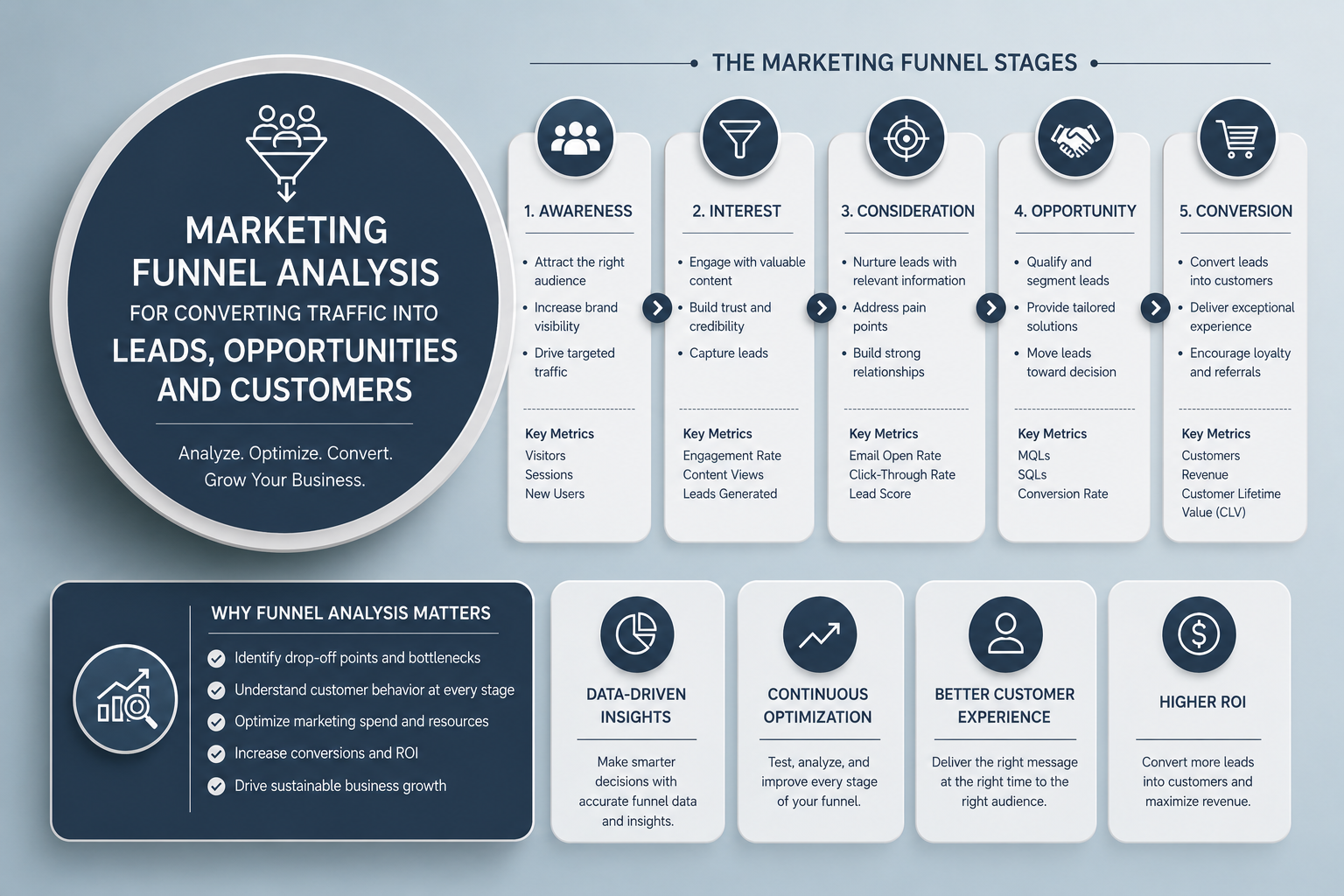
Think of a physical store. Hundreds of people may walk past the shop, some may enter, fewer may ask questions, and only some may buy. A marketing funnel works in the same way — it tracks the journey from attention to action.
However, the real value of a funnel is not just understanding stages. It is analyzing performance. A business needs to know why visitors are not becoming leads, why leads are not becoming opportunities, and why opportunities are not becoming customers.
A well-optimized funnel helps businesses improve lead quality, increase conversions, reduce wasted marketing spend, and create a smoother customer journey.
Table of Contents
- What Is a Marketing Funnel? Understanding the Customer Journey
- Why Marketing Funnel Analysis Matters for Business Growth
- Marketing Funnel Stages: From Visitor to Customer
- How to Analyze Each Funnel Stage and Identify Bottlenecks
- Marketing Funnel Metrics and Conversion Rate Analysis
- Marketing Funnel Tools, Analytics, and Real-World Examples
- Funnel Optimization Strategies: Improving Conversions and Fixing Leaks
- Conclusion
- Frequently Asked Questions
What Is a Marketing Funnel? Understanding the Customer Journey
A marketing funnel is a framework that shows the steps potential customers go through before becoming buyers.
In simple words:
A marketing funnel represents the path from someone discovering a business to eventually purchasing from it.
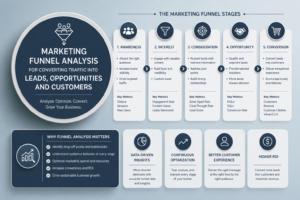
The journey usually looks like:
Visitor
↓
Lead
↓
Marketing Qualified Lead (MQL)
↓
Sales Qualified Lead (SQL)
↓
Opportunity
↓
Customer
Not every visitor moves through every stage. Some people leave early, while others continue toward a purchase.
Marketing Funnel Explained with a Simple Example
Imagine an online software company selling project management software.
A person searches:
“How to manage remote teams better”
They find a blog post from the company.
At this point, they are a visitor.
The company offers a free project management checklist.
The person downloads it and shares their email.
Now they become a lead.
After receiving emails and showing interest in pricing, they become a marketing qualified lead.
When they request a demo, they become a sales qualified lead.
The sales team speaks with them.
They become an opportunity.
Finally, they purchase the software.
They become a customer.
Sales Funnel vs Marketing Funnel
The terms are often used together, but they focus on different areas.
Marketing Funnel
Focus:
Attracting and nurturing potential customers.
Examples:
- Content marketing
- SEO
- Email campaigns
- Advertising
Sales Funnel
Focus:
Converting interested prospects into customers.
Examples:
- Sales calls
- Product demonstrations
- Negotiations
Modern businesses usually combine both.
Marketing Funnel and AIDA Model
The AIDA model is one of the oldest marketing funnel frameworks.
It includes:
Awareness
People discover the brand.
Example:
Someone sees a social media post.
Interest
They want to learn more.
Example:
They visit the website.
Desire
They consider the solution.
Example:
They compare products.
Action
They make a purchase.
Example:
They subscribe or buy.
Full Funnel Marketing Approach
Full funnel marketing means businesses optimize every stage instead of focusing only on attracting traffic.
A common mistake is:
“Get more visitors.”
A better approach is:
“Get the right visitors and help them move through the funnel.”
Why Marketing Funnel Analysis Matters for Business Growth
Many businesses focus heavily on getting traffic but ignore what happens afterward.
A website may receive thousands of visitors but generate very few leads.
Funnel analysis helps answer:
- Where are people leaving?
- Why are they leaving?
- Which stage needs improvement?
- Which campaigns generate valuable customers?
Why Traffic Alone Does Not Guarantee Results
Example:
An ecommerce store runs ads and receives 50,000 visitors.
However:
- Product pages are unclear
- Pricing feels high
- Checkout is complicated
The result:
High traffic, low sales.
The problem is not traffic.
The problem is the funnel.
Understanding Where Customers Drop Off
Every drop-off tells a story.
Example:
A SaaS company gets:
10,000 website visitors
↓
2,000 visit pricing page
↓
100 request a demo
The company notices many people leave after viewing pricing.
Possible reasons:
- Pricing is too high
- Value is unclear
- Competitors offer better alternatives
- Product positioning is weak
The solution depends on understanding the reason.
Landing Page Example: Price Issue vs Product Positioning Issue
Imagine a company selling an email automation tool.
Visitors reach the landing page but do not sign up.
There could be two different problems.
Price Issue
Customers understand the product but think:
“This is too expensive.”
Solution:
- Add cheaper plans
- Explain ROI
- Offer trials
Product Positioning Issue
Customers think:
“I do not understand why I need this.”
Solution:
- Improve messaging
- Explain benefits clearly
- Show use cases
The same conversion problem can have completely different causes.
Improving Lead Quality
More leads do not always mean better results.
Example:
A business collects 10,000 email subscribers through a free giveaway.
But only 50 are interested in buying.
Another business collects 1,000 subscribers from a targeted industry guide.
500 may become potential customers.
Funnel analysis helps businesses focus on quality.
Understanding Customer Behavior
Funnels reveal:
- What content attracts users
- What pages influence decisions
- Where users hesitate
- What encourages purchases
This helps businesses make better decisions.
Marketing Funnel Stages: From Visitor to Customer
Every funnel stage represents a different level of customer interest.
Visitor Stage: Traffic Sources and Quality
Visitors are people who interact with your business.
Sources include:
- Search engines
- Social media
- Paid ads
- Referrals
- Direct visits
The important question:
“Are these visitors likely to become customers?”
Lead Stage: Capturing Visitor Information
A lead is someone who shares information with a business.
Examples:
- Email signup
- Contact form
- Demo request
- Download
Lead generation methods include:
- Lead magnets
- Free trials
- Webinars
MQL: Marketing Qualified Lead
An MQL is a lead showing stronger interest.
Examples:
A person who:
- Downloads multiple resources
- Visits pricing pages
- Opens many emails
They are more valuable than a basic subscriber.
SQL: Sales Qualified Lead
An SQL is ready for direct sales interaction.
Examples:
- Requests a demo
- Asks for pricing
- Contacts sales team
Opportunity Stage
An opportunity is a prospect with real buying potential.
The business usually evaluates:
- Budget
- Need
- Timing
- Decision-making authority
Customer Stage
This is the final stage.
The prospect becomes a paying customer.
However, the funnel does not end here.
Businesses should also focus on:
- Retention
- Repeat purchases
- Referrals
How to Analyze Each Funnel Stage and Identify Bottlenecks
Funnel analysis means examining each stage to find problems.
Analyze Traffic Quality
Questions:
- Which channels bring visitors?
- Which channels bring customers?
- Are visitors matching the target audience?
Example:
A business may receive lots of social media traffic but most visitors leave quickly.
The issue may be audience mismatch.
Analyze Lead Generation
Questions:
- Are visitors signing up?
- Which offers perform best?
- Which landing pages convert?
Analyze Sales Readiness
Questions:
- Are leads qualified?
- Are sales conversations successful?
- Where do prospects hesitate?
Marketing Funnel Metrics and Conversion Rate Analysis
Metrics help businesses measure funnel performance.
Funnel Conversion Rate
Formula:
Conversion Rate = (Conversions ÷ Total Visitors) × 100
Example:
1,000 visitors
50 purchases
Conversion rate:
5%
Key Funnel KPIs
Visitor Stage
Metrics:
- Website traffic
- Bounce rate
- Session duration
Lead Stage
Metrics:
- Lead conversion rate
- Cost per lead
- Subscriber growth
Sales Stage
Metrics:
- MQL to SQL conversion
- Sales conversion rate
Customer Stage
Metrics:
- Customer acquisition cost
- Customer lifetime value
- Revenue
Marketing Funnel Tools, Analytics, and Real-World Examples
Businesses use tools to track customer movement.
Analytics Tools
Examples:
- Website analytics platforms
- Marketing automation tools
- CRM systems
They help track:
- User behavior
- Conversions
- Campaign performance
CRM and Marketing Platforms
CRM tools help businesses manage:
- Leads
- Sales conversations
- Customer relationships
Real-World Funnel Examples
Ecommerce
A clothing store funnel:
Visitor:
Sees Instagram ad
↓
Lead:
Signs up for discount
↓
MQL:
Views multiple products
↓
Opportunity:
Adds items to cart
↓
Customer:
Completes purchase
B2B SaaS
A software company funnel:
Visitor:
Reads blog article
↓
Lead:
Downloads guide
↓
MQL:
Attends webinar
↓
SQL:
Requests demo
↓
Customer:
Purchases subscription
Funnel Optimization Strategies: Improving Conversions and Fixing Leaks
Funnel optimization means improving every step to increase conversions.
Improving Visitor-to-Lead Conversion
Strategies:
- Better landing pages
- Clear offers
- Strong calls-to-action
- Relevant content
Example:
Instead of:
“Subscribe to our newsletter”
Use:
“Get the free 30-day marketing checklist”
Improving Landing Pages
A good landing page should clearly communicate:
- What is offered
- Who it is for
- Why it matters
- What action to take
Improving Lead Nurturing
Not every lead is ready immediately.
Businesses can use:
- Email sequences
- Educational content
- Case studies
Improving Lead-to-Customer Conversion
Focus on:
- Better sales follow-up
- Clear pricing
- Product demonstrations
- Customer proof
Common Funnel Mistakes
Common problems include:
- Tracking only traffic
- Ignoring conversion rates
- Poor audience targeting
- Weak messaging
- No lead nurturing process
Funnel Optimization Best Practices
Successful businesses:
- Test continuously
- Analyze data
- Improve customer experience
- Align marketing and sales
Conclusion
A marketing funnel helps businesses understand how people move from discovering a brand to becoming customers. However, the real value comes from analyzing and improving each stage.
A business may have strong traffic but weak conversions, or many leads but poor-quality customers. Funnel analysis helps identify these problems and provides a clear path for improvement.
By tracking the customer journey, measuring important KPIs, fixing bottlenecks, and continuously optimizing, businesses can turn more visitors into leads, opportunities, and long-term customers.
Frequently Asked Questions
What is a marketing funnel?
A marketing funnel is a framework that shows the steps customers take from discovering a business to making a purchase.
What are the stages of a marketing funnel?
The common stages are awareness, consideration, decision, and conversion. In business analysis, these can include Visitor, Lead, MQL, SQL, Opportunity, and Customer.
What is funnel analysis?
Funnel analysis is the process of studying each stage to understand where customers drop off and how conversions can improve.
Why is marketing funnel optimization important?
It helps businesses increase conversions, improve lead quality, and reduce wasted marketing efforts.
What is the difference between a marketing funnel and sales funnel?
A marketing funnel focuses on attracting and nurturing prospects, while a sales funnel focuses on converting interested prospects into customers.
What is an MQL?
An MQL is a Marketing Qualified Lead who has shown enough interest to potentially become a customer.
What is an SQL?
An SQL is a Sales Qualified Lead who is ready for direct sales engagement.
How do I improve my marketing funnel?
Businesses can improve funnels by optimizing landing pages, improving messaging, nurturing leads, and analyzing performance data.
What tools help analyze marketing funnels?
Businesses use analytics platforms, CRM systems, and marketing automation tools to track funnel performance.
What is a good funnel conversion rate?
Conversion rates vary by industry, business model, and audience. The focus should be on improving performance over time rather than one universal benchmark.