


Getting more website visitors is only one part of digital growth. A business can spend heavily on SEO, advertising, or social media campaigns, but if visitors do not take action, the opportunity is lost.
This is where Conversion Rate Optimization (CRO) becomes important. Instead of only trying to bring more people to a website, CRO focuses on helping more existing visitors complete valuable actions such as signing up, requesting a demo, filling a form, or making a purchase.
Think of a physical store. If 1,000 people enter a shop but only 10 buy something, the problem may not be the number of visitors. It could be the store layout, unclear pricing, poor product presentation, or lack of trust. CRO works in the same way by identifying what prevents website visitors from converting.
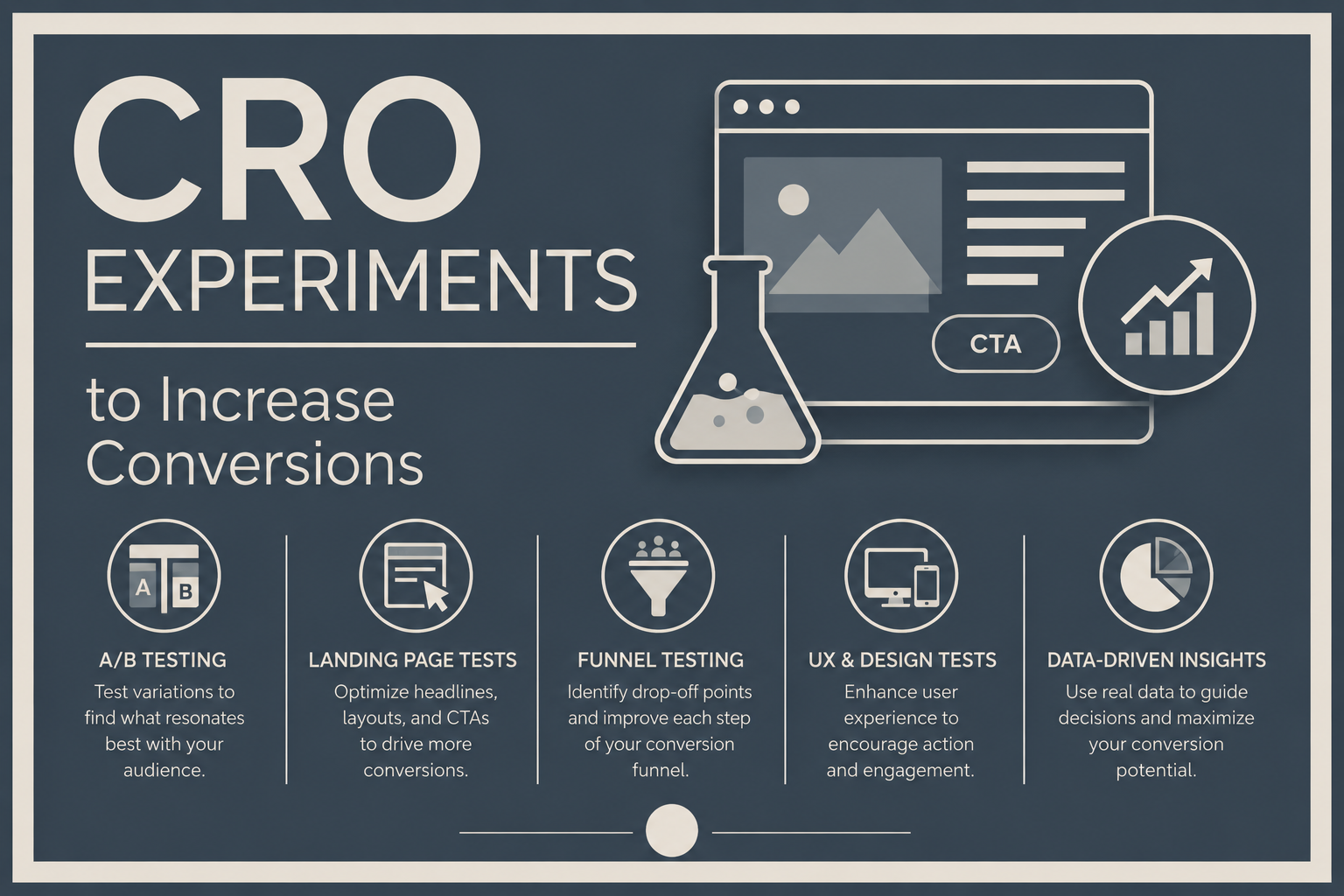
CRO is not about random design changes or guessing what users want. It is a structured process of studying user behavior, creating ideas, testing changes, and improving results based on data.
Table of Contents
- What Is Conversion Rate Optimization (CRO)?
- Why CRO Matters for Business Growth
- How CRO Experiments Work: Testing, Analysis, and Optimization Process
- CTA, Landing Page, and Headline Experiments to Increase Conversions
- Form, Demo Request, and Lead Generation Optimization Experiments
- Pricing Pages, Social Proof, and Trust-Building CRO Experiments
- Mobile, UX, and Conversion Funnel Optimization Experiments
- CRO Metrics, Tools, and Building a Testing Roadmap
- Conclusion
- Frequently Asked Questions
What Is Conversion Rate Optimization (CRO)?
Conversion Rate Optimization (CRO) is the process of improving a website or digital experience to increase the percentage of visitors who complete a desired action.
In simple words:
CRO helps businesses get more results from the traffic they already have.
A conversion can be any action important to the business, such as:
- Buying a product
- Filling a contact form
- Signing up for a newsletter
- Requesting a demo
- Creating an account
- Downloading a resource
Conversion Rate Explained with an Example
Imagine an ecommerce website receives:
10,000 visitors per month
Out of these:
200 people purchase
The conversion rate is:
200 ÷ 10,000 × 100 = 2%
If CRO improvements increase the conversion rate to 3%, the same website now generates:
300 purchases
without needing additional traffic.
This is why CRO can directly impact revenue.
CRO Explained Through a Simple Analogy
Imagine a restaurant.
The restaurant gets many visitors, but few people order food.
The owner studies the problem:
- Menu is confusing
- Prices are unclear
- Waiting time is long
- Popular dishes are not highlighted
After improvements, more visitors become customers.
CRO works the same way for websites.
Businesses identify problems, remove friction, and make the customer journey easier.
CRO vs Increasing Website Traffic
Many businesses focus only on:
“More visitors = more sales”
But the complete equation is:
Traffic × Conversion Rate = Results
Example:
Business A:
100,000 visitors
1% conversion rate
= 1,000 customers
Business B:
50,000 visitors
4% conversion rate
= 2,000 customers
The second business performs better because it converts visitors more effectively.
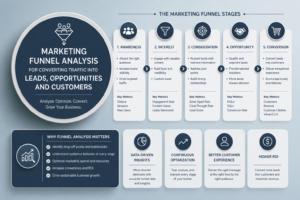
Conversion Funnel and User Journey
CRO focuses on improving different steps of the customer journey:
Visitor
↓
Interest
↓
Lead
↓
Customer
At every stage, users can leave.
CRO identifies where and why this happens.
Why CRO Matters for Business Growth
CRO is important because businesses often lose potential customers due to small problems.
A visitor may leave because:
- The message is unclear
- The page loads slowly
- The form is too long
- The pricing feels confusing
- There is not enough trust
CRO helps fix these issues.
Improving Revenue Without Increasing Traffic
One of the biggest advantages of CRO is efficiency.
Example:
A SaaS company spends money to generate 50,000 monthly visitors.
Current conversion rate:
2%
Customers:
1,000
After CRO:
Conversion rate improves to 3%
Customers:
1,500
The company gains 500 additional customers from the same traffic.
Reducing Customer Acquisition Costs
If more visitors convert, businesses spend less to acquire each customer.
Example:
Advertising cost:
$10,000
Customers generated:
100
Customer acquisition cost:
$100
After CRO:
150 customers
New acquisition cost:
$66.67
Improving User Experience
CRO is closely connected with user experience.
A better experience helps users:
- Understand products
- Find information
- Complete actions easily
Example: High Traffic but Low Signups
A website receives:
20,000 monthly visitors
But only:
100 signups
Possible problems:
- Weak headline
- Unclear benefit
- Poor CTA
- Wrong audience targeting
CRO helps discover the actual issue.
Example: Visitors Leaving Pricing Pages
A software company notices many users visit pricing pages but do not purchase.
Possible reasons:
Price Problem
Users understand the product but feel it is expensive.
Solutions:
- Add cheaper plans
- Explain value
- Show ROI
Positioning Problem
Users do not understand why the product is worth buying.
Solutions:
- Improve messaging
- Add use cases
- Show customer results
The same symptom can require different solutions.
How CRO Experiments Work: Testing, Analysis, and Optimization Process
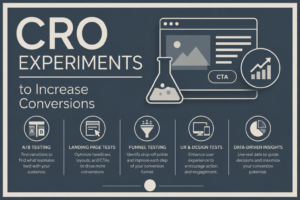
CRO experiments are structured tests designed to improve conversions.
A good CRO process follows:
Research
↓
Find Problem
↓
Create Hypothesis
↓
Test Change
↓
Analyze Results
↓
Improve
What Are CRO Experiments?
A CRO experiment compares different versions of a website element.
Example:
Version A:
“Start Free Trial”
Version B:
“Create Your Free Account Today”
The business tests which performs better.
Understanding User Behavior
Before making changes, businesses study:
- Where users click
- Where they leave
- Which pages they visit
- How they navigate
Tools like heatmaps and analytics help reveal behavior patterns.
Creating CRO Hypotheses
A hypothesis explains:
Problem:
“Visitors are not completing the signup form.”
Possible reason:
“The form asks for too much information.”
Test:
Reduce fields from 10 to 5.
Expected result:
More users complete the form.
A/B Testing Explained
A/B testing compares two versions.
Example:
Original landing page:
A
↓
New landing page:
B
Traffic is divided between both versions.
The better-performing version becomes the winner.
CTA, Landing Page, and Headline Experiments to Increase Conversions
Calls-to-action and landing pages are some of the biggest CRO opportunities.
CTA Button Testing
A CTA tells users what to do next.
Examples:
Weak:
“Submit”
Better:
“Get My Free Guide”
Better CTAs communicate value.
CTA Placement Testing
Businesses can test:
- Above the fold
- After product explanation
- Multiple locations
Example:
A demo CTA may perform better after explaining benefits rather than immediately appearing.
CTA Messaging Experiments
Small wording changes can impact conversions.
Examples:
“Buy Now”
vs
“Get Started Today”
The better choice depends on audience intent.
Landing Page Redesign Experiments
Landing pages should answer:
- What is the offer?
- Why should users care?
- What action should they take?
Tests include:
- Layout changes
- Images
- Headlines
- Benefits
- Testimonials
Headline Testing
The headline is often the first thing visitors see.
Example:
Generic:
“Project Management Software”
Better:
“Manage Your Team Projects Without Confusing Spreadsheets”
Clear value usually performs better.
Page Layout and Visual Hierarchy Testing
Businesses can test:
- Content order
- Images
- Navigation
- Section placement
The goal is making important information easier to find.
Form, Demo Request, and Lead Generation Optimization Experiments
Forms are common conversion points.
Small improvements can increase leads.
Reducing Form Length
Long forms create friction.
Example:
10 fields:
Name
Email
Phone
Company
Job title
Industry
Revenue
Location
Team size
Budget
Users may leave.
Testing fewer fields can improve completion rates.
Improving Form Design
Tests include:
- Clear labels
- Better error messages
- Simple layouts
- Progress indicators
Demo Request Optimization
For SaaS companies, demo requests are valuable conversions.
Improve:
- Demo page messaging
- Scheduling process
- Qualification questions
Improving Lead Quality Without Reducing Conversions
The goal is not only more leads.
Businesses need better leads.
Example:
Adding one qualification question may reduce submissions but improve sales quality.
Pricing Pages, Social Proof, and Trust-Building CRO Experiments
Trust strongly affects buying decisions.
Pricing Page Experiments
Businesses can test:
- Pricing layout
- Plan comparison
- Feature explanations
- Annual vs monthly options
Making Pricing Easier to Understand
Confusing pricing creates hesitation.
Good pricing pages explain:
- Who each plan is for
- Main benefits
- Differences between options
Social Proof Testing
Social proof reduces uncertainty.
Examples:
- Testimonials
- Reviews
- Customer logos
- Case studies
Case Study Placement Testing
A business may test:
Before:
Case studies at bottom
After:
Case studies near pricing section
The second option may increase confidence.
Trust Signal Experiments
Examples:
- Security badges
- Guarantees
- Ratings
- Customer numbers
Mobile, UX, and Conversion Funnel Optimization Experiments
Many users access websites through mobile devices.
Mobile Optimization Tests
Businesses can improve:
- Button size
- Page speed
- Navigation
- Checkout process
Improving User Experience
Common UX improvements:
- Clear navigation
- Faster pages
- Less distraction
- Easier actions
Finding Funnel Leaks
Example:
Website:
10,000 visitors
↓
1,000 product page views
↓
50 purchases
The biggest drop happens between product page and checkout.
That area needs attention.
CRO Metrics, Tools, and Building a Testing Roadmap
CRO requires measurement.
Important CRO Metrics
Conversion Rate
Percentage of visitors completing an action.
Click-Through Rate
Percentage clicking an element.
Bounce Rate
Visitors leaving without interaction.
Revenue Per Visitor
Revenue generated per visitor.
Customer Acquisition Cost
Cost to gain a customer.
CRO Tools
Businesses use tools for:
- Analytics
- Heatmaps
- User recordings
- A/B testing
- Customer feedback
Building a CRO Testing Roadmap
A practical approach:
- Find biggest problems
- Prioritize high-impact tests
- Run experiments
- Measure results
- Repeat
Conclusion
Conversion Rate Optimization helps businesses improve results without depending only on increasing traffic. By testing CTAs, landing pages, forms, pricing pages, social proof, and user experiences, businesses can discover what prevents visitors from becoming customers.
Successful CRO is not about making random changes. It is about understanding user behavior, testing ideas, and continuously improving the customer journey.
As businesses become more data-driven, CRO will become increasingly important for improving revenue, reducing acquisition costs, and creating better digital experiences.
Frequently Asked Questions
What is Conversion Rate Optimization?
Conversion Rate Optimization is the process of improving a website to increase the percentage of visitors who complete desired actions.
What is an example of CRO?
Changing a CTA button from “Submit” to “Download Free Guide” and testing whether more users click is an example of CRO.
How does CRO work?
CRO works by analyzing user behavior, identifying problems, testing improvements, and measuring results.
What are CRO experiments?
CRO experiments are tests where businesses compare different versions of website elements to improve conversions.
What is A/B testing?
A/B testing compares two versions of a page or element to see which performs better.
How can I increase website conversions?
Businesses can improve conversions through better messaging, landing pages, CTAs, forms, trust signals, and user experience.
What affects conversion rates?
Factors include website design, pricing, messaging, trust, user experience, and audience relevance.
What are the best CRO tools?
Common CRO tools include analytics platforms, heatmap tools, user behavior tools, and A/B testing software.
How long should CRO tests run?
Testing time depends on traffic volume and conversion rates. Businesses should collect enough data before making decisions.
What are common CRO mistakes?
Common mistakes include testing without data, changing too many things at once, and focusing only on design instead of user needs.