



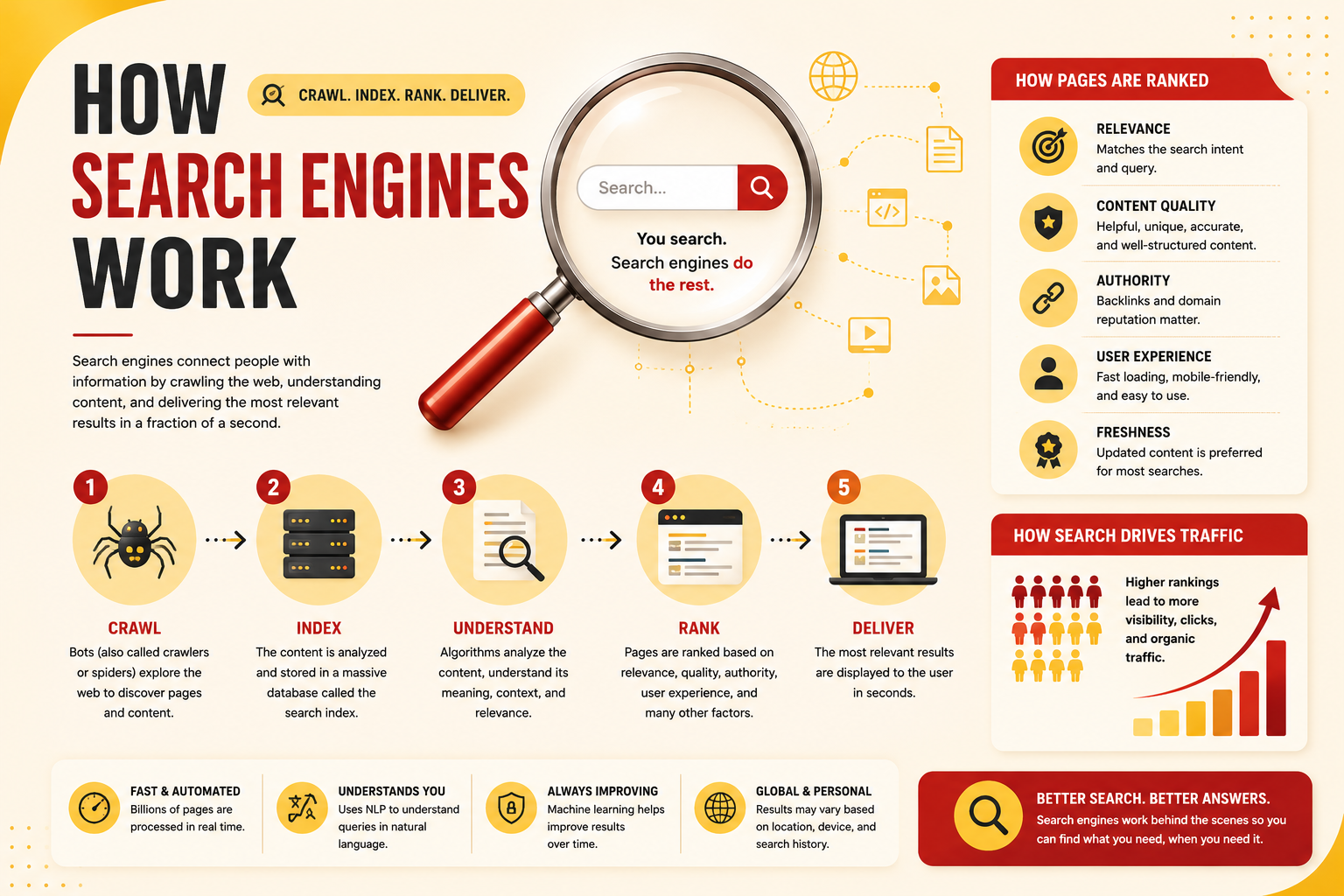
Search engines help users find information by processing search queries and retrieving relevant results from a vast collection of webpages, documents, and online resources. This process, known as information retrieval, involves understanding the meaning behind a search query, matching it with relevant content, and presenting the most useful results.
Search engines use complex algorithms to analyze factors such as relevance, content quality, authority, user experience, and context to determine rankings. Pages that provide valuable, well-structured, and trustworthy information are more likely to appear higher in search results.
Higher rankings increase visibility, helping websites attract organic traffic from users actively searching for related topics, products, or services. By optimizing content for search intent, keywords, technical performance, and overall user experience, businesses can improve their chances of being discovered. Effective search engine optimization (SEO) helps bridge the gap between user searches and relevant content, driving consistent traffic and growth.
Table of Contents
- What Is a Search Engine? Understanding How Search Works
- How Search Engines Work
- How Search Algorithms Decide What Users See
- Organic Search vs Paid Search
- How Businesses Can Improve Search Engine Visibility
- The Future of Search Engines: AI Search and Changing Search Behavior
- Conclusion
- Frequently Asked Question
What Is a Search Engine? Understanding How Search Works
A search engine is a technology platform that helps users find information on the internet by searching through billions of webpages, documents, images, videos, and other online content.
When someone types a query into a search engine, the system analyzes the request, finds relevant information, and displays the most useful results.
Examples of search engines include:
- Bing
- Yahoo
- DuckDuckGo
- Baidu
- Yandex
Among these, Google is the most widely used search engine globally and has become the primary platform businesses focus on for online visibility.
A simple definition:
A search engine is a system that discovers, organizes, and ranks online information so users can quickly find relevant answers.
Search Engines as Digital Libraries
A simple way to understand search engines is to compare them with a library.
Imagine walking into a massive library containing billions of books.
You ask the librarian:
“Which books explain digital marketing strategies?”
The librarian does not randomly hand you books. They:
- Understand your question
- Search their catalog
- Identify relevant books
- Recommend the most useful ones
Search engines work in a similar way.
The internet is the library.
Websites are the books.
Search engines are the librarians.
However, instead of manually reading every website, search engines use automated systems called crawlers, indexes, and ranking algorithms.
Why Search Engines Matter for Businesses
For businesses, search engines are one of the biggest sources of online discovery.
A customer may search:
- “best accounting software for small businesses”
- “digital marketing agency near me”
- “how to improve website traffic”
If your website appears in those search results, you have an opportunity to attract potential customers.
Search visibility helps businesses:
- Generate organic traffic
- Increase brand awareness
- Reach new customers
- Build credibility
- Generate leads and sales
This is why SEO (Search Engine Optimization) exists.
SEO is the process of improving a website so search engines can better understand it and users can find it more easily.
How Search Engines Work: Crawling, Indexing and Ranking
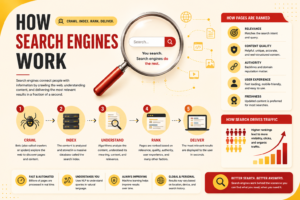
At a basic level, search engines work through three major processes:
- Crawling
- Indexing
- Ranking
Crawling is all about how search engines discover new and updated content.
Indexing is about how search engines store and understand that content.
Ranking is about how search engines decide which content appears first for a search query.
The complete flow looks like this:
Website → Search Engine Crawler → Search Engine Index → Ranking Algorithm → Search Results Page
Search Engine Crawling: How Websites Are Discovered
Crawling is the process where search engines discover webpages and collect information about them.
Search engines use automated programs called:
- Crawlers
- Bots
- Spiders
Google’s crawler is commonly known as Googlebot.
These bots continuously scan the internet to find:
- New websites
- New pages
- Updated content
- Broken links
- Website changes
How Do Search Engines Find New Websites?
Search engines discover websites through several methods.
1. Links From Other Websites
Links act like pathways between websites.
For example:
A popular marketing website links to your SEO guide.
A search engine crawler follows that link and discovers your page.
This is one reason backlinks are important in SEO.
2. XML Sitemaps
A sitemap is a file that tells search engines about important pages on your website.
It helps search engines understand:
- Which pages exist
- When pages were updated
- How content is organized
3. Website Submissions
Businesses can also submit websites through tools like Google Search Console.
This helps search engines understand website ownership and monitor performance.
Common Crawling Problems
Sometimes search engines cannot properly discover pages. Common issues include:
- Broken links
- Poor website structure
- Incorrect robots.txt settings
- No internal links
- Slow website performance
If a page cannot be crawled, it may never appear in search results.
Search Engine Indexing: How Search Engines Understand Content
After crawling a webpage, search engines decide whether to store it in their database.
This process is called indexing.
The search engine index is like a giant database containing information about webpages.
When Google indexes a page, it analyzes:
- Page content
- Keywords
- Topic
- Images
- Links
- Website information
- User experience factors
Crawling vs Indexing: What Is the Difference?
Many beginners confuse these concepts.
Crawling: Finding the page. Example:
A search engine discovers your new blog post.
Indexing: Understanding and storing the page. Example:
Google analyzes your article and adds it to its database.
A page can be crawled but not indexed if search engines believe it provides little value or has technical issues.
Why Some Pages Do Not Appear in Google Search
A webpage may not appear because:
- It has not been indexed yet
- It provides low-quality content
- It has duplicate content
- Technical settings block search engines
- The website has weak authority
This is why SEO involves both content improvement and technical optimization.
Search Engine Ranking: How Websites Appear in Results
Ranking is the process of deciding where webpages appear in search results.
When someone searches:
“best email marketing software”
Google does not show every page it knows about.
Instead, it ranks pages based on:
- Relevance
- Quality
- Authority
- User experience
- Search intent
The page considered most useful appears higher.
Understanding Search Engine Results Pages (SERPs)
The page showing search results is called the Search Engine Results Page (SERP).
A SERP may include:
- Organic results
- Paid advertisements
- Featured snippets
- Maps
- Images
- Videos
- People Also Ask sections
- AI-generated answers
Modern search visibility is no longer only about ranking position one.
Businesses can appear through multiple SERP features.
How Search Algorithms Decide What Users See
Search algorithms are complex systems that evaluate billions of webpages and determine the most relevant results.
An algorithm is essentially a set of rules and calculations used to solve a problem.
In search, the problem is:
“Which information best answers this user’s question?”
What Are Search Algorithms?
Search algorithms analyze different signals to determine rankings.
These signals help search engines understand:
- What a page is about
- Whether it is trustworthy
- Whether users find it helpful
Google uses hundreds of ranking signals, although the exact formula is not publicly available.
The Importance of Search Intent
Search intent means the reason behind a search.
Search engines try to understand what users actually want.
Example:
Search:
“best laptops”
The user probably wants:
- Comparisons
- Reviews
- Recommendations
Not a technical explanation of what laptops are.
Matching search intent is one of the most important parts of SEO.
Information Retrieval: How Search Engines Find Answers
Information retrieval is the technology behind finding relevant information from huge databases.
Search engines analyze:
- Words
- Meaning
- Relationships between topics
- Context
Modern search engines no longer depend only on exact keyword matches.
They use semantic understanding to identify meaning.
For example:
A page about:
“improving website visitors”
may also rank for:
“increase online traffic”
because search engines understand these concepts are related.
Factors Influencing Search Engine Visibility
Search rankings depend on many factors.
Some of the most important ones include:
1. Content Quality and Relevance
Search engines prioritize content that provides useful answers.
High-quality content usually:
- Answers questions clearly
- Provides accurate information
- Covers topics deeply
- Helps users solve problems
Businesses should focus on creating content for users first.
2. Keywords and Topic Relevance
Keywords help search engines understand topics.
However, SEO is not about repeating keywords.
Modern SEO focuses on:
- Topic coverage
- Related concepts
- User intent
Example:
A guide about “email marketing” may include:
- Email automation
- Newsletters
- Segmentation
- Campaign strategy
3. Website Authority
Authority refers to how trustworthy a website appears.
Search engines evaluate signals such as:
- Backlinks
- Brand mentions
- Expertise
- Content quality
A website consistently creating valuable content can build stronger authority over time.
4. User Experience
Search engines care about how users interact with websites.
Important factors include:
- Mobile friendliness
- Website speed
- Easy navigation
- Clear structure
A good user experience helps visitors find information quickly.
5. Technical SEO
Technical SEO focuses on improving the foundation of a website.
Examples:
- Website speed
- Indexability
- Structured data
- Security
- Mobile optimization
Technical issues can prevent good content from performing well.
Organic Search vs Paid Search
Businesses can appear in search results in two main ways:
- Organic search
- Paid search
Organic Search
Organic results are unpaid listings.
Businesses earn visibility through SEO.
Benefits:
- Long-term traffic
- Higher trust
- Sustainable growth
However, SEO requires time and consistent effort.
Paid Search
Paid search involves advertisements.
Example:
Google Ads allows businesses to pay for placement above organic results.
Benefits:
- Faster visibility
- Targeted audiences
- Immediate traffic
However, traffic stops when advertising stops.
What Is Search Engine Marketing (SEM)?
Search Engine Marketing refers to using paid advertising to increase visibility on search engines.
SEM commonly includes:
- Google Ads
- Paid search campaigns
- Shopping ads
SEO and SEM are often used together.
SEO builds long-term visibility.
SEM provides immediate exposure.
How Businesses Can Improve Search Engine Visibility
Businesses can improve visibility by building a strong SEO foundation.
Important steps include:
Create Helpful Content
Answer customer questions through:
- Blogs
- Guides
- Resources
Optimize Website Structure
Make it easy for search engines and users to navigate.
Use:
- Clear menus
- Internal links
- Organized pages
Understand Audience Searches
Research:
- Keywords
- Problems
- Questions
- Buying behavior
Monitor Performance
Use tools like:
- Google Search Console
- Google Analytics
Track:
- Traffic
- Rankings
- Clicks
- Conversions
Common Search Engine Misconceptions
“Ranking Is Permanent”
Search rankings change because:
- Competitors improve
- Search algorithms update
- User behavior changes
“More Keywords Means Better Rankings”
Keyword stuffing does not improve SEO.
Search engines reward useful content.
“Only Big Brands Can Rank”
Small businesses can rank by creating:
- Specific content
- Local SEO strategies
- Helpful resources
The Future of Search Engines: AI Search and Changing Search Behavior
Search engines are changing rapidly with artificial intelligence. AI search engines and AI-powered features are changing how users find information.
The future of search engines is moving beyond traditional keyword-based results toward more intelligent systems that understand context, meaning, and user intent. AI answer engines are transforming search by providing direct responses instead of only displaying a list of webpages. Advances in natural language processing (NLP) allow search systems to better understand conversational queries, complex questions, and the relationships between different topics.
Modern search is increasingly powered by semantic search, where engines focus on the meaning behind words rather than exact keyword matches. Vector-based search enables AI systems to understand similarities between concepts, content, and user queries by analyzing patterns and relationships in large datasets. Generative search combines search technology with generative AI to create detailed responses by extracting and synthesizing information from multiple sources.
As AI models become more advanced, they will rely on content extraction to identify valuable information from webpages, documents, and structured data. Search experiences will become more contextual, personalized, and capable of understanding user goals, preferences, and previous interactions. At the same time, citations and references will become increasingly important as AI-generated answers need to show where information comes from and improve trust.
For businesses and content creators, the future of search will require creating accurate, authoritative, and well-structured content that AI systems can understand, extract, and reference. Optimizing for search will no longer be only about ranking for keywords but about becoming a reliable source that AI platforms can use when generating answers.
Examples include:
- AI-generated answers
- Conversational search
- Personalized recommendations
Users are increasingly asking longer questions.
Instead of:
“SEO tools”
they may search:
“What are the best SEO tools for a small business website?”
Future search will focus more on:
- Context
- User intent
- Experience
- Authority
- Helpful answers
Businesses will need to focus less on manipulating rankings and more on becoming reliable sources of information.
Conclusion
Search engines are the connection between people looking for information and businesses offering solutions.
Understanding how search engines work helps businesses create better websites, better content, and better customer experiences.
The journey is simple:
Search engines discover websites through crawling, organize information through indexing, and show results through ranking algorithms.
For businesses, visibility depends on creating useful content, improving website quality, understanding customer intent, and building trust.
SEO is not about tricking search engines.
It is about helping search engines understand your value so they can connect you with the right audience.
Frequently Asked Questions
What is a search engine?
A search engine is a platform that helps users find information online by discovering, organizing, and ranking webpages based on relevance.
What are the top 5 search engines?
Some of the most popular search engines include:
- Bing
- Yahoo
- Baidu
- Yandex
What is search engine crawling?
Search engine crawling is the process where automated bots discover webpages and collect information about them.
What is search engine indexing?
Search engine indexing is the process of storing and organizing webpage information so it can appear in search results.
What are search algorithms?
Search algorithms are systems that analyze webpages and decide which results best match a user’s query.
How do search engines rank websites?
Search engines rank websites based on factors such as:
- Relevance
- Content quality
- Authority
- User experience
- Technical SEO
What is search engine marketing?
Search engine marketing (SEM) involves using paid advertising on search engines to increase website visibility.
Why is my website not appearing on Google?
Common reasons include:
- Website not indexed
- Technical problems
- Weak content
- Low authority
- Poor SEO optimization
What is the difference between SEO and SEM?
SEO focuses on improving unpaid organic rankings.
SEM focuses on paid search advertising.
How do AI search engines work?
AI search engines use artificial intelligence to understand user questions, analyze information, and provide more conversational answers.