


Marketing is the process of understanding customer needs, communicating value, building relationships, and encouraging people to choose your product or service. Contrary to popular belief, marketing is not just advertising or social media. It is the entire process of attracting potential customers, converting them into buyers, and keeping them engaged so they continue buying from your business.
Think of marketing as building and maintaining a relationship. You first introduce yourself, then build trust, demonstrate value, solve problems, and eventually create loyal customers who recommend you to others.
Imagine you own a restaurant.
Simply opening the doors doesn’t guarantee customers will arrive.
You need to:
- Help people discover your restaurant.
- Explain why your food is worth trying.
- Convince them to visit.
- Deliver a great experience.
- Encourage them to return.
That entire process is marketing.
Now replace “restaurant” with:
- An ecommerce store
- A SaaS company
- A consulting business
- A local service business
- A startup
The same principles apply.
Marketing helps businesses attract attention, build trust, generate sales, and create long-term customer relationships.
Table of Contents
- What is Marketing?
- How Marketing Works in the Digital Space?
- Important Marketing Concepts
- Understanding the Customer Journey and Marketing Funnel
- Top Marketing Strategies
- Omnichannel Marketing
- Marketing Metrics and Analytics
- Marketing Tools and Platforms
- FAQs
What is Marketing?
Marketing is the process of connecting a business with people who need its products or services.
At its core, marketing answers four simple questions:
Who are our customers?
What problems do they have?
How can we solve those problems?
Why should they choose us?
Everything in marketing ultimately revolves around answering these questions.
Why Every Business Needs Marketing
A great product alone is rarely enough.
Consider two coffee shops:
Coffee Shop A serves excellent coffee but does no marketing.
Coffee Shop B serves similar coffee but actively communicates its story, shares customer reviews, runs promotions, and engages with customers online.
Which business is likely to attract more customers?
Most people would choose Coffee Shop B.
Marketing creates visibility.
Visibility creates opportunities.
Opportunities create revenue.
Marketing Is Not Just Advertising
Many beginners think marketing means running ads.
Advertising is only one component.
Marketing includes:
- Market research
- Branding
- Positioning
- Content creation
- Email marketing
- SEO
- Social media
- Customer retention
- Analytics
- Customer experience
Advertising is simply one tool within a much larger marketing system.
How Marketing Works in the Digital Space?
Digital marketing follows a relatively simple flow.
Business Creates Value
↓
Audience Discovers Business
↓
Interest Develops
↓
Trust Builds
↓
Purchase Happens
↓
Customer Returns
↓
Customer Refers Others
Every marketing activity supports one or more stages in this journey.
The Modern Digital Customer Journey
Today’s customer rarely buys immediately.
Instead, they follow a path.
For example:
A small business owner searches Google for accounting software.
↓
Reads a blog article.
↓
Watches a YouTube review.
↓
Joins an email newsletter.
↓
Receives educational emails.
↓
Books a demo.
↓
Purchases software.
Marketing influences every stage of this process.
Important Marketing Concepts
Understanding these concepts creates a strong foundation for every marketing decision.
Target Audience
A target audience is the specific group of people a business wants to reach.
Not everyone is your customer.
For example:
A luxury watch brand targets different customers than a discount retailer.
Trying to market to everyone often results in marketing to nobody effectively.
Questions to Define a Target Audience
- Who are they?
- What challenges do they face?
- What goals do they have?
- What influences their decisions?
The clearer your audience definition, the more effective your marketing becomes.
Buyer Persona
A buyer persona is a detailed profile of your ideal customer.
Think of it as creating a character.
Example:
Sarah
- 35 years old
- Owns a small business
- Wants more customers
- Has limited marketing knowledge
- Reads business blogs
- Uses LinkedIn
Marketing becomes easier when you imagine speaking directly to Sarah instead of a vague audience.
Customer Segmentation
Segmentation means dividing customers into smaller groups.
Not all customers behave the same way.
Common segments include:
Demographic Segmentation: Age, gender, income, education.
Geographic Segmentation: Country, city, region.
Behavioral Segmentation: Purchase behavior, engagement level, interests.
Psychographic Segmentation: Lifestyle, values, attitudes.
Segmentation improves personalization and campaign performance.
Value Proposition
A value proposition explains why customers should choose your business.
It answers:
“What makes us different?”
Examples:
- Faster delivery
- Lower prices
- Better customer service
- Higher quality
- Unique expertise
Strong value propositions reduce customer hesitation.
Branding
Branding is how customers perceive your business.
Many people think branding means logos and colors.
Those are only visual elements.
A brand is the feeling people associate with your business.
Examples:
- Reliability
- Innovation
- Luxury
- Simplicity
- Trust
Strong brands often command higher prices because customers trust them.
Positioning
Positioning determines where your brand fits in customers’ minds.
Consider automobiles.
Some brands position themselves as:
- Affordable
- Luxury
- Performance-focused
- Family-friendly
Positioning influences how customers compare alternatives.
Lead Generation
Lead generation is the process of attracting potential customers.
Examples include:
- Blog content
- Webinars
- Email signups
- Free tools
- Downloads
- Product demos
Without lead generation, sales pipelines eventually dry up.
Lead Nurturing
Not every lead is ready to buy immediately.
Lead nurturing involves educating and building trust over time.
Example:
A prospect downloads an ebook.
↓
Receives educational emails.
↓
Attends a webinar.
↓
Books a consultation.
↓
Becomes a customer.
Nurturing helps move prospects toward purchasing decisions.
Lead Scoring
Lead scoring helps businesses prioritize opportunities.
Each action receives points.
Example:
Downloaded ebook = 10 points
Visited pricing page = 20 points
Booked demo = 50 points
Higher scores indicate stronger buying intent.
Sales teams can focus on the most promising prospects.
MQLs and SQLs
These are common marketing and sales terms.
MQL (Marketing Qualified Lead)
Someone who has shown interest but isn’t ready to buy yet.
Examples:
- Downloaded a guide
- Joined a newsletter
- Attended a webinar
SQL (Sales Qualified Lead)
Someone showing clear purchase intent.
Examples:
- Requested a demo
- Asked for pricing
- Contacted sales
MQL
↓
Lead Nurturing
↓
SQL
↓
Customer
This transition is one of the most important goals in modern marketing.
BANT Framework
Sales and marketing teams often use BANT to evaluate prospects.
BANT stands for:
Budget
Can they afford the solution?
Authority
Can they make purchasing decisions?
Need
Do they genuinely need the solution?
Timing
Are they ready to buy now?
The stronger the BANT criteria, the higher the likelihood of conversion.
Understanding the Customer Journey and Marketing Funnel
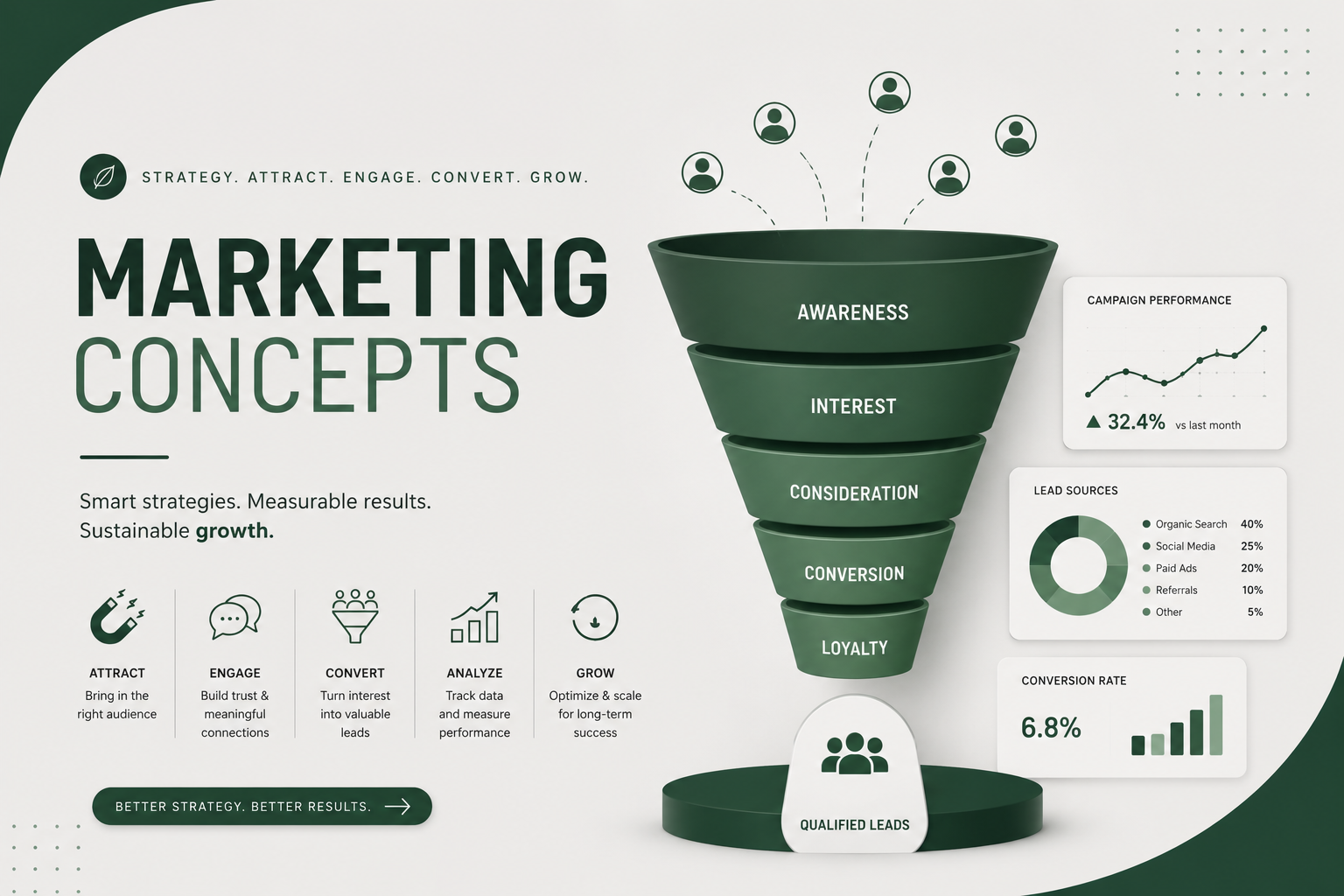
One of the most important concepts in marketing is the funnel.
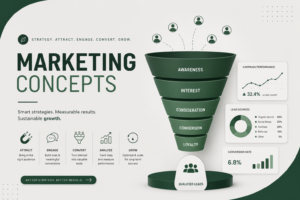
A marketing funnel visualizes how people move from awareness to purchase.
The Basic Marketing Funnel
Awareness
↓
Interest
↓
Consideration
↓
Decision
↓
Purchase
↓
Retention
Awareness
Customers discover your brand.
Examples:
- Search engines
- Social media
- Referrals
- Advertising
Interest
Prospects begin learning more.
Consideration
They compare alternatives.
Decision
They decide whether to purchase.
Purchase
The customer buys.
Retention
The customer continues buying.
Funnel Analysis
Funnel analysis identifies where prospects drop off.
Example:
10,000 Website Visitors
↓
1,000 Leads
↓
200 Sales Calls
↓
50 Customers
If conversions drop significantly between stages, marketers investigate the cause.
Possible issues:
- Weak messaging
- Poor lead quality
- Complicated forms
- Pricing concerns
Understanding these bottlenecks often creates the biggest growth opportunities.
Revenue Growth Formula
Every business should understand one critical equation:
Revenue = Traffic \times Conversion\ Rate \times Average\ Deal\ Value
When revenue slows, the problem usually falls into one of three categories:
Traffic Problem
Not enough people are finding the business.
ConversionProblem
Visitors are not becoming customers.
Value Problem
Customers are spending too little.
This simple formula helps diagnose many business growth challenges.
Marketing primarily improves all three variables simultaneously.
Omnichannel Marketing
Modern customers rarely use just one channel. Omnichannel marketing, however, focuses on creating a seamless and consistent customer experience across multiple channels and touchpoints, both online and offline. It includes integrating digital marketing channels and physical marketing presence into a single ecosystem.
What are Marketing Channels?
Marketing channels are the various platforms, methods, and mediums that businesses use to communicate with potential customers and promote their products or services. They act as pathways that connect a brand with its target audience and help businesses build awareness, generate leads, and drive sales.
Most successful companies use multiple marketing channels together because customers often interact with brands across several touchpoints before making a purchase.
Here are some of the most commonly used digital marketing channels:
Search Engine Optimization (SEO)
SEO focuses on improving a website’s visibility in search engine results and attracting long-term organic traffic. It is often considered a sustainable marketing channel because high-quality content can continue generating visitors for years. For example: A travel blog ranks for “best places to visit in June” and receives thousands of visitors every month from Google.
Social Media
Social media enables businesses to build communities, engage directly with customers, and share content in real time. Different platforms serve different purposes, from professional networking to entertainment and visual storytelling.
Email Marketing
Email marketing helps businesses maintain direct communication with subscribers and nurture relationships over time. It is widely used for newsletters, promotions, and personalized customer engagement.
Paid Advertising
Paid advertising allows businesses to quickly increase visibility by paying to reach specific audiences across search engines, websites, and social platforms. Its precise targeting and measurable results make it one of the most controllable marketing channels. For example, a local restaurant runs Facebook ads targeting people within a 10-kilometre radius.
Content Marketing
Content marketing focuses on creating valuable and informative content that attracts, educates, and builds trust with potential customers. Rather than promoting products directly, it aims to provide useful information that encourages long-term engagement. For example, a software company publishes detailed guides explaining cybersecurity best practices.
Affiliate Marketing
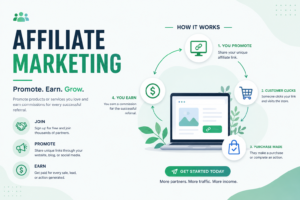
Affiliate marketing enables businesses to expand their reach by partnering with individuals or publishers who promote products in exchange for commissions. This performance-based approach can generate sales without significant upfront advertising costs. For example, a technology blogger earns commissions by recommending laptops and software products.
Video and Podcast Marketing
Video and podcast marketing allow brands to communicate ideas in more engaging and personal formats. They are particularly effective for storytelling, education, interviews, and building deeper audience connections. For example, a finance company hosts a weekly podcast discussing investment trends and market insights.
Influencer Marketing
Influencer marketing leverages the credibility and reach of content creators to introduce products and services to highly engaged audiences. Successful campaigns often depend on authenticity and a strong alignment between the influencer and the brand.
Each channel plays a different role within the customer journey.
A typical customer journey might look like this:
Google Search
↓
Blog Article
↓
YouTube Video
↓
Instagram Profile
↓
Email Newsletter
↓
Product Demo
↓
Purchase
This is why businesses increasingly adopt omnichannel marketing.
What Is Omnichannel Marketing?
Omnichannel marketing creates a consistent customer experience across multiple channels. By integrating channels such as websites, phone messaging, social media, email, and physical stores, businesses can deliver more personalized experiences and build stronger customer relationships.
The customer experiences one connected brand rather than separate marketing activities.
Example of Omnichannel Marketing
Imagine a customer:
- Discovers your business through Instagram
- Visits your website
- Downloads a guide
- Receives emails
- Sees retargeting ads
- Schedules a call
Every interaction should feel connected.
The message, positioning, and customer experience should remain consistent.
Benefits of Omnichannel Marketing
Better Customer Experience: Customers enjoy smoother interactions.
Higher Conversion Rates: Multiple touchpoints increase trust.
Improved Retention: Customers stay engaged longer.
Better Data Collection: Businesses gain deeper insights into customer behavior.
Marketing Metrics and Analytics
One of the biggest differences between amateur and professional marketing is measurement.
Professional marketers track performance. They don’t guess.
Customer Acquisition Cost (CAC)
CAC measures how much it costs to acquire a customer.
Formula:
Marketing Spend ÷ New Customers
Example:
$10,000 spent
100 customers acquired
CAC = $100
The lower your CAC, the more efficient your marketing.
Customer Lifetime Value (LTV)
LTV estimates how much revenue a customer generates throughout their relationship with your business.
Example:
Customer spends:
$50 per month
for 24 months
LTV = $1,200
Understanding LTV helps businesses determine how much they can afford to spend acquiring customers.
CAC to LTV Ratio
This is one of the most important business metrics.
A healthy business generally aims for:
LTV significantly greater than CAC.
Example:
CAC = $100
LTV = $1,200
Ratio = 1:12
This indicates strong economics.
If CAC exceeds LTV, growth becomes difficult.
Return on Investment (ROI)
ROI measures overall profitability.
Formula:
Profit Generated
÷
Marketing Investment
ROI helps determine whether marketing activities create value.
Return on Ad Spend (ROAS)
ROAS measures advertising effectiveness.
Formula:
Revenue Generated
÷
Advertising Spend
Example:
$10,000 revenue
$2,000 ad spend
ROAS = 5x
Meaning every dollar spent generated five dollars in revenue.
Retention Rate
Retention measures how many customers continue doing business with you.
High retention often signals:
- Strong products
- Good customer experience
- Effective relationship management
Churn Rate
Churn measures customer loss.
Example:
100 customers
10 cancel
Churn = 10%
Reducing churn often creates faster growth than acquiring new customers.
Cohort Analysis
Cohort analysis groups customers based on shared characteristics.
Example:
January Customers
↓
Track behavior over 12 months
Compare against:
February Customers
↓
Track behavior over 12 months
This reveals:
- Retention trends
- Revenue patterns
- Product improvements
- Marketing effectiveness
Cohort analysis helps businesses understand long-term customer behavior.
Marketing Tools and Platforms
Marketing becomes increasingly difficult without technology.
Modern businesses use specialized tools to manage customers, automate processes, and analyze performance.
CRM Platforms
CRM stands for Customer Relationship Management.
Think of a CRM as a central customer database.
It stores:
- Contact information
- Conversations
- Purchases
- Sales opportunities
- Marketing interactions
Popular CRM Platforms
- HubSpot
- Salesforce
- Zoho CRM
- Microsoft Dynamics 365
Without a CRM, businesses often lose track of opportunities.
Marketing Automation Platforms
Marketing automation helps businesses scale communication.
Examples:
Lead Nurturing: Automatically send educational emails.
Customer Onboarding: Guide new customers through setup.
Follow-Up Campaigns: Maintain engagement automatically.
Popular platforms include:
- Marketo
- HubSpot Marketing Hub
- ActiveCampaign
Automation allows businesses to communicate consistently without manual effort.
Customer Behavior Analytics Tools
These tools help businesses understand how people interact with websites and products.
Popular Platforms
- Mixpanel
- PostHog
- FullStory
- Amplitude
- Contentsquare
Questions these tools answer:
- Where do users drop off?
- Which features are popular?
- Which pages convert best?
- Why are customers leaving?
Business Intelligence and Data Visualization Platforms
Data becomes valuable when it is understandable.
BI platforms transform raw data into dashboards and reports.
Popular solutions include:
- Microsoft Power BI
- Tableau
- Domo
- Looker Studio
These platforms help leaders make informed decisions.
Common Marketing Mistakes
Even experienced businesses make marketing mistakes.
Trying to Target Everyone
Specific audiences outperform broad audiences.
Ignoring Customer Needs
Marketing should solve customer problems, not promote business features endlessly.
Focusing Only on Acquisition
Growth doesn’t come solely from acquiring customers.
Retention often drives the highest profits.
Not Measuring Results
Without metrics, improvement becomes difficult.
Poor Positioning
If customers cannot quickly understand your value, conversions suffer.
Overcomplicating Marketing
Simple, customer-focused communication usually performs better than complex messaging.
Conclusion
Marketing is not simply advertising, social media, or sales. It is the complete system businesses use to attract attention, build trust, generate revenue, and create long-term customer relationships. Whether you operate a local business, startup, ecommerce store, consulting firm, or global enterprise, the same core principles apply.
The businesses that grow consistently understand their customers, communicate clear value, guide prospects through well-designed funnels, measure performance carefully, and invest in long-term relationships. By mastering concepts such as positioning, segmentation, lead nurturing, CRM systems, omnichannel marketing, customer retention, and analytics, business owners can make better decisions and build more predictable growth engines.
Marketing changes constantly, but these core concepts remain timeless. Master them, and you’ll have a foundation that supports business growth regardless of industry, platform, or technology.
Frequently Asked Questions (FAQs)
What Is the Most Important Marketing Concept?
Understanding customer needs is the foundation of all successful marketing.
What Is a Marketing Funnel?
A funnel describes the stages customers move through before making a purchase.
What Is Lead Generation?
Lead generation is the process of attracting potential customers.
What Is Lead Nurturing?
Lead nurturing builds trust and educates prospects until they are ready to buy.
What Is a Buyer Persona?
A buyer persona is a detailed representation of an ideal customer.
What Is the Difference Between an MQL and SQL?
An MQL shows marketing engagement, while an SQL demonstrates stronger buying intent and sales readiness.
Why Is Customer Retention Important?
Retaining customers is often less expensive than acquiring new ones and typically increases profitability.
What Is Omnichannel Marketing?
Omnichannel marketing creates a consistent customer experience across multiple channels and touchpoints.
What Is CAC?
Customer Acquisition Cost measures how much it costs to acquire a new customer.
What Is LTV?
Customer Lifetime Value estimates the total revenue generated by a customer over time.
Why Is CAC to LTV Ratio Important?
It helps determine whether customer acquisition efforts are financially sustainable.
What Is CRO?
Conversion Rate Optimization improves the percentage of visitors who take desired actions.
Do Small Businesses Need CRM Software?
As businesses grow, CRM platforms become increasingly valuable for managing customer relationships and opportunities.
What Is Marketing Automation?
Marketing automation uses software to automate communication, lead nurturing, and customer engagement processes.