



Imagine recommending your favourite restaurant to a friend. If the restaurant owner gave you a small commission every time someone visited because of your recommendation, you would be doing a form of affiliate marketing.
Affiliate marketing works in much the same way. It is a type of performance-based marketing in which individuals or businesses promote another company’s products or services and earn a commission whenever someone makes a purchase, signs up for a service, or completes a specific action through their referral link.
For example, suppose you run a technology blog and write an article titled “Best Laptops for Students.” You include links to the laptops you recommend. If a reader clicks one of those links and buys a laptop, you earn a commission from the retailer. Similarly, a fitness YouTuber might recommend a protein supplement and earn money every time viewers purchase the product using their special link.
Table of Contents
- What Is Affiliate Marketing?
- How Does Affiliate Marketing Work?
- Top Affiliate Networks and Programs
- Affiliate Marketing for promoting a Tool, Brand, or Course?
- How Bloggers and Creators Make Money with Affiliate Marketing
- Understanding Affiliate Funnels and Tracking
- Common Affiliate Marketing Mistakes to Avoid
- The Future of Affiliate Marketing
- Conclusion
- Frequently Asked Questions
What Is Affiliate Marketing?
Affiliate marketing is a performance-based marketing model where creators, publishers, and marketers earn commissions by promoting products or services. When someone purchases through their unique affiliate link, the affiliate earns a commission.
Search Engine Journal describes affiliate marketing as a way for publishers to earn commissions by promoting products or services, while brands gain additional exposure and sales.
Affiliate marketing is often compared to a digital version of word-of-mouth marketing. In the past, people recommended books, restaurants, or shops to friends simply because they liked them. Affiliate marketing adds a tracking system and a financial reward to this process.
Today, millions of bloggers, influencers, content creators, and businesses use affiliate marketing to generate income online. From travel and fashion to software and financial services, almost every industry now offers affiliate programs, making affiliate marketing one of the most accessible ways to earn money and grow businesses in the digital economy.
A Simple Real-World Analogy
Imagine your friend asks for a recommendation for a good laptop. You suggest a store and tell them: “If you buy from this store using my referral code, you’ll get a discount and I’ll receive a small referral reward.”
If your friend buys the laptop, the store rewards you.
That’s affiliate marketing. In simple terms, you are not the owner of the product. You are the referrer who brings customers.
Another Example
Suppose you run a blog about fitness. You write a review of a protein supplement.
A reader clicks your affiliate link and buys the supplement. The company tracks the sale and pays you a commission.
Here:
- You didn’t create the product.
- You didn’t handle shipping.
- You didn’t provide customer support.
- You simply connected a buyer with a product they needed.
How Does Affiliate Marketing Work?
Affiliate marketing involves four key participants:
1. The Merchant
Merchant here refers to the company selling the product or service.
Examples include:
- Software companies
- Ecommerce stores
- Online course creators
- SaaS platforms
2. The Affiliate
In affiliate marketing, affiliate is the person promoting the product.
Examples:
- Bloggers
- YouTubers
- Influencers
- Website owners
- Newsletter creators
3. The Customer
The person who clicks the affiliate link and purchases the product.
4. The Affiliate Network
A platform that connects merchants and affiliates.
Examples include:
- ShareASale
- CJ Affiliate
- Impact
- ClickBank
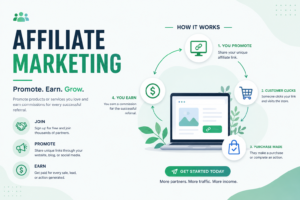
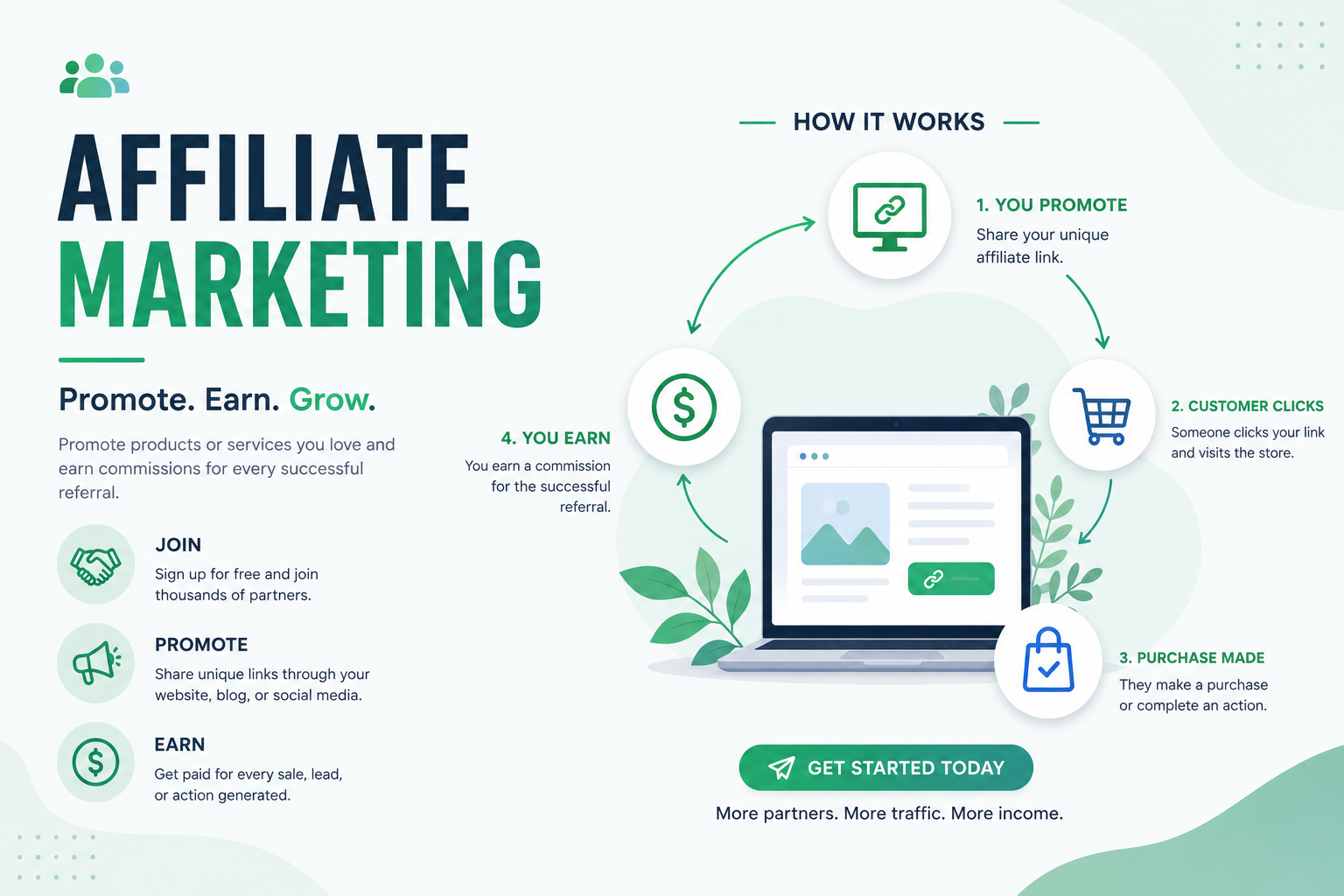
Here’s the Affiliate Marketing flow to help you understand the basic process:
Business Creates Product → Affiliate Joins Program → Affiliate Receives Tracking Link → Affiliate Creates Content → Audience Clicks Link → Customer Purchases → Sale Is Tracked → Affiliate Earns Commission
For affiliates, the process is much simpler:
Traffic → Content → Trust → Click → Purchase
This process allows companies to pay only for actual results rather than advertising impressions.
Top Affiliate Networks and Programs
Affiliate networks act as marketplaces where affiliates can discover products and merchants can recruit promoters.
Amazon Associates
Amazon Associates is one of the most popular affiliate programs.
It is best for:
- Product reviews
- Ecommerce blogs
- Technology websites
- Lifestyle creators
ShareASale
ShareASale offers thousands of affiliate programs across different industries.
It is ideal for:
- Bloggers
- Niche websites
- Content creators
CJ Affiliate
CJ Affiliate is a large affiliate network with many established brands.
It is best for:
- Experienced affiliates
- Professional publishers
Impact
Impact is popular among SaaS companies and online businesses.
It is best for:
- Software affiliates
- B2B marketers
- Bloggers
ClickBank
Known for digital products and online courses.
Best for:
- Education
- Personal development
- Digital marketing niches
PartnerStack
Specializes in SaaS and software affiliate programs.
Best for:
- Tech creators
- Marketing professionals
Apart from these, some companies run their own direct affiliate programs. These often pay higher commissions because there is no middle network. These include SaaS tools, hosting companies and online course platforms.
Affiliate Marketing for Promoting a Tool, Brand, or Course
Affiliate marketing works best when recommendations solve real problems. For businesses, affiliate marketing is particularly attractive as they don’t have to pay any advertising upfront and give commissions only where a product or service is sold. They rely on different commission models for content creators. These include:
1. Percentage commission: Example: 5%–20% of product price.
2. Fixed payout: Example: ₹500 per signup.
3. Recurring commission: Example: Monthly payment for subscriptions.
Promoting Software Tools
Suppose you are running a website on SEO-related news and updates. In your articles, you recommend keyword research tools, analytics software and SEO platforms. After this, you join an affiliate network to share links for these tools and platforms.
Now, when readers purchase the software through your links, you earn a commission.
Promoting Online Courses
Many course platforms offer affiliate programs. Examples include business courses, coding bootcamps, cybersecurity courses, marketing education, etc.
Promoting Services
Affiliates can also promote hosting companies, email marketing tools, website builders and freelance platforms.
The Golden Rule
The golden rule for content creators in affiliate marketing is to promote products you genuinely believe in. This is because trust is difficult to build and easy to lose. One poor recommendation can damage audience confidence.
How Bloggers and Creators Make Money with Affiliate Marketing
Affiliate marketing has become one of the most popular monetization methods because content continues generating traffic long after publication.
Content is the engine of affiliate marketing. Without content, affiliate marketing does not work.
Content is how you:
- Inform users
- Build trust
- Explain products
- Guide decisions
Content Formats
Here are different content formats that content creators can choose from to earn money through affiliate marketing:
Product Reviews
Review content is highly effective because users already have buying intent. Examples include:
- Best laptops for students
- Best SEO tools
- Best project management software
Tutorials
People love step-by-step guides. For example, “How to Build a Website Using WordPress”.
Throughout the tutorial, you recommend:
- Hosting providers
- Themes
- Plugins
Comparison Articles
Comparison content helps readers make decisions.
Examples include:
- Tool A vs Tool B
- Canva vs Adobe Express
- Notion vs Trello
YouTube Videos
Video creators often place affiliate links in descriptions.
Examples include:
- Camera reviews
- Software walkthroughs
- Productivity tools
Email Newsletters
Newsletter creators recommend products to subscribers. In this case, since subscribers already trust the creator, conversion rates are often higher.
Choosing a Niche and Building an Audience
One of the biggest mistakes beginners make is promoting everything. Instead, one must focus on one niche.
- Technology
- Travel
- Fitness
- Digital Marketing
Choosing a Niche
A niche is a specific topic or market segment. Examples include fitness, personal finance, SEO and productivity.
To choose a niche, look for the overlap between:
- Your interests
- Audience demand
- Available affiliate programs
The ideal niche contains all three.
Some of the popular affiliate niches include software and SaaS, web hosting, personal finance, health and wellness, education, business tools and digital marketing.
Niches matter because:
- Specialization builds trust.
- People follow experts.
- They rarely follow generalists who talk about everything.
Scaling Affiliate Marketing
Once the affiliate business is set up, the next step is to scale it. Scaling means increasing:
- Traffic
- Conversions
- Commission value
There are different ways of scaling affiliate marketing.
1. Scale Content: More content should ideally be seen as more entry points. This way, each piece becomes a potential income asset. Examples:
- More blog posts
- More videos
- More comparisons
2. Scale Traffic Channels: Do not rely on one platform. In the long run, diversification stabilizes income. Combine:
- SEO
- YouTube
- Social media
3. Scale Conversion Rate: Even small improvements increase earnings. Therefore, provide:
- better reviews
- better comparisons
- better recommendations
4. Scale High-Ticket Products: Higher commissions come from:
- software tools
- subscriptions
- courses
Example:
- ₹300 product → low commission
- ₹10,000 SaaS → high recurring income
5. Scale Trust: Trust compounds over time. More trust often converts into:
- higher clicks
- higher conversions
- higher repeat audience
Affiliate Marketing Traffic Generation Strategies
Affiliate links don’t generate sales without traffic. One may think of traffic as visitors entering your digital store.
SEO
Traffic can be generated through SEO, which helps content rank in search engines.
Some of the benefits of SEO include:
- Consistent traffic
- Long-term growth
- High buying intent
Content Marketing
Publishing valuable content attracts readers. For this, one may think of blog posts, guides, case studies and videos.
Social Media Marketing
Short-form content on social media platforms such as LinkedIn, Instagram and Facebook can drive traffic to affiliate offers.
YouTube Marketing
YouTube functions as both a search engine and content platform. Many successful affiliates create YouTube videos for:
- Product reviews
- Tutorials
- Comparisons
Email Marketing
Email remains one of the highest-converting channels. Email marketing follows a simple process:
Content -> Email Subscriber -> Helpful Emails -> Affiliate Recommendation -> Commission
Income Potential and Scaling Strategies
One of the biggest attractions of affiliate marketing is its virtually unlimited income potential. Unlike traditional jobs, earnings are not directly tied to the number of hours worked; a single piece of content can generate commissions for months or even years.
Successful affiliates scale their income by creating more content, targeting multiple niches, building email lists, and promoting products across blogs, YouTube channels, and social media platforms. As traffic and audience trust grow, affiliate marketing can evolve from a side income into a highly scalable online business.
Income Potential and Expectations
Income through affiliate marketing varies significantly. Some affiliates earn a few hundred dollars per month. Others build six-figure or seven-figure businesses. Some of the key factors include:
- Traffic volume
- Conversion rates
- Product pricing
- Commission structure
- Audience trust
You can also align your income potential based on growth strategies:
- Month 1–3: Learning and content creation.
- Month 3–12: Growing traffic and earning first commissions.
- Year 1–3: Building systems and scaling.
Scaling Strategies
Create More Content: More content creates more opportunities to rank and convert.
Build an Email List: Email subscribers often become repeat buyers.
Promote Recurring Commission Products: Many SaaS companies pay monthly recurring commissions.
Expand Into Multiple Traffic Channels: As stated earlier, it is important to combine SEO, YouTube, email and social media.
Build a Personal Brand: People buy recommendations from creators they trust. This trust often becomes the biggest competitive advantage.
Understanding Affiliate Funnels and Tracking
Building a smooth customer journey can significantly improve conversions and long-term affiliate earnings. Similarly, accurate tracking enables affiliates to measure performance, optimize campaigns, and identify their most profitable traffic sources.
Affiliate Funnel
An affiliate funnel is the journey a potential customer takes from discovering a recommendation to completing a purchase. Affiliates often guide users through blog posts, videos, email newsletters, or landing pages before directing them to a product.
In short, a funnel is the journey from discovery to purchase. A simple affiliate funnel looks like this:
Visitor Reads Content
↓
Learns About Problem
↓
Discovers Solution
↓
Clicks Affiliate Link
↓
Purchases Product
↓
Commission Earned
Funnels matter because most visitors don’t buy immediately. They tend to gather information and compare features and prices before making a decision. It is therefore important to understand the funnel workflow before selling.
Affiliate Tracking
Without tracking, affiliate marketing would not function.
Tracking systems, usually through unique affiliate links and cookies, help merchants identify which affiliate generated the sale and ensure the correct commission is paid. In simple words, these systems help affiliate programs identify referrals. This allows merchants to know:
- Which affiliate generated the click
- Which sale resulted from the referral
- How much commission is owed
The technologies involved in tracking affiliate links include:
Cookie Tracking: Uses browser cookies to attribute sales or actions to a specific affiliate within a predefined time window.
Pixel Tracking: Employs tracking pixels or snippets of code to monitor conversions and user actions across websites and landing pages.
Server-to-Server (S2S) Tracking: Sends conversion data directly between servers, offering greater accuracy and resilience against browser restrictions.
UTM Parameters and Sub-ID Tracking: Uses custom tags and unique identifiers to track traffic sources, campaigns, keywords, and individual affiliate links in detail.
Some of the top tracking tools for Affiliate marketing include:
RedTrack: A multi-channel attribution and tracking platform designed to monitor affiliate, advertising, and e-commerce campaigns from a single dashboard.
Everflow: A partner and affiliate management platform that helps businesses track conversions, manage partnerships, and automate payouts.
Voluum: An advanced ad and affiliate tracking platform focused on real-time analytics, attribution, and campaign optimization.
Tapfiliate: An affiliate management solution that enables businesses to create, track, and scale their own affiliate programs.
Refersion: An affiliate and influencer marketing platform widely used by e-commerce brands to manage referrals, commissions, and partner performance.
Bitly / Rebrandly: Link management and branded URL platforms that provide click analytics and tracking insights for marketing campaigns.
| Platform | Category | Main Purpose |
| RedTrack | Affiliate & ad tracking platform | Tracks campaigns, conversions, attribution, and performance across multiple traffic sources. |
| Everflow | Partner and affiliate management platform | Manages affiliates, tracks conversions, and automates payouts. |
| Voluum | Ad and affiliate tracking platform | Advanced click tracking, attribution, and campaign optimization. |
| Tapfiliate | Affiliate management software | Helps businesses create and manage affiliate programs. |
| Refersion | Affiliate management platform | Popular with e-commerce brands for affiliate tracking and commission management. |
| Bitly / Rebrandly | Link management tools | Primarily for link shortening, branding, and click analytics rather than full affiliate tracking. |
Affiliate Disclosure
Many countries require affiliates to disclose affiliate relationships. A simple disclosure might say: “This article contains affiliate links. We may earn a commission if you purchase through these links at no additional cost to you.“
This way, transparency builds trust.
Common Affiliate Marketing Mistakes to Avoid
Many affiliates struggle not because of a lack of opportunities but because they focus on short-term gains instead of building trust and providing genuine value to their audience. Consistency, transparency, and a data-driven approach often make the difference between campaigns that fail quickly and affiliate businesses that grow sustainably over time.
Here are some of the common mistakes associated with affiliate marketing:
Promoting Too Many Products
It is important to focus on quality over quantity.
Chasing High Commissions Only
A product with a high commission but poor quality can damage credibility.
Ignoring SEO
Many affiliates rely entirely on social media. However, diversifying traffic sources through SEO, newsletters and YouTube is safer.
Expecting Instant Results
Affiliate marketing is not a get-rich-quick strategy. Building trust and traffic takes time.
Not Understanding the Audience
Successful affiliates solve problems. They don’t simply place links everywhere. For example, it would be better spending more time on product research and past reviews before mentioning the products.
The Future of Affiliate Marketing
Affiliate marketing continues evolving. Several trends are shaping the future:
AI-Powered Content Creation: Creators can produce content more efficiently.
Creator Economy Growth: More individuals are building audiences online.
SaaS Affiliate Programs: Software companies continue offering attractive commissions.
Video-First Marketing: Video content is becoming a dominant discovery channel.
Community-Based Marketing: Newsletters, memberships, and online communities create stronger relationships and higher conversions.
The fundamentals, however, remain unchanged:
- Inform the audience.
- Build trust.
- Provide value.
- Recommend solutions.
These principles will continue driving affiliate success regardless of platform changes.
Conclusion
Affiliate marketing is one of the simplest online business models to understand but one of the most challenging to master. At its core, the concept is straightforward: recommend valuable products, help people solve problems, and earn commissions when those recommendations lead to results.
Success doesn’t come from posting random affiliate links. It comes from building trust, creating useful content, understanding your audience, and consistently helping people make better decisions. Whether you’re a blogger, YouTuber, freelancer, student, or entrepreneur, affiliate marketing can become a scalable revenue stream when approached with patience, transparency, and a long-term mindset.
Frequently Asked Questions (FAQs)
Is Affiliate Marketing Legitimate?
Yes. Affiliate marketing is a legitimate business model used by major brands worldwide.
Do I Need a Website to Start Affiliate Marketing?
No. You can use YouTube, social media, newsletters, or other content platforms. However, a website provides greater long-term control.
Is Affiliate Marketing Passive Income?
Not completely. Creating content requires active effort, but successful content can generate commissions long after publication.
How Much Money Do Beginners Make?
Many beginners earn little initially while learning. Earnings typically grow as traffic and audience trust increase.
What Is the Best Affiliate Program for Beginners?
Amazon Associates is often beginner-friendly because of its broad product selection and brand recognition.
Can I Do Affiliate Marketing Without Followers?
Yes. SEO-driven content can attract visitors from search engines even if you have no social media audience.
How Long Does It Take to Make Money?
Some affiliates earn commissions within weeks, while others take several months. Results depend on content quality, traffic, and niche selection.
Do I Need to Buy the Products I Promote?
Not always, but firsthand experience generally creates stronger and more trustworthy recommendations.
Which Traffic Source Is Best?
There is no single best source. Many successful affiliates combine SEO, email marketing, YouTube, and social media.
Is Affiliate Marketing Still Worth It?
Yes. As more businesses move online and expand partner programs, affiliate marketing remains one of the most accessible online business models for creators and marketers.