



Imagine opening a bookstore that contains millions of books.
No matter how valuable your book is, people cannot buy it if they cannot find it. Even if they find it, they may not choose it unless the title is attractive, the cover looks professional, and the reviews inspire confidence.
Mobile apps face exactly the same challenge.
Every day, millions of users search for apps in app stores while millions of apps compete for attention. Simply publishing an app is not enough. People must be able to discover it, trust it, and decide to download it.
This is where App Store Optimization (ASO) comes in.
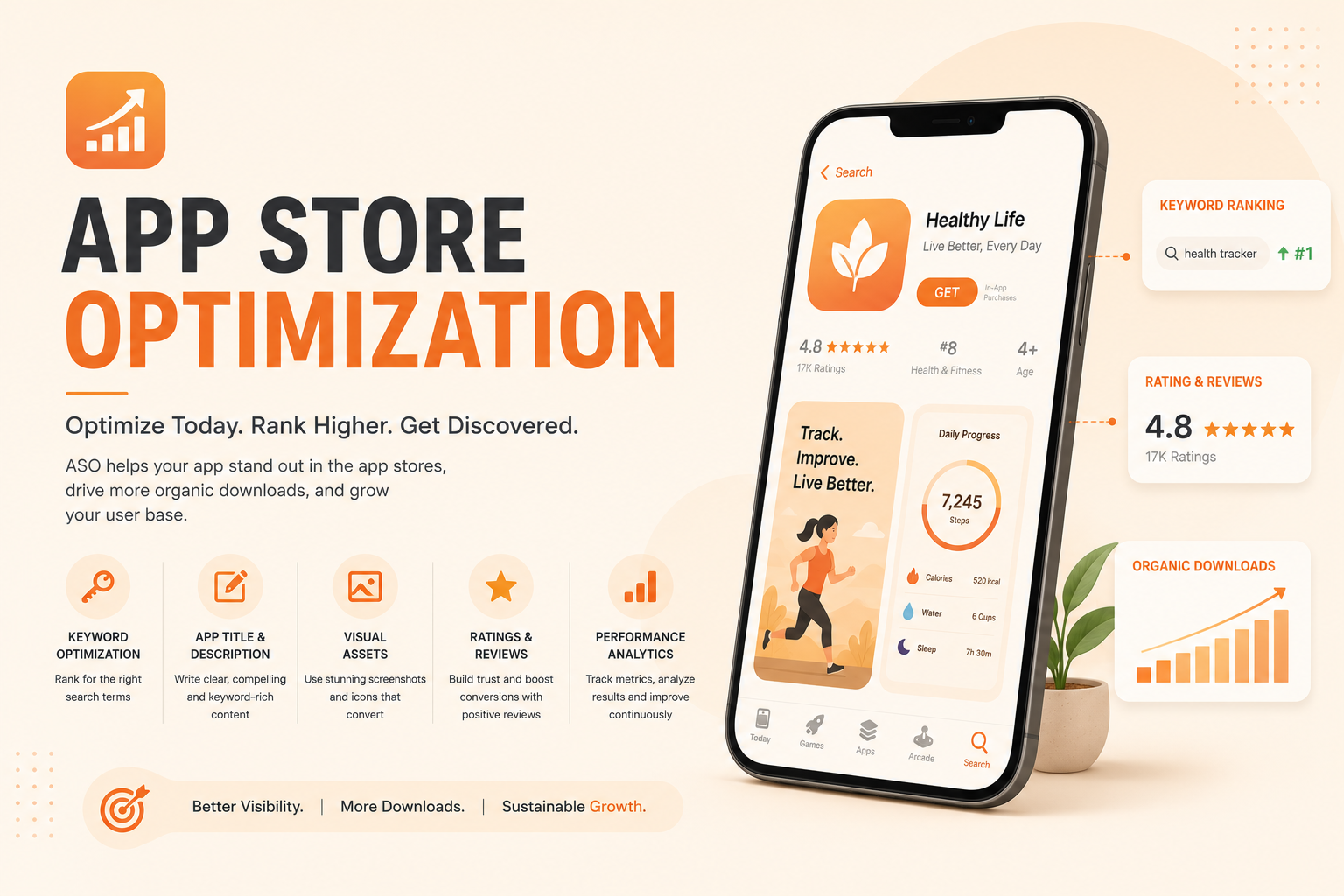
In simple terms, ASO is the process of improving an app’s visibility and attractiveness in app stores so that more people discover it and install it. Just as Search Engine Optimization (SEO) helps websites rank higher in search engines, ASO helps apps rank higher in app stores.
The goal is simple:
ASO turns app store visitors into app users.
Whether you are an app developer, startup founder, SaaS business owner, product manager, or mobile marketer, understanding ASO can help you increase downloads, reduce customer acquisition costs, and grow your business through organic app discovery.
Table of Contents
- What Is App Store Optimization (ASO)?
- How App Stores Decide Which Apps Appear First
- Google Play Store and Apple Play Store
- The Core Elements of ASO
- How ASO Increases Downloads, Users, and Revenue
- Common ASO Mistakes and Future Trends
- A Beginner’s ASO Strategy
- Conclusion
- Frequently Asked Questions
What Is App Store Optimization (ASO)?
App Store Optimization (ASO) is the process of improving an app’s visibility, rankings, and conversion rate within app stores.
The two largest app stores are the Apple App Store and the Google Play Store. Every day, millions of searches take place inside these platforms as users look for solutions to specific problems. Some want a budgeting app, others want a fitness tracker, language-learning platform, or meditation tool.
The app store must decide which apps deserve to appear first. ASO helps your app become one of those results.
The Bookstore Shelf Analogy
Think of an app store as a giant bookstore.
Your app is the book. The app title is the book title. The app icon is the cover. Screenshots are the pages readers quickly browse before deciding whether to buy. Ratings and reviews are recommendations from other readers.
ASO helps place your book on the correct shelf where interested people can actually find it.
Without ASO, even an excellent app can get lost among millions of competitors.
Why ASO Matters
Many developers spend months building features, improving performance, and polishing user experiences. However, even the best app cannot generate downloads if nobody discovers it.
ASO helps bridge the gap between building a great product and getting that product in front of potential users.
Good ASO can help:
- Increase app visibility
- Improve rankings
- Generate more downloads
- Lower acquisition costs
- Improve conversion rates
- Increase revenue
For many apps, ASO becomes one of the most cost-effective marketing channels because it generates organic downloads long after the initial optimization work is completed.
How App Stores Decide Which Apps Appear First
When someone searches for an app, the app store uses algorithms to determine which apps should appear at the top of the results.
The process looks something like this:
User Search
↓
App Store Algorithm
↓
Relevant Apps
↓
Rankings
↓
Downloads
The goal of the algorithm is straightforward. App stores want users to find useful apps quickly. If users consistently discover high-quality apps, they continue using the platform and trust its recommendations.
Because of this, app stores evaluate several signals before deciding which apps deserve top positions.
Imagine two fitness apps targeting the same keywords.
One app has:
- Better screenshots
- Higher ratings
- More reviews
- Strong retention
- More downloads
The other app lacks those signals. Even if both apps provide similar functionality, the first app will likely rank higher because it sends stronger quality signals to the algorithm.
This is exactly what ASO attempts to improve.
Important App Store Ranking Factors
Keywords
Keywords help app stores understand what an app does and which searches it should appear for.
For example, a meditation app may target terms such as:
- Meditation
- Mindfulness
- Sleep sounds
- Stress relief
When a user’s search closely matches those keywords, the app has a better chance of appearing in the results.
App Title
The app title is one of the strongest ranking signals.
A title such as:
CalmMind: Meditation & Sleep
immediately tells both users and the app store what the app is about.
A title like:
CalmMind
provides much less context.
Downloads
Downloads are often viewed as a signal of popularity and relevance. If thousands of users choose an app, the algorithm may see it as a strong candidate for future users.
This is one reason why successful apps often continue attracting even more downloads over time.
Ratings and Reviews
Ratings and reviews provide valuable feedback about user satisfaction.
Apps with strong ratings generally inspire more confidence and often perform better than apps with poor reviews.
User Retention
Getting downloads is only the beginning.
App stores also want to know whether people continue using an app after installing it. If users repeatedly uninstall an app shortly after downloading it, that may signal a poor experience.
Apps that keep users engaged often earn stronger long-term visibility.
Google Play Store and Apple App Store
The rise of smartphones has transformed the way people access information, shop, communicate, and entertain themselves. At the centre of this mobile revolution are two digital marketplaces: the Google Play Store and the Apple App Store. These platforms serve as gateways between app developers and billions of smartphone users worldwide.
The Google Play Store and Apple App Store have created an entire digital economy that supports millions of developers, businesses, and content creators. They provide companies with direct access to customers, enable digital payments, and have become essential channels for mobile commerce, education, entertainment, and productivity.
For businesses, choosing the right platform depends on their target audience, budget, and growth strategy. Most successful companies eventually build applications for both ecosystems to maximize reach and revenue.
In today’s mobile-first world, the Google Play Store and Apple App Store are not merely software marketplaces—they are powerful digital ecosystems that shape how people interact with technology every day.
Google Play Store
The Google Play Store is the official app marketplace for devices running the Android operating system. Developed by Google, it was launched in 2012 by combining several existing services, including Android Market and Google Music.
Important features of Google Play Store include:
- Largest App Ecosystem: The Play Store hosts millions of applications across categories such as education, business, games, health, and productivity.
- Open Platform: Android’s relatively open ecosystem allows developers greater flexibility in app development and distribution.
- Multiple Device Support: Apps are available not only for smartphones but also for tablets, smart TVs, wearables, and automobiles.
- Easy Publishing Process: Developers can publish apps more quickly compared to Apple’s stricter review process.
- Freemium Model: Many applications are free to download and generate revenue through advertisements or in-app purchases.
- Google Play Protect: The platform scans apps regularly to detect malware and security threats.
Advantages of Google Play Store
- Massive global reach, particularly in emerging markets.
- Lower entry barriers for developers.
- Greater customization and flexibility.
- Faster app approvals and updates.
Challenges
- Higher risk of malicious applications due to the open ecosystem.
- Greater device fragmentation because of numerous Android manufacturers.
- Intense competition due to the large number of available apps.
Apple App Store
The Apple App Store is the official application marketplace for devices running the iOS operating system, including the iPhone and iPad. It was launched in 2008 and played a significant role in creating the modern app economy.
Important features of Apple App Store include:
- Strict Quality Control: Every application undergoes a detailed review process before being published.
- Enhanced Security: Apple’s closed ecosystem significantly reduces the risk of malware.
- Premium User Base: iPhone users generally spend more on apps and digital subscriptions.
- High Performance Standards: Apps are optimized for a limited range of devices, ensuring consistent performance.
- Privacy Focus: Apple places strong emphasis on user privacy and data protection.
- Strong Brand Trust: Users often perceive App Store applications as safer and more reliable.
Advantages of Apple App Store
- Higher average revenue per user.
- Better app quality and consistency.
- Strong security and privacy protections.
- Loyal and highly engaged customer base.
Challenges
- Strict review guidelines can delay app approvals.
- Higher developer restrictions and compliance requirements.
- Smaller global market share compared with Android.
- Limited customization options.
Key Differences Between the Two Platforms
| Feature | Google Play Store | Apple App Store |
| Operating System | Android | iOS |
| Review Process | Faster and more flexible | Strict and detailed |
| Security | Good, but more open | Very high |
| Market Reach | Larger global user base | Smaller but premium audience |
| Revenue Potential | High download numbers | Higher spending per user |
| Device Variety | Many manufacturers | Limited Apple devices |
The Core Elements of ASO
Successful ASO is not built around a single factor. Instead, several elements work together to improve both visibility and conversion rates.
Keywords
+
Metadata
+
Visual Assets
+
Trust Signals
Better Rankings
When all these pieces support one another, the app becomes easier to discover and more appealing to potential users.
Keywords
Keywords are the foundation of ASO.
They help app stores understand your app and determine which searches it should appear for. The best keywords are relevant to the app, commonly searched by users, and closely connected to user intent.
Avoid chasing unrelated high-volume keywords simply to gain visibility. Ranking for the wrong search terms often attracts the wrong audience.
App Title and Subtitle
The title and subtitle provide both ranking value and user clarity.
Good example:
Expense Tracker: Budget Planner
Poor example:
MoneyMaster X
The first title immediately communicates the app’s purpose, making it easier for both users and algorithms to understand.
App Description
The description explains:
- What the app does
- Who it helps
- Why it is valuable
A good description focuses on benefits rather than technical features. Users care more about solving problems than understanding technical specifications.
App Icon
The icon creates a first impression.
When users browse search results, the icon is often one of the first things they notice. A clean, recognizable icon can dramatically improve click-through rates.
Cluttered icons often disappear into the crowd.
Screenshots
Screenshots are among the most powerful conversion tools available.
Once users visit an app listing, screenshots help them visualize the experience. Strong screenshots focus on outcomes and benefits rather than simply displaying interface elements.
Instead of saying:
“Advanced Analytics Dashboard”
a screenshot might say:
“Track Your Spending in Seconds”
The second message is much more user-focused.
Preview Videos
A short preview video can quickly demonstrate the app experience and help users understand the value proposition before downloading.
For complex apps, videos can significantly improve conversion rates because they reduce uncertainty.
Categories
Selecting the correct category helps app stores understand where the app belongs and who should see it.
Choosing the wrong category can limit visibility even if the app itself is excellent.
Localization
Localization means adapting app listings for different languages and regions.
Many developers focus only on English-speaking markets. However, translating titles, descriptions, and screenshots can dramatically expand reach and improve conversion rates in international markets.
Ratings and Reviews
Reviews act as social proof.
Before downloading an unfamiliar app, many users check ratings and read feedback from existing users. Positive reviews build trust, while poor reviews can discourage installations.
This is why managing user satisfaction is an important part of ASO, not just customer support.
How ASO Increases Downloads, Users, and Revenue
Many people think ASO is only about improving rankings.
Higher rankings are important, but they are only the beginning. The real goal is to create a chain reaction that turns visibility into downloads, downloads into users, and users into revenue.
A well-optimized app listing helps at every stage of this journey.
ASO Increases Visibility
Before someone can download your app, they must first discover it.
When your app ranks higher for relevant searches, more people see it. This increased exposure creates more opportunities for potential users to visit your listing.
The process starts with visibility:
Visibility
↓
Store Visitors
Even a small improvement in rankings can generate a significant increase in traffic because users tend to click on apps appearing near the top of search results.
Better Listings Increase Downloads
Once visitors reach your listing, a different challenge begins.
At this stage, users are asking questions such as:
- Does this app solve my problem?
- Does it look trustworthy?
- Is it worth downloading?
Your title, icon, screenshots, reviews, ratings, and description all work together to answer these questions.
Store Visitor
↓
App Listing
↓
Trust
↓
Download
Think of this stage like a shopper standing in front of a supermarket shelf. The product is visible, but visibility alone does not guarantee a purchase. Packaging, presentation, and reputation all influence the final decision.
Apps work the same way.
More Downloads Improve Rankings
One of the most interesting aspects of ASO is that success often creates more success.
As downloads increase, app stores may interpret that growth as a sign that users find the app valuable. This can lead to stronger rankings and even more visibility.
Downloads
↓
Popularity Signals
↓
Better Rankings
This positive feedback loop is one reason why ASO can generate long-term growth. Improvements made today may continue producing results months later.
More Users Create Revenue
Downloads are important, but businesses do not grow from downloads alone.
Growth happens when users actively use the app, subscribe to premium plans, make purchases, or interact with advertisements.
The business journey typically looks like this:
Downloads
↓
Users
↓
Subscriptions
↓
Purchases
↓
Revenue
Whether the app earns money through subscriptions, advertising, in-app purchases, or paid upgrades, a larger user base creates more opportunities for revenue generation.
The ASO Growth Flywheel
When everything works together, ASO creates a self-reinforcing growth cycle.
Visibility
↓
Downloads
↓
Users
↓
Revenue
↓
Better Product
↓
More Visibility
As revenue increases, businesses can invest more resources into product improvements, marketing, customer support, and user experience. These improvements often lead to stronger reviews, higher retention, and even better rankings.
This is why ASO is often viewed as a growth engine rather than a simple optimization tactic.
Common ASO Mistakes and Future Trends
ASO can produce powerful results, but many apps fail to realize its full potential because they overlook basic principles.
Understanding common mistakes can save months of effort and prevent missed opportunities.
Common ASO Mistakes
Ignoring Keywords
Some developers publish an app without researching how users actually search.
This is similar to placing a book in a bookstore without a title that readers recognize. Even a great product may remain invisible if it is not connected to the right search terms.
Poor Screenshots
Screenshots are often treated as an afterthought.
However, they are among the first elements users evaluate when deciding whether to install an app. Screenshots that focus only on interface elements instead of benefits frequently reduce conversion rates.
Misleading Descriptions
Trying to attract users with exaggerated claims can backfire.
Users who feel disappointed are more likely to leave negative reviews and uninstall the app. In the long run, honesty usually produces better results than hype.
Ignoring Ratings and Reviews
Many businesses focus heavily on acquisition while paying little attention to user feedback.
Reviews influence both user trust and app store algorithms. Ignoring them can gradually weaken performance.
No Localization Strategy
An app may perform well in one country while remaining virtually invisible elsewhere.
Without localization, businesses often miss valuable opportunities to reach international audiences.
Focusing Only on Downloads
Downloads are easy to measure, but they do not tell the whole story.
Retention, engagement, and customer satisfaction are equally important. An app with fewer downloads but highly engaged users can often outperform an app with large installation numbers and poor retention.
Future Trends in ASO
App stores continue evolving, and ASO evolves alongside them.
Several trends are likely to shape the future of app discovery.
AI-Powered Discovery
Artificial intelligence is increasingly helping app stores understand user intent.
Rather than relying only on exact keywords, algorithms are becoming better at understanding what users actually mean when they search.
Personalized Recommendations
Recommendations are becoming more individualized.
Two users searching for the same term may eventually receive different recommendations based on their interests, behavior, and app usage history.
Voice Search
As voice assistants become more common, voice-based app discovery may play a larger role in the future.
This could change how developers think about keywords and search intent.
Advanced Localization
Global competition continues to increase.
Apps that effectively adapt content, screenshots, and messaging for different regions are likely to gain a significant advantage.
A Beginner’s ASO Strategy
ASO can seem overwhelming at first because there are many factors involved.
Fortunately, beginners do not need to master everything immediately. A simple and consistent approach can often produce meaningful improvements.
The process can be summarized as:
Research
↓
Optimize
↓
Measure
↓
Improve
↓
Grow
Step 1: Research Keywords
Start by identifying the phrases potential users are likely to search.
Think about the problems your app solves rather than simply listing features.
A budgeting app, for example, might target searches related to expense tracking, personal finance, budgeting, and money management.
The goal is to understand how users think.
Step 2: Optimize the Title
The title is one of the most important elements of an app listing.
A clear title that communicates the app’s purpose is often more effective than a creative name that requires explanation.
Users should immediately understand what the app does.
Step 3: Improve Screenshots
Review your screenshots from the perspective of a first-time visitor.
Can someone understand the app’s value within a few seconds?
Focus on benefits, outcomes, and user problems rather than technical features.
Step 4: Collect Ratings and Reviews
Satisfied users are often willing to leave feedback if asked at the right time.
Positive reviews improve trust and can strengthen app store performance.
Make it easy for happy users to share their experiences.
Step 5: Monitor Performance
ASO should be treated as an ongoing process.
Track important metrics such as:
- Rankings
- Downloads
- Conversion rates
- Ratings
- Retention
These numbers help reveal what is working and what needs improvement.
Step 6: Continuously Improve
Successful ASO is not a one-time project.
User behavior changes, competitors update their listings, and app stores continue evolving. Regular testing and refinement are essential for long-term growth.
Small improvements made consistently often outperform large one-time changes.
Conclusion
Building an app is only the first step.
No matter how useful or innovative an app may be, it cannot generate value if people never discover it. Visibility, trust, and user experience all play a role in determining success.
Think back to the bookstore analogy.
A great book hidden on the wrong shelf may never find its readers. A great app faces the same challenge inside crowded app stores.
App Store Optimization helps solve that challenge.
By improving rankings, strengthening listings, increasing trust, and boosting conversion rates, ASO helps transform visibility into growth.
At its core, the idea is simple:
ASO turns app store visitors into app users.
Frequently Asked Questions
What does ASO stand for?
ASO stands for App Store Optimization. It is the process of improving an app’s visibility and conversion rate within app stores.
Is ASO the same as SEO?
No.
SEO focuses on helping websites rank in search engines, while ASO focuses on helping apps rank in app stores. The underlying goal is similar: improving discoverability.
Why is ASO important?
ASO helps users find your app. Better visibility can lead to more downloads, more users, and greater revenue.
How do app stores rank apps?
App stores evaluate factors such as keywords, app titles, downloads, ratings, reviews, engagement, and retention when determining rankings.
Do keywords matter in ASO?
Yes. Keywords help app stores understand what an app does and which searches it should appear for.
How important are screenshots?
Very important.
Screenshots often determine whether a visitor decides to download the app after reaching the listing page.
Do ratings affect rankings?
Yes.
Strong ratings can improve user trust and may positively influence app store algorithms.
What is app store conversion rate?
Conversion rate measures the percentage of visitors who install an app after viewing its listing.
For example:
100 Listing Visitors
↓
25 Downloads
Conversion Rate = 25%
How long does ASO take to show results?
Some changes may produce results within a few weeks, while larger improvements often require several months of testing and optimization.
Can ASO increase downloads?
Yes.
ASO improves both visibility and conversion rates, which can significantly increase downloads over time.
Is ASO free?
Many ASO improvements can be implemented without paying for advertising. However, tools, testing, and design improvements may involve costs.
Should I focus on ASO or paid advertising?
The most successful apps often use both.
Paid advertising can generate immediate visibility, while ASO supports long-term organic growth.
How often should ASO be updated?
ASO should be reviewed regularly. Monitoring performance and making ongoing improvements helps maintain competitiveness.