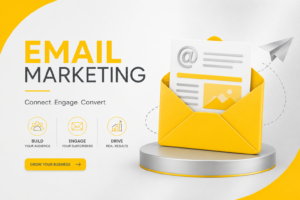




Email marketing is the process of sending emails to prospects and customers to build relationships, generate leads, nurture trust, promote products, and increase sales. Despite the rise of social media, AI, and new marketing channels, email remains one of the most effective ways to communicate directly with an audience because businesses own their email lists and can reach subscribers without depending on changing algorithms.
According to the Digital Marketing Institute, email marketing is a digital marketing strategy that involves sending emails to prospects and customers to promote products, share information, and build customer relationships. At its core, email marketing helps businesses communicate with people who have shown interest in their brand.
Think of email marketing like maintaining a long-term relationship. Social media is like meeting people at a crowded networking event. Email marketing is like having their phone number and being able to continue meaningful conversations over time.
A social media post may disappear from a feed within hours.
An email arrives directly in a subscriber’s inbox.
That direct connection is why email marketing continues to be one of the most powerful marketing channels available.
Table of Contents
- What is Email Marketing?
- How Email Marketing Works?
- Email Marketing Trends
- Email Marketing for Businesses
- Newsletter Format
- How to Generate Leads Through Emails and Newsletters?
- How to Sell Products and Services Through Emails and Newsletters?
- Popular Email Marketing Platforms and Metrics
- Conclusion
- FAQs
What is Email Marketing?
Email marketing is a method of communicating with prospects, leads, customers, and existing clients through email.
Businesses use email marketing to:
- Generate leads
- Build trust
- Educate prospects
- Promote products
- Increase sales
- Retain customers
- Encourage repeat purchases
Why Email Marketing Still Works
Many marketers assume social media has replaced email. It hasn’t.
People may follow hundreds of social media accounts, but most individuals check their email every day for work, personal communication, purchases, receipts, and important updates.
Email remains one of the few marketing channels where businesses have direct access to their audience. Email subscribers are worth far more than pageviews.
A visitor may read one article and disappear. A subscriber can:
- Buy eBooks
- Buy reports
- Buy new products
- Click affiliate links
- Attend webinars
- Join memberships
- Become a customer years later
The Relationship Analogy
Imagine opening a coffee shop.
People walking past your store are like website visitors.
People following your social media accounts are like occasional customers.
People joining your email list are like loyalty club members.
They have given you permission to stay in touch.
The relationship becomes stronger over time.
That’s the true power of email marketing.
Types of Email Marketing
Newsletter Emails
Regular updates sent to subscribers.
Examples:
- Industry news
- Company updates
- Educational content
- Weekly insights
Promotional Emails
Designed to generate sales.
Examples:
- Product launches
- Discounts
- Special offers
Welcome Emails
Sent immediately after someone subscribes.
Transactional Emails
Triggered by customer actions.
Examples:
- Purchase confirmations
- Password resets
- Shipping notifications
Drip Campaigns
Automated sequences delivered over time.
Cold Emails
Emails sent to individuals who haven’t interacted with your business yet.
Warm Emails
Emails sent to people who already know your brand or have subscribed.
How Email Marketing Works?
Email marketing follows a simple process.
Business Creates Value
↓
Visitor Becomes Subscriber
↓
Subscriber Receives Emails
↓
Trust Builds Over Time
↓
Subscriber Becomes Customer
↓
Customer Becomes Repeat Buyer
Step 1: Build an Email List
The foundation of email marketing is your email list.
An email list contains people who have voluntarily shared their email addresses.
Common sources include:
- Website forms
- Newsletter signups
- Lead magnets
- Webinar registrations
- Ecommerce checkouts
Step 2: Segment Subscribers
Not every subscriber has the same interests.
Segmentation organizes subscribers into groups.
Examples:
- New subscribers
- Existing customers
- Ecommerce buyers
- SaaS trial users
- High-value customers
Step 3: Send Relevant Emails
Subscribers receive content relevant to their interests and stage in the buying journey.
Step 4: Nurture Relationships
Consistent communication builds trust.
Trust leads to conversions.
Step 5: Convert Subscribers Into Customers
When subscribers are ready to buy, they already know your brand and understand your value.
This makes sales conversations easier.
Email Marketing Trends
Email marketing continues evolving alongside technology and customer expectations.
AI-Powered Personalization
Modern platforms can personalize emails based on:
- User behavior
- Purchase history
- Interests
- Engagement patterns
Instead of sending the same email to everyone, businesses can deliver highly relevant content.
Interactive Emails
Interactive elements include:
- Polls
- Surveys
- Product carousels
- Quizzes
These features increase engagement.
First-Party Data Growth
As privacy regulations expand, businesses rely more heavily on data collected directly from subscribers.
Email lists have become increasingly valuable because businesses own this audience.
Automation Expansion
Automated email workflows are replacing manual follow-ups.
Common automations include:
- Welcome sequences
- Cart abandonment emails
- Lead nurturing campaigns
- Re-engagement campaigns
Mobile-First Design
Most subscribers read emails on mobile devices.
Modern newsletters prioritize:
- Short paragraphs
- Large buttons
- Mobile-friendly layouts
GDPR Compliance
The General Data Protection Regulation (GDPR) governs how businesses collect and process personal data.
Key principles include:
- Consent
- Transparency
- Data protection
- Easy unsubscribe options
CAN-SPAM Compliance
The CAN-SPAM Act regulates commercial email communications.
Requirements include:
- Accurate sender information
- Honest subject lines
- Clear identification of advertisements
- Easy unsubscribe mechanisms
Compliance protects both subscribers and businesses.
Email Marketing for Businesses
Email marketing is one of the most powerful but underrated systems in affiliate marketing and online business.
Unlike social media, where algorithms control reach, email gives you direct access to your audience. You are not “renting attention” anymore — you are owning it.
Think of it like this:
Social media = shouting in a crowded marketplace
Email list = speaking directly to people who already know you
This makes email one of the highest-converting affiliate channels over time.
How Email Marketing Works in Affiliate Business
The system is simple:
Traffic → Lead Magnet → Email List → Nurturing → Recommendations → Sales
Instead of sending people directly to affiliate links, you first build a relationship through email.
This increases:
- trust
- click-through rate
- conversion rate
- long-term income stability
Monetization Timeline
Email marketing becomes more powerful as your list grows.
Stage 1 (0–1,000 Subscribers)
Focus: Growth, not money
At this stage:
- build trust
- share useful content
- avoid aggressive selling
No monetization pressure. The goal is attention and consistency.
Stage 2 (1,000–5,000 Subscribers)
Focus: First monetization layer
You can introduce:
- affiliate links
- digital courses
- ebooks
- paid guides
- research reports
Here, your audience starts trusting your recommendations.
Even small lists can generate income if targeting is strong.
Stage 3 (5,000–20,000 Subscribers)
Focus: Audience monetization expansion
You can now access:
- newsletter sponsorships
- dedicated ad placements
- partner promotions
- brand collaborations
At this stage, you are no longer just a creator — you are a distribution channel.
Brands begin paying for access to your audience.
Stage 4 (20,000+ Subscribers)
Focus: Media-level monetization
Now email becomes a serious business asset.
You can earn from:
- major sponsorship deals
- industry reports
- webinars and workshops
- premium memberships or paid newsletters
At this stage, your email list is a revenue engine, not just a communication tool.
Newsletter Format
A newsletter is one of the most common email marketing formats.
Think of a newsletter like a magazine delivered directly to someone’s inbox.
Weekly: Every Tuesday or Thursday. Consistent and manageable. Avoid Daily newsletters.
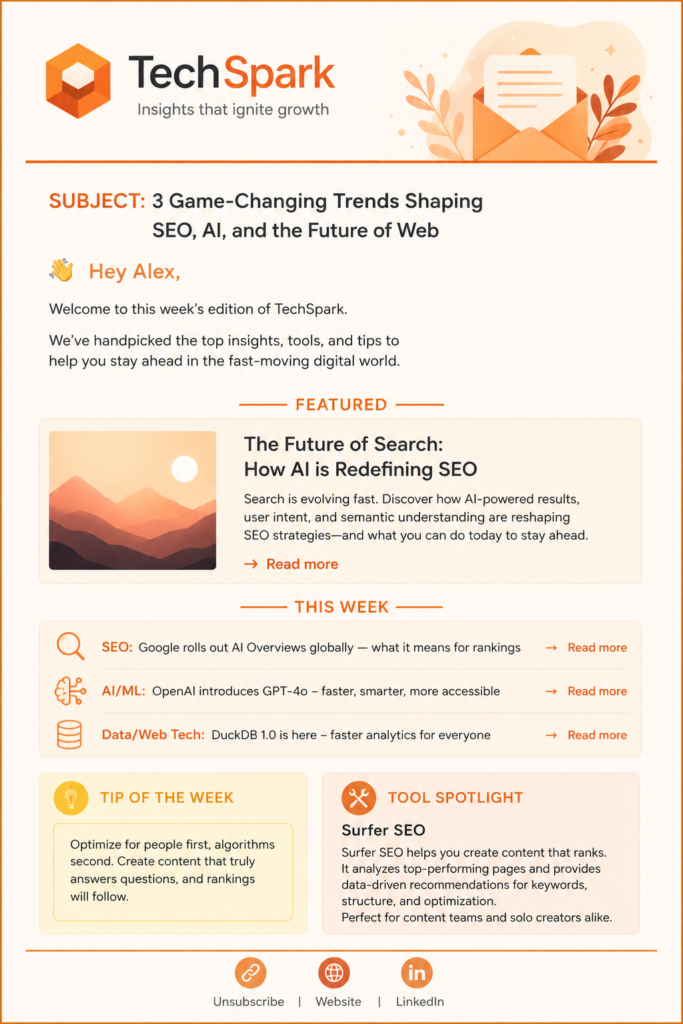
Basic Newsletter Structure
An effective newsletter usually begins with a compelling subject line that encourages subscribers to open the email, followed by a brief personal introduction that establishes a connection with the reader. It then delivers valuable educational content and practical tips that readers can apply immediately. Finally, the newsletter ends with a clear call-to-action and a signature that adds a personal and professional touch.
Subject Line
↓
Personal Introduction
↓
Educational Content
↓
Practical Tips
↓
Call-to-Action
↓
Signature
Subject Line: The first thing subscribers see. Example: “5 Marketing Lessons We Learned This Month”
Opening: A personal introduction.
Main Content: Valuable insights, stories, tips, or updates.
Call-to-Action (CTA): Encourages readers to take action. Examples:
- Read a blog
- Watch a video
- Download a guide
- Book a demo
Footer: Includes:
- Contact information
- Unsubscribe option
- Legal disclosures
Newsletter Sections
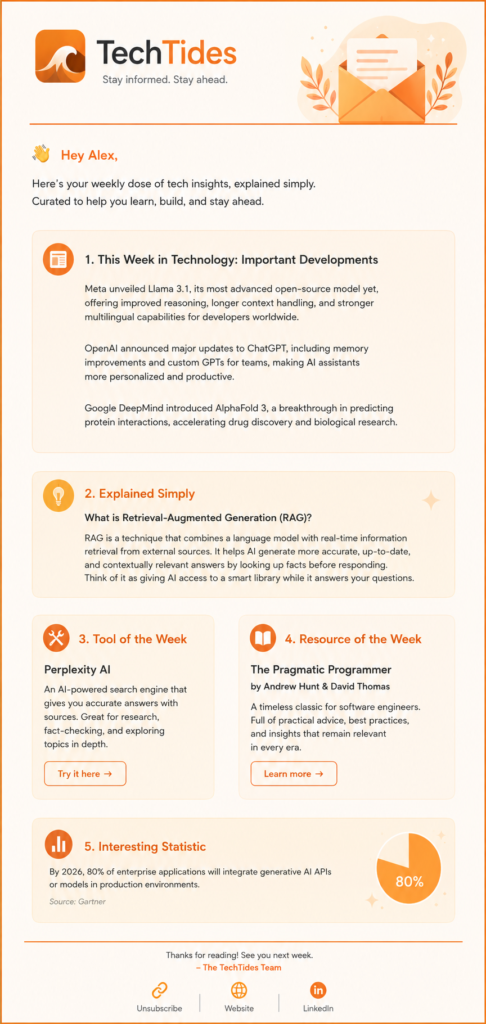
Try to divide your newsletters into sections. A simple format. 2-3 minutes reading time.
1. This Week in Technology: Important Developments: 2–3 paragraphs.
2. Explained Simply: One concept explained. Example: “What is Retrieval-Augmented Generation?”
3. Tool of the Week: One useful tool.
4. Resource of the Week: Book, paper, article, course.
5. Interesting Statistic: One surprising data point.
Here’s another example based on these newsletter sections:
Best Practices for Newsletters
- Focus on value first
- Avoid excessive selling
- Use conversational language
- Maintain consistency
- Keep designs clean and readable
How to Generate Leads Through Emails and Newsletters?
Generating leads starts before email marketing. First, businesses need subscribers.
What Is a Lead?
A lead is someone who has shown interest in your product or service.
An email subscriber often becomes a lead.
Lead Magnets
A lead magnet is something valuable offered in exchange for an email address.
Examples include:
- Ebooks
- Templates
- Checklists
- Free courses
- Webinars
- Industry reports
Lead Generation Flow
Website Visitor
↓
Lead Magnet Offer
↓
Email Signup
↓
Welcome Email
↓
Lead Nurturing Sequence
↓
Sales Opportunity
Welcome Email
The welcome email is often the highest-performing email in any campaign.
A welcome email is the first direct interaction between a brand and a new subscriber, making it an important opportunity to create a positive first impression and set expectations for future communication. These emails usually introduce the brand, explain what subscribers can expect, and encourage an initial action, such as exploring products or reading helpful content.
For example, an online bookstore might send a welcome email thanking a new subscriber, offering a 10% discount on the first purchase, and recommending a few bestselling titles. A well-crafted welcome email can significantly improve engagement and help build long-term relationships with customers from the very beginning.
Welcome email could be used to:
- Welcome and deliver the lead magnet.
- Introduce your brand story.
- Provide educational content.
- Share customer success stories.
- Present a product or service offer.
Lead Nurturing
Lead nurturing is a long-term process that focuses on building trust and maintaining meaningful communication with potential customers over time. Consistently delivering relevant and valuable information often increases engagement and improves the likelihood of future conversions.
In email marketing, lead nurturing involves educating subscribers before asking for a sale. Instead of saying: “Buy our software.” A nurturing approach says: “Here’s how to solve a problem.” This builds trust first.
Cold Email vs Warm Email
Both warm emails and cold emails can be highly effective when used in the right context, although they often require different approaches to engagement and personalization. Successful email marketers carefully tailor their messaging based on the recipient’s familiarity with the brand and the specific goals of the campaign.
Cold Email
Sent to prospects who have never interacted with your business.
Goal:
- Start conversations
- Generate interest
- Book meetings
Warm Email
Sent to existing subscribers.
Goal:
- Build trust
- Educate
- Convert
Warm email campaigns generally achieve higher engagement because the relationship already exists.
How to Sell Products and Services Through Emails and Newsletters?
Many businesses struggle because they attempt to sell too early.
Successful email marketing follows a relationship-first approach.
The Trust-Building Formula
Value
↓
Trust
↓
Authority
↓
Offer
↓
Sale
Product Launch Emails
Businesses often create launch sequences. These emails could involve:
- Introducing the problem.
- Explaining the solution.
- Sharing proof and testimonials.
- Presenting the offer.
- Creating urgency before the deadline.
Ecommerce Email Funnels
Common ecommerce emails include:
- Welcome emails
- Abandoned cart emails
- Product recommendations
- Post-purchase emails
Cart Abandonment Example
Customer adds product to cart.
↓
Leaves website.
↓
Receives reminder email.
↓
Returns and completes purchase.
SaaS Email Funnels
Software companies commonly use:
Trial Signup Email: Introduces the platform.
Onboarding Emails: Teach users how to use features.
Upgrade Emails: Encourage paid subscriptions.
Retention Emails: Increase long-term customer value.
Customer Retention Emails: Keeping existing customers is often cheaper than acquiring new ones.
Retention emails include:
- Loyalty programs
- Product education
- Renewal reminders
- Customer appreciation campaigns
Popular Email Marketing Platforms & Metrics
Modern email marketing relies heavily on specialized platforms that simplify everything from designing emails and managing subscriber lists to automation and performance tracking. These tools cater to businesses of all sizes, offering features such as segmentation, personalization, and advanced analytics.
Email Marketing Platforms
Choosing the right platform often depends on factors such as budget, ease of use, integration capabilities, and the complexity of a company’s marketing needs. Here are some of the popular newsletter platforms for email marketing:
Mailchimp: Popular among beginners and small businesses.
ConvertKit: Popular among creators and bloggers.
Brevo: Suitable for startups and growing businesses.
ActiveCampaign: Known for advanced automation.
HubSpot: Popular among B2B companies.
Klaviyo: Widely used by ecommerce brands.
Beehiiv: Growing platform for newsletter creators.
Email Marketing Metrics
Email marketing success depends on measurement.
Open Rate: Percentage of recipients who open an email. Formula: Emails Opened ÷ Emails Delivered
Click Rate: Percentage of recipients who clicked a link. Measures engagement.
Email CTR (Click-Through Rate): One of the most important metrics. Indicates how effectively content motivates action.
Bounce Rate: Percentage of emails that fail to reach recipients. High bounce rates may indicate poor list quality.
Unsubscribe Rate: Percentage of users who leave the email list. Some unsubscribes are normal. Consistently high unsubscribe rates signal problems.
Conclusion
Email marketing remains one of the most powerful ways to generate leads, nurture relationships, increase conversions, and retain customers. While social media algorithms change and advertising costs rise, an email list remains a business asset that you directly control.
The most successful email marketers do not treat subscribers as numbers on a list. They treat them as relationships to be nurtured. By collecting subscribers through valuable lead magnets, delivering helpful newsletters, using automation and segmentation, and maintaining compliance with privacy regulations, businesses can build predictable systems for growth.
Whether you’re a small business owner, SaaS founder, ecommerce brand, freelancer, or marketer, email marketing provides a scalable way to turn strangers into subscribers, subscribers into customers, and customers into loyal advocates.
FAQs
Is Email Marketing Still Effective?
Yes. Email remains one of the highest-performing digital marketing channels because it enables direct communication with subscribers.
How Often Should I Send Emails?
Frequency depends on audience expectations. Many businesses send weekly newsletters, while ecommerce brands may send multiple emails per week.
What Is a Good Email Open Rate?
Benchmarks vary by industry. Focus on improving your own historical performance rather than chasing a universal number.
What Is the Difference Between a Newsletter and Email Marketing?
A newsletter is one type of email marketing. Email marketing includes newsletters, automation, promotional emails, transactional emails, and nurturing sequences.
What Is Email Segmentation?
Segmentation divides subscribers into groups based on interests, behaviors, or demographics so that emails become more relevant.
What Is a Drip Campaign?
A drip campaign is a series of automated emails sent according to a predefined schedule or user action.
What and Warm and Cold Emails?
Warm emails are sent to people who already have some familiarity or prior interaction with a brand or business. In contrast, cold emails are sent to individuals or organizations with whom the sender has no previous relationship or direct connection.
Why Are Welcome Emails Important?
Welcome emails create the first impression and often generate the highest engagement rates in an email program.
How Large Should My Email List Be?
List quality matters more than list size. A smaller, engaged audience can outperform a large, inactive list.
What Is the Biggest Email Marketing Mistake?
Sending emails that focus entirely on selling rather than providing value. Subscribers stay engaged when businesses consistently educate, help, and solve problems.