


Many websites struggle to increase organic traffic even after publishing content because they focus on creating more pages without understanding what users are searching for.
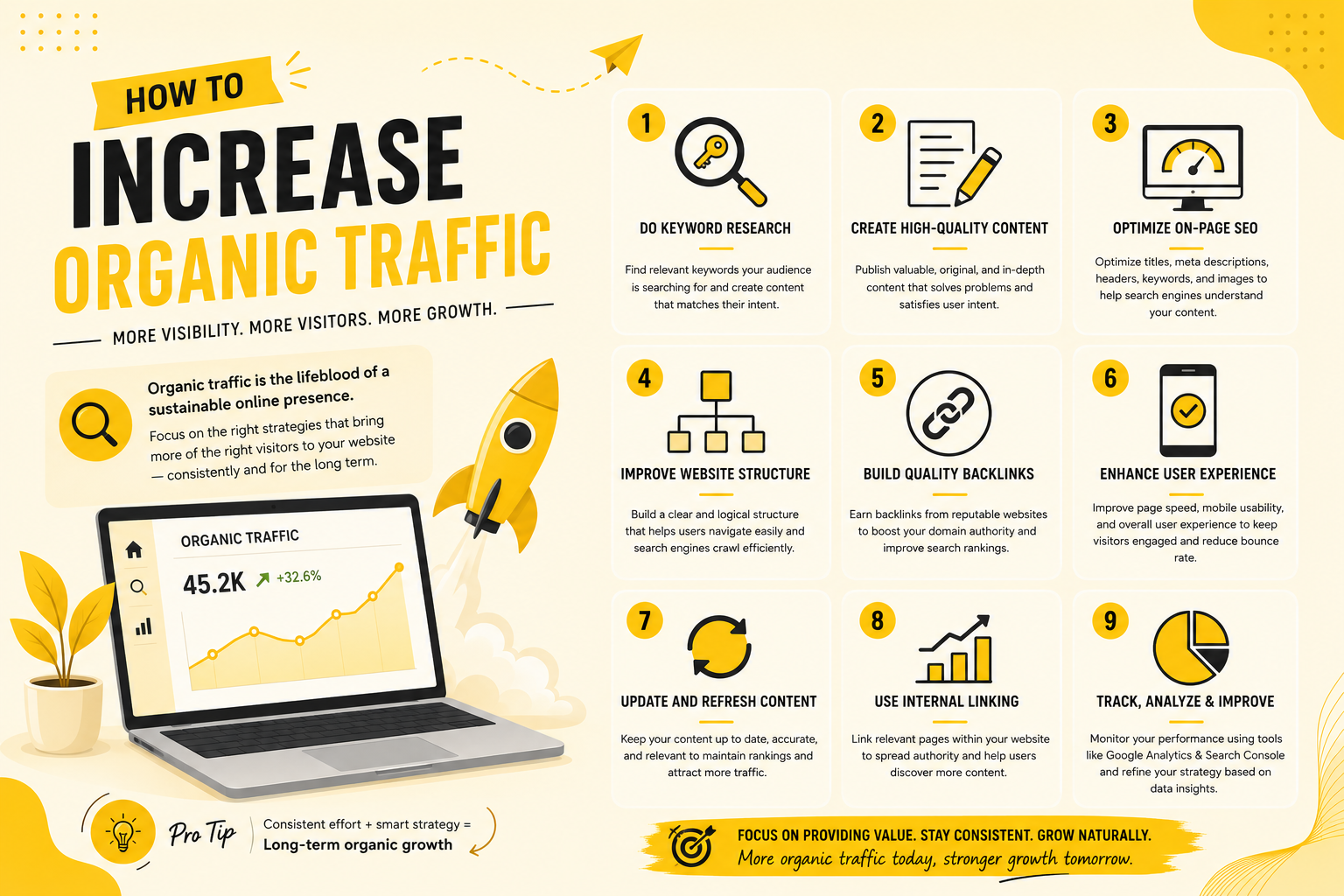
Growing organic traffic requires a strategic approach that combines keyword research, search intent analysis, high-quality content creation, and strong SEO foundations. Optimizing on-page elements, improving technical performance, building authority through backlinks, and regularly updating content can help improve search visibility. Tracking performance through analytics and continuously refining strategies based on results allows websites to attract more relevant visitors over time.
Long-term organic growth comes from consistently providing valuable information that matches user needs and builds trust with both audiences and search engines.
Table of Contents
- What Is Organic Traffic?
- How Search Engines Help Generate Organic Traffic
- Increasing Organic Traffic by Improving Search Rankings
- Content and Topic Strategy for Long-Term Organic Growth
- Complete Organic Traffic Growth Checklist: 35 Practical Steps
- How to Measure and Analyze Organic Traffic Performance
- Common Mistakes and Long-Term Growth Strategies
- Conclusion
- Frequently Asked Questions
What Is Organic Traffic?
Organic traffic refers to visitors who reach your website through unpaid search engine results.
When someone searches on Google, clicks on a website result, and lands on that website without clicking an advertisement, that visit is considered organic traffic.
For example:
A user searches:
“best email marketing tools for small businesses”
They see several results on the Search Engine Results Page (SERP).
They click a blog article from a software company.
That visit is organic traffic.
A simple definition:
Organic traffic is website traffic generated naturally through search engines based on relevance, visibility, and rankings.
Organic Traffic Analogy: Being Discovered Without Paying for Attention
Imagine you own a physical store in a busy marketplace.
There are two ways customers can find you.
The first option:
You pay someone to stand outside and bring customers inside.
This is similar to paid advertising.
The second option:
Your store becomes well-known because:
- People recommend it
- It appears in local directories
- Customers trust it
- It is located in the right place
This is similar to organic traffic.
In digital marketing, search engines are the marketplace, and search rankings determine how easily people discover your website.
Why Is Organic Traffic Important?
Organic traffic is valuable because it attracts people who are actively searching for information, products, or solutions.
Unlike some advertising methods where businesses interrupt users, organic search connects businesses with people already showing interest.
Organic traffic helps businesses:
- Reduce dependence on paid advertising
- Generate consistent visitors
- Build brand visibility
- Attract potential customers
- Improve long-term growth
For example:
A company ranking for:
“best project management software”
can receive visitors every day from people researching solutions.
This creates ongoing opportunities for:
- Leads
- Sign-ups
- Purchases
Organic Traffic vs Paid Traffic
The main difference is how visitors reach your website.
Organic Traffic
Comes from unpaid search results.
Examples:
- Google search results
- Bing search results
Requires:
- SEO
- Content optimization
- Website improvements
Paid Traffic
Comes from advertisements.
Examples:
- Google Ads
- Social media ads
- Display ads
Paid traffic can deliver immediate visitors, but traffic usually decreases when advertising stops.
Organic traffic generally takes longer to build but can become a sustainable source of visitors.
How Search Engines Help Generate Organic Traffic
Search engines act as a connection between users searching for answers and websites providing those answers.
The process involves:
- Understanding user searches
- Discovering webpages
- Indexing information
- Ranking relevant pages
- Showing results
Search Queries and User Intent
Every search starts with a user query.
Example:
“how to improve website traffic”
Behind this search is a need:
“I want more visitors to my website.”
Search engines analyze the meaning behind queries to understand what users want.
This is called search intent.
Common search intents include:
Informational Intent
Users want information.
Example:
“What is SEO?”
Commercial Intent
Users compare options.
Example:
“Best SEO tools”
Transactional Intent
Users want to take action.
Example:
“Buy SEO software”
Matching search intent is one of the most important factors for improving organic traffic.
Search Engine Results Pages (SERPs)
The page showing search results is called the Search Engine Results Page (SERP).
Organic visibility means how often your website appears in these results.
A website can appear through:
- Traditional organic listings
- Featured snippets
- People Also Ask sections
- Image results
- Local results
Higher visibility creates more opportunities to receive clicks.
Search Visibility: The Foundation of Organic Growth
Search visibility measures how visible a website is across search results.
A website with strong search visibility:
- Ranks for many relevant keywords
- Appears higher in results
- Receives more impressions
Improving search visibility requires:
- Better keyword targeting
- Strong content
- Technical SEO
- Authority building
Increasing Organic Traffic by Improving Search Rankings
Organic traffic growth starts with a strong SEO foundation. Search rankings determine where your website appears in search results. Higher rankings generally create more clicks and traffic. Improving rankings requires a combination of relevance, authority, and experience.
SEO helps search engines understand your website and connect it with relevant searches.
The key areas include:
- Keyword research
- Search intent
- On-page SEO
- Technical SEO
- Internal linking
- Website structure
- Helpful Content
- Topical Authority
- User Experience
- Analyzing SERP Competition
Keyword Research
Keyword research helps identify the terms people use when looking for information.
For example:
A business selling SEO services may discover searches like:
- SEO services
- SEO audit
- How to improve Google rankings
These keywords reveal audience needs.
A strong keyword strategy focuses on:
- Search volume
- Competition
- Search intent
- Business value
Search Intent
Targeting keywords is not enough.
The page must satisfy the reason behind the search.
Example:
Keyword:
“best laptops for students”
Users expect:
- Comparisons
- Recommendations
- Features
- Pricing information
A basic definition page would not perform well because it does not match intent.
On-Page SEO and Organic Traffic
On-page SEO improves individual webpages.
Important elements include:
- Title tags
- Headings
- Content structure
- Keywords
- Internal links
- Meta descriptions
A well-optimized page helps search engines understand:
- Topic
- Relevance
- Value
Technical SEO and Organic Visibility
Technical SEO ensures search engines can properly access and understand your website.
Important areas include:
- Crawling
- Indexing
- Website speed
- Mobile optimization
- Site structure
A website may have excellent content, but technical issues can prevent it from appearing in search results.
Internal Linking
Internal linking connects related pages within a website, helping users discover more content while allowing search engines to understand the relationship between different topics. A strong internal linking strategy distributes authority across pages, improves navigation, and helps important pages gain better visibility in search results.
Website Structure
A well-organized website structure makes it easier for search engines to crawl, index, and understand the content hierarchy of a website. A clear structure with logical categories, simple navigation, and properly connected pages improves user experience and supports stronger organic traffic growth.
Helpful Content
Search engines prioritize pages that answer user questions effectively.
High-performing pages usually:
- Provide complete answers
- Explain concepts clearly
- Help solve user problems
- Include examples
Topic Authority
Topic authority means becoming a trusted source around a subject. Instead of creating random articles, businesses can build content groups.
Example:
Main topic:
Digital Marketing
Supporting topics:
- SEO
- Content marketing
- Email marketing
- PPC advertising
- Social media marketing
This helps search engines understand expertise.
User Experience
Search engines care about how users interact with websites.
Important factors include:
- Page speed
- Mobile experience
- Easy navigation
- Readability
A website that users enjoy is more likely to perform better.
Analyzing SERP Competition
Before targeting a keyword, analyze current search results.
Look at:
- Ranking pages
- Content quality
- Website authority
- Search intent
This helps identify what is needed to compete.
Content and Topic Strategy for Long-Term Organic Growth
Content plays an important role in organic traffic because search engines need information to rank.
However, successful organic growth is not about publishing more content.
It is about creating content that answers real searches.
Topic Clusters and Content Hubs
A topic cluster organizes related content around a main subject.
Example:
Hub:
“SEO Guide”
Supporting articles:
- Keyword research
- Technical SEO
- Link building
- On-page SEO
This creates a connected information system.
Title Analysis
Focus on first 6-7 words that usually appear on SERP pages. Check the article intent for queries on SERP pages for pages that rank. Include main keyword in the title.
Evergreen Content
Evergreen content remains valuable over time.
Examples:
- Beginner guides
- Tutorials
- Definitions
- Checklists
These pages can continue attracting organic traffic for months or years.
Align with Search Intent
Content must solve the exact problem your audience is typing into the search bar. Map your topics to the three main intent stages: Problem-aware, solution-aware and product-aware.
Stick to Niche
Sticking to a niche topic or industry helps websites build topical authority by consistently creating content around related subjects that attract a specific audience.
A focused content strategy makes it easier for search engines to understand the website’s expertise, improving the chances of ranking for relevant searches and driving targeted organic traffic.
Repurpose Content for Social Posts and Email Newsletter
A single pillar article can be turned into a series of smaller pieces of content, extending your reach across multiple channels. Use customer feedback, real struggles, and client transformations to build trust faster than dry credentials.
Updating Existing Pages
Older content may lose rankings because:
- Information becomes outdated
- Competitors improve
- Search behavior changes
Updating content helps maintain visibility. This is especially true for content with data and statistical infographics.
Author Bio
An author bio provides information about the writer’s background, expertise, experience, and credibility on a specific topic. It helps build trust with readers and search engines by demonstrating expertise and authority, especially for content where accuracy and reliability are important.
Search engines consider authority when ranking websites. Authority shows that a website is trusted and recognized.
Backlinks and Organic Growth
Backlinks are links from other websites to your website.
They act as recommendations.
A backlink from a trusted industry website can improve credibility.
Quality matters more than quantity.
Digital PR and Brand Mentions
Digital PR helps businesses gain visibility through:
- Publications
- Industry websites
- Expert mentions
Brand mentions help build recognition and trust.
Complete Organic Traffic Growth Checklist: 35 Practical Steps
Search Research and Planning
- Identify the keywords your target audience searches before creating content.
- Analyze search intent to understand whether users want information, comparisons, or solutions.
- Build a keyword map connecting keywords with specific website pages.
- Identify competitors ranking for your target searches and study their strategies.
- Find keyword opportunities where competitors rank but your website does not.
Website and Technical Optimization
- Ensure important pages can be crawled and indexed by search engines.
- Improve website speed to reduce user frustration and increase engagement.
- Make sure your website works properly on mobile devices.
- Create a clear website structure so users and search engines can navigate easily.
- Fix broken links and technical errors that affect crawling.
Content Optimization
- Create content that directly answers user search questions.
- Improve existing pages instead of only publishing new content.
- Use clear titles and headings that explain page topics.
- Add relevant internal links between related pages.
- Improve readability using better formatting and structure.
- Include examples, data, and practical explanations to increase usefulness.
- Create topic clusters to build authority around important subjects.
- Develop evergreen resources that continue attracting visitors over time.
Search Visibility Improvement
- Optimize pages for featured snippets and SERP features where possible.
- Improve click-through rates with stronger titles and descriptions.
- Monitor ranking changes and identify pages losing visibility.
- Update outdated information regularly to maintain rankings.
- Improve pages that rank on the second page of Google.
Authority Building
- Earn backlinks from relevant and trustworthy websites.
- Create content that naturally attracts references and mentions.
- Build relationships with industry websites and creators.
- Use Digital PR to increase brand visibility.
- Encourage customer reviews and online reputation building.
Measurement and Growth
- Track organic traffic trends regularly.
- Monitor impressions, clicks, and rankings through SEO tools.
- Analyze which pages generate the most valuable visitors.
- Measure conversions from organic traffic, not just visits.
- Identify content gaps and create new opportunities.
- Continue testing and improving SEO strategies.
- Focus on sustainable growth instead of quick ranking tricks.
Organic Traffic Metrics and Analysis
Organic traffic growth should be measured using meaningful metrics.
Important metrics include:
Organic Visitors
Shows how many users arrive through search engines. It helps evaluate the overall effectiveness of SEO efforts and whether a website is attracting users through search visibility.
Search Rankings
Shows how pages perform for target keywords. Monitoring rankings helps measure SEO progress and understand which keywords are driving visibility and potential traffic.
Impressions
Impressions represent how many times a webpage appears in search results, regardless of whether users click on it. This metric helps identify search visibility and opportunities to improve rankings or optimize content for more clicks. Google Search Console helps measure how often pages appear in the SERP.
Click-Through Rate (CTR)
CTR shows the percentage of users who click after seeing your result.
Improving:
- Titles
- Descriptions
- Search relevance
can improve CTR.
Average Engagement Time
Average engagement time measures how long visitors actively spend on a webpage or website. Longer engagement often indicates that users find the content useful, relevant, and worth exploring.
Organic Conversions
Traffic matters, but business results matter more. Organic conversion rate tracks how many visitors from search engines complete desired actions such as purchases, sign-ups, or inquiries. It helps measure the business impact of SEO beyond just increasing website traffic.
Measure:
- Leads
- Sign-ups
- Sales
Backlinks and Referring Domains
Backlinks and referring domains measure the number and quality of external websites linking to your content. Strong backlinks from relevant sources can improve website authority, search visibility, and long-term organic traffic growth.
Common Mistakes and Long-Term Growth Strategies
Increasing organic traffic requires consistently publishing valuable content, optimizing website performance, building authority, and adapting based on data and search trends.
Common Mistakes
Common mistakes in driving organic traffic include focusing only on rankings instead of user intent, creating low-value content, ignoring technical SEO issues, and failing to optimize content consistently.
Sustainable organic growth requires a balanced approach that combines quality content, proper keyword targeting, website optimization, and continuous analysis of performance.
Targeting Only High-Volume Keywords
Popular keywords are often competitive.
Specific keywords can bring more qualified visitors.
Ignoring Search Intent
Ranking is difficult when content does not match what users want.
Publishing Without Strategy
Random content rarely creates sustainable growth.
Ignoring Technical SEO
Poor website performance can limit visibility.
Expecting Immediate Results
Organic growth requires:
- Consistency
- Optimization
- Authority building
Long-Term Organic Growth Strategy
Sustainable organic traffic comes from combining:
- Strong SEO foundations
- Search-focused content
- Technical improvements
- Authority building
- Continuous analysis
SEO is a long-term investment.
Conclusion
Organic traffic is one of the most valuable sources of website growth because it connects businesses with people actively searching for solutions.
Increasing organic traffic requires more than publishing content.
It requires improving the entire search experience:
- Understanding user intent
- Creating valuable pages
- Improving rankings
- Building authority
- Optimizing website performance
As search evolves with AI-powered experiences, businesses will need to focus even more on creating trustworthy, useful, and well-structured information that search engines can understand.
The goal is not simply getting more visitors.
The goal is attracting the right visitors who are more likely to become customers.
Frequently Asked Questions
What is organic traffic?
Organic traffic is website traffic that comes from unpaid search engine results.
What is the difference between organic and inorganic traffic?
Organic traffic comes from unpaid search results.
Inorganic traffic usually comes from paid advertising or other paid promotions.
How can I check website organic traffic?
You can check organic traffic using tools like:
- Google Analytics
- Google Search Console
- Semrush
- Ahrefs
How can I increase organic traffic to my website?
Increase organic traffic by:
- Improving SEO
- Targeting relevant keywords
- Creating useful pages
- Building authority
- Improving user experience
What is search visibility in SEO?
Search visibility refers to how often a website appears in search results for relevant queries.
How can I improve search rankings?
Improve rankings by:
- Creating better content
- Matching search intent
- Improving technical SEO
- Building backlinks
- Optimizing user experience
How long does it take to increase organic traffic?
The timeline depends on factors such as competition, website authority, content quality, and SEO efforts. Sustainable growth usually requires consistent improvement over time.
Does content help increase organic traffic?
Yes, content helps attract search traffic when it targets relevant searches and provides valuable answers.
What tools can check organic traffic?
Popular tools include:
- Google Search Console
- Google Analytics
- Semrush
- Ahrefs
Why is my website getting low organic traffic?
Common reasons include:
- Poor keyword targeting
- Weak content
- Technical SEO issues
- Low authority
- Poor search visibility
- High competition