What Is Keyword Density? Does It Still Matter for SEO?
Key Takeaways
- Keyword density measures a phrase’s share of total words, while keyword frequency counts occurrences and TF-IDF compares term importance across documents.
- No universal keyword-density percentage guarantees rankings; topic, search intent, content quality, writing style, and natural vocabulary matter more.
- Use density as an editorial warning system to identify unclear focus or repetitive wording, not as an optimization target.
- Place primary keywords naturally in relevant titles, headings, URLs, introductions, body content, and metadata, while avoiding keyword stuffing and forced variations.
Keyword density measures how often a keyword appears in a piece of content compared with the total number of words. Keyword density was once widely treated by SEO practitioners as an important optimization target, but modern search engines evaluate far more than repeated phrases.
Today, keyword density is most useful as an editorial check. It can reveal whether the main topic is barely mentioned or whether the same wording has been repeated so often that the content sounds unnatural.
Content creators should therefore understand how density is calculated, how it differs from keyword frequency and TF-IDF, and how to use primary and related keywords without turning optimization into keyword stuffing.
Table of Contents
What Is Keyword Density? Formula, Frequency and TF-IDF
Keyword density is the percentage of a page’s words represented by a particular keyword or key phrase. It compares the number of times the keyword appears with the total word count of the content.
How Keyword Density Is Calculated
The basic formula is:
For example, suppose the phrase coffee beans appears 10 times in a 1,000-word article. The keyword density for coffee beans would be 1% (10 ÷ 1,000 × 100 = 1%)
The calculation is simple, but different tools may produce slightly different results. One tool may analyze only the main body content, while another may also count the title, headings, image alt text, captions, or metadata. Tools may also differ in how they handle plurals, punctuation, word forms, and partial matches.
For this reason, a density score should be treated as an approximate editorial measurement rather than an exact assessment of SEO quality.
Keyword Density vs. Keyword Frequency
Keyword frequency is the raw number of times a word or phrase appears. Keyword density expresses that frequency as a percentage of the total content.
Consider two pages:
Here, both pages have a keyword frequency of five. However, the phrase occupies a much larger proportion of Page A.
Keyword frequency is therefore an absolute count, while density adjusts the count according to content length. Neither metric reveals whether the page is useful, accurate, or well matched to the searcher’s needs.
Is TF-IDF the Same as Keyword Density?
TF-IDF stands for term frequency–inverse document frequency. It is an information-retrieval method used to estimate the importance of a term within one document compared with a larger collection of documents.
The first part, term frequency, considers how often a term appears in a document. The second part, inverse document frequency, reduces the weight of terms that occur across many documents and gives more weight to terms that are relatively distinctive.
The basic relationship is:
A term receives a higher weight when it appears frequently in a particular document but is less common throughout the wider document collection.
TF-IDF is therefore not the same as keyword density. Density looks only at the proportion of a keyword within one page. TF-IDF compares the term’s importance across multiple documents.
Content optimization tools sometimes use TF-IDF-inspired comparisons to suggest words found on competing pages. However, creators should not assume that matching every suggested term or percentage will produce higher rankings. Such tools can identify possible gaps, but they cannot determine whether a term is necessary for a particular article.
How Often Should Keywords Appear?
There is no universal percentage that defines good keyword usage. The appropriate number depends on the topic, article length, writing style, search intent, and natural vocabulary required to explain the subject.
Google recommends helpful, reliable content and says to use the words people search for in prominent, descriptive locations. It does not prescribe a keyword-density target.
A detailed guide about keyword research will naturally use the word keyword frequently. A product page for a specific espresso machine may need the exact model name several times but would sound unnatural if it appeared in every paragraph.
Is There an Ideal Percentage?
Google’s current guidance does not prescribe a minimum or maximum keyword-density percentage. Instead, it recommends creating helpful content, using the words people search for in relevant locations, and avoiding excessive repetition.
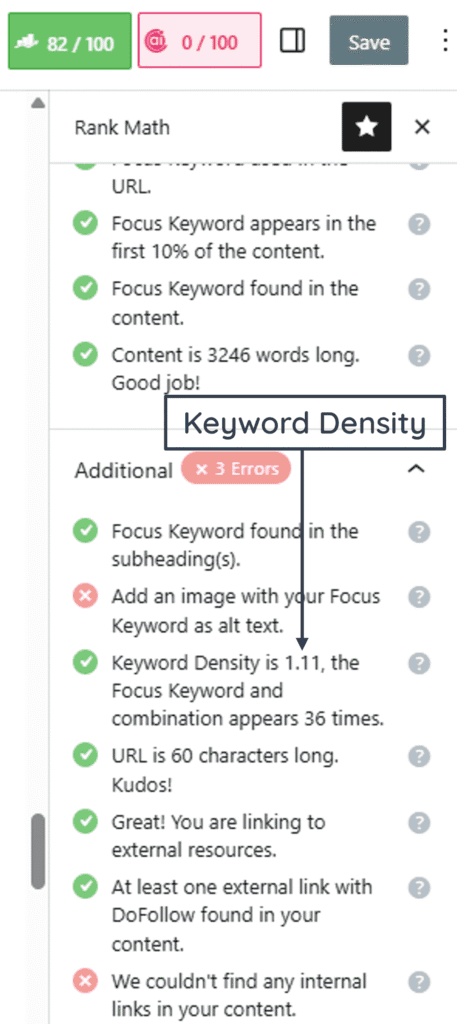
SEO plugins may provide their own recommended ranges. For example, Rank Math commonly treats approximately 1% to 1.5% as sufficient in many cases. However, this is a content-analysis guideline used by the plugin, not an official Google requirement or guaranteed ranking formula.
A page can rank with a lower percentage when its subject is clear, and a page with a higher percentage can perform poorly if the writing is repetitive or fails to answer the search query.
It is therefore better to ask:
- Is the main topic immediately clear?
- Does the exact keyword appear where readers expect it?
- Is repetition necessary for meaning?
- Are close variations used naturally?
- Does the page fully answer the intended question?
These questions are more useful than trying to reach a predetermined percentage.
How Often Should the Primary Keyword Appear?
The primary keyword should appear enough times to establish the page’s subject without distracting the reader. There is no exact number that applies to every article.
As a practical editorial approach, a long-form guide may use its exact primary phrase naturally several times across the introduction, headings, body, conclusion, and FAQs. The appropriate number depends on the topic and writing rather than a fixed target.
Shorter pages may need fewer mentions, while technical subjects may require more. The phrase should never be inserted simply because a tool requests another occurrence.
Read the article aloud after optimization. If the keyword repeatedly draws attention to itself, replace some instances with pronouns, close variations, or more specific terminology.
A page can use as many relevant variations as needed to explain the subject. There is no fixed limit.
For an article targeting keyword density, useful variations might include keyword frequency, keyword usage, keyword repetition, keyword-density percentage, primary keyword, focus keyword, and keyword stuffing.
However, these terms are not always interchangeable. Keyword frequency is a raw count, while density is a percentage. Keyword stuffing is a manipulative practice rather than another name for optimization.
For many long-form articles, a small number of meaningful variations may be sufficient. Each should appear only when it improves clarity or accurately expresses the topic. The purpose is to cover the subject clearly, not to build a list of phrases and distribute them mechanically.
Google notes that its language-matching systems can understand how pages relate to many searches even when every possible variation is not used explicitly. Creators should therefore anticipate the words readers use without trying to include every imaginable version.
Keyword Density vs. Keyword Stuffing
Keyword density is a neutral measurement, while keyword stuffing is the excessive or unnatural use of keywords or numbers in an attempt to manipulate search rankings.
A page can have a relatively high density without being manipulative when the subject naturally requires repeated terminology. Similarly, a lower density does not automatically make the content useful.
What Is Keyword Stuffing?
Google defines keyword stuffing as filling a page with keywords or numbers in an attempt to manipulate rankings. The terms may appear unnaturally, out of context, or in repetitive lists.
A stuffed paragraph might read:
Our coffee beans store sells coffee beans online. Buy coffee beans from our coffee beans shop for the best coffee beans prices.
The subject is obvious, but the repetition makes the text difficult to read and provides little useful information.
A natural version would be:
Our store offers freshly roasted Arabica and Robusta beans for espresso, filter coffee, and cold brew.
The revised sentence explains the offering with specific, helpful details instead of repeatedly forcing the same phrase.
Signs That Keywords Are Overused
Keywords may be overused when:
- the exact phrase appears in nearly every paragraph;
- several variations are placed together in one sentence;
- headings are rewritten awkwardly to include the keyword;
- image alt text lists keywords instead of describing the image;
- internal links repeatedly use identical anchor text;
- sentences sound unnatural when read aloud;
- synonyms are avoided even when they would improve clarity;
- the keyword appears where it adds no meaning.
Repetition can also affect titles. A title such as Keyword Density Guide: Keyword Density Tips and Keyword Density Tools is less informative than Keyword Density: How to Measure and Use Keywords Naturally.
How Stuffing Affects Content
Keyword stuffing weakens readability and can make a page appear unreliable or commercially aggressive. Readers may leave because the writing feels repetitive, which means the content fails before any ranking question is considered.
Google’s spam policies also identify keyword stuffing as a practice that can lead to lower visibility or exclusion from search results.
It is therefore important to distinguish optimization from repetition. Good optimization clarifies the page’s purpose, while stuffing sacrifices communication to satisfy an imagined formula.
Does Keyword Density Still Matter for SEO?
Keyword density still has limited value, but not as a percentage that creators should attempt to maximize.
It can help answer two useful editorial questions:
- Is the primary topic mentioned clearly enough?
- Has the wording become unnecessarily repetitive?
Beyond these checks, the percentage says very little about the quality of the page.
How Search Engines Understand Keywords
Search engines use page language, links, surrounding context, and relationships between words to understand what content is about and how it may relate to queries. They can also connect a page with queries that do not repeat its exact wording.
For example, a page titled How to Brew Better Espresso may also be relevant to searches involving espresso extraction, grind size, water temperature, and shot timing. It does not need to repeat one exact query in every section.
Google Search Essentials recommends using the words people would use to find the content in prominent and descriptive locations. These locations include the title, main heading, alt text, and link text. More importantly, Google emphasizes creating helpful, reliable, and people-first content rather than repeating keywords simply to satisfy an optimization target.
Why Context and Search Intent Matter
A page may have a seemingly appropriate density but still miss the search intent.
Suppose an article targets best coffee grinders. Repeating the phrase ten times will not make the page useful if it does not compare grinder types, grind consistency, settings, cleaning requirements, price, and brewing suitability.
Another page may use the exact phrase only a few times but offer a clear comparison table, testing criteria, product advantages, and purchasing guidance. The second page is more likely to satisfy someone evaluating grinders.
In other words, keyword usage helps establish relevance, but the page must still provide the type of information the searcher expects.
What Content Creators Need to Keep in Mind
Content creators should use density as a warning system rather than a target.
Check whether the page:
- has one clear primary subject;
- answers the probable search intent;
- includes essential concepts and examples;
- uses terminology accurately;
- places the primary phrase naturally;
- avoids repetitive sentences;
- offers more value than a basic definition;
- remains easy to read.
The objective is not to produce a particular percentage. It is to make the page’s purpose unmistakable while preserving natural language.
How to Select, Set and Place a Primary Keyword
The primary keyword is the main search phrase or topic a page is designed to address. It may also be called the main keyword, target keyword, or focus keyword.
These labels usually describe the same editorial idea, although SEO tools may use a particular term within their interfaces.
Choosing the Primary or Focus Keyword
Choose a phrase that accurately represents the page’s central purpose. It should align with what the intended reader wants and be specific enough to guide the article. For example:
Do not select a broad phrase merely because it has higher search volume. The keyword must match the content that can realistically be created.
Before writing, review the search results and consider:
- What type of pages currently appear?
- Is the query informational, commercial, or transactional?
- Which questions do readers need answered?
- Can the article offer a clear and original contribution?
- Does another page on the website already target the same intent?
Setting the Focus Keyword in Rank Math
In WordPress, open the post or page and select the Rank Math panel. Look for the post for which you want to a a focus keyword and click on the icon next to the column heading “SEO Details”. Enter the main phrase in the Focus Keyword field and press Enter to save it.
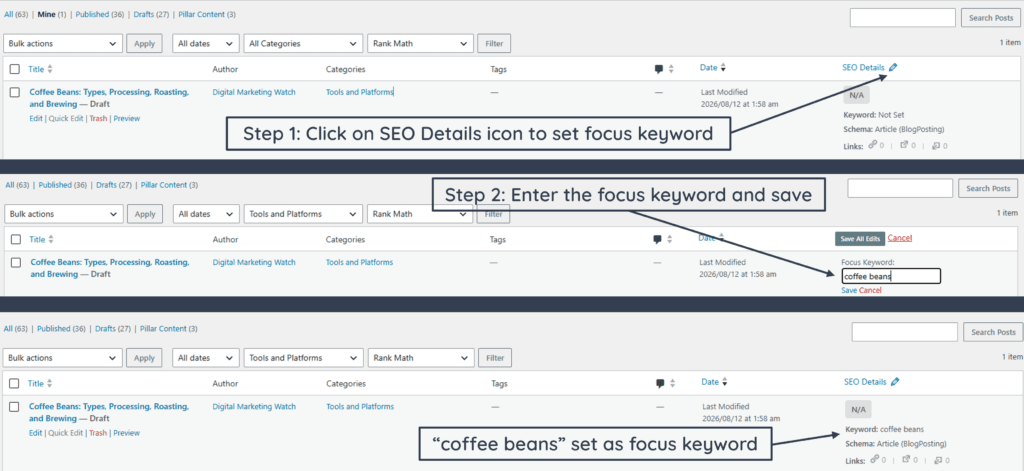
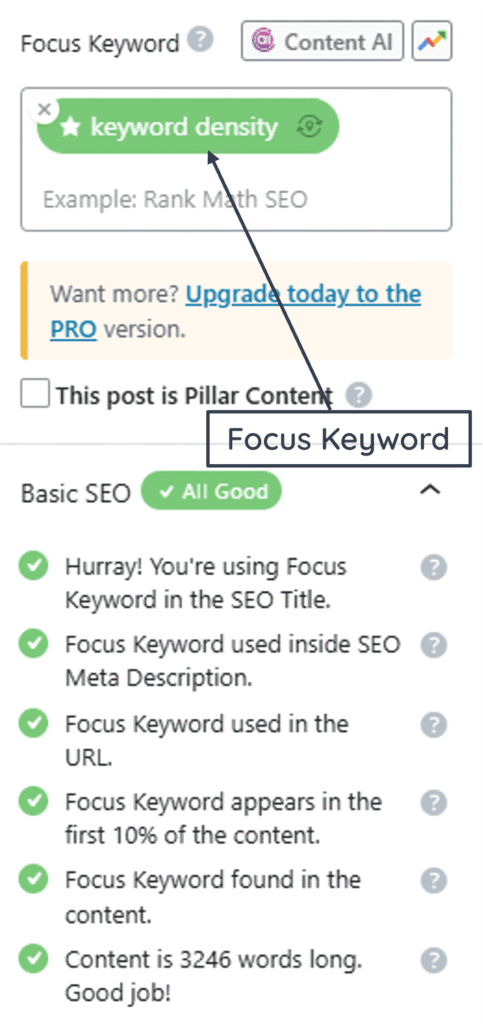
Rank Math then checks whether that phrase appears in locations such as the SEO title, description, URL, introduction, headings, and body content. Its focus keyword field provides editorial recommendations based on the phrase entered.
However, entering a focus keyword does not send a special ranking instruction to Google. The field is primarily used by Rank Math to analyze the page and calculate its SEO score.
It is important to note here that Google does not use the old meta-keywords tag. Therefore, the focus-keyword field should be treated as a writing and review aid rather than a hidden signal that determines rankings.
Where to Place Keywords
A primary keyword may appear in several important locations when it accurately describes the content. These are possible locations, not a checklist requiring the exact keyword to appear in every element.
Keywords should not be forced into every location. A decorative image, for example, may need empty alt text, while an informative image needs an accurate description rather than a target phrase added for SEO.
Google’s image alt-text guidance recommends useful, contextual descriptions and warns against filling alt attributes with keywords.
Anchor text should also describe the destination naturally. Repeated use of the same exact-match anchor text across internal links is unnecessary and can reduce the natural flow of the surrounding content.
How to Check Keyword Usage
Keyword checkers can calculate density quickly, but they should support human review rather than replace it.
Checking Keyword Usage in Rank Math
After setting the focus keyword, review Rank Math’s Basic SEO and Additional sections in the WordPress editor. The plugin evaluates the keyword across several locations and reports its calculated density.
If Rank Math shows low usage, do not immediately add the phrase several times. Instead, first check whether:
- the keyword uses punctuation the tool cannot match;
- the page uses a plural or close variation;
- the phrase appears in dynamic content the plugin cannot read;
- the content is naturally clear without more repetition.
Similarly, a green score does not prove that the page is accurate, original, or useful. It confirms only that the content passed the plugin’s programmed checks.
Keyword-Density Checker Tools
Keyword-density checker tools can show how frequently a word or phrase appears within a webpage and, in some cases, where those repetitions occur. They are most useful for identifying excessive or uneven keyword use rather than targeting a specific “ideal” density.
Some tools offer free density checks or limited free access. However, features and pricing can change over time.
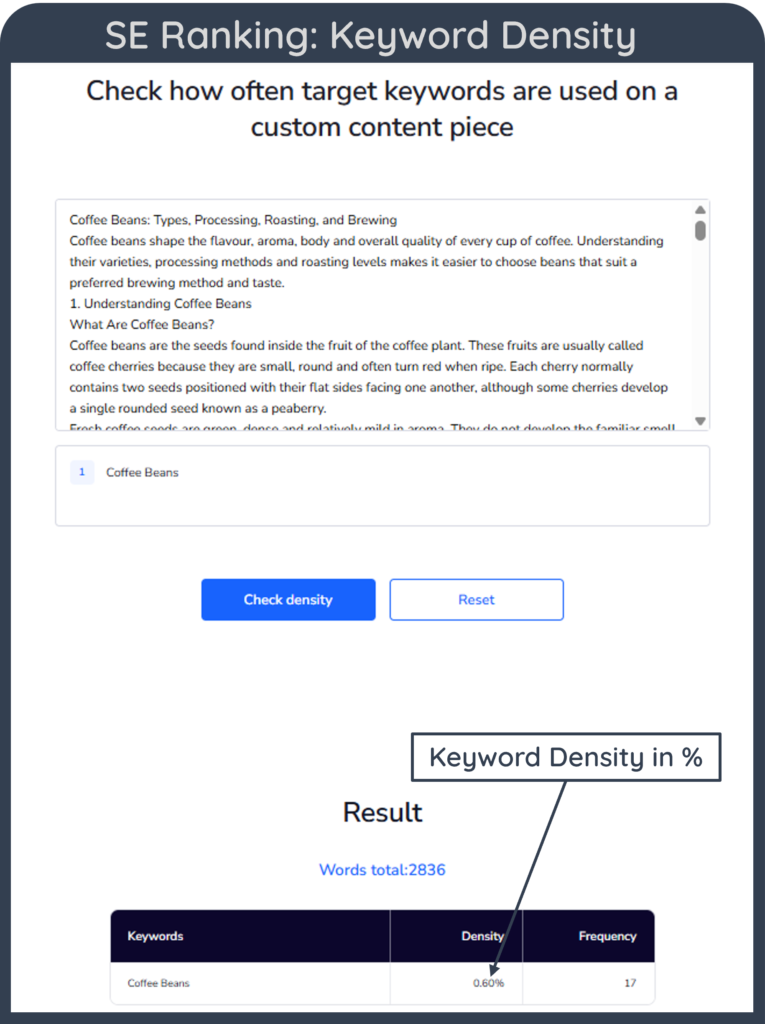
When using an external checker, confirm whether it analyzes pasted text, a live URL, or both. Also check whether titles, headings, and metadata are included in the calculation.
Different results do not necessarily mean one tool is broken. They may simply measure different parts of the page.
Reviewing Usage Without Chasing a Score
Complete the automated check with a manual review:
- Read the introduction and confirm that the topic is clear.
- Search the document for the exact primary phrase.
- Review every occurrence in its full sentence.
- Remove repetitions that add no new meaning.
- Replace awkward uses with natural variations.
- Check headings for readability rather than exact-match density.
- Confirm that alt text describes each image accurately.
- Review internal-link anchors for relevance and variety.
- Read difficult sections aloud.
- Evaluate whether the page satisfies the title’s promise.
This process keeps the keyword visible without allowing a score to control the writing.
Conclusion
Keyword density is the percentage of content occupied by a particular word or phrase. It differs from keyword frequency, which is a raw count, and from TF-IDF, which weighs a term by comparing it with a wider document collection.
There is no universal keyword-density percentage that guarantees better rankings. Content creators should instead select a clear primary keyword, place it naturally in important parts of the page, and use relevant variations only when they improve the explanation.
To sum up, keyword density remains useful as a diagnostic measurement. It can identify missing focus or excessive repetition, but it should never replace search-intent analysis, content quality, accuracy, or human readability.
Frequently Asked Questions
What is keyword density in SEO?
Keyword density is the percentage of a page’s total words represented by a specific keyword or phrase. It is calculated by dividing keyword occurrences by the total word count and multiplying the result by 100.
Does Google use keyword density as a ranking factor?
Google does not publish keyword density as a ranking target or recommend an ideal percentage. Its current guidance emphasizes helpful content, relevant terminology in descriptive locations, and avoidance of keyword stuffing.
What is the ideal keyword density in SEO?
There is no universally ideal percentage. The keyword should appear often enough to make the subject clear but not so frequently that the writing becomes repetitive or unnatural.
Is keyword frequency the same as keyword density?
No. Keyword frequency is the number of times a phrase appears, while density expresses that count as a percentage of the total words on the page.
How many keyword variations should a page use?
There is no fixed limit. Use only the variations needed to explain the topic accurately and match natural ways readers discuss or search for it.
Can high keyword density hurt SEO?
A high percentage is not automatically harmful, but excessive or manipulative repetition may become keyword stuffing. It can weaken readability and violate search-engine spam policies.
How can I check keyword density in WordPress?
Install an SEO plugin such as Rank Math, enter the primary focus keyword, and review its content-analysis recommendations. The plugin will calculate usage based on the parts of the page it can analyze.
Is there any free tool to check keyword density?
Yes. Rank Math, SEO Review Tools, Small SEO Tools, and Internet Marketing Ninjas offer free ways to review keyword frequency or density.
How do I set and check the primary or focus keyword?
Choose the phrase that best represents the page’s main purpose. Enter it in the focus-keyword field of the SEO plugin, then review its placement in the title, heading, URL, introduction, body content, metadata, and other relevant locations.