Knowledge Graph
A knowledge graph is a structured representation of real-world entities, concepts or events and the relationships between them. It stores information as connected data rather than isolated records, making it easier for systems to explore how people, places, organizations and other entities relate to one another. Unlike “flat” databases or spreadsheets, a knowledge graph stores information as an interconnected network.
An important precursor to the modern concept of knowledge graph was “The Semantic Web”, published in Scientific American in May 2001 by Tim Berners-Lee (the inventor of the World Wide Web), James Hendler and Ora Lassila. The paper outlined a future web where machines could read, process, and automatically link data through universal relationships.
Google brought the term into mainstream search through its 16th May 2012 announcement, “Introducing the Knowledge Graph: Things, Not Strings.” Google described the system as a way to understand real-world people, places and things and the relationships between them.
Knowledge graphs can help reduce data silos by connecting scattered information across different systems. They also provide additional context that can support search, data integration and AI retrieval. When built from reliable sources, knowledge graphs can ground AI-generated responses in more traceable information, although they cannot guarantee factual accuracy or eliminate hallucinations completely.
Architecture
Knowledge graphs are commonly represented using the following structural elements:
- Nodes (Vertices): Represent individual entities or concepts, such as a person, place, organization or product.
- Edges (Links): Represent meaningful relationships between nodes, such as
worksFor,locatedInordevelopedBy. In other words, edges connect two nodes by defining the semantic relationship between them. - Attributes (Properties): Store descriptive information about a node or relationship, such as a publication date, geographic coordinate or a movie’s release date.
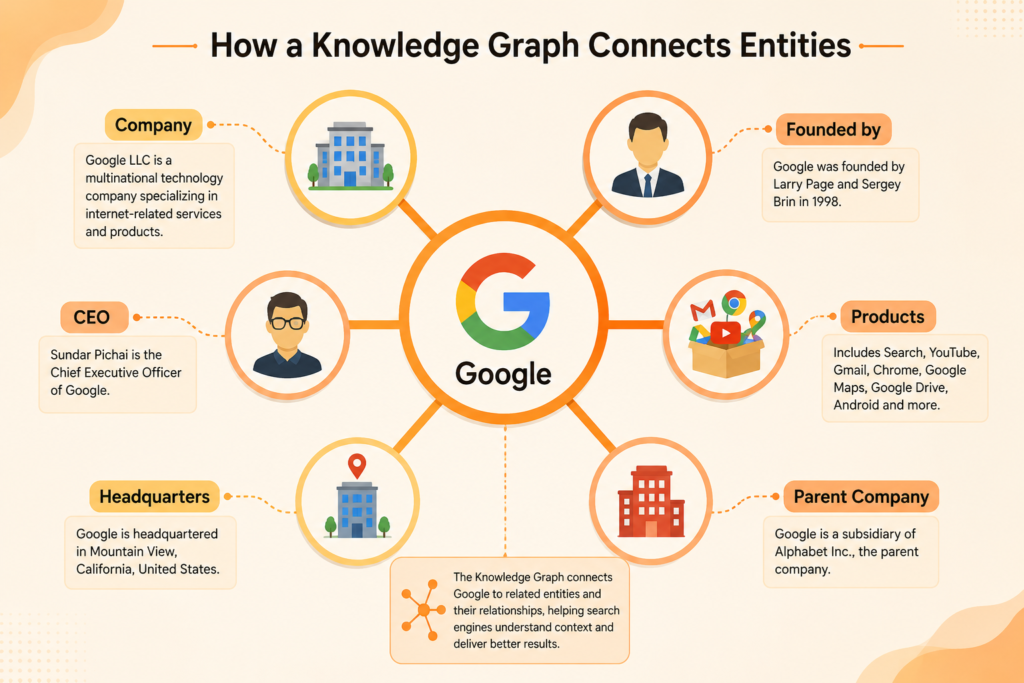
- Schema or Ontology: Defines the classes, relationships and rules used to organize and interpret the graph. Some knowledge graphs enforce strict constraints, while others use more flexible models. For example, it may define Company and Person as classes and foundedBy as a permitted relationship between them.
For example: (Node 1) Person: Lionel Messi (Property: dateOfBirth: 1987-06-24) ➔ bornin (Edge) ➔ (Node 2) Place: Rosario
Storage: Graphs and Databases
Knowledge Base
A knowledge base is an organized collection of information designed for retrieval and reuse. It may contain documents, rules, records or structured facts. A knowledge graph organizes selected information into a searchable network of entities and relationships. This manner of knowledge representation emphasizes entities and explicit relationships.
RDF Graphs and RDF Databases
RDF, or Resource Description Framework, is a W3C standard for “representing and exchanging information on the web.” An RDF graph consists of subject–predicate–object statements called triples. An RDF database, often called a triplestore, stores, manages and retrieves data structured as semantic facts.
Knowledge Graphs and Semantic Triples
In an RDF-based knowledge graph, a triple or semantic triple is the fundamental unit of data used to represent a fact through a subject, predicate and object. The subject is the core concept, the object represents a secondary entity or a distinct data value, and the predicate is the explicit relationship or verb that connects them (e.g., [Sundar Pichai] ➔ [isCEOOf] ➔ [Google]). By converting information into interconnected statements, triples allow systems to query and interpret relationships between entities.
How Google Uses Knowledge Graph
Google describes the Knowledge Graph as a large virtual collection of facts used to support knowledge panels, which summarize important facts and provide paths for exploring related topics. The Knowledge Graph also helps Google move beyond basic keyword matching and understand entities and concepts..
Traditional keyword-based search relied heavily on matching the words in a query with words appearing in indexed documents. The Knowledge Graph helps Google execute entity disambiguation and distinguish whether a query such as “Apple” refers to the technology company, the fruit or another entity.
How a Knowledge Graph is Built
Building a knowledge graph involves collecting information, identifying entities and relationships, organizing them according to a defined structure and continuously validating and updating the connected data.
- Data Collection: Information is gathered from structured and unstructured sources such as databases, documents, tables, websites or approved internal sources.
- Entity Extraction: People, organizations, places, products and other entities are identified.
- Entity Resolution: Different references to the same entity, such as “M. Jordan” and “Michael Jordan,” are matched where appropriate. This involves assigning unique identifiers to entities so that entities with identical or similar names are not incorrectly combined.
- Relationship Extraction: Statistical models, rules or structured mappings identify relationships between entities.
- Schema or Ontology Mapping: Entities and relationships are organized according to the graph’s data model.
- Validation and Provenance: Facts are checked, linked to their sources and reviewed for conflicts or uncertainty.
- Storage and Updating: The graph is stored in a suitable database and updated as information changes.
A Simple Example
Imagine three simple facts:
- Microsoft developed Windows.
- Bill Gates co-founded Microsoft.
- Bill Gates was born in Seattle.
The resulting knowledge graph visually connects these facts like a spiderweb:
- Nodes: Microsoft, Windows, Bill Gates and Seattle.
- Edges or links: developed, coFoundedBy and bornIn.
Suppose a user searches for “Where was a founder of the company that developed Windows born?” A knowledge system does not need to find a webpage containing that exact sentence. Instead, it can follow the relationships in the graph:
Windows ➔ developedBy ➔ Microsoft ➔ coFoundedBy ➔ Bill Gates ➔ bornIn ➔ Seattle
By connecting these separate facts, the system can return the answer: Seattle.
How It Helps AI and Machine Learning Systems
Some machine-learning systems can be difficult to interpret because their predictions are based on complex statistical patterns. Knowledge graphs can add explicit entities, relationships and source information, allowing certain decisions or retrieved facts to be traced more clearly.
How Knowledge Graphs and Vector Databases Work Together
GraphRAG, or graph-based retrieval-augmented generation, uses graph structures to improve the information retrieved for a language model. Microsoft’s GraphRAG approach extracts entities and relationships from source documents, builds a knowledge graph and organizes related information into hierarchical summaries.
Some GraphRAG systems combine graph traversal—the process of moving from one entity to other entities by following their relationships—with vector search. Vector search identifies text with similar meaning, while graph retrieval follows explicit relationships between entities. Together, these methods can improve context and reduce unsupported answers, but they cannot eliminate hallucinations completely.
What Businesses and Content Creators Need to Know
Websites can help search engines understand their content by using clear names, accurate information, descriptive internal links and valid structured data where appropriate. Schema markup can identify organizations, people, products and articles and may make pages eligible for supported rich results. At the same time, it is important to note that structured data does not guarantee inclusion in Google’s Knowledge Graph, knowledge panels or AI-generated answers.
Similarly, businesses must ensure that their names, addresses, telephone numbers and official profiles remain accurate and consistent.
Real-World Applications of Knowledge Graphs
Knowledge graphs are used across industries to connect complex information, reveal relationships, improve search and support more informed decisions.
Recommendation Systems: Graphs can connect users, products, preferences and interactions to support personalized recommendations.
Biomedical Research: Knowledge graphs can connect genes, proteins, diseases, drugs and research findings to support discovery and analysis.
Supply Chain Management: Graphs can model suppliers, components, orders, availability and dependencies to assess disruptions and identify alternatives.
Financial Fraud Detection: Accounts, transactions, devices and locations can be connected to identify suspicious networks and shared attributes.
Enterprise Data Integration: Knowledge graphs can connect records from departments such as finance, sales, human resources and IT while preserving relationships and definitions.