



Sending an email is only the beginning of email marketing. The real question is: did the email achieve its purpose? Did people open it, click on the links, complete an action, or ignore it completely?
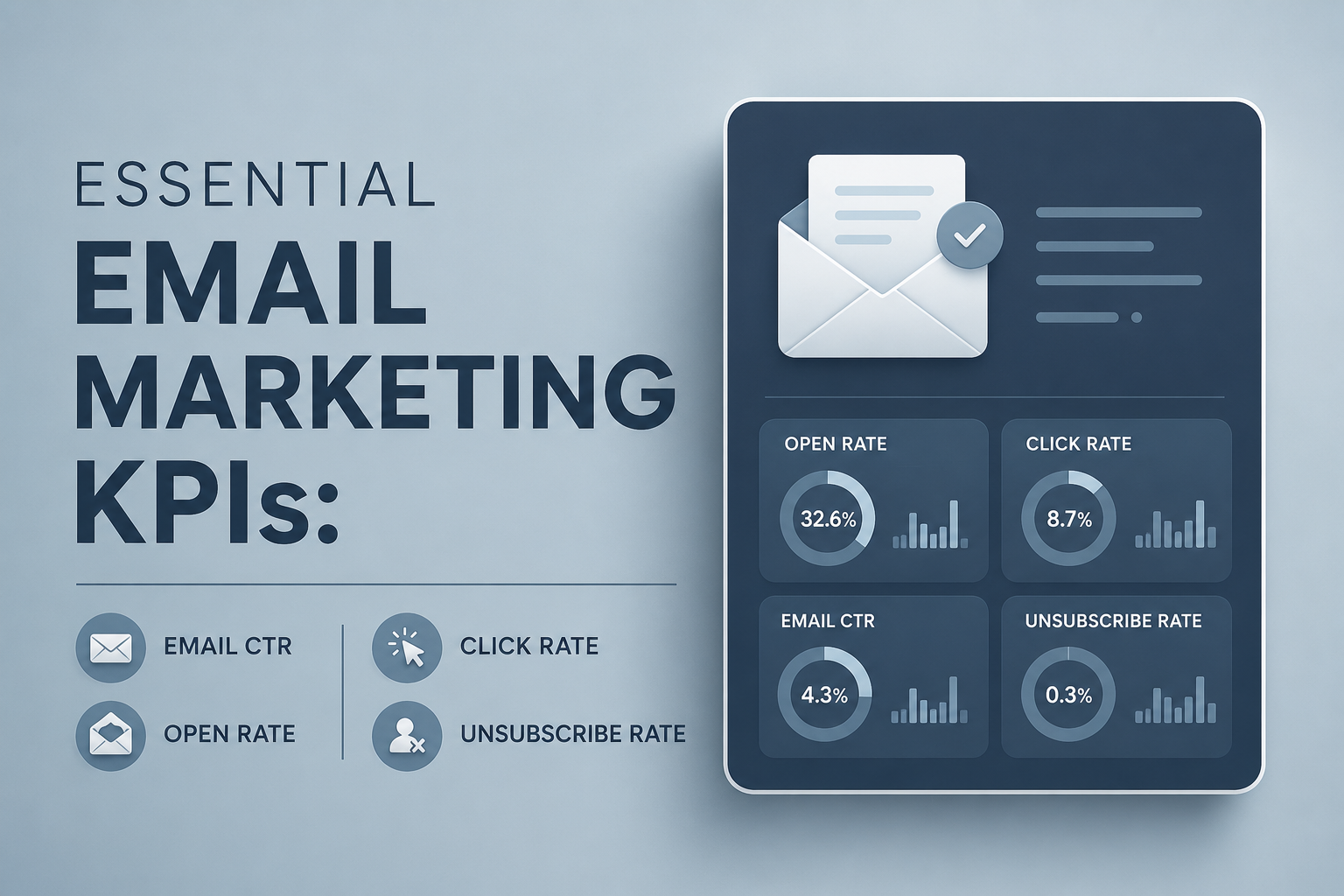
This is where Email Marketing KPIs (Key Performance Indicators) become important. They help marketers understand whether campaigns are working, where users are losing interest, and what needs improvement.
Imagine sending 10,000 invitations to an event. Knowing how many people opened the invitation, how many clicked “register,” and how many actually attended tells you much more than simply knowing that the invitations were sent. Email marketing metrics work in the same way.
By tracking metrics like Open Rate, Click-Through Rate (CTR), Bounce Rate, Unsubscribe Rate, Conversion Rate, and ROI, businesses can move from guessing to making data-driven decisions.
Table of Contents
- Email Marketing Basics: Campaigns, Newsletters, and Welcome Emails
- Writing Emails That Drive Opens, Clicks, and Conversions
- Essential Email Marketing KPIs: Measuring Campaign Performance
- Email Marketing Analytics Tools and Platforms
- Conclusion
- Frequently Asked Questions
Email Marketing Basics: Campaigns, Newsletters, and Welcome Emails
Before measuring email performance, it is important to understand what different types of emails businesses send and why.
Email marketing is the process of communicating with customers or subscribers through emails to build relationships, share information, promote products, and encourage actions.
However, not every email has the same goal.
Some emails are designed to educate.
Some are designed to sell.
Some are designed to build customer relationships.
KPIs help measure whether each type of email is achieving its purpose.
Email Marketing Campaigns
An email campaign is a planned series of emails sent to achieve a specific goal.
Examples:
- Product launch campaign
- Sales promotion campaign
- Customer retention campaign
- Event registration campaign
- Newsletter campaign
A campaign may include multiple emails sent over several days or weeks.
Marketers measure each email to understand what works best.
Email Newsletters
A newsletter is a regular email sent to subscribers with useful information.
Examples:
- Industry updates
- Company news
- Blog content
- Tips and resources
The main goal of newsletters is often engagement and relationship building.
Important metrics include:
- Open rate
- Click rate
- Engagement
- Subscriber growth
Welcome Emails
Welcome emails are the first messages sent after someone subscribes, creates an account, or joins a list.
They are important because they create the first impression.
A good welcome email can:
- Introduce the brand
- Explain next steps
- Share useful resources
- Encourage engagement
Automated Emails
Automated emails are messages triggered by user actions.
Examples:
- Abandoned cart emails
- Signup confirmations
- Product recommendations
- Birthday emails
These emails are often highly effective because they are based on user behavior.
Why Email Engagement Matters
Sending emails does not automatically create results.
A successful campaign depends on:
- People opening emails
- Users clicking links
- Visitors completing actions
- Customers generating revenue
KPIs help answer:
- Are people interested?
- Is the message effective?
- Are users taking action?
- Is the campaign profitable?
Writing Emails That Drive Opens, Clicks, and Conversions
Before measuring KPIs, marketers need emails that are designed to perform.
A poor email will usually produce poor metrics.
Understanding the Goal of an Email
Every email should have a clear purpose.
Examples:
A newsletter goal:
“Educate readers”
A sales email goal:
“Generate purchases”
A welcome email goal:
“Introduce the brand”
The KPI you focus on depends on the goal.
Writing Effective Subject Lines
The subject line determines whether many people open the email.
A strong subject line should be:
- Clear
- Relevant
- Interesting
- Benefit-focused
Example:
Weak:
“Monthly Update”
Better:
“5 New Ways to Improve Your Marketing Results”
Creating Valuable Email Content
People unsubscribe when emails provide little value.
Good emails should:
- Solve problems
- Share useful information
- Provide relevant offers
- Respect the reader’s time
Personalization and Segmentation
Not every subscriber wants the same message.
Segmentation divides audiences based on factors like:
- Interests
- Previous purchases
- Location
- Behavior
Personalized emails often create stronger engagement.
Clear Calls-to-Action
A call-to-action tells users what to do next.
Examples:
- Download the guide
- Shop now
- Read the article
- Book a demo
A confusing CTA can reduce clicks even if the email is opened.
Common Email Mistakes That Reduce Performance
Some common mistakes include:
- Sending too many emails
- Weak subject lines
- No clear purpose
- Poor mobile design
- Irrelevant content
- Ignoring inactive subscribers
These mistakes directly affect KPIs.
Essential Email Marketing KPIs: Measuring Campaign Performance
Email marketing KPIs are measurable values that show how effectively email campaigns perform.
They help marketers understand the complete journey:
Email Sent
↓
Email Delivered
↓
Email Opened
↓
Link Clicked
↓
Action Completed
↓
Revenue Generated
Each stage has different metrics.
Without KPIs, marketers only know that emails were sent.
With KPIs, they understand:
- Audience interest
- Content performance
- Campaign effectiveness
- Revenue impact
Email Open Rate
What Is Email Open Rate?
Email Open Rate measures the percentage of delivered emails that were opened by recipients.
Formula:
Open Rate = (Number of Opens ÷ Delivered Emails) × 100
Example:
You send 10,000 emails.
9,000 are delivered.
900 people open the email.
Open Rate:
900 ÷ 9,000 × 100 = 10%
Why Open Rate Matters
Open rate shows how effective your:
- Subject line
- Sender name
- Timing
- Audience targeting
are.
A low open rate often means people are not interested enough to open the message.
How to Improve Open Rate
Improve open rates through:
- Better subject lines
- Personalization
- Sending at appropriate times
- Cleaning inactive subscribers
- Building trust with your audience
Email Click Rate
What Is Email Click Rate?
Click Rate measures the percentage of delivered emails where users clicked a link.
Formula:
Click Rate = (Total Clicks ÷ Delivered Emails) × 100
Example:
10,000 emails delivered.
500 clicks.
Click Rate:
5%
Why Click Rate Matters
Opening an email does not mean success.
The real question is:
“Did the email convince people to take action?”
Click rate shows content effectiveness.
Email Click-Through Rate (CTR)
What Is Email CTR?
Email CTR measures clicks compared with the number of emails opened.
Formula:
CTR = (Clicks ÷ Opens) × 100
Example:
1,000 people open an email.
200 click.
CTR:
20%
Click Rate vs CTR
The difference:
Click Rate:
Measures clicks from delivered emails.
CTR:
Measures clicks from people who opened the email.
CTR helps understand how persuasive the email content was after opening.
How to Improve Email CTR
Improve CTR by:
- Writing stronger email copy
- Improving CTAs
- Using relevant offers
- Reducing distractions
- Creating better landing pages
Email Delivery Rate
What Is Delivery Rate?
Delivery Rate shows how many emails successfully reached recipients.
Formula:
Delivery Rate = (Delivered Emails ÷ Sent Emails) × 100
A high delivery rate means your emails are reaching inboxes.
Why Delivery Rate Matters
Poor delivery can happen due to:
- Invalid email addresses
- Spam issues
- Poor sender reputation
Good deliverability improves campaign performance.
Email Bounce Rate
What Is Bounce Rate?
Bounce Rate measures emails that could not be delivered.
Two main types:
Hard Bounce
Permanent problems.
Examples:
- Invalid email address
- Deleted account
Soft Bounce
Temporary problems.
Examples:
- Full inbox
- Server issue
How to Reduce Bounce Rate
Improve bounce rate by:
- Removing invalid emails
- Using double opt-in
- Maintaining clean lists
Unsubscribe Rate
What Is Unsubscribe Rate?
Unsubscribe Rate shows how many people leave your email list after receiving a campaign.
Formula:
Unsubscribe Rate = (Unsubscribes ÷ Delivered Emails) × 100
Why People Unsubscribe
Common reasons:
- Too many emails
- Irrelevant content
- Poor targeting
- Lack of value
How to Reduce Unsubscribes
Improve retention by:
- Sending relevant emails
- Segmenting audiences
- Allowing preference control
- Avoiding excessive promotion
Email Conversion Rate
What Is Email Conversion Rate?
Conversion Rate measures how many recipients completed the desired action.
Examples:
- Purchase
- Signup
- Download
- Registration
Formula:
Conversion Rate = (Conversions ÷ Delivered Emails) × 100
Why Conversion Rate Matters
Conversions connect email performance with business goals.
A campaign with fewer clicks but more purchases may be more successful than one with many clicks but no revenue.
Email Marketing ROI
What Is Email Marketing ROI?
ROI measures financial return from email campaigns.
Formula:
ROI = ((Revenue – Cost) ÷ Cost) × 100
Example:
You spend $500 on email marketing.
Generate $2,500 revenue.
ROI:
(($2,500 – $500) ÷ $500) × 100
= 400%
Email Marketing Benchmarks 2026
Benchmarks vary by:
- Industry
- Audience
- Email type
- Customer relationship
Instead of chasing a single number, compare:
- Your previous campaigns
- Industry averages
- Business goals
How to Analyze Multiple KPIs Together
No single KPI tells the full story.
Example:
High open rate + low CTR:
People like the subject line but the email content needs improvement.
Low open rate + high CTR:
The email works for those who open, but more people need to open it.
Metrics should be analyzed together.
Email Marketing Analytics Tools and Platforms
Email analytics tools help marketers track campaign performance.
Email Marketing Platforms
Popular platforms provide:
- Campaign reports
- Automation tracking
- Audience segmentation
- Conversion tracking
Examples include:
- Mailchimp
- HubSpot
- Klaviyo
- ActiveCampaign
Tracking Campaign Performance
Marketers should monitor:
- Opens
- Clicks
- Conversions
- Revenue
- Subscriber growth
Measuring Automation Performance
Automated emails should be measured separately.
Examples:
- Welcome series performance
- Abandoned cart recovery
- Customer lifecycle emails
Testing and Optimization Tools
Testing helps improve results.
Common tests include:
- Subject line testing
- CTA testing
- Email design testing
- Send time testing
Using Data to Improve Future Campaigns
Analytics should lead to action.
For example:
Low open rate → improve subject lines
Low clicks → improve content and CTA
Low conversions → improve offer or landing page
Conclusion
Email marketing success is not measured by how many emails are sent. It is measured by how people respond.
KPIs like Open Rate, Click Rate, CTR, Bounce Rate, Unsubscribe Rate, Conversion Rate, and ROI help marketers understand what is working and where improvement is needed.
The most successful email strategies use data continuously. By tracking the right metrics, testing campaigns, and improving based on audience behavior, businesses can increase engagement, build stronger relationships, and generate better returns from email marketing.
Frequently Asked Questions
What are email marketing KPIs?
Email marketing KPIs are measurable values used to evaluate the performance of email campaigns.
What is the most important email marketing metric?
The most important metric depends on the campaign goal. For awareness, open rate may matter more, while for sales, conversion rate and ROI are usually more important.
What is email open rate?
Email open rate measures the percentage of delivered emails that recipients opened.
What is email CTR?
Email CTR measures the percentage of opened emails that resulted in clicks.
What is a good email click-through rate?
A good click-through rate depends on industry and audience, but marketers should focus on improving performance compared with their own previous campaigns.
How can I improve email CTR?
You can improve CTR by creating better content, stronger calls-to-action, better targeting, and more relevant offers.
What is unsubscribe rate?
Unsubscribe rate measures the percentage of recipients who choose to stop receiving emails after a campaign.
How do I measure email campaign success?
Email campaign success is measured through a combination of open rate, clicks, conversions, revenue, and ROI.
What is email marketing ROI?
Email marketing ROI measures the financial return generated compared with the cost of running email campaigns.
How do I improve email engagement?
Improve engagement through personalization, segmentation, valuable content, relevant offers, and consistent testing.