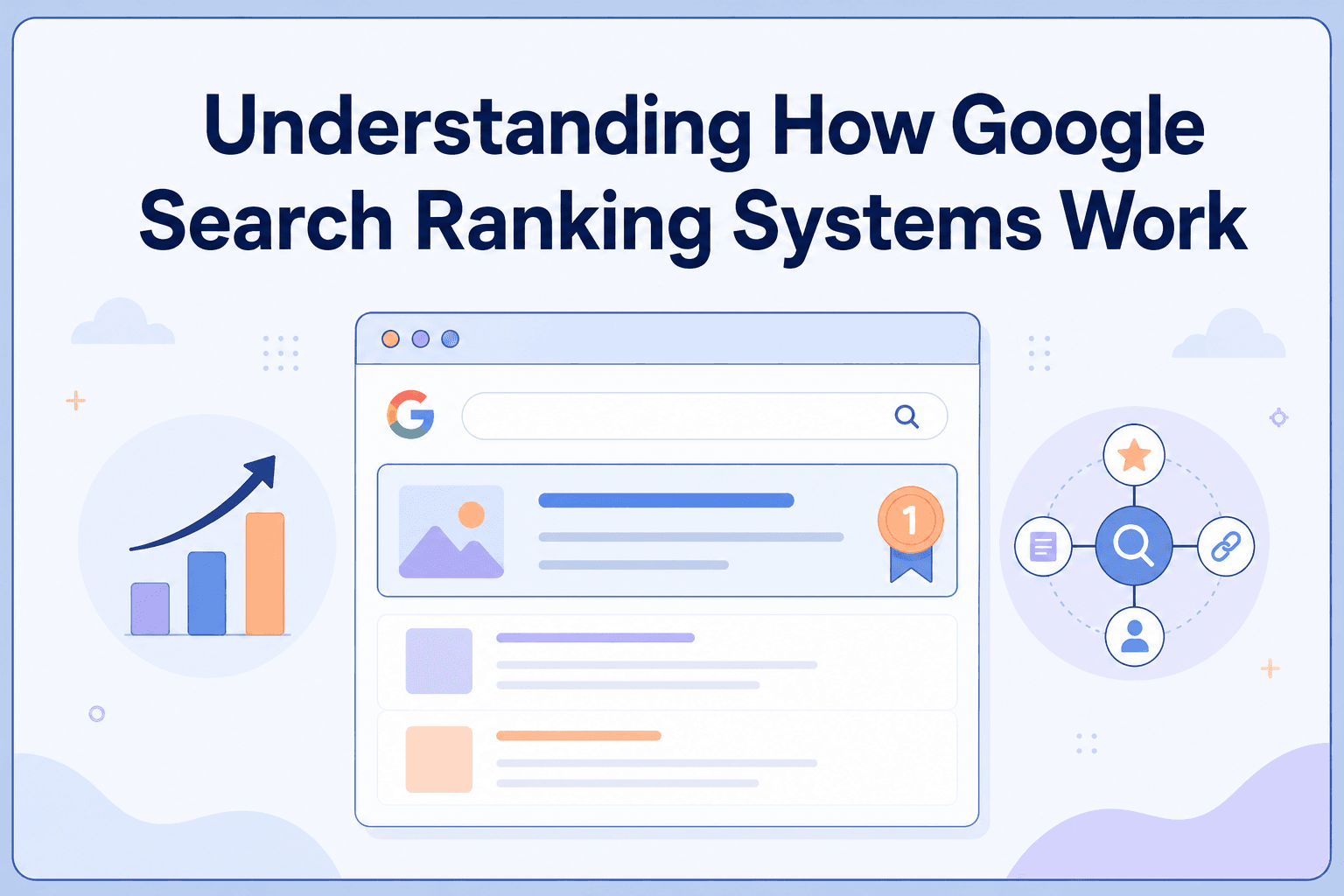
Understanding How Google Search Ranking Systems Work
Key Takeaways
- Google doesn't use not one fixed algorithm. Instead, it uses multiple automated ranking systems for language, links, freshness, originality, spam detection, and specialized needs.
- The 2024 documentation leak revealed internal modules and attributes, but not their weighting, current use, or complete ranking process.
- Ranking systems, signals, factors, algorithms, and updates describe different concepts, making precise terminology important when interpreting SEO evidence.
- Ranking declines can reflect algorithmic updates, technical issues, changing demand, competition, or volatility, so diagnosis should precede major changes.
Google does not publish a complete blueprint of its Search ranking algorithm. It explains many important systems, principles, and signals, but does not publicly disclose the complete combination, weighting, or interaction of technologies used to rank search results. Google’s public ranking systems guide therefore describes some of its more notable systems rather than presenting a complete formula.
That distinction became particularly important in 2024, when thousands of pages of internal Google Search documentation were leaked publicly. The documents revealed 2,596 modules containing 14,014 attributes, offering an unusual look at information used inside Google’s Search infrastructure. However, they did not reveal how those attributes were weighted, whether every attribute was actively used for ranking, or how Google’s complete ranking process worked.
Google ranking process is therefore better understood as a complex collection of systems rather than one simple algorithm with a fixed list of factors. Some systems help understand language, some analyze relationships between linked pages, some determine when freshness matters, and others address specialized search needs.
In addition, ranking systems continue to change as Google tests and updates how results are evaluated. These changes can influence both the composition of search results and the relative ranking positions of webpages for specific queries.
For SEO, understanding these concepts is more useful than trying to reduce Google Search to a fixed checklist of ranking factors. They also helps explain why rankings fluctuate, what core updates actually change, why new websites can take time to establish visibility, and how website owners should respond when performance declines.
Table of Contents
Google Search Ranking Systems
A Google ranking system is an automated system involved in evaluating information and determining which results should appear for a search. Google says its ranking systems consider several ranking factors and signals across hundreds of billions of webpages and other content in its indexed records to identify relevant and useful results.

Google does not rely on one ranking system for every task. Instead, its main ranking systems include multiple technologies, while other systems address specific page ranking features. The search engine lists systems for language understanding, links, freshness, original content, passages, local news, crisis information, reliable information, and other specialized needs.
Ranking Systems, Signals, Factors, and Updates
Several terms are commonly mixed together in SEO, although they do not mean exactly the same thing.
Google itself has emphasized the distinction between ranking systems and updates. A system is something that operates to produce or improve results, whereas an update changes or improves a system. This distinction became necessary because names such as “Helpful Content Update” were sometimes used interchangeably for both a system and a change to that system.
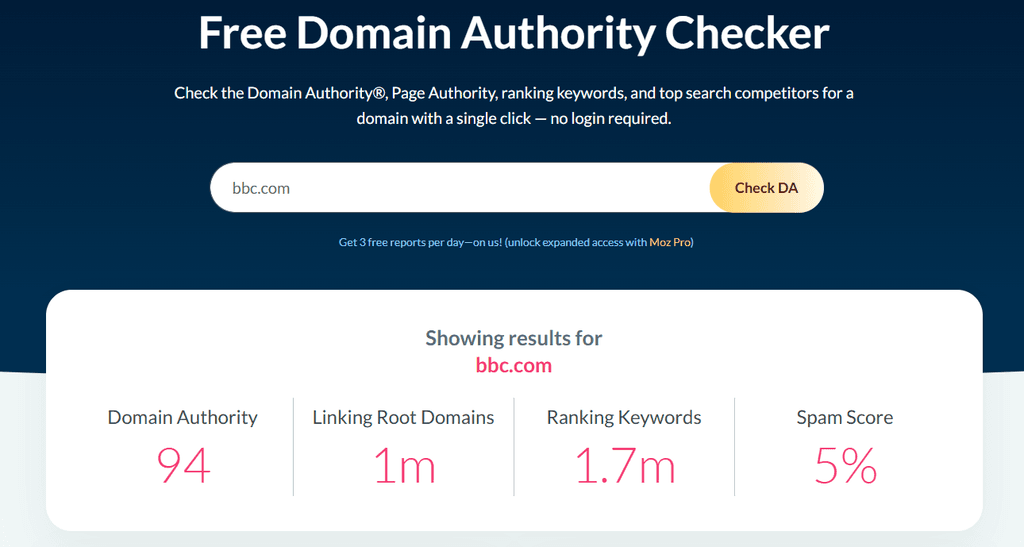
Similarly, ranking factor is widely used in SEO, but Google more often discusses systems, factors, and signals. For example, Google confirms that Core Web Vitals are used by ranking systems, but it also warns against assuming that one metric determines ranking success. Likewise, third-party “authority” or “reputation” scores do not correspond to Google’s own signals.
E-E-A-T and Google Ranking Systems
E-E-A-T stands for Experience, Expertise, Authoritativeness, and Trustworthiness. It is a framework used by Google to characterize helpful and reliable content, particularly for topics where inaccurate information could significantly affect a person’s health, financial stability, safety, or well-being. Among these qualities, Google describes trust as the most important.
However, E-E-A-T is not a single ranking factor or separate ranking system. Google explains that its automated systems use a mixture of factors that can help identify content demonstrating aspects of experience, expertise, authoritativeness, and trustworthiness.
For example, a medical article written or reviewed by an appropriately qualified professional, supported by reliable evidence, and clearly identifying its author may provide stronger indicators of expertise and trust than an anonymous article making unsupported health claims.
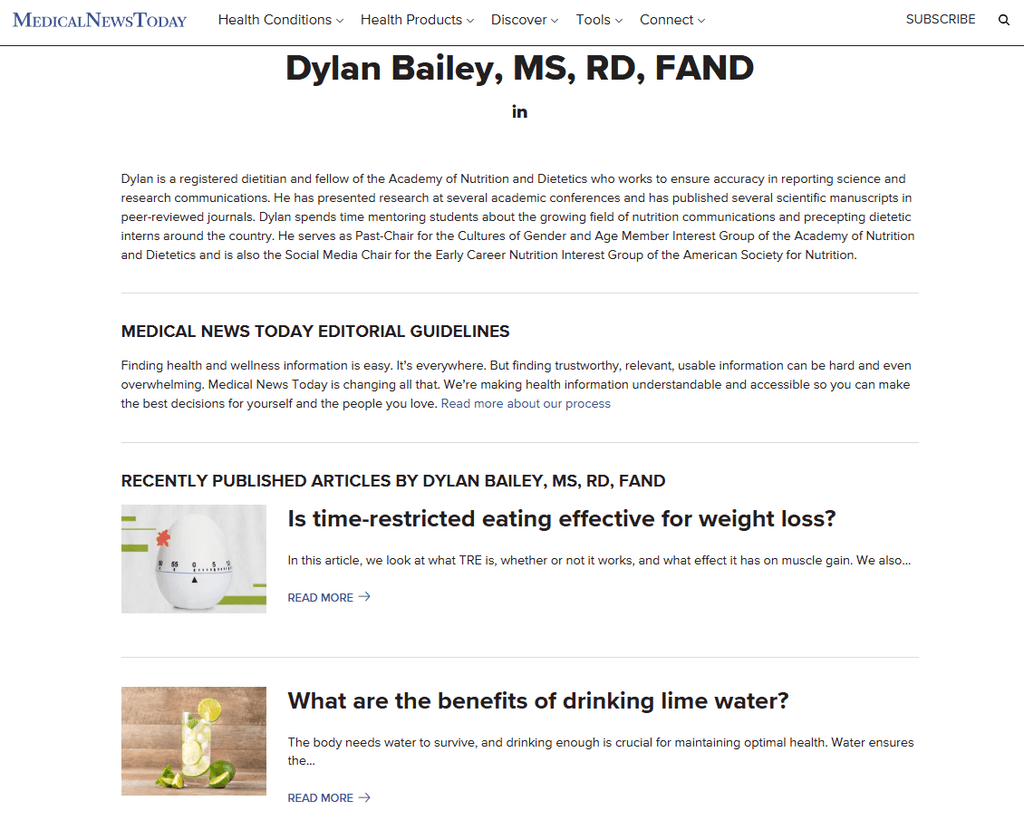
Google’s Search Quality Raters also use E-E-A-T concepts when evaluating search quality. However, individual quality-rater assessments do not directly determine a webpage’s rankings; instead, their feedback helps Google evaluate how well its ranking systems are performing.
What the 2024 Google Leak Actually Revealed
The leaked 2024 documentation provided valuable information about Google’s internal Search infrastructure, including thousands of modules and attributes. However, the documents contained no weighting information, which means the presence of an attribute alone does not establish how important it is—or even whether it currently affects ranking in a particular Search system.
It is therefore important to separate documented evidence from SEO speculation. Concepts such as links, Core Web Vitals, freshness, RankBrain, and PageRank have direct support in Google’s documentation. Other ideas may be useful hypotheses, but repetition within the SEO industry does not turn them into confirmed ranking factors.
How Google Ranking Systems Work
Google’s ranking process begins after crawling and indexing have made content available to Search. When someone searches, Google’s systems retrieve potential results from the index and evaluate which are most relevant and useful for that query. Google notes that relevance can depend on hundreds of factors, including information such as location, language, and device.
Importantly, Google’s core ranking systems primarily operate at the page level. Site-wide signals and classifiers also exist, but a strong site-wide signal does not guarantee that every page will rank well, and a weak site-wide signal does not automatically prevent every page from performing.
Consider the query “how to repair a leaking faucet.”
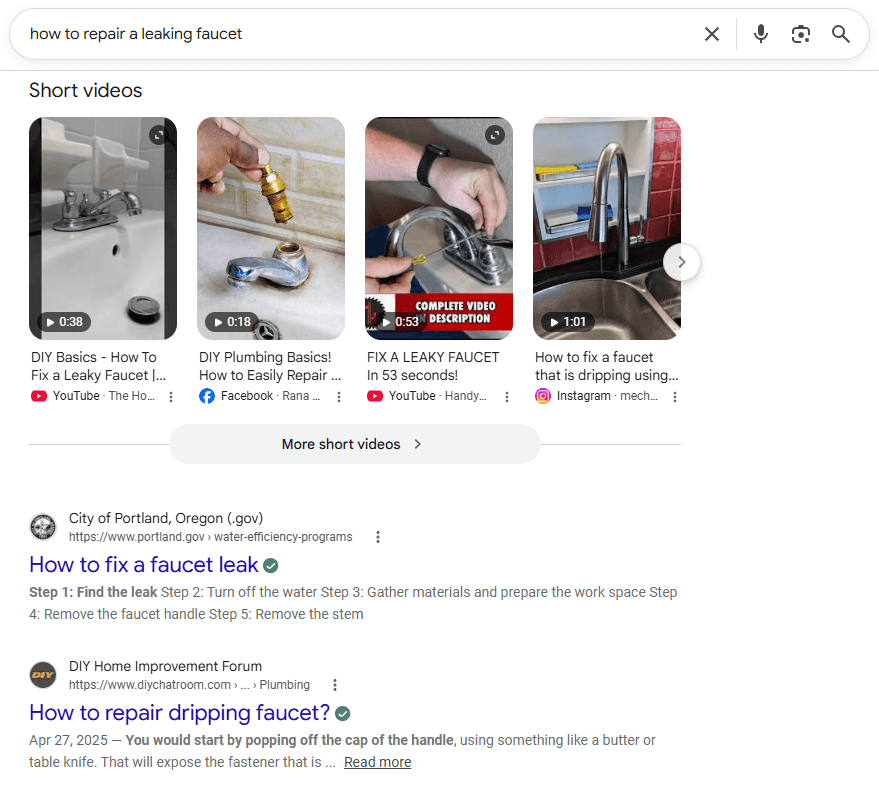
For this query, Google does not simply count how often a page or a video description repeats repair, leaking, and faucet. Different systems can help interpret what the searcher means, match the query with relevant concepts, evaluate links and other information, and determine which available pages or videos are suitable results.
Important Google Ranking Systems
Google’s link-analysis systems include PageRank, which has evolved considerably since Google’s early years but remains part of its core ranking systems. Links can help Google understand relationships between pages and identify information that may be useful for a query. A site’s internal linking structure is one source of those relationships because it connects related pages within the same website.
Multitask Unified Model (MUM)
Not every AI technology Google uses is a general ranking system. For example, Google’s Multitask Unified Model (MUM), which can understand and generate language, it is not currently used for general Search ranking. MUM is instead used for particular Search applications.
Language understanding is handled through several technologies. RankBrain, introduced in 2015, helps Search understand how words relate to real-world concepts, while BERT helps interpret words in context. Neural matching similarly helps Google match representations of concepts within queries and webpages rather than relying only on identical wording.
Freshness is more situational. Google’s freshness systems are designed for queries where newer information is expected. For example, someone searching for reviews of a newly released movie probably needs current reviews.
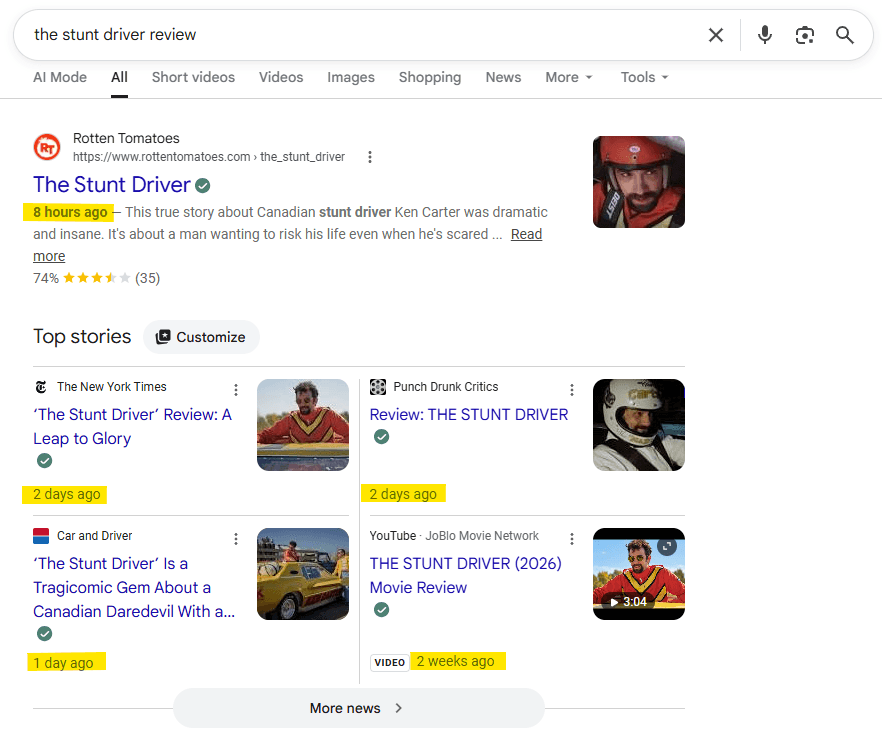
On the other hand, a historical query or a search about historical ideas may not necessarily benefit from recent or “fresh” pages.

Google also documents systems for original content, reviews, site diversity, spam detection, deduplication, exact-match domains, reliable information, and several other specialized ranking needs.
In other words, there is no reason to expect every ranking system or signal to have the same importance for every search. Different queries create different information needs, and Google’s systems can play different roles depending on those needs.
How Google Ranking Systems Have Evolved
Google’s ranking technology has changed continuously. Some historically important systems are now integrated into broader core systems, while newer technologies have improved areas such as language understanding and content evaluation.
Google’s current ranking documentation identifies Panda, Penguin, Hummingbird, and the Helpful Content System as retired systems, meaning they have either been incorporated into successor technologies or integrated into its core ranking systems. Panda became part of core systems in 2015, Penguin in 2016, and the Helpful Content System was incorporated into core ranking systems in March 2024.
The March 2024 change is particularly important for current SEO terminology. Google no longer operates one separate Helpful Content System in the way it originally did. Instead, its core systems use multiple signals and approaches to evaluate and surface helpful content.
Core Updates and Broad Core Updates
A core update is a significant, broad change to Google’s search algorithms and systems. Google says these updates are intended to improve Search overall rather than target particular websites or individual pages. Therefore, a page losing positions during an update has not necessarily been penalized; other results may simply be assessed as more useful under the updated systems.
The phrase broad core update was frequently used in Google’s earlier communications, while current documentation generally uses core update. Google also makes smaller core improvements between announced updates, so ranking systems do not remain unchanged between major rollout dates.
Ranking Volatility, Fluctuations, and New Websites
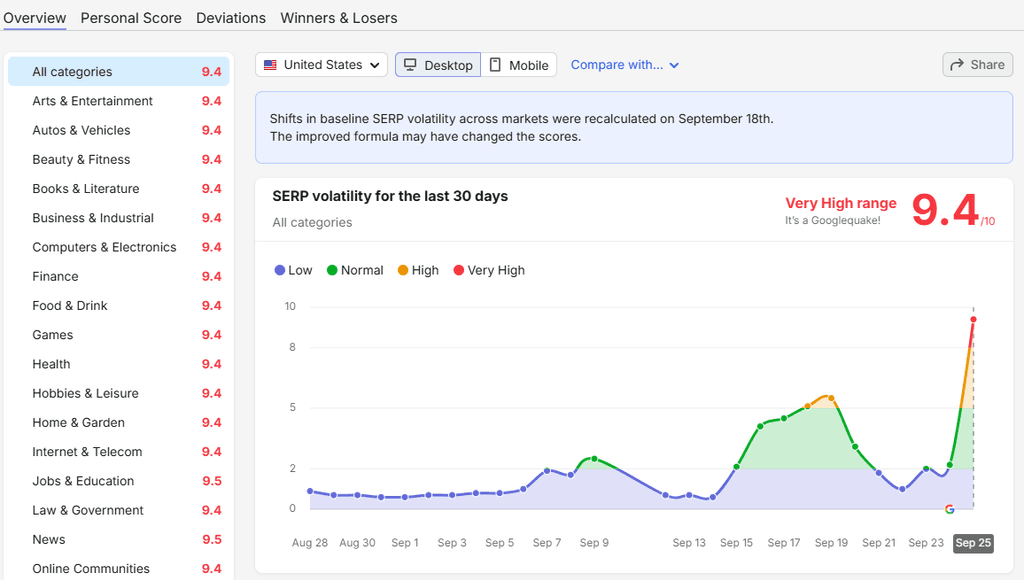
Rankings are not permanent positions. Search results change because Google updates its systems, webpages change, new competitors appear, search behavior changes, technical issues occur, and different results become more relevant. Google therefore advises website owners not to treat every small movement as evidence that something is wrong.
Ranking volatility broadly describes how much search positions change over time. SERP volatility usually refers to wider movement across search results, while ranking fluctuations describe gains and losses affecting individual pages or queries.
What Was the Google Dance?
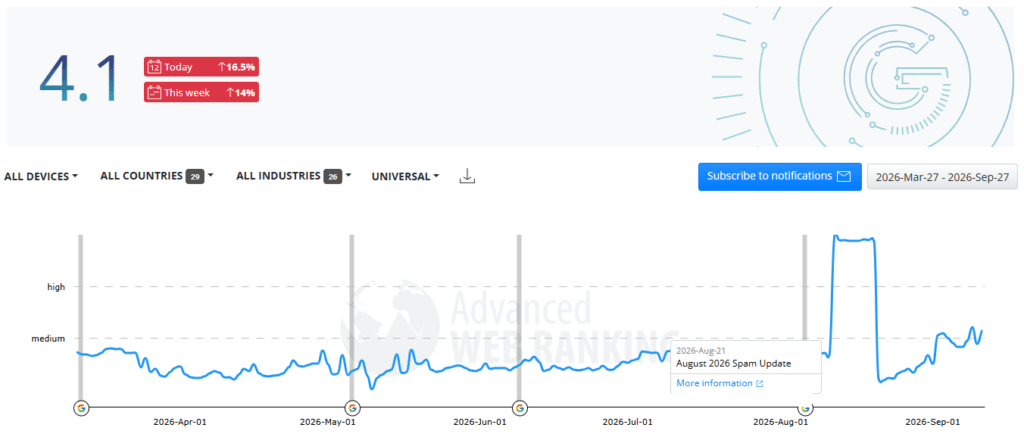
The Google Dance is a historical SEO term. In Google’s earlier years, its index was updated periodically, which could cause search positions to move substantially while new data propagated. The SEO industry called this temporary period of movement the Google Dance. Google later moved away from those large monthly index refreshes toward more continuous updating.
Today, people sometimes use Google Dance informally for ranking fluctuations, but modern volatility can have many causes and should not be assumed to represent the historical Google Dance process.
Why Website Rankings Drop
A ranking or traffic decline does not automatically mean that an algorithm update is responsible. Google identifies several causes for drops in search traffic, including algorithmic changes, technical problems, security issues, spam issues, changing search demand, seasonality, and site migrations.
For example, a misplaced noindex directive can gradually remove important pages from Search, while server failures may prevent crawling. Alternatively, a page can remain technically healthy but lose visibility because search demand changes or competing content becomes more relevant.
New Websites and the Google Sandbox Effect
New websites can take time to become visible, but that should not automatically be attributed to a hidden “sandbox.” The Google Sandbox Effect is an SEO hypothesis that new domains may experience a period in which competitive rankings are difficult to achieve. Google does not document a formal ranking system called the Google Sandbox.
There are simpler documented reasons why new websites may initially struggle. Google notes that a new site may take a few weeks to be noticed, and discovery can be more difficult when other websites do not link to it. Crawling and indexing also take time, and neither indexing nor submission through a sitemap guarantees ranking.
Therefore, a new website’s limited initial visibility does not by itself prove that Google is deliberately suppressing it.
How to Respond to Ranking Updates and Drops
When rankings fall, the first task is diagnosis rather than immediate editing. Google recommends using Search Console to determine whether a decline affected a few queries, particular pages, an entire section, or the site more broadly. It also recommends checking whether an announced update has finished before drawing conclusions.
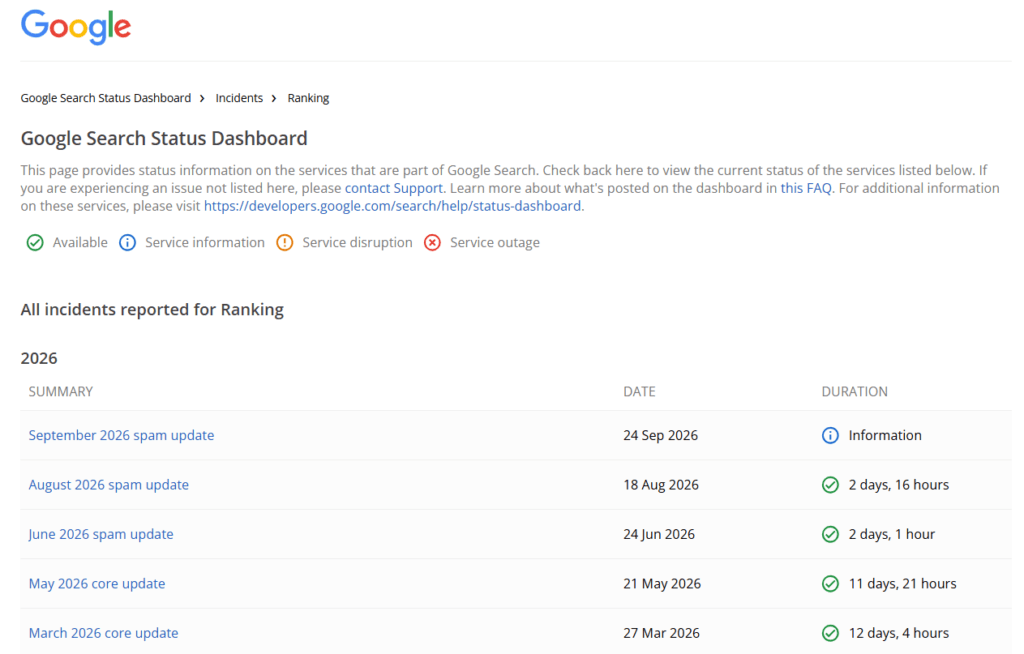
For core updates specifically, Google suggests waiting at least a full week after rollout completion before comparing performance. Small movements, such as dropping from position 2 to 4, generally do not justify drastic changes, while large sustained losses deserve deeper assessment.
A useful diagnostic sequence is:
The Search Status Dashboard records significant ranking updates and widespread Search incidents, while Search Console can show whether clicks, impressions, queries, pages, countries, devices, or search appearances changed.
Ranking Recovery After an Update
Recovery is not necessarily immediate. Google says some improvements can affect results within a few days, while others may require several months for its systems to determine that a site is consistently producing helpful, reliable, people-first content. A site also does not necessarily need to wait for the next major core update because smaller core updates continue between major announcements.
However, improvement does not guarantee recovery to a previous position. Search results are dynamic, and other pages may become more relevant or useful over time. It is therefore better to focus on meaningful improvements than to reverse-engineer individual ranking movements.
How to Respond to Ranking Changes
Before making major changes after a ranking decline:
- Check whether an announced Google update or widespread Search issue occurred before assuming that the decline was caused by the website itself.
- Compare affected pages and queries in Search Console so that a site-wide traffic figure does not hide the actual source of the change.
- Rule out technical and indexing problems first, including server failures, accidental noindex directives, robots.txt problems, crawl errors, and incorrect migrations.
- Review whether affected pages still satisfy the searcher’s needs, provide substantial original information, and remain competitive with other useful results.
- Avoid drastic reactions to normal ranking fluctuations, particularly when pages remain strong and only small position changes have occurred.
- Allow sufficient time after substantial improvements, because Google’s systems may need days or months to reassess pages and broader site patterns.
Google’s document on people-first content emphasizes creating useful material for an intended audience rather than content designed primarily to manipulate Search rankings. Its current guidance also recommends considering the overall page experience rather than pursuing one isolated metric as the solution to ranking problems.
In short, understanding ranking systems does not provide a formula for controlling rankings. It provides a better framework for separating documented systems from speculation, interpreting algorithm updates, diagnosing volatility, and making improvements that remain useful even as Google Search continues to evolve.
Frequently Asked Questions
What are Google ranking systems?
Google ranking systems are automated technologies that evaluate many signals and factors to help determine which indexed content is most relevant and useful for a search.
What is the difference between a ranking system and a ranking factor?
A ranking system performs part of the evaluation or ranking process, while ranking factor is a broader SEO term for information or characteristics that may influence ranking.
What is a Google algorithm update?
A Google algorithm update is a change or improvement to the algorithms or systems used to produce and evaluate search results.
What is a Google core update?
A core update is a broad improvement to Google’s overall search algorithms and systems rather than a change designed to target one particular website.
Is the Helpful Content System still separate?
No, the former Helpful Content System became part of Google’s core ranking systems in March 2024.
What is ranking volatility?
Ranking volatility describes changes in search-result positions over a period of time.
What was the Google Dance?
The Google Dance was an SEO term for the substantial ranking movement that occurred during Google’s older periodic index updates.
Does Google have a sandbox for new websites?
Google does not document a formal ranking system called the Google Sandbox, although new websites can take time to be discovered, crawled, indexed, and established in competitive search results.
Why do Google rankings suddenly drop?
Rankings can decline because of algorithmic changes, technical or security problems, spam issues, changing search demand, site migrations, competition, or normal Search volatility.
How long does recovery after a core update take?
Improvements may affect Search within days, but some reassessments can take several months, and recovery is never guaranteed.
Does Google disclose all of its ranking factors?
No, Google publishes information about many important systems and signals but does not provide a complete ranking formula or the weighting of every factor.
Did the 2024 Google leak reveal Google’s algorithm?
No, the leaked documentation exposed thousands of internal modules and attributes but did not reveal their weighting, current use, or Google’s complete ranking algorithm.