



Affiliate marketing has become a popular way for creators, bloggers, and businesses to earn income online by recommending products and services. However, creating affiliate content is not just about adding links and waiting for commissions. The biggest challenge is getting that content discovered by the right audience.
An affiliate is a person, creator, or business that promotes another company’s products and earns a commission when someone makes a purchase through their recommendation. Affiliate marketing is the business model that connects brands with affiliates who help drive customers through content, reviews, comparisons, or recommendations.
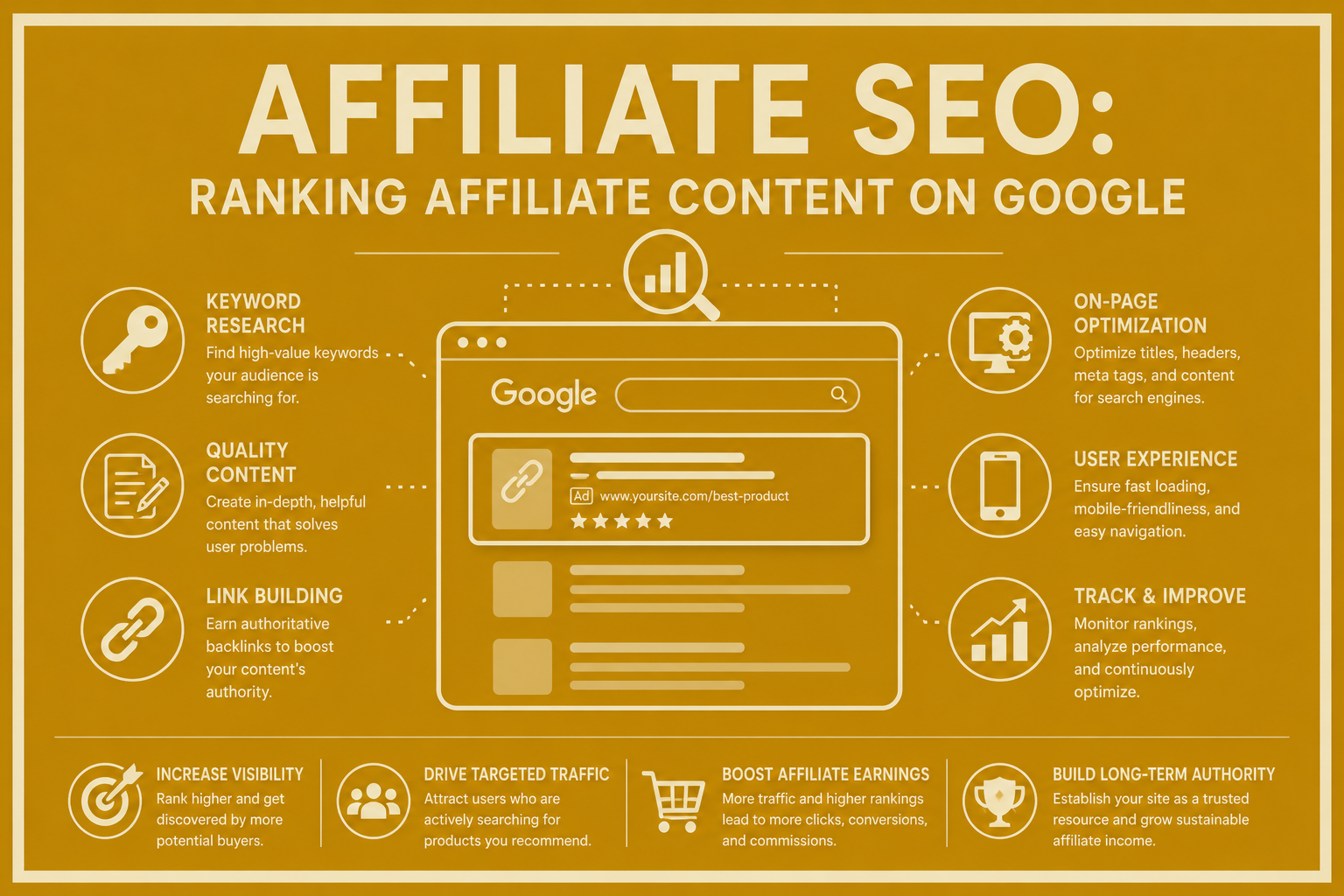
Ranking affiliate content means optimizing this content so it appears higher in search results when users are looking for information before making a purchase. This includes ranking product reviews, comparison articles, buying guides, and other commercial content that helps people make decisions.
For example, imagine someone searches:
“Best wireless headphones for working out”
A website that publishes a detailed comparison of different headphones, explains their features, compares prices, shares pros and cons, and includes affiliate links can earn a commission if the reader purchases through those links. But before that happens, the content needs to rank on Google and attract visitors.
This is where affiliate SEO becomes important. Successful affiliate websites do not simply publish random product articles. They understand what customers are searching for, create useful content around those needs, build trust, and structure their websites so both users and search engines understand their value.
Table of Contents
- Understanding How Affiliate Content Ranks
- Choosing the Right Affiliate Niche and Content Opportunities
- Keyword Research for Affiliate Content That Converts
- Creating Affiliate Reviews and Comparison Articles That Rank
- Building an Effective Affiliate Content System
- Google Helpful Content, AI Overviews, and the Future of Affiliate SEO
- Conclusion
- Frequently Asked Questions
Understanding How Affiliate Content Ranks
Affiliate content ranking refers to the process of improving affiliate-focused pages so they appear in search results and attract visitors who are likely to purchase products or services.
In simple terms:
Ranking affiliate content means creating the right content, for the right search, at the right stage of the buyer journey.
A normal informational article may answer a question.
Example:
“What is a standing desk?”
An affiliate article usually targets someone closer to making a decision.
Example:
“Best standing desks for home offices”
The second search shows stronger buying intent because the person is comparing options.
What Is Affiliate SEO?
Affiliate SEO is the process of applying SEO strategies specifically to affiliate websites and affiliate content.
While traditional SEO focuses on attracting traffic, affiliate SEO focuses on attracting valuable traffic.
The goal is not only:
“Get more visitors.”
The goal is:
“Get visitors who are interested in buying.”
A successful affiliate page connects three things:
Search Query
↓
Helpful Affiliate Content
↓
Product Recommendation and Conversion
How Affiliate Content Is Different from Regular SEO Content
A regular blog may aim to educate.
An affiliate article usually needs to educate and support a buying decision.
For example:
A regular article:
“How Does a Coffee Machine Work?”
An affiliate article:
“Best Coffee Machines for Small Apartments”
The second article requires:
- Product research
- Comparisons
- Recommendations
- Purchase guidance
Search Intent and Conversion
Many beginners make a simple mistake: They create content around products without understanding search intent.
Example:
Writing:
“Best Gaming Laptop”
without knowing:
- Who is searching?
- What budget do they have?
- What features matter?
- What alternatives exist?
Successful affiliate content starts with customer understanding.
The Search Traffic → Clicks → Commissions Journey
Affiliate revenue usually follows this path:
User Searches on Google
↓
Finds Affiliate Article
↓
Reads Recommendation
↓
Clicks Affiliate Link
↓
Purchases Product
↓
Affiliate Earns Commission
Every step matters.
A page that ranks but does not convince users will struggle.
A page that converts well but receives no traffic will also struggle.
Commercial Intent and Buyer Journeys
Not every search has the same value.
A user searching:
“What is a laptop?”
is probably learning.
A user searching:
“Best laptop under $1000”
is comparing.
A user searching:
“Dell XPS 13 review”
may be close to buying.
Affiliate websites should understand where users are in their decision journey.
Affiliate Content as a Digital Salesperson
A good affiliate article works like a salesperson.
It should:
- Understand customer needs
- Explain options
- Compare choices
- Answer doubts
- Recommend suitable solutions
The difference is that the article can work continuously and attract visitors from search engines over time.
Choosing the Right Affiliate Niche and Content Opportunities
One of the biggest reasons affiliate websites fail is not poor writing or weak SEO. It is choosing the wrong direction from the beginning.
Many beginners select a niche only because they see someone else making money from it. They start publishing random product articles without understanding whether people are searching, whether the audience has buying intent, or whether they can create better content than existing websites.
A profitable affiliate niche is not just about finding expensive products with high commissions.
It is about finding the intersection of:
Audience demand + Search opportunity + Product value + Your ability to create useful content
Why Niche Selection Matters for Affiliate Success
Your niche determines:
- The type of audience you attract
- The products you can promote
- The keywords you target
- The competition you face
- The type of content you create
For example:
A website about “fitness” is broad.
A website about “home workout equipment for beginners” is more focused.
The second option may have fewer visitors but a more specific audience with stronger buying intent.
Understanding Profitable Affiliate Niches
Some affiliate niches perform well because they naturally connect with purchasing decisions.
Examples include:
- Software and SaaS tools
- Personal finance
- Health and fitness products
- Technology products
- Education platforms
- Travel services
- Business tools
However, profitability alone should not decide your niche.
A niche with high commissions but no interest from your audience will not succeed.
Competition vs Opportunity
Many beginners make one of two mistakes:
They either choose extremely competitive niches:
“Best smartphones”
or extremely narrow topics with no audience.
A better approach is finding smaller opportunities.
Example:
Instead of:
“Best laptops”
Consider:
“Best laptops for graphic design students”
The audience is smaller, but the search intent is clearer.
Understanding Audience Problems
Strong affiliate content starts with problems, not products.
People rarely search because they want a product name.
They search because they want a solution.
Examples:
Problem:
“My back hurts while working”
Potential content:
“Best office chairs for back support”
Problem:
“I want to learn coding”
Potential content:
“Best coding courses for beginners”
Finding Topics with Buying Potential
Good affiliate topics usually include words that suggest comparison or purchase intent.
Examples:
- Best
- Review
- Alternative
- Comparison
- Vs
- Top
- Discount
- Pricing
These searches often indicate that users are closer to making decisions.
Choosing Products and Affiliate Programs Strategically
The product you promote matters.
Consider:
- Product quality
- Brand reputation
- Commission structure
- Customer demand
- Conversion potential
A low-quality product may generate short-term commissions but damage audience trust.
Avoiding Random Content Publishing
A common mistake is publishing articles like:
- Random product reviews
- Unconnected topics
- Content without keyword research
A stronger approach is building a content plan around:
- Audience questions
- Buying journeys
- Product categories
- Supporting informational content
Keyword Research for Affiliate Content That Converts
Keyword research for affiliate websites is different from normal informational SEO.
The goal is not only finding traffic.
The goal is finding people who are closer to buying.
Buyer-Intent Keywords
Buyer-intent keywords indicate that users are evaluating products.
Examples:
- Best noise-cancelling headphones
- Best accounting software for small businesses
- Best running shoes for beginners
These users are usually comparing options.
Best X for Y Keywords
This is one of the strongest affiliate keyword formats.
Examples:
- Best cameras for beginners
- Best laptops for students
- Best CRM software for startups
The “for Y” part helps identify a specific audience.
Product Comparison Keywords (X vs Y)
Comparison searches usually happen near the decision stage.
Examples:
- Canva vs Adobe Express
- iPhone vs Samsung
- Shopify vs WooCommerce
A strong comparison article should not simply declare a winner.
It should explain:
- Who each option is best for
- Strengths
- Weaknesses
- Different use cases
Product Review Keywords
Review keywords show strong interest.
Examples:
- Bluehost review
- Notion review
- Dyson Airwrap review
However, modern affiliate reviews need more than basic summaries.
They should include:
- Experience
- Testing
- Pros and cons
- Alternatives
- Real limitations
Alternatives and Replacement Keywords
Many users search for alternatives after knowing a product.
Examples:
- Canva alternatives
- Amazon alternatives
- Mailchimp alternatives
These searches can create strong affiliate opportunities.
Finding Low-Competition Affiliate Keywords
Beginners should look beyond large keywords.
Useful sources include:
- Google autocomplete
- Related searches
- Competitor content analysis
- Customer reviews
- Forums and communities
Look for unanswered questions and underserved audiences.
Matching Keywords with Purchase Intent
A keyword’s value depends on intent.
Example:
“what is a standing desk”
has informational intent.
“best standing desk under $500”
has commercial intent.
Affiliate websites need both, but commercial content usually drives direct revenue.
Creating Affiliate Reviews and Comparison Articles That Rank
Affiliate content succeeds when it helps people make better decisions. A weak affiliate article says:
“Buy this product. It is the best.”
A strong affiliate article explains:
“Here are the options, here is who they suit, and here is what you should consider.”
Structure of High-Performing Review Articles
A strong review article usually includes:
- Clear introduction
- Product overview
- Features
- Benefits
- Limitations
- Alternatives
- Pricing
- Recommendation
Adding Real Experience and Insights
Google and users value first-hand experience.
Examples:
- Testing products
- Sharing screenshots
- Explaining personal observations
- Showing practical usage
Writing Helpful Product Reviews
A useful review should answer:
- Who is this product for?
- Who should avoid it?
- What problems does it solve?
- What are the drawbacks?
Honest reviews build trust.
Comparison Article Framework
Comparison articles should focus on decisions.
Example:
“Product A vs Product B”
Structure:
Overview
Explain both options.
Key Differences
Compare features.
Best Use Cases
Explain who should choose what.
Final Recommendation
Provide guidance.
Comparison Tables
Tables improve readability.
Example:
| Feature | Product A | Product B |
| Price | Higher | Lower |
| Best For | Professionals | Beginners |
| Ease of Use | Advanced | Simple |
Creating Content That Helps Purchase Decisions
The best affiliate content reduces uncertainty.
Customers usually have questions before buying.
Your content should answer those questions.
Avoiding Thin Affiliate Content
Thin affiliate content usually:
- Repeats manufacturer information
- Adds no unique value
- Exists only to place links
Better affiliate content adds:
- Research
- Comparisons
- Experience
- Helpful recommendations
Product Placement Strategy
Affiliate links should appear naturally.
Good placement:
- After explaining benefits
- Inside comparison sections
- Near purchase decisions
Poor placement:
- Random links everywhere
- Aggressive promotion
Calls-to-Action
Good calls-to-action guide users without pressure.
Examples:
“Check current pricing”
“Compare latest offers”
“See available plans”
Improving Conversions From Affiliate Content
Conversions improve when users trust the recommendation.
Improve conversions through:
- Better explanations
- Clear comparisons
- Strong visuals
- Transparent recommendations
Building an Effective Affiliate Content System
Successful affiliate websites are not collections of random articles.
They are structured content systems.
Money Pages vs Informational Content
Money pages are pages designed to generate affiliate revenue.
Examples:
- Best product lists
- Reviews
- Comparisons
Informational content helps attract users earlier.
Examples:
- How-to guides
- Educational articles
- Beginner tutorials
Why Affiliate Websites Need Both
A website with only money pages can look promotional.
A website with only informational content may attract traffic but struggle to monetize.
The combination creates a stronger system.
Example:
Informational article:
“How to choose a gaming laptop”
↓
Internal link
↓
Money page:
“Best gaming laptops under $1500”
Effective Affiliate Content System
An effective affiliate content system focuses on consistently creating valuable, trustworthy content that helps users make informed purchasing decisions. Combining product reviews, tutorials, comparisons, and educational content across multiple channels can attract targeted traffic and generate long-term affiliate revenue.
A well-structured content system also allows affiliates to scale by continually publishing content that remains useful and discoverable over time.
Here are some important points to consider while building an affiliate content system:
Creating Content Clusters
A content cluster organizes related topics.
Example:
Main topic:
“Email Marketing Software”
Supporting content:
- Email marketing basics
- Email automation guide
- Mailchimp alternatives
- Best email tools
This helps build topical authority.
Internal Linking Strategy
Internal links help users and search engines discover related content.
Affiliate websites should connect:
- Informational pages → Money pages
- Supporting articles → Product comparisons
Building Topical Relevance
A website becomes stronger when it demonstrates knowledge around a topic.
Instead of publishing one article about laptops, create a complete resource covering:
- Laptop buying guides
- Accessories
- Reviews
- Comparisons
E-E-A-T for Affiliate Websites
Experience, Expertise, Authoritativeness, and Trust are especially important for affiliate content.
Demonstrating Personal Experience
Examples:
- Testing products
- Sharing usage details
- Including original images
- Explaining practical limitations
Author Bios and Credibility
Strong affiliate websites show:
- Who created the content
- Relevant experience
- Expertise
Affiliate Disclosures and Trust Signals
Disclosures do not reduce trust.
They show transparency.
A simple explanation that affiliate links may generate commissions helps build credibility.
Measuring Affiliate Performance
Track:
- Organic traffic
- Affiliate clicks
- Conversion rates
- Revenue per article
- Top-performing pages
Data helps identify what content deserves improvement.
Google Helpful Content, AI Overviews, and the Future of Affiliate SEO
Affiliate content is changing.
Search engines increasingly focus on helpful, experience-based information.
How Google Evaluates Affiliate Content
Google aims to reward content that provides genuine value.
Pages that simply summarize existing information may struggle.
Why Generic Reviews Struggle
A basic review that repeats specifications may not stand out.
Better content includes:
- Original analysis
- Real comparisons
- Practical recommendations
AI Overviews and Affiliate Content
AI-powered search changes how users discover information.
Affiliate websites need to focus on:
- Clear answers
- Strong expertise
- Unique insights
- Structured information
The goal is not only ranking but becoming a trusted source.
Future-proof Affiliate Content that Remains Valuable
Future-proof affiliate content should focus on:
- Real experience
- Customer needs
- Original research
- Helpful recommendations
Conclusion
Ranking affiliate content on Google requires much more than publishing product reviews and adding affiliate links. Successful affiliate websites understand search intent, choose the right opportunities, create useful content, and build trust with users.
The strongest affiliate strategies combine keyword research, helpful reviews, comparison content, internal linking, and a structured content system. As search evolves with AI-powered experiences, affiliates that focus on genuine value and real expertise will have the strongest chance of long-term success.
Frequently Asked Questions
How do you rank affiliate content on Google?
Affiliate content ranks through a combination of keyword targeting, helpful content, strong structure, internal linking, authority signals, and user satisfaction.
What is affiliate SEO?
Affiliate SEO is the process of optimizing affiliate websites and content to attract search traffic and generate commissions through product recommendations.
How is affiliate SEO different from normal SEO?
Affiliate SEO focuses more on commercial intent, product comparisons, reviews, and conversion-focused content rather than only informational traffic.
What keywords work best for affiliate websites?
Keywords such as “best,” “review,” “comparison,” “alternative,” and “vs” often have strong commercial intent.
How do you write affiliate comparison articles?
Good comparison articles explain differences, strengths, weaknesses, pricing, use cases, and which option suits different users.
Are affiliate websites still profitable in 2026?
Yes, but success requires higher-quality content, stronger trust signals, and a better understanding of search behavior.
What are money pages in affiliate marketing?
Money pages are pages designed to generate revenue, such as product reviews, comparisons, and buying guides.
How does Google Helpful Content affect affiliate websites?
Google increasingly rewards affiliate content that provides unique value, experience, and useful information rather than generic product summaries.
Can affiliate content appear in AI Overviews?
Yes, but content needs strong relevance, authority, clear information, and unique value to become a useful source for AI-powered search systems.
How can beginners start affiliate SEO?
Beginners should start by selecting a focused niche, researching buyer-intent keywords, creating useful content, and building trust over time.