


Businesses today have more advertising opportunities than ever before. A local store can attract nearby customers through Google Ads, a consumer brand can build demand through Meta Ads across Facebook and Instagram, and a software company can reach decision-makers through LinkedIn Ads. All of these platforms help businesses connect with the right audiences at different stages of the customer journey.
At first glance, the digital advertising ecosystem can seem complicated. There are search ads, social ads, display ads, video ads, remarketing campaigns, bidding systems, targeting options, and countless platform choices. The good news is that businesses do not need to master every advertising feature to succeed. Most successful campaigns begin with understanding one simple question: Where are your customers spending their time, and what are they trying to accomplish?
Think of digital advertising platforms as different marketplaces. Some people enter a marketplace already looking for a product or solution, while others are browsing, discovering, and exploring new ideas. Google Ads, Meta Ads, and LinkedIn Ads each work differently because they connect businesses with audiences based on different behaviors, intentions, and needs. Understanding these differences is the key to choosing the right advertising strategy and improving marketing ROI.
Table of Contents
- What Is Paid Advertising?
- Google Ads: Search Intent, Performance Marketing, and Customer Acquisition
- Meta Ads: Facebook and Instagram Advertising for Brand Growth
- LinkedIn Ads: B2B Advertising, Lead Generation, and Professional Audiences
- TikTok Ads and Amazon Ads: Emerging and Industry-Specific Platforms
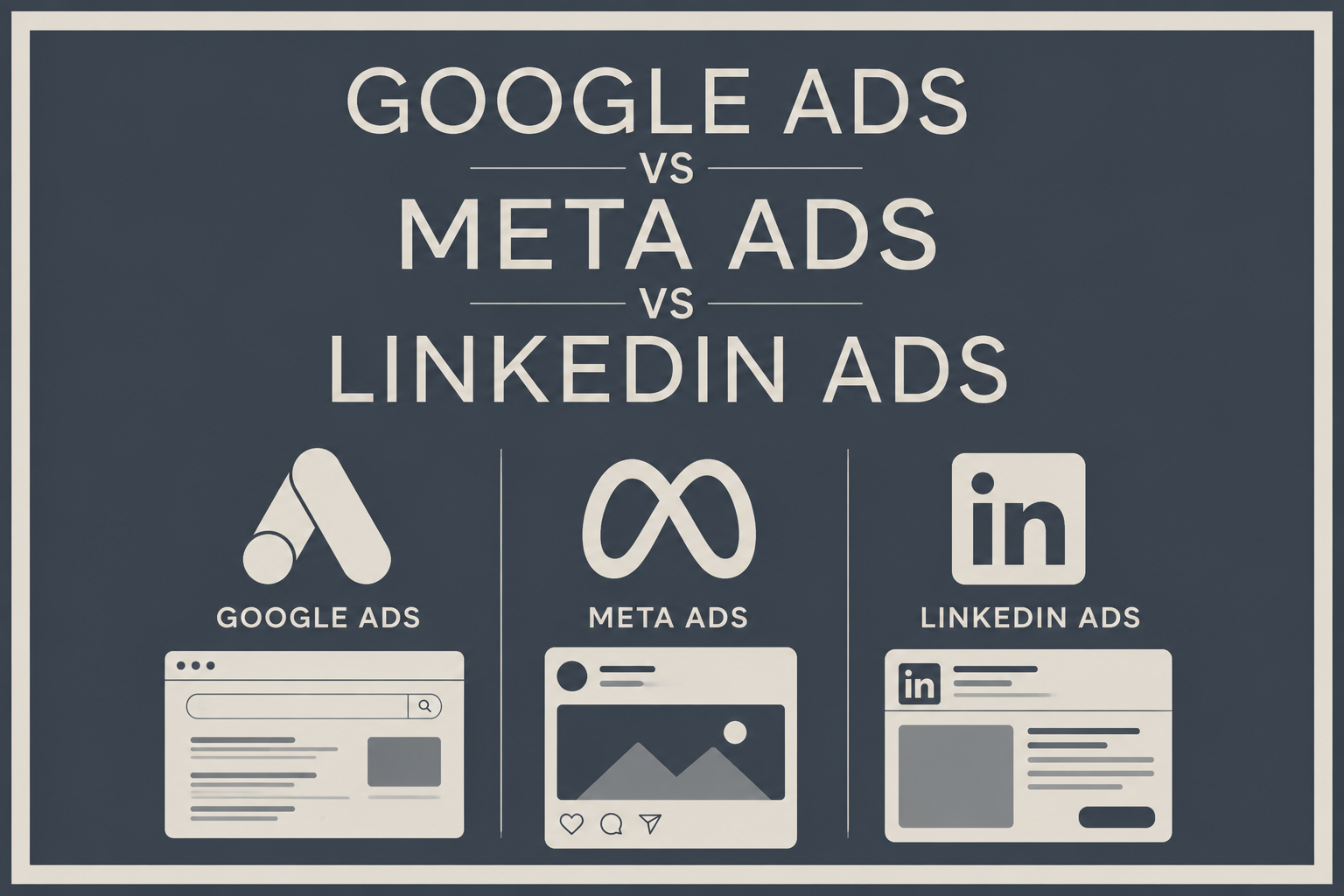
- Google Ads vs Meta Ads vs LinkedIn Ads: Choosing the Right Platform
- Paid Advertising Optimization: ROI, Retargeting, and Best Practices
- Conclusion
- Frequently Asked Questions
What Is Paid Advertising?
Paid advertising is a marketing method where businesses pay platforms to show promotional messages to specific audiences. These advertisements can appear on search engines, social media networks, video platforms, websites, and ecommerce marketplaces.
A simple analogy is renting space in a busy marketplace. Instead of waiting for customers to find your store naturally, you pay for a prominent location where more people can see your products or services.
Paid Advertising vs Organic Marketing
Organic marketing focuses on attracting visitors naturally through content, SEO, social media engagement, and brand building.
Paid advertising accelerates visibility by placing your message directly in front of a targeted audience.
For example:
- A blog article ranking on Google is organic marketing.
- A Google Search Ad appearing above search results is paid advertising.
- An Instagram Reel reaching followers naturally is organic.
- A sponsored Instagram campaign is paid advertising.
Most successful businesses use both approaches together.
How Digital Advertising Platforms Work
Although every platform has unique features, most follow a similar process:
Step 1: Define a Goal
Businesses choose a campaign objective such as:
- Website traffic
- Lead generation
- Sales
- Brand awareness
- App installs
- Video views
Step 2: Select a Target Audience
Platforms allow advertisers to reach specific users based on:
- Demographics
- Interests
- Behaviors
- Search activity
- Job titles
- Locations
- Previous website visits
Step 3: Create Advertisements
Businesses create ads using:
- Text
- Images
- Videos
- Product listings
- Interactive formats
Step 4: Participate in an Ad Auction
Most advertising platforms use auction systems.
Advertisers compete for placement opportunities. The winner is not always the highest bidder. Platforms also evaluate ad relevance, user experience, expected engagement, and overall quality.
Step 5: Measure Results
Platforms provide data on:
- Impressions
- Clicks
- Leads
- Sales
- Revenue
- Return on investment
This allows businesses to continuously improve performance.
Common Paid Advertising Models
Pay-Per-Click (PPC)
Advertisers pay when someone clicks an advertisement.
Cost Per Mille (CPM)
Advertisers pay for every thousand impressions.
Cost Per Acquisition (CPA)
Advertisers pay based on desired outcomes such as leads or purchases.
Cost Per View (CPV)
Common in video advertising campaigns.
Google Ads: Search Intent, Performance Marketing, and Customer Acquisition
When most people think about paid digital advertising, they think about Google Ads.
Google Ads is one of the largest advertising platforms in the world and serves businesses of all sizes, from local shops to multinational corporations.
The biggest advantage of Google Ads is intent.
People using Google are actively searching for answers, products, services, or solutions. They already have a need.
Why Search Intent Matters
Imagine two people:
Person A searches:
“best accounting software for small business”
Person B is scrolling through Instagram looking at travel photos.
Which person is closer to making a purchase?
Usually Person A.
Google Ads captures demand that already exists.
This is why Google Ads is often considered one of the strongest performance marketing platforms.
Types of Google Ads
Search Ads
These ads appear directly in Google search results.
Businesses bid on keywords related to their products and services.
Example:
Search: “emergency plumber near me”
The sponsored results at the top are Google Search Ads.
Display Ads
Display Ads appear across Google’s partner websites.
They are useful for:
- Brand awareness
- Retargeting
- Visual advertising
YouTube Ads
Since YouTube belongs to Google, advertisers can run:
- Video ads
- In-stream ads
- Discovery ads
- Shorts ads
These campaigns help build awareness and engagement.
Shopping Ads
Shopping campaigns are especially useful for ecommerce businesses.
These ads display:
- Product image
- Product title
- Price
- Store name
directly in search results.
Google AdSense vs Google Ads
Many beginners confuse these terms.
Google Ads
Used by advertisers to run campaigns.
Google AdSense
Used by publishers to display advertisements and earn revenue.
Think of Google Ads as the buying side and AdSense as the selling side of Google’s advertising ecosystem.
When Businesses Should Use Google Ads
Google Ads is ideal for:
- Local businesses
- Service providers
- Ecommerce stores
- SaaS companies
- Healthcare providers
- Professional services
It works particularly well when users actively search for solutions.
Meta Ads: Facebook and Instagram Advertising for Brand Growth
Meta Ads power advertising across Facebook, Instagram, Messenger, and Meta’s audience network.
Unlike Google Ads, Meta focuses more on audience discovery rather than search intent.
People may not be actively searching for products, but advertisers can place products in front of highly targeted audiences.
What Makes Meta Ads Different?
Meta advertising is interruption-based marketing.
Instead of responding to a search query, Meta introduces products during browsing sessions.
This creates opportunities for businesses to generate demand rather than simply capture existing demand.
Facebook Ads
Facebook remains one of the largest social media advertising platforms globally.
Advertisers can target users based on:
- Interests
- Behaviors
- Demographics
- Life events
- Purchase patterns
Facebook advertising works well for:
- Local businesses
- Lead generation
- Community building
- Brand awareness
Instagram Ads
Instagram focuses heavily on visual content.
Businesses use Instagram for:
- Product promotion
- Influencer marketing
- Lifestyle branding
- Ecommerce growth
Popular ad formats include:
- Stories
- Reels
- Feed posts
- Carousel ads
Meta Audience Targeting
One of Meta’s biggest strengths is audience targeting.
Businesses can create audiences based on:
Interest Targeting
People interested in specific topics.
Custom Audiences
Users who previously interacted with the business.
Lookalike Audiences
New users who resemble existing customers.
When Businesses Should Use Meta Ads
Meta Ads are particularly effective for:
- Ecommerce brands
- Consumer products
- Lifestyle businesses
- Personal brands
- Startups
- Content creators
LinkedIn Ads: B2B Advertising, Lead Generation, and Professional Audiences
LinkedIn Ads occupy a unique position in digital advertising.
While Google focuses on search intent and Meta focuses on social discovery, LinkedIn focuses on professional audiences.
This makes LinkedIn especially valuable for B2B marketing.
What Is LinkedIn Campaign Manager?
LinkedIn Campaign Manager is the platform used to create and manage LinkedIn advertising campaigns.
Businesses can target users based on professional information unavailable on most other platforms.
LinkedIn Targeting Options
Advertisers can target users by:
- Job title
- Company size
- Industry
- Seniority level
- Skills
- Education
- Professional interests
This precision is why LinkedIn is popular among B2B marketers.
LinkedIn Lead Generation
LinkedIn excels at attracting:
- Decision-makers
- Executives
- Managers
- Procurement teams
- Business owners
A software company selling enterprise solutions may find LinkedIn significantly more effective than other social platforms.
LinkedIn Ads vs Google Ads
Google Ads captures people actively searching for solutions.
LinkedIn helps businesses reach specific professionals before they begin searching.
Both approaches can work together effectively.
When Businesses Should Use LinkedIn Ads
LinkedIn is often ideal for:
- SaaS companies
- B2B service providers
- Recruitment firms
- Consultants
- Professional training organizations
- Enterprise software providers
TikTok Ads and Amazon Ads: Emerging and Industry-Specific Platforms
Not every business should limit itself to Google, Meta, and LinkedIn.
Other advertising platforms continue growing rapidly.
TikTok Ads
TikTok has become a major platform for content discovery.
Unlike search-based advertising, TikTok focuses heavily on algorithmic recommendations.
Businesses use TikTok Ads for:
- Product discovery
- Brand awareness
- Influencer campaigns
- Viral content promotion
TikTok often performs best for younger audiences and visually engaging products.
Amazon Ads
Amazon Ads are highly valuable for ecommerce businesses.
Users on Amazon often have strong purchase intent.
Advertisers can promote:
- Individual products
- Product categories
- Brand stores
For many ecommerce brands, Amazon Ads directly influence sales performance.
When These Platforms Make Sense
TikTok Ads work well for:
- Consumer brands
- Fashion
- Beauty
- Lifestyle products
Amazon Ads work well for:
- Ecommerce businesses
- Consumer products
- Marketplace sellers
Google Ads vs Meta Ads vs LinkedIn Ads: Choosing the Right Platform
Choosing the right platform depends on business goals rather than platform popularity.
Platform Comparison
| Factor | Google Ads | Meta Ads | LinkedIn Ads |
| Audience Intent | High | Medium | Medium |
| B2B Potential | High | Moderate | Very High |
| B2C Potential | High | Very High | Moderate |
| Brand Awareness | Good | Excellent | Good |
| Lead Generation | Excellent | Very Good | Excellent |
| Ecommerce | Excellent | Excellent | Limited |
| Cost Per Click | Moderate to High | Low to Moderate | High |
| Audience Targeting | Strong | Very Strong | Exceptional |
Best Platform by Business Type
Local Businesses
Google Ads
Ecommerce Brands
Google Ads + Meta Ads
SaaS Companies
Google Ads + LinkedIn Ads
Personal Brands
Meta Ads
Enterprise B2B Companies
LinkedIn Ads + Google Ads
Startups
Meta Ads + Google Ads
Paid Advertising Optimization: ROI, Retargeting, and Best Practices
Running ads is only the beginning.
Success depends on continuous optimization.
Conversion Tracking
Businesses should track:
- Purchases
- Leads
- Phone calls
- Form submissions
- Revenue
Without tracking, it becomes impossible to measure success accurately.
Retargeting
Most users do not convert during their first visit.
Retargeting helps businesses reconnect with:
- Website visitors
- Cart abandoners
- Previous customers
These campaigns often generate some of the highest returns.
Attribution
Attribution helps businesses understand which marketing channels contribute to conversions.
A customer may:
- See a Meta Ad
- Search on Google
- Visit the website
- Convert
Understanding this journey improves budget decisions.
Common Advertising Mistakes
Many advertisers:
- Target audiences that are too broad
- Ignore conversion tracking
- Focus only on clicks
- Neglect landing page quality
- Stop campaigns too quickly
Advertising success usually comes from gradual optimization rather than instant results.
AI and Automation in Advertising
Artificial intelligence is becoming increasingly important.
Modern advertising platforms use AI for:
- Bid optimization
- Audience prediction
- Ad creation assistance
- Budget allocation
- Performance forecasting
Advertisers who combine human strategy with AI-powered tools are likely to gain significant advantages in the coming years.
Conclusion
Digital advertising platforms have transformed how businesses attract customers, generate leads, and build brands. While Google Ads, Meta Ads, and LinkedIn Ads all belong to the broader paid advertising ecosystem, they solve different marketing challenges.
Google Ads excels at capturing existing demand through search intent. Meta Ads help businesses build awareness and generate demand through highly targeted social advertising. LinkedIn Ads provide unmatched access to professional and B2B audiences. TikTok Ads and Amazon Ads further expand opportunities for businesses with specific goals and customer segments.
The best advertising strategy is rarely about choosing a single platform. Many successful businesses combine multiple advertising channels, using each platform for what it does best. By understanding audience behavior, campaign objectives, and performance metrics, businesses can create advertising systems that deliver sustainable growth and stronger marketing ROI.
Frequently Asked Questions
What is paid advertising?
Paid advertising is a marketing method where businesses pay digital platforms to display advertisements to targeted audiences. Examples include Google Ads, Facebook Ads, Instagram Ads, LinkedIn Ads, TikTok Ads, and Amazon Ads.
Which is an example of paid advertising?
A Google Search Ad appearing at the top of search results, a sponsored Instagram post, or a LinkedIn lead generation campaign are all examples of paid advertising.
Are paid ads profitable?
Paid ads can be highly profitable when businesses target the right audience, use effective messaging, and measure campaign performance accurately. Profitability depends on factors such as conversion rates, customer value, and advertising costs.
Is Google Ads better than Meta Ads in 2026?
Neither platform is universally better. Google Ads is generally stronger for capturing high-intent searches, while Meta Ads often excel at audience discovery, brand awareness, and social commerce.
What are Meta Ads used for?
Meta Ads are used to promote products, services, events, and brands across Facebook, Instagram, Messenger, and Meta’s advertising network. They are particularly useful for audience targeting and visual storytelling.
How do you run Google Ads and Meta Ads together?
Many businesses use Meta Ads to create awareness and Google Ads to capture demand when potential customers begin searching for solutions. This combination often produces stronger results than relying on a single platform.
How much does a LinkedIn ad cost?
LinkedIn Ads typically have higher costs than Google or Meta because of their highly specialized professional targeting capabilities. However, they can deliver strong returns for B2B campaigns.
How do ads work on LinkedIn?
LinkedIn Ads allow businesses to target professionals using criteria such as job title, company size, industry, skills, and seniority level. Advertisers can use sponsored content, lead generation forms, message ads, and other formats.
What are the best paid advertising platforms?
The best platform depends on business goals. Google Ads is often strongest for search intent, Meta Ads for social engagement and ecommerce, LinkedIn Ads for B2B marketing, TikTok Ads for discovery, and Amazon Ads for ecommerce sales.
How can businesses improve advertising ROI?
Businesses can improve ROI by optimizing targeting, improving ad creatives, enhancing landing pages, tracking conversions accurately, using retargeting campaigns, and continuously analyzing performance data.