Entity SEO is the process of making the identity, meaning and relationships behind a website, brand, person, product or subject easier for search engines to interpret. It goes beyond repeating keywords because the same word may refer to different things, while different phrases may describe the same underlying concept.
For example, Apple may refer to a fruit, a technology company or one of that company’s products. A search engine therefore needs context to identify the intended meaning. It may consider the surrounding language, the purpose of the page, connected people and products, structured information and evidence from other sources.
Entity SEO does not replace keyword research, useful content or technical SEO. Instead, it strengthens these foundations by reducing ambiguity and creating clearer connections between organizations, authors, products, services, locations and topics.
Note
Entity SEO is an industry term for SEO practices focused on entities and their relationships. It is not an official separate ranking system.
Table of Contents
What Is Entity SEO?
An entity is a distinct person, place, organization, product, event or concept that can be identified separately from other things. Its name is only one part of its identity. Attributes and relationships help distinguish it from entities with similar names.
Consider an author named Alex Smith. The name alone may match many people. However, the author’s employer, field of expertise, official website, published work and location can help identify the correct individual. In other words, context makes the entity easier to distinguish. This process of determining which specific entity a name or reference represents is commonly called entity disambiguation.
Entity SEO applies this principle to websites. A business should clearly explain who it is, what it offers, where it operates and how its important people, services and publications connect. A topical website should also organize related subjects logically rather than publish isolated pages without visible relationships.
The objective is not to insert a long list of related names into every article. It is to present accurate information in a structure that makes sense to readers and machines. Clear page purposes, useful internal links, consistent identity information and appropriate structured data can all support this objective.
Keywords vs Entities
Keywords are the words and phrases used in searches or content. Entities are the people, organizations, products, places or concepts those words represent.
| Element | What it Represents | Example |
|---|---|---|
| Keyword | The language used in a query | Apple support |
| Entity | The identified thing | Apple Inc. |
| Attribute | A characteristic of the entity | Technology company |
| Relationship | A connection to another entity | Apple Inc. produces the iPhone |
The distinction matters because one entity may be described using several phrases. Someone may search for Apple customer service, iPhone company support or Apple technical help while referring to the same organization. Similarly, one keyword may remain ambiguous until the surrounding context reveals its meaning.
Keyword research is therefore still necessary because it shows how people express their needs. Entity-focused planning adds another layer by asking which people, products, organizations, locations and concepts must be explained for the page to answer the query properly.
A strong page uses the primary keyword naturally, includes the concepts necessary for a complete explanation and avoids mentioning unrelated entities merely because competing pages contain them.
How Search Engines Use Entities, Relationships, and the Knowledge Graph
A knowledge graph represents entities as connected points and their relationships as links between those points. A research overview describes real-world entities as nodes and their relationships as edges, which illustrates how knowledge can be organized through connected entities rather than treated as a flat collection of terms.
Google states that its Knowledge Graph contains billions of facts about people, places and things. Information from this system may appear in features such as Knowledge Panels, although the underlying graph is broader than any single result box.
For example, a graph may connect an author with a book, the book with a publisher and the publisher with an official website. These relationships can help a system distinguish between similarly named entities and retrieve information relevant to a particular search.
A separate example of graph-based information retrieval is Microsoft Research’s GraphRAG, which can extract entities and relationships from unstructured documents, organize them into a knowledge graph and use that structure to answer questions requiring connections across the source material.
Knowledge Graphs and Knowledge Panels
A Knowledge Graph is a structured system of entities, facts and relationships. A Knowledge Panel is a visible search feature that may summarize information about an entity.
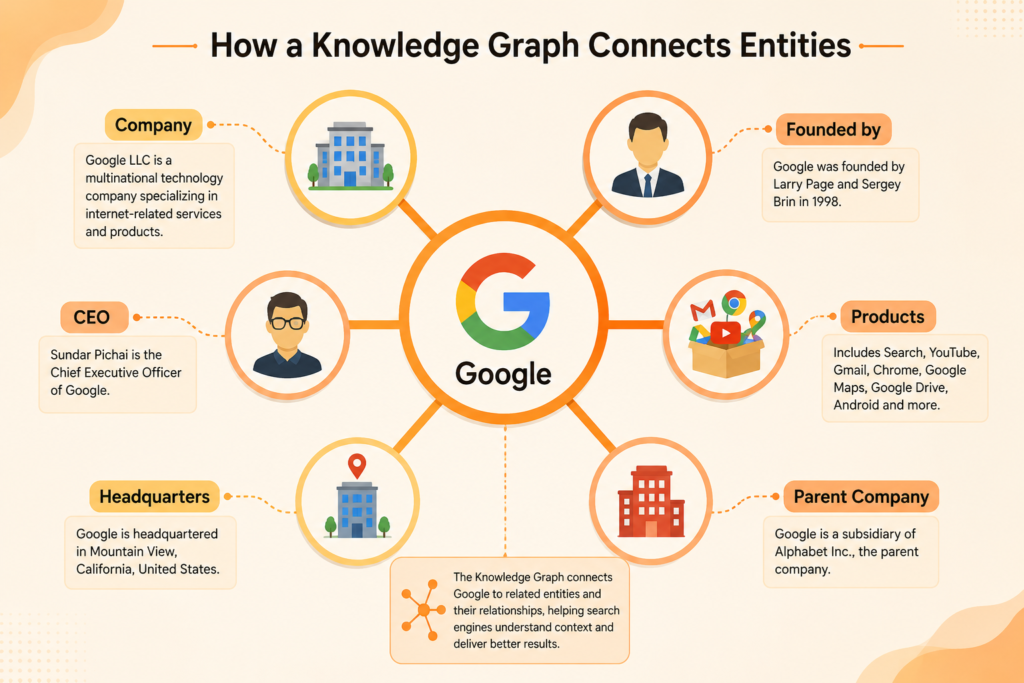
These terms should not be treated as interchangeable. Knowledge Panels are generated automatically by Google’s search algorithms using information these systems find across the web. Therefore, adding schema markup or publishing an About page does not guarantee that a panel will appear.
Some existing Knowledge Panels can be claimed by the person or organization they represent after the available verification process is completed. Verified representatives can then suggest changes, and their feedback may receive priority for review.
Entity SEO and Topical Authority
Topical authority is an SEO planning concept rather than a publicly available score that website owners can inspect. It generally describes the extent to which a website becomes a useful and credible resource across a defined subject.
Entity SEO supports this objective by organizing content around meaningful relationships. A website about email marketing, for example, may connect the central topic with subscriber acquisition, segmentation, automation, deliverability, analytics and compliance. These are not random keyword variations; they are concepts required to explain the wider subject.
A practical topic structure may include:
- A pillar page introducing the main subject.
- Cluster pages covering its major areas.
- Supporting articles answering narrower questions.
- Internal links reflecting genuine relationships.
- Author and organization pages explaining who produced the content.
However, publishing a large number of pages does not establish authority by itself. Repetitive articles may create overlap and make the website harder to understand. It is therefore better to cover each subject with a clear purpose, consolidate duplicate pages and update important resources when their information changes.
Search Engine Land describes entity mapping as a process of identifying the people, tools, products and concepts connected with a topic and using those relationships to guide content coverage and internal linking. The useful principle is purposeful completeness rather than mechanical inclusion of every related term.
Entity SEO Strategies for Brands, People, and Businesses
A well-planned entity SEO strategy can help brands, people and businesses present a clear identity, strengthen relevant relationships and reduce ambiguity across their websites and wider digital presence.
Establish an Entity Home
The term “entity home,” used in entity-focused SEO, describes a primary webpage that clearly identifies and explains a person, organization or other entity. For a company, this may be its homepage or About page, while an author may use a detailed profile page.
The page should state the official name, purpose, main activities and important relationships. It should also link to relevant supporting pages and official profiles where appropriate. The objective is to provide one clear reference point rather than distribute essential identity information across disconnected pages.
Maintain Consistent Identity Information
Use a consistent public name, logo, description, website and contact information across important profiles. However, consistency should not be confused with proof of authority or notability. Its main value is reducing conflicting information and customer confusion.
Local businesses should also keep addresses, telephone numbers, opening hours and business profiles accurate. Organizations with several branches should clearly distinguish the parent brand from individual locations.
Create Useful Entity Pages
Important products, services, people and locations may deserve dedicated pages when enough useful information is available. Each page should have a distinct purpose and explain how the entity connects with the broader organization or subject.
For example, an author page can include a biography, areas of expertise and published work. A product page may explain its manufacturer, category, features and intended users. A location page can connect a branch with its address, services and parent organization.
Strengthen Context Through Internal Links
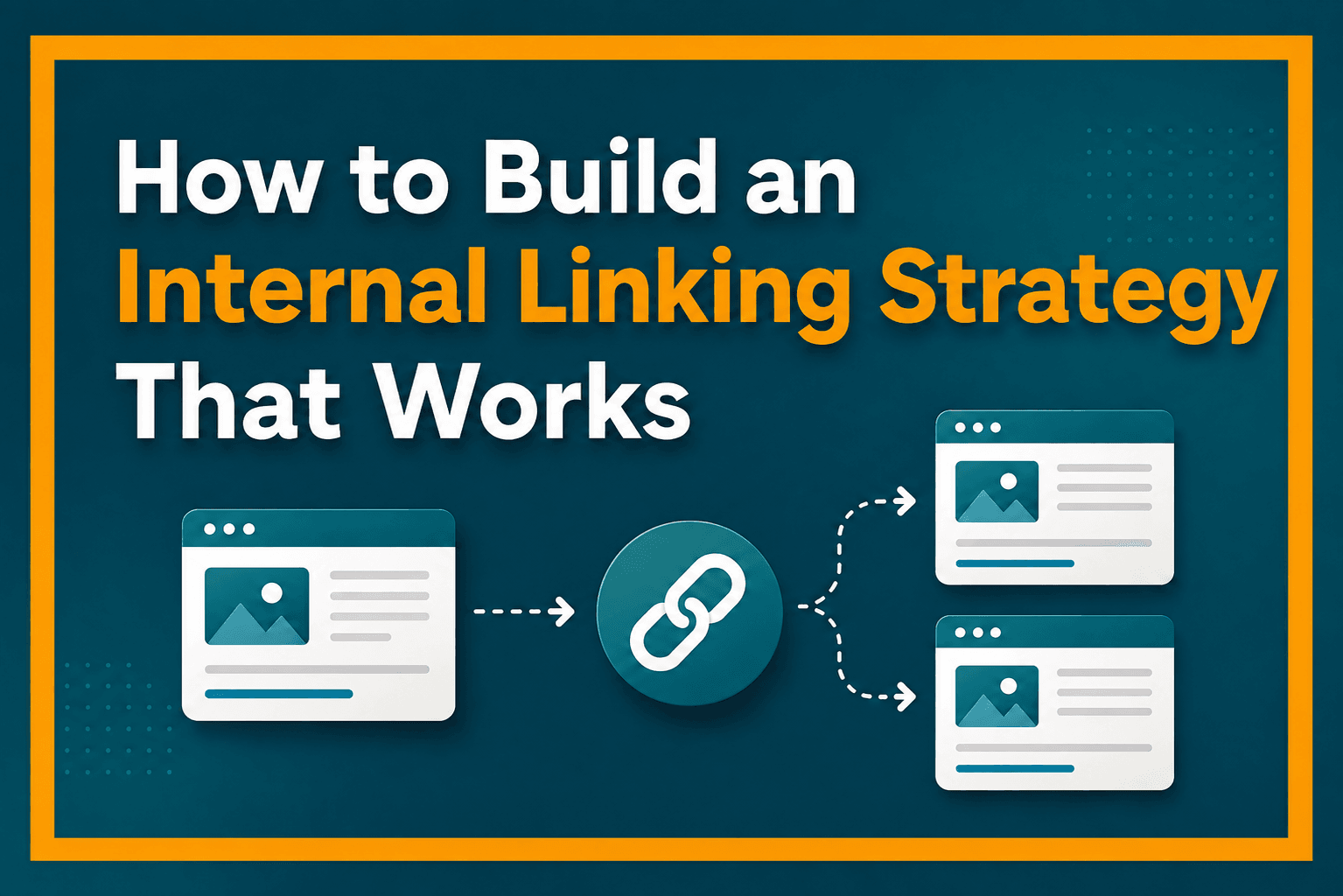
Internal links should describe genuine relationships between pages. A guide to schema markup may link to articles about JSON-LD, rich results and structured-data validation because these subjects directly support the reader’s understanding.
Descriptive anchor text is therefore more useful than vague wording such as click here. However, links should not be added merely to create artificial density. Every link should help the reader reach relevant supporting information.
Earn Independent References
Accurate coverage, professional profiles, interviews, reviews, citations and editorial links can create a broader digital footprint. Nevertheless, no individual mention guarantees recognition in a knowledge graph or higher rankings.
It is better to earn references from sources that genuinely document, review or cover the entity. Fabricated profiles, copied biographies and large numbers of weak directory listings may increase mentions without adding meaningful corroboration.
Schema Markup and Structured Data
Structured data is machine-readable information added to a webpage to classify its content and describe specific details. Common types include Organization, Person, Product, Article and LocalBusiness.
Adding organization structured data to a homepage or About page can help Google understand an organization’s administrative details and distinguish it from similarly named organizations. Relevant properties include its official name, address, telephone number, website, logo and profile URLs.
Structured data must represent visible page content and should not describe information that is hidden, irrelevant or misleading. If structured data meets Google’s technical, content and feature-specific requirements, it can make a page eligible for supported rich results, but it does not guarantee that Google will display one.
Similarly, the sameAs property can connect an organization with pages on other websites that provide additional information, such as its social media or review profiles. Because the property is intended to identify the same entity, it should be used only for pages that clearly refer to that organization.
It is also important to note that Google generally recommends JSON-LD because it is easier to implement and maintain at scale and works well with the visible page content. After adding structured data, enter the page URL in the Rich Results Test to check whether Google can access the page and recognize the supported markup.
Entity SEO Checklist and Common Mistakes
A structured entity SEO review helps identify ambiguity, disconnected pages and unsupported markup before they weaken the website’s overall clarity.
Entity SEO Checklist
Effective Entity SEO depends on clear identities, accurate information and meaningful relationships across a website and its wider digital presence. A practical review should therefore include the following steps:
- Define the main organization, people, products, services, locations and topics represented by the website.
- Select one primary home page for every major entity.
- State official names and descriptions clearly on relevant pages.
- Distinguish entities that have identical or similar names.
- Explain relationships between the brand, authors, products and services.
- Maintain accurate identity and contact details across important profiles.
- Create dedicated pages only when an entity deserves substantial information.
- Organize content into logical pillars, clusters and supporting resources.
- Use internal links to connect genuinely related pages.
- Write descriptive anchor text that explains the linked destination.
- Consolidate pages that compete for the same purpose.
- Add appropriate schema types to pages that support them.
- Ensure structured data matches the visible information.
- Use sameAs only for relevant external profiles.
- Validate supported markup before publishing.
- Correct structured-data errors reported after deployment.
- Create complete profiles for authors and subject experts.
- Earn legitimate references from relevant external sources.
- Review how branded and personal searches present the entity.
- Update identity and relationship information when it changes.
Common Mistakes
A common mistake is treating entity SEO as keyword stuffing with related names. Mentioning additional companies, products or people does not strengthen a page when those references are irrelevant or unexplained.
Another mistake is assuming that structured data creates authority, guarantees rankings or forces a Knowledge Panel to appear. Markup can clarify information and support eligibility for search features, but valid implementation does not guarantee an enhanced result.
Websites may also create ambiguity through duplicate author profiles, inconsistent company descriptions and thin product or location pages. It is therefore important to resolve contradictions instead of attempting to cover them with additional schema markup.
Entity SEO Tools
Entity SEO tools can support research, content mapping and structured-data testing, but their results still require human verification.
| Tool | Main Use |
|---|---|
| Kalicube Pro | Monitoring Brand SERPs and entity-related brand information |
| InLinks | Entity research, content planning and internal-link management |
| Wikidata | Exploring openly maintained entities and relationships |
| DBpedia | Querying structured information derived from Wikipedia |
| Diffbot | Extracting entities and relationships from web content |
| Google Knowledge Graph Search API | Searching for matching Knowledge Graph entities |
| Google Rich Results Test | Testing supported rich-result markup |
| JSON-LD Playground | Processing and debugging JSON-LD code |
| Schema.org Validator | Checking Schema.org markup structure |
The Knowledge Graph Search API returns entities that match a query, together with details such as their name, type, description, official URL and result score. It is therefore useful for identifying likely entity matches, but the response does not provide a complete map of every relationship connected with an entity.
Similarly, the Rich Results Test checks which Google-supported rich results may be generated from a page’s structured data, whereas the Schema.org Validator checks Schema.org markup without applying Google-specific feature validation. Passing either test confirms only that the markup meets the checks performed by that tool; it does not guarantee that Google will display a rich result.
Conclusion
Entity SEO helps search engines and readers understand what a website represents, which entities matter and how those entities relate to one another. It combines clear identity pages, logical topic coverage, useful internal links, consistent public information, appropriate structured data and legitimate external references.
However, it is not a separate shortcut that replaces conventional SEO. Keywords still reveal how people search, content must still solve the reader’s problem and pages must remain crawlable, usable and trustworthy.
The future of entity-based search is likely to involve more systems that retrieve and connect information across different formats and interfaces. However, this does not justify unsupported promises about rankings or AI visibility. The practical approach remains the same: publish accurate information, identify important entities clearly and maintain relationships that can be verified. To sum up, a strong entity strategy reduces ambiguity rather than creating more signals for their own sake.
Frequently Asked Questions
What is an entity in SEO?
An entity is a distinct person, organization, place, product, event or concept that can be identified and connected with attributes and relationships.
What is Entity SEO?
Entity SEO is the practice of making the identity, meaning and relationships behind a website and its content easier for search engines to interpret.
Are entities replacing keywords?
No. Keywords express the language used by searchers, while entities represent the underlying people, things and concepts. Effective SEO continues to use both.
What is a Knowledge Graph?
A Knowledge Graph is a structured system that stores entities, facts and the relationships connecting them.
What is a Knowledge Panel?
A Knowledge Panel is an automatically generated search feature that provides a summary of information about an entity represented in Google’s Knowledge Graph.
Does schema markup create an entity?
No. Schema markup can provide explicit information and reduce ambiguity, but it does not independently create authority, establish notability or guarantee Knowledge Graph inclusion.
How does internal linking support Entity SEO?
Internal links show readers and search engines how related pages connect. They are most useful when the destination is relevant and the anchor text explains the relationship clearly.
Can Entity SEO improve rankings?
Entity-focused improvements can make content and website relationships clearer, but there is no guaranteed Entity SEO ranking boost. Visibility still depends on relevance, quality, technical accessibility, competition and other search systems.
Which Entity SEO tools are useful?
Useful options include InLinks, Kalicube Pro, Wikidata, DBpedia, Diffbot, the Google Knowledge Graph Search API and structured-data validation tools.
How can a brand begin Entity SEO?
A brand can begin by establishing a clear entity home, maintaining accurate identity information, connecting important pages logically and adding structured data that matches visible content.