



Imagine opening a retail store that can welcome visitors from every city, state, and country without requiring hundreds of physical locations. That is what ecommerce promises.
A traditional store depends on foot traffic while an ecommerce business depends on digital traffic. Yet the underlying principle remains the same: attract customers, build trust, make sales, and encourage repeat purchases.
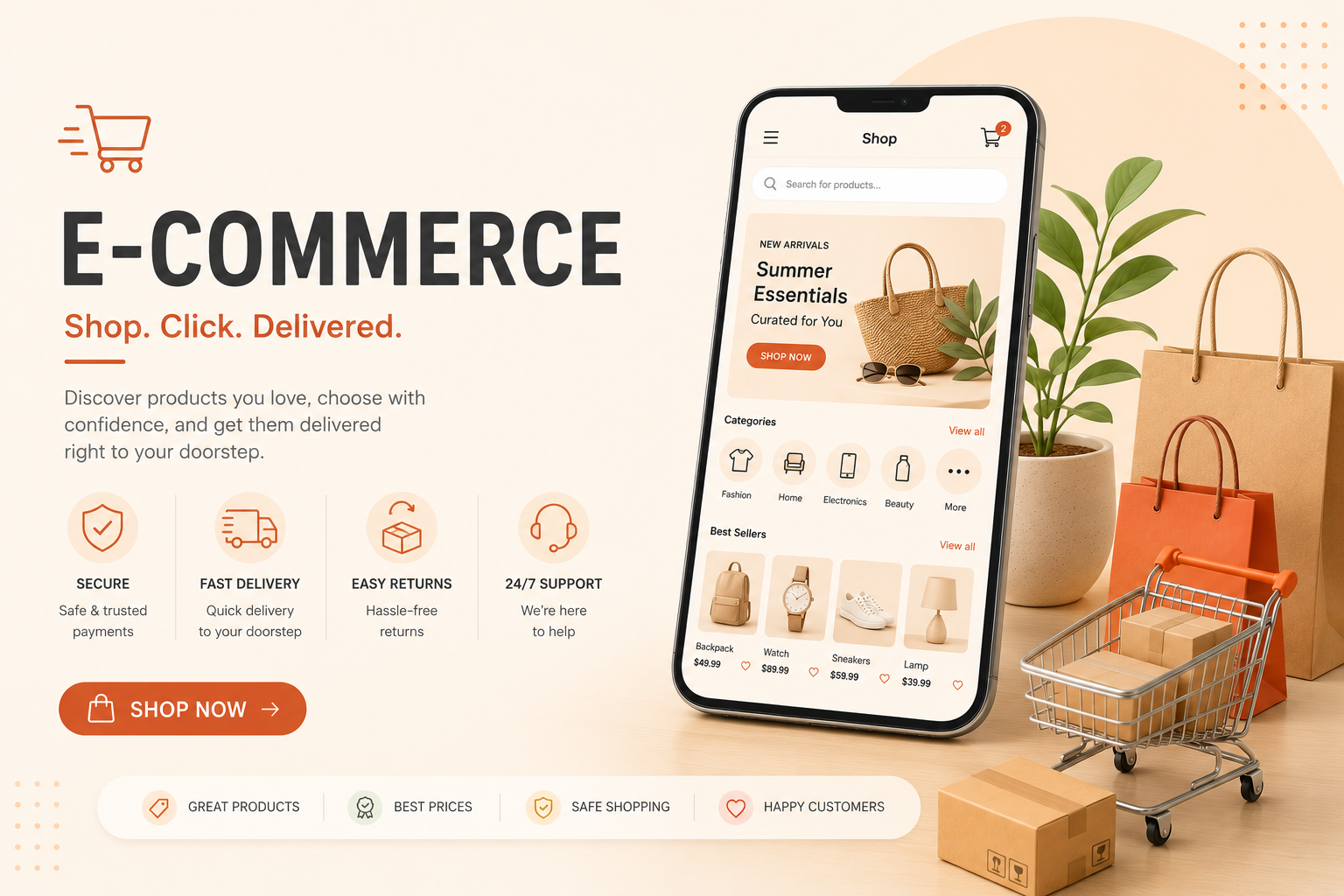
The difference is scale. A local shop may serve a few thousand customers while an ecommerce business can potentially serve millions. This is why ecommerce has become one of the most attractive business opportunities of the digital age.
Whether you are a student, entrepreneur, freelancer, retailer, creator, or small business owner, ecommerce offers you to sell products without the limitations of geography. However, success rarely comes from simply launching a website.
The businesses that win understand products, customers, marketing, conversion optimization, and long-term growth.
| Physical Store | Ecommerce Store |
| Storefront | Website |
| Shelves | Product Pages |
| Shopping Basket | Shopping Cart |
| Cash Counter | Checkout |
| Store Location | SEO |
| Word-of-Mouth | Social Media |
| Billboards | Paid Advertising |
| Loyalty Program | Email Marketing |
Every successful ecommerce business follows a simple flow:
Products -> Store -> Visitors -> Customers -> Revenue
Once you understand this journey, ecommerce becomes much easier to understand.
Table of Contents (TOC)
- What Is Ecommerce and How Does It Work?
- Ecommerce Business Models Explained
- How to Make Money With Ecommerce?
- Building Your Ecommerce Business
- How Ecommerce Stores Get Customers
- Increasing Revenue and Scaling Your Ecommerce Business
- Ecommerce Metrics That Actually Matter
- Common Ecommerce Mistakes and Beginner Action Plan
- FAQs
What Is Ecommerce and How Does It Work?
Ecommerce, electronic commerce, refers to buying and selling products or services online. Whenever someone purchases a product from an online store, books a hotel online, subscribes to software, or orders groceries through an app, they are participating in ecommerce.
Today, ecommerce powers businesses ranging from individual creators selling handmade products to multinational brands generating billions in annual sales.
The process is surprisingly simple. A customer visits an online store, browses products, adds items to a cart, completes payment, and receives the product through shipping or digital delivery.
Behind the scenes, however, dozens of systems work together:
- Product catalogs
- Payment gateways
- Inventory systems
- Shipping providers
- Marketing platforms
- Analytics tools
- Customer support systems
The customer sees only the storefront. The business owner manages the entire machine behind it.
Why Ecommerce Continues to Grow
Consumers increasingly prefer convenience. Instead of driving to multiple stores, they can compare products, read reviews, check prices, and place orders within minutes.
In the process, businesses benefit as well. These benefits include:
- Lower startup costs
- Wider customer reach
- Easier scalability
- Better customer data
- More measurable marketing
This combination of convenience and scalability explains why ecommerce continues to attract entrepreneurs worldwide.
The Ecommerce Revenue Engine
At its core, ecommerce is a numbers game. Whether its online traffic, conversion rate, orders, revenue or profit, ecommerce is primarily about numbers and metrics.
Every successful ecommerce strategy focuses on improving one or more of these stages. For example, if you increase traffic, conversions, or average order value, revenue grows.
That principle will appear repeatedly throughout this guide.
Ecommerce Business Models Explained
Before building an ecommerce business, you must decide what exactly you want to sell and how you want to sell it.
Many beginners assume all ecommerce businesses work the same way. They do not.
Different business models have different costs, risks, profit margins, and growth potential. So choosing the right model can save months or even years of frustration.
B2C (Business-to-Consumer)
This is the model most people think about when they hear the word ecommerce. A business sells directly to individual consumers. Examples include clothing stores, electronics stores, beauty brands, and home décor websites.
The business-to-consumer model offers large customer base, faster sales cycles and easier marketing. At the same time, it includes intense competition and customer acquisition and marketing costs.
Most ecommerce startups operate on the B2C model.
B2B (Business-to-Business)
In this model, businesses sell products to other businesses. For example, industrial equipment, packaging materials, office supplies and manufacturing components.
This model is primarily associated with larger order values, repeat purchases and long-term customer relationships. It includes challenges like longer sales cycles and hard negotiations. Although B2B receives less attention than consumer ecommerce, it often produces higher revenues per customer.
Direct-to-Consumer (DTC)
DTC brands manufacture or source products and sell directly to customers without retailers or distributors. In other words, it removes distributor and retailer from the traditional model and deals directly with the customer.
Traditional model:
Manufacturer
↓
Distributor
↓
Retailer
↓
Customer
DTC model:
Manufacturer
↓
Customer
The advantages of D2C include higher margins, stronger brand control and better customer data. Many modern ecommerce success stories use this model because it allows brands to own the customer relationship.
Marketplace Selling
In marketplace selling, you sell on established marketplaces instead of building traffic to your own website. You may think of marketplaces as renting a stall in a busy shopping mall rather than building your own store.
Examples of marketplace selling include Amazon, Alibaba and eBay.
Some of the advantages of marketplace selling include existing traffic, faster launch and customer trust.
Dropshipping
Dropshipping removes the need to hold inventory. In this mode of ecommerce, the customer places an order, the store owner receives the order, the supplier ships the product and the customer receives the product. The advantages include low startup costs, no inventory investment and easy testing of products. At the same time, dropshipping involves lower margins and limited quality control.
Many beginners start with dropshipping because it reduces risk. But building a long-term brand usually requires more control over products and customer experience.
Print-on-Demand
In print-on-demand, products are manufactured only after a customer places an order. For example, t-shirts, mugs, posters, phone cases and notebooks. Some of the advantages of print-on-demand includes no inventory, low risk and easy customization.
This model is popular among creators and influencers.
Which Model Is Best for Beginners?
The best model depends on your resources, expertise, and goals. The important thing is understanding that ecommerce is not a single business model.
For most new entrepreneurs:
- Marketplace selling is easiest to start.
- Dropshipping has the lowest financial risk.
- DTC brands offer the greatest long-term value.
How to Make Money with Ecommerce?
It is important to bear in mind that successful ecommerce businesses rarely appear overnight. The reality is less glamorous than social media success stories suggest. Most profitable ecommerce businesses are built through research, testing, optimization, and persistence.
How Big Is the Opportunity?
Millions of products are sold online every day. Contrary to popular belief, most successful sellers are not selling revolutionary inventions. Instead, consumers purchase clothes, beauty products, pet products, home improvement products, kitchen accessories, electronics accessories, fitness products, baby products and hobby products.
A simple water bottle can outperform a technically superior competitor if customers perceive more value. This is because people rarely buy products alone: they buy outcomes.
They do not buy skincare. They buy confidence.
Similarly, they do not buy fitness equipment. They buy health.
Understanding this distinction changes everything.
How Much Can Ecommerce Sellers Earn?
Some sellers earn merely a few thousand dollars per month. Others turn their ideas into multi-million-dollar businesses.
The difference often lies in strategy, which often includes research, analysing competition and product positioning.
Most beginners underestimate the timeline. A realistic journey includes a few months of research and learning, followed product testing, scaling operations and building a recognized brand.
Establishing a brand may take up to three years. Some businesses grow faster while many grow slower. In general, ecommerce rewards consistency more than speed.
Most sellers start with demand research. They ask:
- What problem does the product solve?
- Are people searching for this?
- Are people already buying it?
- Can I compete effectively?
Many beginners fear competition, experienced sellers study it. Competitors reveal valuable information such as:
- What customers want
- What customers dislike
- Pricing expectations
- Product weaknesses
- Marketing strategies
Hence, it is important to analyze product reviews, pricing, product descriptions, advertising approaches and customer complaints. Negative reviews are especially valuable. They reveal opportunities for improvement.
Product positioning is very important for ecommerce sellers. Positioning answers a simple question: “Why should a customer buy from you instead of someone else?” Strong positioning creates clarity while weak positioning creates confusion, which often leads to customers opting out at the checkout stage. A clear message can improve conversions. For example, “Our product is the easiest to use”, or “Our product is designed specifically for professionals.”
Building Your Ecommerce Business
Once you have chosen a business model and identified products worth selling, the next step is building the business itself.
Choosing the Right Ecommerce Platform
An ecommerce platform is the software that powers your online store.
It manages:
- Product listings
- Payments
- Orders
- Inventory
- Customer accounts
- Marketing integrations
Here’s a compilation of some of top ecommerce platforms:
Shopify
Shopify us often considered the easiest platform for beginners. It features fast setup, excellent user experience, large app ecosystem and reliable hosting.
Given its advantages, Shopify is ideal for new ecommerce businesses, DTC brands and small and medium-sized stores.
WooCommerce
A plugin that transforms WordPress into an ecommerce platform.
Strengths:
- High flexibility
- Strong SEO capabilities
- Lower ongoing costs
Best for:
- Content-driven websites
- SEO-focused businesses
- Users comfortable with WordPress
Magento
Designed for larger and more complex businesses.
Strengths:
- Extreme customization
- Enterprise capabilities
- Scalability
Best for:
- Large brands
- Complex product catalogs
- High-volume stores
BigCommerce
A platform positioned between Shopify and Magento.
Strengths:
- Built-in features
- Strong scalability
- Multi-channel selling
Best for:
- Growing ecommerce businesses
Wix Ecommerce
Simple website builder with ecommerce functionality.
Strengths:
- Ease of use
- Quick setup
- Good design flexibility
Best for:
- Small businesses
- Beginners
Squarespace Commerce
Known for design-focused websites.
Strengths:
- Attractive templates
- Simple management
- Strong branding options
Best for:
- Creators
- Designers
- Lifestyle brands
Which Platform Should You Choose?
For most beginners:
Shopify
→ Fastest path to launch
WooCommerce
→ Best SEO flexibility
Magento
→ Enterprise scale
BigCommerce
→ Growing businesses
Wix/Squarespace
→ Simplicity and design
Do not spend months comparing platforms.
Choose one that matches your needs and begin selling.
Execution matters more than platform perfection.
The Ecommerce Infrastructure Formula
A successful ecommerce business combines several systems.
Products + Store + Payments + Inventory + Shipping + Customer Service
Commerce Infrastructure
Without strong infrastructure, growth becomes difficult.
With strong infrastructure, scaling becomes much easier.
How Ecommerce Stores Get Customers
Building an ecommerce store is relatively easy; attracting customers is the real challenge. Even the best-designed store will struggle if people never discover it. Just as a retail shop needs a good location, an online store needs traffic. Without visitors, there are no customers, sales, or growth.
Successful ecommerce businesses rarely depend on a single source of traffic. Instead, they build a customer acquisition engine using SEO, social media, email marketing, paid advertising, and marketplaces. Diversifying traffic sources reduces risk and creates a more stable business.
Ecommerce SEO
Search Engine Optimization (SEO) helps stores appear when people search for products online. When customers search for terms like “best yoga mat” or “running shoes for beginners,” stores that rank near the top receive the majority of attention.
SEO is valuable because it continues generating traffic long after content is published. Benefits include lower acquisition costs, higher trust, consistent traffic, and long-term growth.
Key ecommerce SEO activities include:
- Keyword Research: Understanding what customers search for. Specific, high-intent keywords often convert better than broad terms.
- Product Page Optimization: Improving titles, descriptions, URLs, images, and metadata.
- Category Page Optimization: Ranking for broader searches such as “office chairs” or “dog accessories.”
- Content Marketing: Publishing buying guides, tutorials, comparisons, and recommendations that attract customers before they are ready to buy.
Social Media Marketing
Social media platforms such as Instagram, Facebook, LinkedIn, YouTube, and TikTok allow businesses to reach audiences where they already spend time.
Many businesses mistakenly treat social media as a direct sales channel. In reality, its primary purpose is often building trust, familiarity, and brand awareness. People are more likely to purchase from brands they recognize.
Effective ecommerce content includes:
- Product demonstrations
- Customer stories
- Educational content
- Behind-the-scenes content
- User-generated content
- Before-and-after examples
The goal is not constant selling but building attention and credibility.
Email Marketing
Email marketing remains one of the highest-ROI channels in ecommerce. Most visitors do not purchase during their first visit, making ongoing communication essential.
Email helps businesses nurture relationships, encourage repeat purchases, and recover potential sales. Important email campaigns include:
- Welcome emails
- Abandoned cart emails
- Product launch announcements
- Loyalty campaigns
- Re-engagement campaigns
Compared with many acquisition channels, email marketing is inexpensive and highly effective for customer retention.
Paid Advertising
While SEO takes time, paid advertising generates traffic immediately. Advertising can be viewed as renting attention.
Common platforms include:
- Google Ads: Captures high-intent users actively searching for solutions.
- Meta Ads: Facebook and Instagram advertising, particularly effective for visual products.
- YouTube Ads: Useful for demonstrations and storytelling.
A key advertising metric is ROAS (Return on Ad Spend), which measures revenue generated relative to advertising costs. A higher ROAS generally indicates more efficient advertising, though profitability also depends on margins and expenses.
Marketplace Selling
Many customers begin their product search on marketplaces rather than search engines. Platforms such as Amazon provide built-in traffic, trust, and infrastructure.
Success on marketplaces depends heavily on visibility. Amazon’s ranking system, often referred to as the A10 algorithm, prioritizes products most likely to satisfy customers. Important ranking factors include:
- Relevance
- Conversion rate
- Sales velocity
- Product reviews
- Customer satisfaction
- External traffic
Amazon A+ Content
A+ Content enhances product listings with richer visuals, brand storytelling, comparison charts, and additional product details.
Benefits include:
- Increased trust
- Better product understanding
- Improved conversion rates
- Stronger brand positioning
Why Multi-Channel Marketing Wins
The strongest ecommerce businesses combine multiple traffic sources:
- SEO drives organic traffic.
- Social media creates awareness.
- Email increases retention.
- Advertising accelerates growth.
- Marketplaces generate additional sales.
Together, these channels create a sustainable customer acquisition system. However, attracting visitors is only half the battle. The next challenge is converting those visitors into customers.
Turning Visitors Into Buyers
Traffic alone does not create revenue. Conversion does.
Two stores with identical traffic can produce dramatically different results depending on their conversion rates. Improving conversion is often more profitable than increasing traffic because it generates more customers from existing visitors.
The Conversion Formula: Higher conversion rates typically result from combining:
- Strong products
- High-quality product pages
- Reviews
- Personalization
- Cart recovery systems
- Optimized checkout experiences
- Clear calls-to-action
Traffic generates opportunities, but conversion generates revenue.
Conversion Rate Optimization (CRO)
Conversion Rate Optimization is the process of increasing the percentage of visitors who take desired actions such as purchasing a product, joining an email list, or starting checkout.
Even small improvements can significantly increase revenue. Because of this, successful ecommerce businesses continuously test and optimize their stores.
Product Pages: Your Digital Salesperson
A product page is often the final step before purchase. It should quickly answer:
- What does the product do?
- Who is it for?
- Why is it useful?
- Why is it better than alternatives?
A strong product page reduces doubt and increases confidence.
Product Images and Videos
Since customers cannot physically inspect products online, visuals play a critical role.
High-performing stores use:
- Multiple product angles
- Lifestyle photography
- Close-up details
- Demonstration videos
- Size and scale references
Videos are particularly effective because they communicate features, appearance, and real-world usage quickly.
Benefit-Focused Descriptions
Customers buy outcomes rather than specifications. Effective product descriptions explain how a product improves the customer’s life rather than simply listing features.
Product Reviews and Social Proof
Reviews act as digital word-of-mouth. They help customers determine whether:
- The product works
- The quality is acceptable
- Other buyers are satisfied
- The brand is trustworthy
Positive reviews often become one of the strongest conversion drivers.
Businesses commonly gather reviews through post-purchase emails, loyalty programs, and follow-up requests.
Ecommerce Personalization
Personalization recreates the experience of a helpful store owner who remembers customer preferences.
Examples include:
- Product recommendations
- Personalized emails
- Dynamic homepage content
- Behavior-based promotions
Personalization increases relevance, customer satisfaction, repeat purchases, and customer lifetime value.
Cart Abandonment
Many shoppers add products to their cart but never complete checkout. Common reasons include:
- Unexpected shipping costs
- Complicated checkout processes
- Security concerns
- Price comparisons
- Distractions
- Technical issues
Many abandoned carts represent delayed purchases rather than lost customers.
Recovering Abandoned Carts
Effective recovery methods include:
- Abandoned cart email sequences
- SMS reminders
- Retargeting advertisements
- Limited-time offers
Even modest recovery rates can generate substantial additional revenue.
Checkout Optimization
Checkout is the ecommerce equivalent of a retail cash register. Any friction during this stage can reduce sales.
Best practices include:
- Guest checkout options
- Fewer form fields
- Multiple payment methods
- Mobile-friendly design
The objective is to make purchasing as easy as possible.
Sticky Add-to-Cart and CTA Buttons
Long product pages can cause important actions to disappear from view. Sticky buttons keep key actions visible while users scroll.
Benefits include:
- Improved usability
- Reduced effort
- Higher conversion rates
These small design improvements can produce significant results.
Building Trust
Conversion optimization is fundamentally about reducing uncertainty. Customers want reassurance that:
- The business is trustworthy
- The product solves their problem
- Payments are secure
- Support is available if issues arise
Trust creates confidence, and confidence drives purchases.
Increasing Revenue and Scaling Your Ecommerce Business
Once a store acquires customers consistently, growth depends on increasing the value generated from those customers.
The four primary drivers of ecommerce growth are:
- More visitors
- Higher conversion rates
- Higher average order value (AOV)
- More repeat purchases
Businesses that improve all four areas simultaneously grow faster than those focused only on traffic.
Increasing Average Order Value (AOV)
AOV measures how much customers spend per order. Increasing AOV often produces immediate revenue growth without requiring additional traffic.
Upselling
Upselling encourages customers to choose premium versions of products.
Examples include:
- Basic chair → Premium ergonomic chair
- Standard laptop → Higher-specification laptop
Effective upselling improves both customer outcomes and revenue.
Cross-Selling
Cross-selling recommends complementary products.
Examples:
- Smartphone → Case → Screen protector → Charger
Since the customer already intends to buy, cross-selling can significantly increase order value.
Product Bundling
Bundles combine multiple products into one offer.
Benefits include:
- Higher order values
- Greater perceived value
- Simplified purchasing decisions
Quantity Discounts
Volume discounts encourage customers to buy more at once and can improve both revenue and inventory turnover.
Subscription Commerce
Subscription models convert one-time purchases into recurring revenue streams.
Examples include:
- Coffee subscriptions
- Supplements
- Pet food
- Personal care products
- Membership programs
Recurring revenue is more predictable, stable, and scalable than one-time sales.
Loyalty Programs
Acquiring customers is expensive, while retaining them is often far cheaper.
Common loyalty incentives include:
- Reward points
- Exclusive discounts
- VIP memberships
- Early product access
The goal is turning first-time buyers into repeat customers.
Repeat Purchases
Repeat customers are often the most profitable customers because acquisition costs have already been incurred.
Strategies for increasing repeat purchases include:
- Email marketing
- Personalized recommendations
- Loyalty rewards
- Excellent customer service
- Product launches
Product Line Expansion
Many successful ecommerce businesses start with a narrow focus and gradually expand into related categories.
For example:
Yoga Mats → Yoga Blocks → Yoga Apparel → Fitness Accessories
Existing trust makes it easier to sell additional products.
Multi-Channel Expansion
Growth can also come from selling through additional channels such as:
- Company websites
- Amazon
- Flipkart
- Social commerce platforms
- Retail partnerships
Multiple channels reduce dependency on a single source of revenue.
International Expansion
Once operations are stable, businesses may expand into new markets.
Benefits include:
- Larger audiences
- Revenue diversification
- Brand growth
However, challenges include logistics, regulations, localization, and support.
Automation and Team Building
As stores grow, manual processes become bottlenecks.
Businesses often automate:
- Email campaigns
- Inventory management
- Customer support
- Advertising optimization
- Reporting
Eventually, founders must delegate responsibilities and build teams to scale efficiently.
Scaling Without Sacrificing Customer Experience
Growth should never come at the expense of quality.
Successful scaling requires maintaining:
- Product quality
- Customer service
- Delivery performance
- Brand consistency
The ultimate goal is transforming one-time buyers into loyal customers and brand advocates.
The Scaling Formula
Sustainable ecommerce growth usually follows a simple framework:
More Visitors + Better Conversion + Higher AOV + More Repeat Purchases = More Revenue
Ecommerce Metrics That Actually Matter
Many businesses focus on vanity metrics such as page views, followers, and likes. While useful, these numbers do not necessarily indicate business success.
The purpose of measurement is to make better decisions.
The Ecommerce Measurement Framework
Most important ecommerce metrics follow this progression:
Traffic → Conversion → Orders → Revenue → Profit → Retention
Each metric measures performance at a different stage of the customer journey.
Conversion Rate
Conversion rate measures the percentage of visitors who complete a desired action, usually a purchase.
Because conversion affects every visitor, even small improvements can create substantial revenue growth.
Average Order Value (AOV)
AOV measures the average amount spent per order.
Increasing AOV often generates more revenue faster than acquiring additional customers, making it one of the most valuable ecommerce metrics.
Return on Ad Spend (ROAS)
ROAS measures advertising efficiency by comparing revenue generated to advertising costs.
Although important, ROAS should never be evaluated in isolation because profitability depends on additional costs such as product expenses, shipping, and returns.
Customer Acquisition Cost (CAC)
CAC measures the cost of acquiring a new customer.
Understanding CAC is critical because it directly affects profitability and growth potential.
Customer Lifetime Value (CLV)
CLV estimates the total revenue generated by a customer throughout their relationship with a business.
Businesses with higher CLV can:
- Spend more on marketing
- Invest more aggressively in growth
- Outcompete rivals
- Scale faster
Many successful ecommerce brands prioritize increasing lifetime value rather than maximizing individual transactions.
Repeat Purchase Rate
Repeat purchase rate measures how often customers return.
Strong repeat purchase rates usually indicate:
- Customer satisfaction
- Product quality
- Brand trust
Since retaining customers is typically cheaper than acquiring new ones, this metric strongly influences profitability.
Cart Abandonment Rate
Cart abandonment measures how many shoppers leave before completing a purchase.
Reducing abandonment often increases revenue without requiring additional traffic.
Revenue vs. Profit
Revenue alone can be misleading. A business with lower revenue but higher profit may be healthier than a business generating more sales with minimal margins.
Important profit metrics include:
- Gross profit
- Operating profit
- Net profit
Ultimately, profit determines business sustainability.
Metrics Beginners Should Prioritize
New ecommerce businesses should focus primarily on:
- Conversion Rate
- Average Order Value
- ROAS
- Customer Acquisition Cost
- Customer Lifetime Value
- Repeat Purchase Rate
- Profit
These metrics provide the clearest picture of overall business performance.
Common Ecommerce Mistakes and Beginner Action Plan
Most ecommerce failures result from poor execution rather than bad ideas.
Common Ecommerce Mistakes
- Choosing products based on personal preference instead of demand.
- Neglecting product pages.
- Relying exclusively on paid advertising.
- Ignoring conversion optimization.
- Delivering poor customer experiences.
- Failing to track key metrics.
Successful ecommerce businesses rely on research, testing, and data rather than assumptions.
Beginner Action Plan
- Choose a focused market and audience.
- Validate demand before building a store.
- Create a simple, functional ecommerce site.
- Launch with a limited product selection.
- Generate traffic through SEO, social media, ads, and marketplaces.
- Improve conversion through testing and optimization.
- Scale successful products, channels, and campaigns.
Future Trends
Several trends are shaping the future of ecommerce:
- AI-Driven Personalization: Customized recommendations, offers, and experiences.
- Social Commerce: Purchasing directly through social platforms.
- Conversational Commerce: Shopping through AI assistants and voice interfaces.
- Hyper-Personalized Marketing: Individualized messaging and landing pages.
- Faster Fulfillment: Growing expectations for rapid delivery.
- First-Party Data: Greater emphasis on direct customer relationships as privacy regulations increase.
Frequently Asked Questions (FAQs)
1. What is ecommerce in simple words?
Ecommerce is buying and selling products or services online through websites or apps instead of physical stores.
2. Do I need a lot of money to start ecommerce?
Not always. Some models like dropshipping, print-on-demand, or digital products can start with low investment, but marketing and testing usually require some budget.
3. How long does it take to succeed in ecommerce?
Most beginners take 6–12 months to find stable products and 1–3 years to build a scalable business, depending on effort, strategy, and execution.
4. Is ecommerce still profitable in 2026?
Yes. Ecommerce is still growing, but competition is higher. Profitability depends on product selection, branding, marketing, and conversion optimization.
5. What is the easiest ecommerce model for beginners?
Marketplace selling (Amazon/Flipkart) and dropshipping are often easiest to start, but building a brand through DTC platforms offers better long-term control.
6. What is the difference between ecommerce and dropshipping?
Ecommerce is the overall business model of selling online. Dropshipping is a type of ecommerce where the seller does not hold inventory and suppliers ship directly to customers.
7. What are the most important ecommerce marketing channels?
The main channels are SEO, social media marketing, paid advertising, email marketing, and marketplace selling.
8. What is AOV in ecommerce?
AOV (Average Order Value) is the average amount a customer spends per order. Increasing AOV is one of the fastest ways to grow revenue.
9. What is ROAS?
ROAS (Return on Ad Spend) measures how much revenue is generated for every unit of money spent on advertising.
10. Why do ecommerce businesses fail?
Most fail due to poor product selection, weak marketing, ignoring customer experience, lack of differentiation, and not tracking key metrics.
11. What is cart abandonment?
Cart abandonment happens when customers add products to their cart but leave without completing the purchase.
12. How important is branding in ecommerce?
Branding is extremely important because it builds trust, improves conversion rates, and increases customer loyalty and repeat purchases.
Final Conclusion
Ecommerce success is not built on a single breakthrough. It comes from continuously improving a system composed of traffic acquisition, conversion optimization, average order value, and customer retention.
Products attract visitors. Marketing brings attention. Stores convert traffic into customers. Great experiences create loyalty. Systems and processes enable scale.
When these elements work together, an online store becomes a sustainable, scalable business capable of generating long-term growth and revenue.