Generative Engine Optimization (GEO): How to Rank in AI Search
Key Takeaways
- GEO expands SEO by optimizing content for discovery, understanding, retrieval and citation within AI-generated answers.
- AI systems may favor relevant, authoritative, clearly structured, accessible, fresh and original content, though no factor guarantees citation.
- GEO strategies emphasize expertise, comprehensive answers, clear language, credible sourcing, technical accessibility, and topical authority.
- SEO remains essential, with GEO adding metrics such as AI citations, brand mentions, referral traffic, conversational visibility and AI-assisted conversions.
Generative Engine Optimization (GEO) is an emerging practice focused on improving the likelihood that content will be retrieved, used, mentioned or cited within answers produced by AI-powered search and answer systems. The term was introduced in the original GEO research paper as a framework for helping content creators improve their visibility in generative engine responses. GEO focuses on helping content appear not only in traditional search results, but also within AI-generated summaries, recommendations and cited responses.
In simple terms, conventional SEO aims to help a webpage rank on a search engine results page, while GEO aims to make the same content useful and credible enough for an AI system to include in a generated answer. As people increasingly use tools such as Google AI Overviews, ChatGPT, Perplexity and other AI search platforms to find information, visibility is no longer limited to earning a blue link. Content must also communicate its meaning clearly, support important claims and demonstrate sufficient authority for AI systems to treat it as a reliable source.
As artificial intelligence plays a bigger role in how people find information online, it is not enough to just rank on search engine results pages. Now marketers and content creators are realizing that their content must be discovered, understood, retrieved and referenced by AI systems. In fact, many people now use AI tools on a daily basis to find information, conduct research, and get recommendations. According to Salesforce’s State of Marketing 2026 report, 75% of surveyed marketers now use AI, while 85% say AI is influencing their SEO strategy. This rapid adoption of generative AI is changing how users interact with search and discover content.
Table of Contents
What is Generative Engine Optimization (GEO)?
Generative Engine Optimization (GEO) involves improving content so it can gain visibility across AI search and answer platforms. Traditional SEO focuses on improving visibility in search engine results pages, while GEO aims to enhance visibility within AI-generated responses.
For decades, search visibility was mainly about one thing: ranking higher on search engines. When someone searched for a question, search engines displayed a list of links, and businesses competed for top spots. The higher your webpage ranks on the search engine results pages, the better the chances of driving more and more traffic.
A useful way to think about traditional search engines is through the librarian analogy. Imagine a vast digital library with billions of books. The librarian’s role is to find the most relevant books and present them to readers. This is what search engines have done for years.
Today, however, search is changing. AI-powered tools like ChatGPT, Google AI Overviews, and Perplexity do more than provide a list of links. They create context-rich answers, summarize information, and often reference multiple sources in a single response.
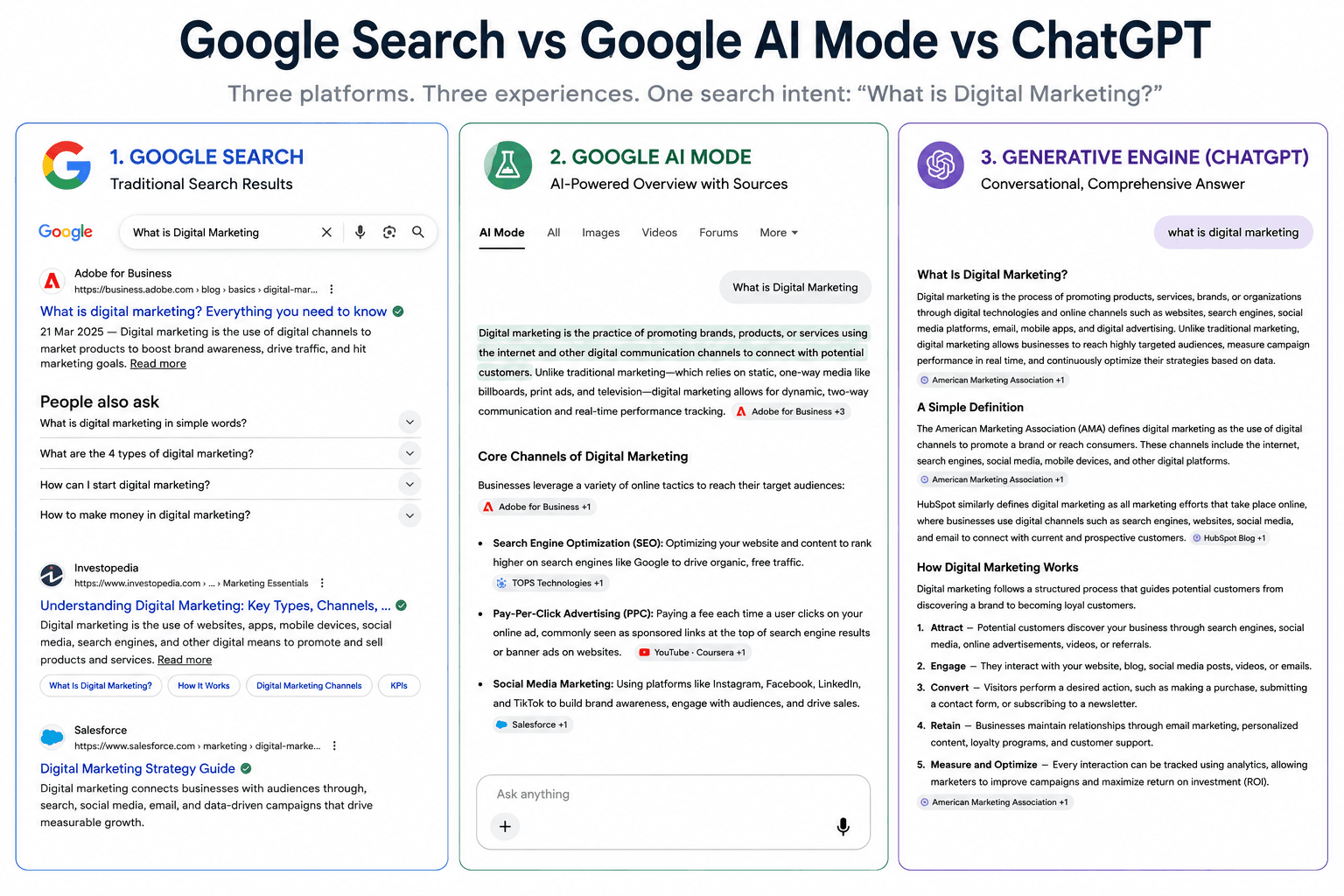
Instead of acting like a librarian, these systems function more like research assistants. Their job is not just to find information, but to gather insights from trusted experts and provide a useful answer. The assistant has access to millions of articles, websites, reports, and documents but cannot quote every source. It must decide which experts are trustworthy, what information is accurate, and which sources explain the topic effectively.
Generative Engine Optimization is all about making your content easier for AI-powered search systems to discover, understand, use and reference when generating answers.
The concept of GEO has emerged because search behavior is changing. More users are asking questions directly to AI systems rather than clicking through multiple search results. As a result, businesses need to look beyond rankings and focus on becoming sources that can be referenced.
This shift creates a new challenge for businesses, marketers, publishers, and content creators. Now, the goal for content creators is not just to rank but also to be referenced and cited. This is where Generative Engine Optimization (GEO) comes into play.
Hence, while SEO helps search engines find your content, GEO aims to make content easier for AI systems to retrieve and reference.
How AI Search Engines Work
AI search engines differ from traditional search engines in several significant ways. Traditional search engines mainly return a list of links, requiring users to click those links, read various pages, and combine the information themselves. AI search engines aim to automate much of that work.
Depending on the platform and query, an AI system may retrieve information from a search index or the live web, evaluate relevant passages, generate a synthesized response and provide links or citations to supporting sources.
In many cases, users receive an answer immediately without having to browse various websites. This fundamentally changes how content is discovered.
How AI Systems Choose Content to Reference
Although AI platforms do not publish a universal list of citation factors, content features that may support visibility include relevance, clear organization, reliable sourcing, original value and accessibility to the platform’s retrieval systems.
Relevance: The content must directly answer the user’s question.
Authority: The source should show credibility in the topic area.
Expertise: The content should demonstrate knowledge, experience, and understanding of the subject.
Clarity: Information should be easy to interpret and explain.
Structure: Well-organized content helps AI systems understand context and relationships between ideas.
Freshness: Current information is often preferred, especially for rapidly changing topics.
Content that combines these qualities may be more suitable for retrieval and citation, although it cannot guarantee a citation or mention in an AI-generated response.
GEO vs. SEO: What’s the Difference?
SEO and GEO are closely related, but their goals are different. The librarian analogy helps clarify the difference. In SEO, the librarian helps people find books. In GEO, the research assistant gathers information from trustworthy experts and incorporates it into an answer.
SEO asks, “How can I rank higher?” While GEO asks, “How can I become a source that AI systems reference?”
The goals of marketers and creators focusing mainly on SEO are to improve rankings, increase organic traffic, earn clicks, and generate conversions. The goals of a GEO-focused strategy are to earn AI citations, boost AI visibility, enhance brand recognition, and become a trusted source.
Both SEO and GEO require high-quality content, expertise, authority, trustworthiness, a good website experience, and topical relevance. However, GEO is more likely to complement SEO than replace it in the foreseeable future. More importantly, GEO builds on strong SEO foundations.
GEO Workflow for Businesses and Content Creators
The growing use of AI-powered search is reshaping how people discover and access information. BrightEdge’s March 2026 analysis across nine industries shows that Google AI Overviews appear in approximately 48% of the queries in its tracked keyword set. Similarly, a 2026 academic study of 55,393 trending queries across 19 categories found that AI Overviews appeared for 13.7% of the entire query set and 64.7% of question-form queries.
As users get answers directly from AI systems, visibility increasingly depends on whether content is referenced, not just ranked. When using AI, users expect direct answers, not lists of links. This shift brings both challenges and opportunities.
Organizations that thoroughly optimize their content for GEO may gain:
• Greater brand visibility.
• More authority in their niche.
• Increased trust from users.
• New traffic opportunities from AI platforms.
In contrast, businesses that ignore GEO may struggle to remain visible as search experiences evolve. Being referenced by AI systems can increase brand mentions, introduce your business to new audiences, and establish you as an authority in your industry.
For content creators, publishers, and educators, GEO offers a chance to engage users right when they ask questions and seek recommendations. Content that demonstrates expertise, provides original insights, and answers questions clearly is more likely to be cited by AI systems. GEO presents an opportunity to become authoritative voices in niche topics and categories.
In many ways, the future of content visibility is shifting from simply ranking on search engines to being referenced and recommended by AI assistants.
GEO Workflow: From Content Creation to AI Citation
The GEO process can be visualized as a simple workflow:
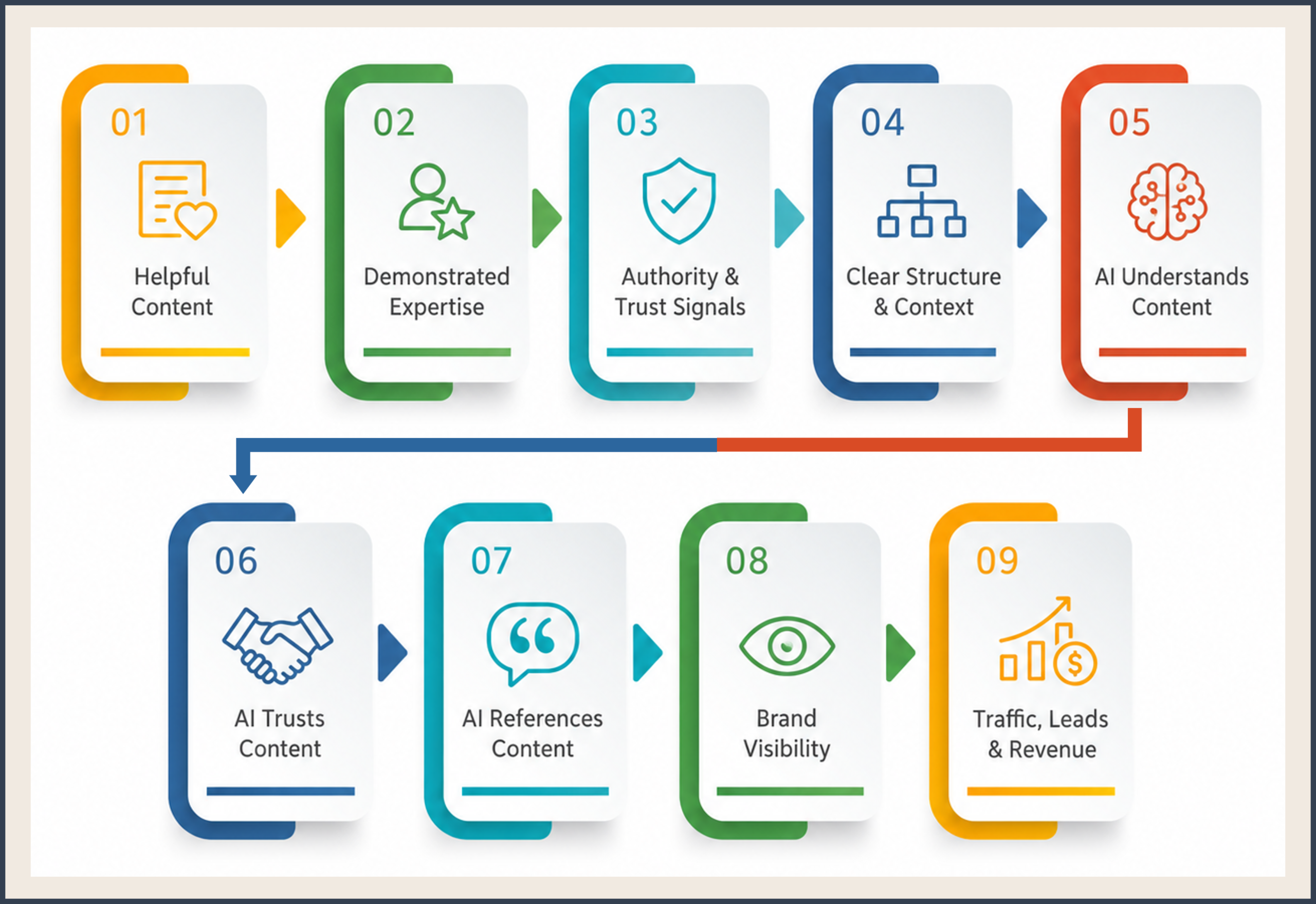
This workflow illustrates the core principle of GEO.
AI systems use different retrieval and source-selection methods rather than selecting sources randomly. Relevant, clearly organized and well-supported content may be more suitable for retrieval and citation, although no combination of factors guarantees that a source will be referenced.
GEO Strategies, Checklist and Metrics
GEO strategies involve optimizing your content to make it easier for AI systems like ChatGPT, Google AI Overviews, Claude, and Perplexity to discover, understand, retrieve and reference.
Like SEO, improving AI visibility requires a combination of content quality, authority building, and clear communication. However, GEO also involves understanding certain technical points specific to large language models.
Complete GEO Checklist
GEO remains an emerging field, and no tactic can guarantee stable citations or visibility across different AI platforms. Here’s a complete GEO checklist to optimize your content for GEO:
1. Publish original insights, opinions, and perspectives rather than repeating existing information.
2. Demonstrate real-world experience with examples, experiments, case studies, or personal observations.
3. Cover topics comprehensively and answer related questions in one place.
4. Build topical authority by publishing multiple articles around the same subject.
5. Create content that genuinely solves user problems and answers specific questions.
6. Include research, surveys, or original statistics whenever possible.
7. Strengthen author credibility with biographies, credentials, and expertise signals.
8. Build your brand authority through consistent publishing and thought leadership.
9. Begin important sections with a clear answer when doing so helps readers understand the subject quickly. At the same time, avoid forcing every section into a rigid format solely for AI systems.
10. Use clear and descriptive headings and write H2 and H3 headings as real user questions where appropriate.
11. Use simple, conversational language and use supported structured data only when it accurately represents the page and is relevant to a currently supported search feature.
12. Add workflows, diagrams, frameworks, and visual summaries that make concepts easier to understand.
13. AI systems interpret the technical structure behind your website in addition to what users see on the page. Hence, it is important to ensure important pages are not blocked by robots.txt.
14. Review access for relevant search crawlers, including OAI-SearchBot, Claude-SearchBot and PerplexityBot. These search crawlers are different from crawlers such as GPTBot or ClaudeBot, which are primarily used for model training.
15. Use semantic HTML for proper heading hierarchy (H1-H6), lists, tables and structured sections. If you are not comfortable with HTML, then you may use H1-H6 headings in MS Word or blocks for elements such as headings, lists and tables in website builders.
16. Maintain clean URLs and logical site architecture.
17. Ensure pages load quickly and work well on mobile devices.
18. Use descriptive internal links to help AI understand relationships between topics.
19. Clear authorship and credible sourcing can strengthen the reliability of published information. Hence, it is important to clearly display author names and biographies.
20. Use first-person experience and evidence-based claims and avoid vague statements and unsupported opinions.
21. Cite authoritative primary sources such as academic research, industry studies, government data and trusted publications.
22. Link to reputable external resources when making factual claims. Also try to earn mentions, citations, and backlinks from other websites.
23. Keep content updated with current information and new findings. Display publication and modification dates.
24. Show clear contact information and organizational details.
25. AI search is becoming increasingly conversational. Hence, it is important to write content using natural language.
26. Answer specific questions users are likely to ask AI assistants and include long-tail and conversational queries.
27. Anticipate follow-up questions and answer them within the article and try to explain complex topics using analogies and examples.
28. Local businesses should maintain consistent names, addresses and phone numbers across official profiles and reputable business directories.
29. Build a recognizable brand entity across multiple platforms.
30. Keep time-sensitive information current. Freshness is especially important when a query concerns recent events, prices, products, laws or rapidly changing subjects.
31. AI visibility cannot yet be measured perfectly, but it can be monitored. Therefore, conduct baseline searches in ChatGPT, Perplexity, Google AI Overviews and Claude.
32. Track whether your website is being cited or referenced. Also, monitor referral traffic from AI platforms in analytics tools.
33. Record which pages receive AI-driven traffic.
34. Track changes in brand mentions and citations over time.
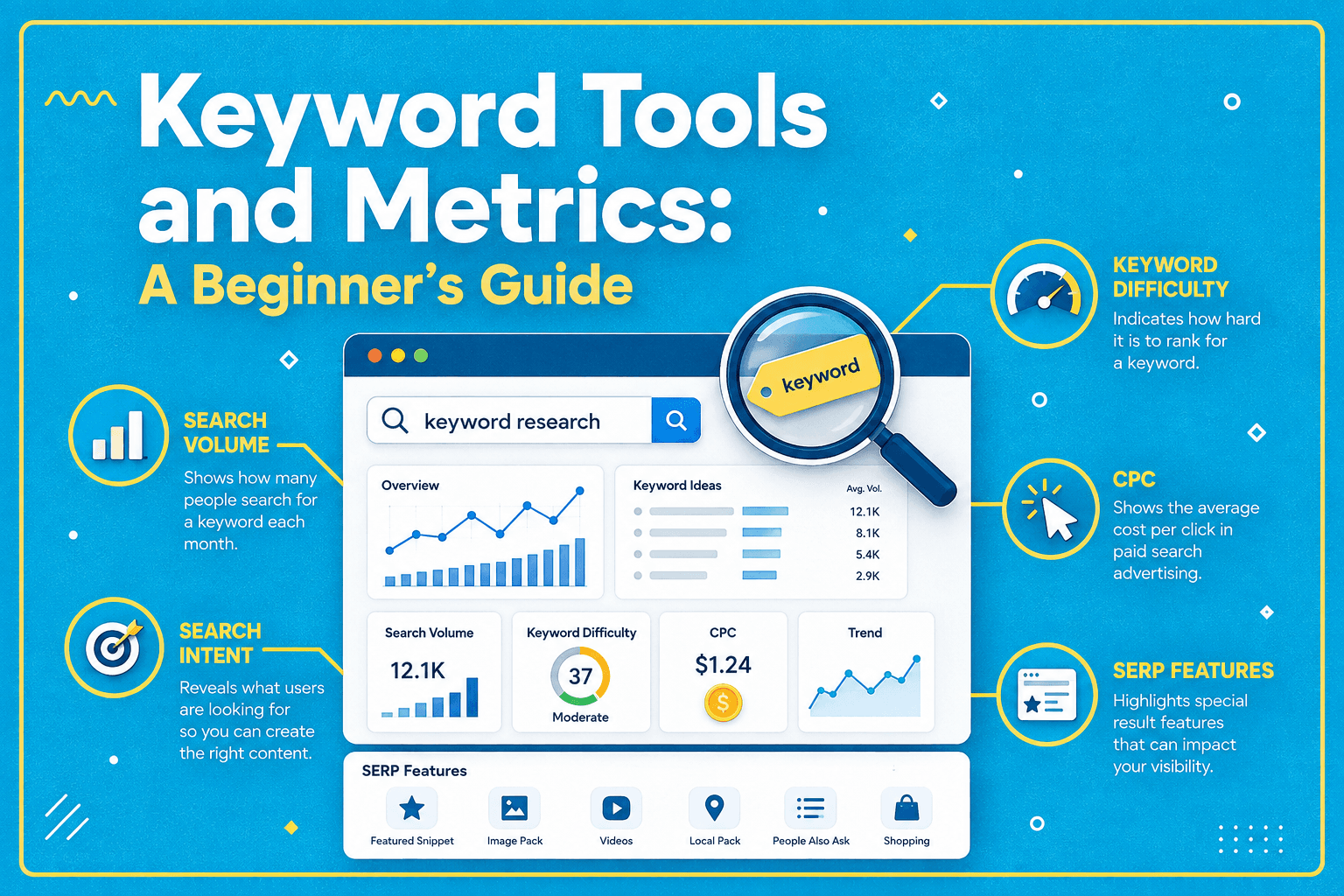
GEO Tools and Metrics
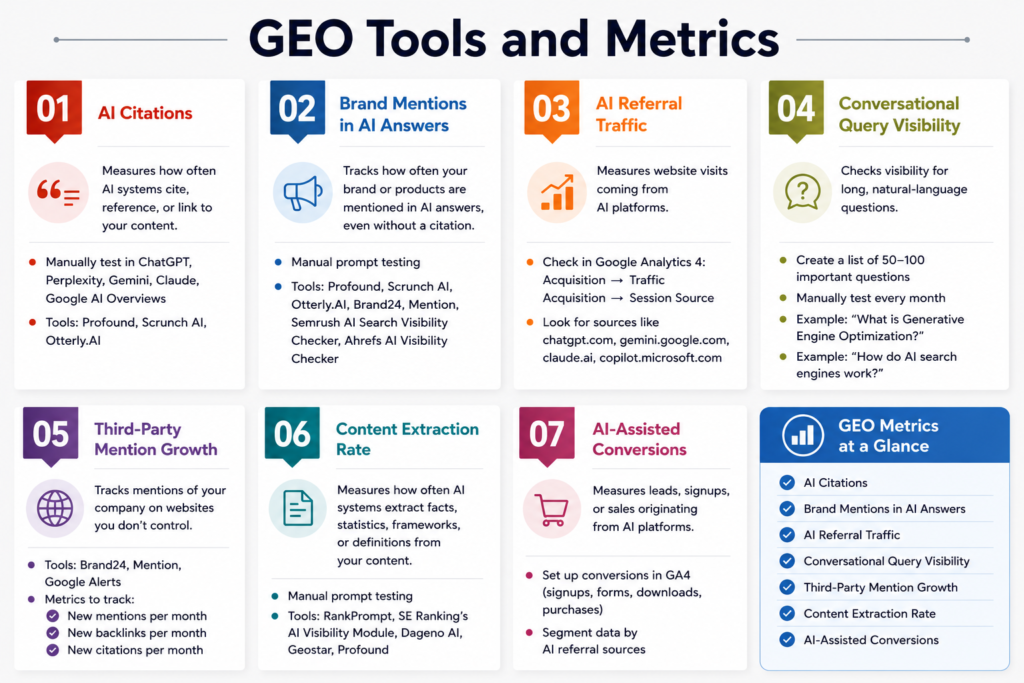
Traditional SEO relies on rankings and organic traffic. GEO, however, requires a broader set of measurements. Here are some of the essential GEO metrics you may need to track:
1. AI Citations
Citation frequency is a useful AI-visibility metric. It measures how often monitored AI responses cite, reference or link to the content.
To find AI citations for your website or specific web pages, manually test important queries in Google AI Overviews, ChatGPT, Perplexity, Gemini, and Claude. For broader AI citation monitoring, you can use tools such as Profound, Scrunch AI or Otterly.AI.
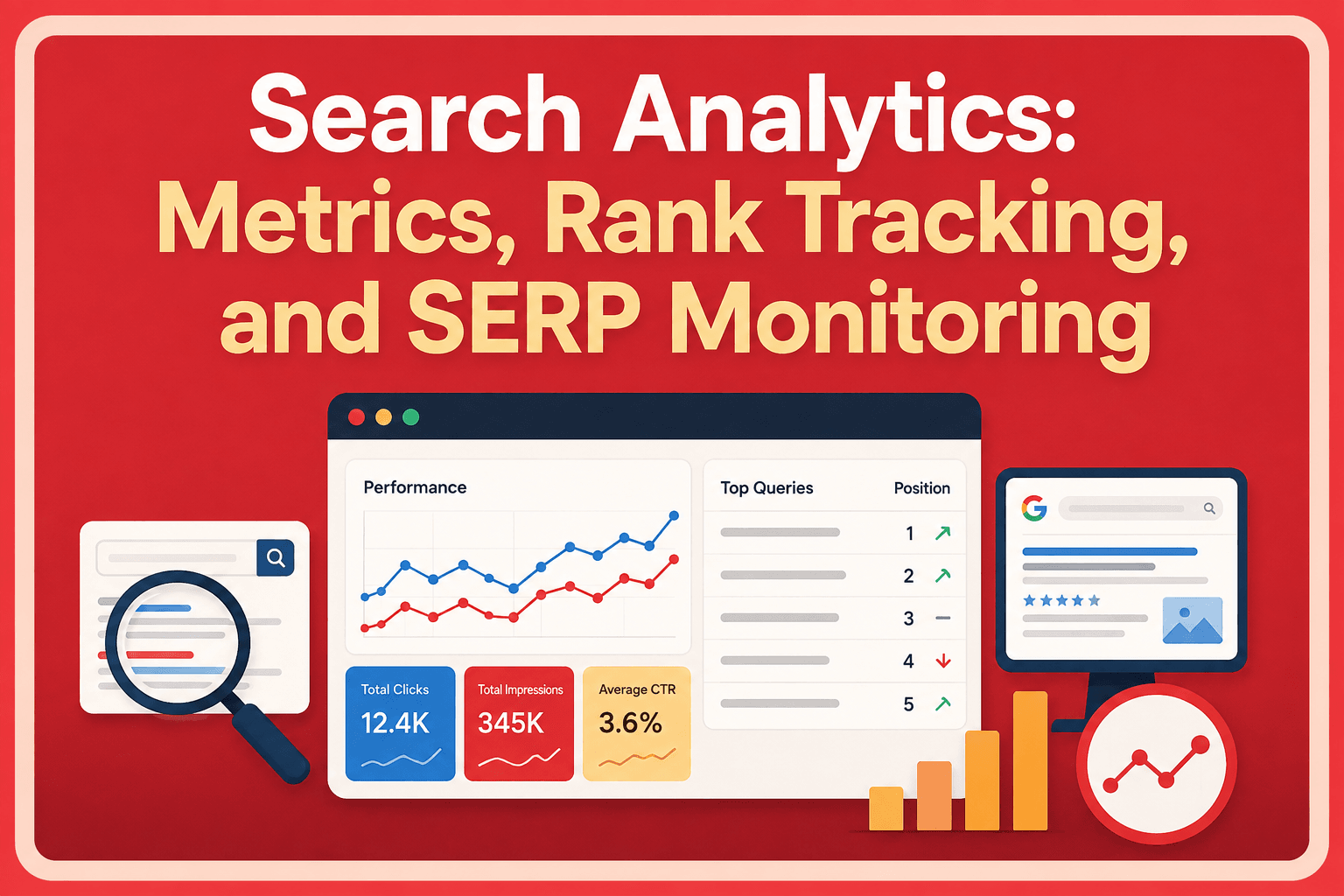
For Google AI Overviews and AI Mode, Google Search Console now provides a dedicated Generative AI performance report for websites worldwide. The report can be used to measure how often a site’s URLs appear in Google’s generative AI features, identify which pages receive the most impressions, and analyze visibility by georgaphy, device, and date. Because it reports first-party Search Console data, it can be added to your citation workflow when documenting a site’s visibility in AI Overviews and AI Mode.
2. Brand Mentions in AI Answers
AI mentions may increase brand awareness and potentially contribute to later branded searches. Hence, it is important to measure how often your company or products are mentioned in AI systems, even without a citation. You may do a preliminary check through manual prompt testing or use AI visibility tools such as Profound, Scrunch AI, Otterly.AI, Brand24, Mention, Semrush AI Search Visibility Checker or Ahrefs AI Visibility Checker.
3. AI Referral Traffic
AI referral traffic measures visits that arrive through detectable links from AI platforms. However, it does not capture every interaction in which an AI answer influenced a later visit or conversion.
You can check AI referral traffic through Google Analytics 4: Acquisition → Traffic Acquisition → Session Source. Here, you can look for sources such as chatgpt.com, gemini.google.com, claude.ai or copilot.microsoft.com
4. Conversational Query Visibility
It checks visibility of your website, web pages or brand for long, natural-language questions. Checking visibility for conversational queries can indicate how consistently a brand or website appears for these types of questions in AI systems, which are highly conversational. For this, you can create a list of 50-100 important questions and manually test them every month. For example,
- What is Generative Engine Optimization?
- How do AI search engines work?
5. Third-Party Mention Growth
It is important to keep track of mentions of your company on websites you do not control. Third-party mentions can provide useful evidence of a brand’s presence and reputation across the wider web. You can measure this using Brand24, Mention or Google Alerts. You can use these tools to measure:
- New mentions per month
- New third-party references per month
6. Quoted or Reused Content
Through repeated manual sampling or monitoring tools, track occasions when an AI response reproduces a distinctive definition, statistic, framework or passage from the website.
Quoted or Reused Content measures how often AI systems extract facts, statistics, frameworks, or definitions from your content. Tracking distinctive facts, definitions and frameworks through manual prompt testing can help show whether AI systems are using information from the website in generated responses. For advanced analytics, you can use tools such as RankPrompt, SE Ranking’s AI Visibility Module, Dageno AI, Geostar and Profound.
7. AI-Assisted Conversions
It measures leads, newsletter signups, or sales originating from AI platforms. You can measure AI-assisted conversions through GA4 by creating conversions for newsletter signups, contact forms, report downloads and purchases. After this, you can segment data by AI referral sources.
Is GEO the Future of Content Visibility?
In a 2026 survey of 300 enterprise marketing leaders, respondents projected that the average share of website traffic attributed to traditional SEO would increase from 45% in 2025 to 53% in 2026. At the same time, they expect traffic from AI-powered search experiences to grow significantly, increasing from 35% to 50% during the same period.
Thus, while SEO remains essential, trends suggest that AI-powered discovery will become an increasingly important channel for content visibility. In fact, 98% of enterprise marketing leaders are either actively optimizing for AI search or plan to do so within the next 12 months.
Hence, GEO is likely to become increasingly important, but it may not replace SEO. Instead, businesses and creators may need to optimize for both traditional search and AI-powered search experiences.
Search engines still rely on many traditional SEO signals, and organic search remains a major source of traffic for many organizations, including e-commerce businesses. For example, people will continue to trust search results for online purchases, news, industry trends and video and image-based searches.
At the same time, AI-powered search experiences are expanding rapidly. As AI assistants become more common, content creators must keep in mind the points discussed in the GEO checklist above to have content discovered, understood, and referenced by generative systems.
Organizations seeking visibility across both search and AI platforms should continue to focus on common areas such as expertise, authority, trust, clarity and helpful content. This is because the future of visibility will not be simply about appearing in search results. It will be about becoming a trusted source that AI systems may choose to reference. In other words, content visibility is expanding beyond ranked links to include mentions, citations and factual use within generated answers.
Conclusion
Traditional SEO helped websites, content creators and businesses become discoverable. Generative Engine Optimization (GEO) is a bit different as it helps them become reference-worthy.
As AI-powered search continues to evolve, organizations that demonstrate expertise, authority, trust and clarity may be better positioned to earn citations and references.
To sum it up, success in the age of generative search is no longer only about ranking higher than competitors. It is about becoming a trusted expert that AI search systems may cite or reference.
Frequently Asked Questions
What is GEO in digital marketing?
Generative Engine Optimization (GEO) primarily involves optimizing content so that AI-powered search systems can discover, understand, retrieve and reference it within generated answers.
Is Generative Engine Optimization (GEO) replacing SEO?
No. Generative Engine Optimization (GEO) is not replacing SEO; instead, it builds upon strong SEO fundamentals. While SEO is mainly about improving visibility in traditional search engine results, GEO aims to increase the likelihood of content being cited, referenced, or summarized in AI-generated responses. Businesses are likely to benefit most by combining both strategies.
Why is Generative Engine Optimization (GEO) important?
Generative Engine Optimization is becoming increasingly important because millions of users now rely on AI-powered platforms such as ChatGPT, Google AI Mode, Google AI Overviews, Perplexity, Claude, and Gemini to discover information. Optimizing content for these systems can help businesses improve brand visibility, reach new audiences, and increase the chances of being referenced in AI-generated results and answers.
How do AI systems decide which content to reference?
AI platforms use different retrieval and source-selection methods, and there is no universal set of citation factors. Relevant, accurate, well-structured and well-supported content may be more suitable for retrieval, while factors such as accessibility, freshness and original information can also matter depending on the query and platform.
What is the difference between ranking and being referenced by AI?
Ranking refers to a webpage appearing in traditional search engine results, usually in a numbered position on the search results page. Being referenced means an AI system uses information from your content or cites your website while generating a conversational answer, even if your page is not the highest-ranking search result.
How can I improve my website’s visibility in AI search?
Improving AI visibility requires creating comprehensive, accurate, and trustworthy content that directly answers user questions. Building topical authority, demonstrating real-world expertise, using clear headings, implementing structured data, earning quality citations and backlinks, and regularly updating content can all improve the likelihood of being referenced by AI systems.
Can small businesses benefit from Generative Engine Optimization (GEO)?
Yes. GEO is not limited to large brands, and small businesses can also benefit by publishing high-quality, experience-based content that addresses specific customer needs. Businesses that demonstrate expertise, build authority within their niche, and consistently create helpful resources can increase their chances of appearing in AI-generated search experiences.
How can I measure the success of a GEO strategy?
You can measure GEO success by tracking AI citations, brand mentions, AI referral traffic, conversational query visibility, and AI-assisted conversions using analytics platforms and AI visibility tools.