
Hybrid search is a search technique that combines keyword-based retrieval with semantic or vector retrieval to find more relevant information. Instead of relying only on exact words or only on similarity in meaning, it uses both approaches and combines their results.
This is useful because real searches often contain a mixture of exact terminology and broader intent. A query such as “Adobe Acrobat error 110 after update” contains an exact product name and error code, but it also expresses a broader problem that may be described differently in relevant documents.
Microsoft Azure AI Search, for example, defines hybrid search as combining full-text and vector queries and merging their results into a unified ranking.
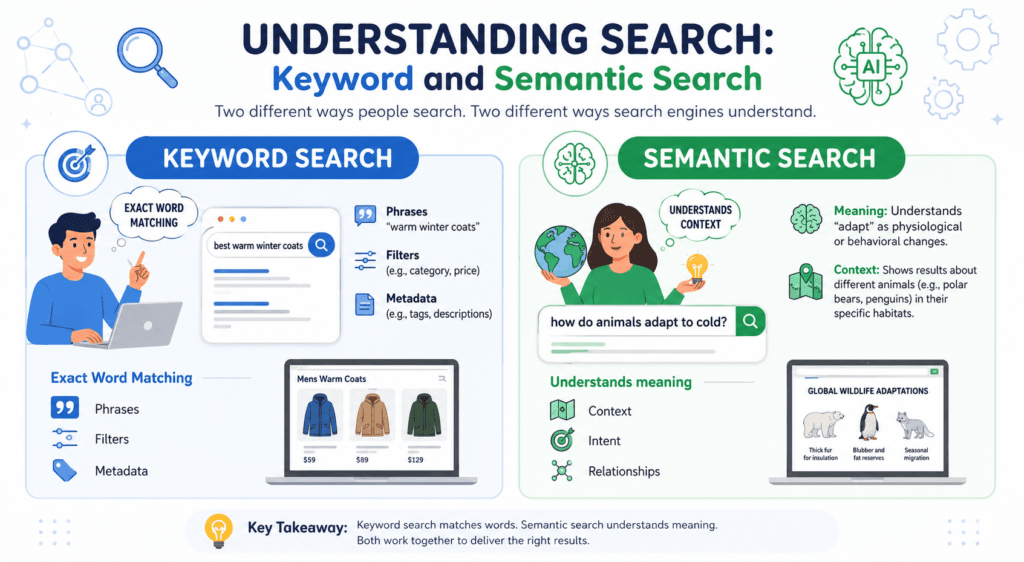
Keyword Search vs. Vector Search vs. Semantic Search vs. Hybrid Search vs. RAG
These concepts are related, but they describe different parts of information retrieval.
Keyword search is particularly valuable when exact wording matters. Names, product codes, quotations, SKUs, legal terms, model numbers, and error codes may lose important meaning if treated only as broadly related concepts.
Vector search represents content and queries as numerical embeddings and retrieves items based on similarity. This makes it useful when the query and relevant document use different words.
Semantic search is the broader idea of searching according to meaning rather than exact wording. Vector search is one important technical method for implementing semantic retrieval, but the two terms are not exact synonyms.
Hybrid search combines keyword retrieval and semantic or vector retrieval. It therefore retains the precision of matching exact terms while gaining the ability to recognize related meanings.
Retrieval-Augmented Generation (RAG) is different again. RAG is an architecture in which relevant information is retrieved and supplied to a generative AI model as context. Hybrid search can be used as the retrieval component of a RAG system, but hybrid search itself does not generate an answer.
| Method | What It Primarily Does | Example |
|---|---|---|
| Keyword Search | Matches words, phrases, and textual patterns | Finds “error 110” because those exact terms occur |
| Vector Search | Finds items with mathematically similar embeddings | Connects “family vehicle” with “seven-seat minivan” |
| Semantic Search | Attempts to retrieve information based on meaning and context | Understands that “laptop battery dies quickly” relates to poor battery life |
| Hybrid Search | Combines lexical and semantic/vector retrieval | Preserves an exact model number while also understanding the broader problem |
| RAG | Retrieves information and gives it to a generative model as context | Retrieves policy passages before an AI assistant answers a question |
How Hybrid Search Works
The exact implementation differs between systems, but the process can be understood through four broad stages.
1. Keyword Retrieval
The search system first looks for lexical matches in a text index. Many modern search platforms use algorithms such as BM25 to score documents according to term matches and other textual relevance characteristics.
Suppose the query is “Canon EOS R6 Mark II battery overheating.”
Keyword retrieval is particularly useful for preserving the exact camera model, EOS R6 Mark II, because those words distinguish it from other Canon cameras.
2. Vector Retrieval
The query can also be converted into an embedding vector. The system compares this vector with embeddings representing stored documents or passages. This semantic search might retrieve an article discussing “excessive battery temperature in Canon mirrorless cameras” even if it never uses the word overheating. Keyword and vector retrieval can therefore address different aspects of the same query.
3. Result Fusion
The two searches produce separate ranked lists. Hybrid search then combines them.
One technique used for this purpose is Reciprocal Rank Fusion (RRF). Instead of assuming that the raw scores from keyword and vector systems are directly comparable, RRF considers the ranking positions produced by each search method.
Azure AI Search runs its full-text and vector queries in parallel and combines their results using RRF.
A page that ranks highly in both lists may therefore receive a favorable position in the combined results, while useful results that appear mainly through one retrieval method can still remain candidates.
4. Reranking and Output
Some systems perform another evaluation after the initial results have been merged.
A reranker examines a smaller set of candidate results in greater detail and changes their order using additional relevance information. Because only a limited set of candidate documents needs to be reconsidered, the reranking model can apply a more detailed relevance evaluation than the first retrieval stage.
The simplified flow is:
Note: Hybrid Search Is Not the Same as RAG
Hybrid search retrieves and ranks information, while RAG uses retrieved information as context for a generative AI model. A RAG system may use hybrid search, vector search, keyword search, or another retrieval method. Retrieval can improve grounding, but it does not guarantee that the generated answer will be accurate.
A Simple Hybrid Search Example
Consider an online electronics store with three pages:
- A: “Apple AirPods Pro 2 USB-C”
- B: “Wireless noise-canceling earbuds for travel”
- C: “Apple USB-C charging cable”
A shopper searches: “AirPods for blocking airplane noise.”
Keyword search can strongly recognize AirPods, making Page A highly relevant. However, Page C also contains Apple-related terminology and could receive some lexical relevance despite being the wrong product.
Vector search can recognize that “blocking airplane noise” is closely related to noise cancellation, making Page B semantically relevant.
Hybrid search combines both forms of evidence. Page A may rank first because it matches the exact product and the broader intent. Page B may rank next because it strongly matches the meaning. Page C can fall lower because its textual overlap does not adequately match the user’s need.
This illustrates the main value of hybrid search: exact terminology remains important without requiring every relevant result to use the same wording as the query.
Where Hybrid Search Is Used
Hybrid search is especially useful in collections where both precise terminology and conceptual meaning matter.
Enterprise search can combine employee language with exact policy names, acronyms, document numbers, and internal terminology.
E-commerce search can recognize exact product models while also understanding descriptive searches such as “lightweight shoes for trail running.”
Customer-support systems can match error codes and product names while also retrieving documentation that describes similar symptoms using different terminology.
Developer search can preserve exact API names, functions, libraries, and error messages while understanding broader programming questions.
AI assistants and RAG systems can use hybrid retrieval to find supporting passages before a language model generates an answer.
Benefits, Limitations, and Why Hybrid Search Matters
The central advantage of hybrid search is that it avoids forcing a search system to choose between words and meaning.
It can preserve exact phrases, names, identifiers, and technical terminology while also recognizing synonyms, paraphrases, and related concepts. This can reduce missed results in searches where vocabulary differs between the query and the indexed content.
Hybrid search is not automatically better in every situation, however. Maintaining both lexical and vector indexes requires additional infrastructure. Search quality also depends on the embedding model, keyword-ranking method, number of candidates retrieved, fusion technique, filters, and any reranking stage.
Another technical challenge is that keyword and vector scores may use completely different scales. A BM25 score cannot necessarily be compared directly with a cosine-similarity score. This is one reason rank-fusion techniques such as RRF are useful: they can combine the positions of results in ranked lists rather than treating unrelated raw scores as equivalent.
Hybrid search is therefore not a replacement for traditional search. It is a way of combining complementary retrieval methods.
Conclusion
Keyword search provides lexical precision. Vector search provides semantic similarity. Hybrid search brings the two together, and RAG can use those retrieved results as evidence for generating an answer.
That distinction is the key to understanding where hybrid search fits within modern search and AI retrieval systems.