



Search Engine Journal describes Generative Engine Optimization (GEO) as the practice of optimizing content to boost visibility in AI-driven search engines and generative AI platforms. As artificial intelligence plays a bigger role in how people find information online, it is not enough to just rank on search engine results pages. Now marketers and content creators are realizing that their content must be discovered, understood, trusted, and referenced by AI systems.
Many people now use AI tools on a daily basis to find information, conduct research, and get recommendations. According to Salesforce’s State of Marketing 2026 report, 87% of marketers now use generative AI in at least one regular workflow, up from 51% in 2024. This rapid adoption of generative AI is changing how users interact with search and discover content.
Table of Contents
- What is Generative Engine Optimization (GEO)?
- How AI Search Engines Work
- GEO vs SEO: What’s the Difference?
- GEO Workflow for Businesses and Content Creators
- GEO Strategies, Checklist and Metrics
- Is GEO the Future of Content Visibility?
- Frequently Asked Questions
What is Generative Engine Optimization (GEO)?
Generative Engine Optimization (GEO) is the process of optimizing content for AI-powered search engines and answer engines. Traditional SEO focuses on improving visibility in search engine results pages, while GEO aims to enhance visibility within AI-generated responses.
For decades, search visibility was mainly about one thing: ranking higher on search engines. When someone searched for a question, search engines displayed a list of links, and businesses competed for top spots. The higher your ranking, the better your chances of attracting visitors.
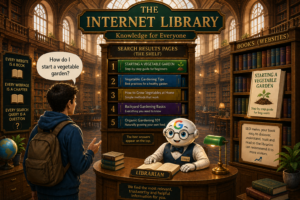
A useful way to think about traditional search engines is through the librarian analogy. Imagine a vast digital library with billions of books. The librarian’s role is to find the most relevant books and present them to readers. This is what search engines have done for years.
Today, however, search is changing. AI-powered tools like ChatGPT, Google AI Overviews, and Perplexity do more than provide a list of links. They create context-rich answers, summarize information, and often reference multiple sources in a single response.
Instead of acting like a librarian, these systems function more like research assistants. Their job is not just to find information, but to gather insights from trusted experts and provide a useful answer. The assistant has access to millions of articles, websites, reports, and documents but cannot quote every source. It must decide which experts are trustworthy, what information is accurate, and which sources explain the topic effectively.
Generative Engine Optimization is all about making your content easier for AI-powered search systems to discover, understand, trust, and reference when generating answers. In simple terms, GEO helps your content become one of the trusted sources that AI systems choose to cite.
This concept has emerged because search behavior is changing. More users are asking questions directly to AI systems rather than clicking through multiple search results. As a result, businesses need to look beyond rankings and focus on becoming sources that can be referenced.
This shift creates a new challenge for businesses, marketers, publishers, and content creators. Now, the goal for content creators is not just to rank but also to be referenced and cited. This is where Generative Engine Optimization (GEO) comes into play.
Hence, while SEO helps search engines find your content, GEO helps AI systems trust and reference your content.
How AI Search Engines Work
AI search engines differ from traditional search engines in several significant ways. Traditional search engines mainly return a list of links, requiring users to click those links, read various pages, and combine the information themselves. AI search engines aim to automate much of that work.
When a user asks a question, the AI system may:
- Search across multiple sources.
- Analyze relevant information.
- Identify trustworthy content.
- Generate a summarized answer.
- Provide references or citations when appropriate.
In many cases, users receive an answer immediately without having to browse various websites. This fundamentally changes how content is discovered.
How AI Systems Choose Content to Reference
Using the Trusted Expert analogy, picture an AI research assistant preparing a briefing for an executive. The assistant must decide which experts are worth quoting. Several factors influence this decision:
Relevance: The content must directly answer the user’s question.
Authority: The source should show credibility in the topic area.
Expertise: The content should demonstrate knowledge, experience, and understanding of the subject.
Clarity: Information should be easy to interpret and explain.
Structure: Well-organized content helps AI systems understand context and relationships between ideas.
Freshness: Current information is often preferred, especially for rapidly changing topics.
AI systems are more likely to reference content that combines these qualities. The better your content performs in these areas, the more likely it is to become a trusted source.
GEO vs SEO: What’s the Difference?
SEO and GEO are closely related, but their goals are different. The librarian analogy helps clarify the difference. In SEO, the librarian helps people find books. In GEO, the research assistant gathers information from trustworthy experts and incorporates it into an answer.
SEO asks, “How can I rank higher?” While GEO asks, “How can I become a source that AI systems reference?”
The goals of marketers and creators focusing mainly on SEO are to improve rankings, increase organic traffic, earn clicks, and generate conversions. The goals of a GEO-focused strategy are to earn AI citations, boost AI visibility, enhance brand recognition, and become a trusted source.
Similarities Between GEO and SEO
Both SEO and GEO require high-quality content, expertise, authority, trustworthiness, a good website experience, and topical relevance. However, this does not mean that GEO will replace SEO anytime soon. Instead, GEO builds on strong SEO foundations.
GEO Workflow for Businesses and Content Creators
The rise of AI-powered search is changing how people find information. BrightEdge’s March 2026 analysis across nine industries shows that Google AI Overviews now appear in approximately 48% of search queries. More importantly, a 2026 academic study of more than 55,000 searches found that AI Overviews appear for 64.7% of question-form queries.
As users get answers directly from AI systems, visibility increasingly depends on whether content is referenced, not just ranked. When using AI, users expect direct answers, not lists of links. This shift brings both challenges and opportunities.
Organizations and creators that thoroughly optimize their content for GEO can gain:
• Greater brand visibility.
• More authority in their niche.
• Increased trust from users.
• New traffic opportunities from AI platforms.
In contrast, businesses that ignore GEO may struggle to remain visible as search experiences evolve. Being referenced by AI systems can increase brand mentions, introduce your business to new audiences, and establish you as an authority in your industry.
For content creators, publishers, and educators, GEO offers a chance to engage users right when they ask questions and seek recommendations. Content that demonstrates expertise, provides original insights, and answers questions clearly is more likely to be cited by AI systems. GEO presents an opportunity to become authoritative voices in niche topics and categories.
In many ways, the future of content visibility is shifting from simply ranking on search engines to being referenced and recommended by AI assistants.
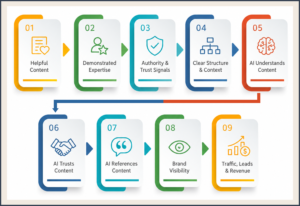
GEO Workflow: From Content Creation to AI Citation
The GEO process can be visualized as a simple workflow:
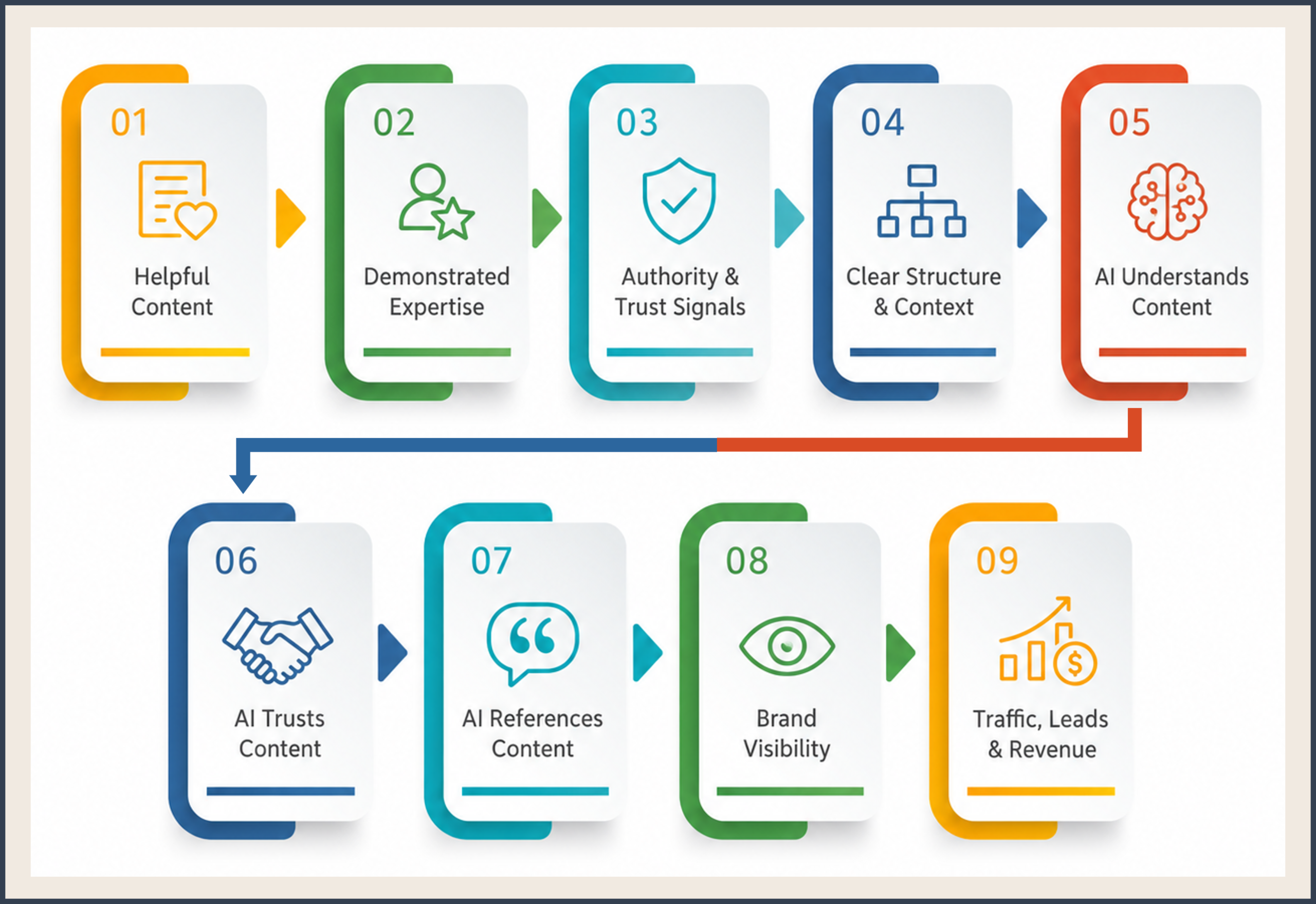
This workflow illustrates the core principle of GEO.
It is important to note here that AI systems do not randomly choose sources. They identify content that demonstrates expertise, authority, trust, and clarity. The more effectively your content moves through this process, the more likely it is to be referenced.
GEO Strategies, Checklist and Metrics
GEO strategies involve optimising your content to make it easier for AI systems like ChatGPT, Google AI Overviews, Claude, and Perplexity to understand, trust, and reference.
Like SEO, improving AI visibility requires a combination of content quality, authority building, and clear communication. However, GEO also involves understanding certain technical points specific to large language models.
Complete GEO Checklist
Here’s a complete GEO checklist to optimize your content for GEO:
1. Publish original insights, opinions, and perspectives rather than repeating existing information.
2. Demonstrate real-world experience with examples, experiments, case studies, or personal observations.
3. Cover topics comprehensively and answer related questions in one place.
4. Build topical authority by publishing multiple articles around the same subject.
5. Create content that genuinely solves user problems and answers specific questions.
6. Include research, surveys, or original statistics whenever possible.
7. Strengthen author credibility with biographies, credentials, and expertise signals.
8. Build your brand authority through consistent publishing and thought leadership.
9. AI systems often extract small pieces of information rather than reading an entire article. Hence, begin important sections with a direct answer in the first two or three sentences.
10. Use clear and descriptive headings and Write H2 and H3 headings as real user questions where appropriate.
11. Use simple, conversational language and try to create FAQ sections answering common questions. Also implement FAQ and HowTo schema where appropriate.
12. Add workflows, diagrams, frameworks, and visual summaries that make concepts easier to understand.
13. AI systems read your site’s underlying structure, not just its visual design. Hence, it is important to ensure important pages are not blocked by robots.txt.
14. Check access for AI crawlers such as GPTBot, ClaudeBot and PerplexityBot.
15. Use semantic HTML for proper heading hierarchy (H1-H6), lists, tables and structured sections. If you are not comfortable with HTML, the you may use H1-H6 heading in MS Word or blocks for elements such as headings, lists and tables in website builders.
16. Implement structured data (JSON-LD), including article schema, organization schema, product schema, FAQ schema and HowTo Schema.
17. Add an llms.txt file at the root directory to provides AI systems with an easy-to-read summary of your most important content.
18. Maintain clean URLs and logical site architecture.
19. Ensure pages load quickly and work well on mobile devices.
20. Use descriptive internal links to help AI understand relationships between topics.
21. AI systems prefer information from credible and trustworthy sources. Hence, it is important to clearly display author names and biographies.
22. Use first-person experience and evidence-based claims and avoid vague statements and unsupported opinions.
23. Cite authoritative primary sources such as academic research, industry studies, government data and trusted publications.
24. Link to reputable external resources when making factual claims. Also try to earn mentions, citations, and backlinks from other websites.
25. Keep content updated with current information and new findings. Display publication and modification dates.
26. Show clear contact information and organizational details.
27. AI search is becoming increasingly conversational. Hence, it is important to write content using natural language.
28. Answer specific questions users are likely to ask AI assistants and include long-tail and conversational queries.
29. Anticipate follow-up questions and answer them within the article and try to explain complex topics using analogies and examples.
30. Maintain consistent business information (Name, Address, Phone Number) across LinkedIn, business directories, social media accounts and company profiles.
31. Build a recognizable brand entity across multiple platforms.
32. AI systems often prefer current and updated information. Hence, regularly update statistics and examples and review older articles periodically.
33. AI visibility cannot yet be measured perfectly, but it can be monitored. Therefore, conduct baseline searches in ChatGPT, Perplexity, Google AI Overviews and Claude.
34. Track whether your website is being cited or referenced. Also, monitor referral traffic from AI platforms in analytics tools.
35. Record which pages receive AI-driven traffic.
36. Track changes in brand mentions and citations over time.
GEO Metrics
Traditional SEO relies on rankings and organic traffic. GEO, however, requires a broader set of measurements. Here are some of the essential GEO metrics you may need to track:
1. AI Citations
Citations are the closest equivalent to rankings in AI search. AI citations measure how frequently AI systems cites, reference, or link to your content.
To find AI citations for your website or specific web pages, you can manually test important queries in ChatGPT, Perplexity, Gemini, Claude, and Google AI Overviews. If you want exact and comprehensive data for AI citations, you can use tools such as Profound, Scrunch AI or Otterly.AI.
2. Brand Mentions in AI Answers
AI mentions create awareness and help influence future branded searches. Hence, it is important to measure how often your company or products are mentioned in AI systems, even without a citation. You may do a preliminary check through manual prompt testing or use AI visibility tools such as Profound, Scrunch AI, Otterly.AI, Brand24, Mention, Semrush AI Search Visibility Checker or Ahrefs AI Visibility Checker.
3. AI Referral Traffic
AI referral traffic measures website visits originating from AI platforms. You can check AI referral traffic through Google Analytics 4: Acquisition → Traffic Acquisition → Session Source. Here, you can look for sources such as chatgpt.com, gemini.google.com, claude.ai or copilot.microsoft.com
4. Conversational Query Visibility
It checks visibility of your website, web pages or brand for long, natural-language questions. Checking visibility for conversation queries shows the efficacy of FAQs and question-answer format that you may be using for visibility in AI systems, which are highly conversational. For this, you can create a list of 50-100 important questions and manually test them every month. For example,
- What is Generative Engine Optimization?
- How do AI search engines work?
5. Third-Party Mention Growth
It is important to keep track of mentions of your company on websites you do not control. This is important because AI systems heavily rely on external validation. You can measure this using Brand24, Mention or Google Alerts. You can use these tools to measure:
- New mentions per month
- New backlinks per month
- New citations per month.
6. Content Extraction Rate
It measures how often AI systems extract facts, statistics, frameworks, or definitions from your content. Content extraction is important because being quoted is often more valuable than merely being linked. You can check content extraction of your content through manual prompt testing. For advanced analytics and precise data, you can use tools such as RankPrompt, SE Ranking’s AI Visibility Module, Dageno AI, Geostar and Profound.
7. AI-Assisted Conversions
It measures leads, newsletter signups, or sales originating from AI platforms. You can measure AI-assisted conversions through GA4 by creating conversions for newsletter signups, contact forms, report downloads and purchases. After this, you can segment data by AI referral sources.
Is GEO the Future of Content Visibility?
Enterprise leaders anticipate that traffic from traditional search engine optimization (SEO) will continue to increase, rising from an average share of 45% of website traffic in 2025 to 53% in 2026. At the same time, they expect traffic from AI-powered search experiences to grow significantly, increasing from 35% to 50% during the same period.
Thus, while SEO remains essential, trends suggest that AI-powered discovery will become an increasingly important channel for content visibility. In fact, Hence, 98% of enterprise marketing leaders are either actively optimizing for AI search or plan to do so within the next 12 months.
Hence, GEO will become more and more important, but it may not replace SEO. Instead, businesses and creators might need to work simultaneously on both.
Search engines still rely on many traditional SEO signals, and organic search remains a major source of traffic for most organizations, especially online stores. For example, people will continue to trust search results for online purchases, news, industry trends and video and image-based searches.
At the same time, AI-powered search experiences are expanding rapidly. As AI assistants become more common, content creators must keep in mind the points discussed in the GEO checklist above to have content discovered, understood, and referenced by generative systems.
The organizations most likely to succeed would need to continuously focus on common areas such as expertise, authority, trust, clarity and helpful content. This is because the future of visibility will not be simply about appearing in search results. It will be about becoming a trusted source that AI systems choose to reference.
The shift is moving from ranking to referencing can become seamless if creators focus more and more on trust signals, helpful content, problem solving skills and clarity.
Frequently Asked Questions
What is GEO in digital marketing?
Generative Engine Optimization (GEO) is the practice of optimizing content so AI-powered search engines can discover, understand, trust, and reference it within generated answers.
Is GEO replacing SEO?
No. GEO complements SEO rather than replacing it. Strong SEO foundations often support successful GEO efforts.
Why is GEO important?
GEO helps businesses remain visible as AI-powered search experiences become more common.
How do AI systems decide which content to reference?
AI systems often evaluate factors such as relevance, authority, expertise, clarity, structure, and freshness.
What is the difference between ranking and referencing?
Ranking means appearing in search results. Referencing means being cited or incorporated into an AI-generated answer.
How can I improve AI visibility?
Focus on creating authoritative content, building topical authority, demonstrating expertise, structuring information clearly, and maintaining trustworthiness.
Can small businesses benefit from GEO?
Yes. Any organization that publishes useful and trustworthy content can potentially improve its visibility within AI-generated search experiences.
Final Thoughts
Traditional SEO helped websites, content creators and businesses become discoverable. GEO is a bit different as it helps them become reference-worthy.
As AI-powered search continues to evolve, the organizations that demonstrate expertise, authority, trust, and clarity will have the greatest opportunity to be cited, referenced, and remembered.
To sum it up, success in the age of generative search is no longer only about ranking higher than competitors. It is about becoming a trusted expert that AI systems choose to reference.