


Table of Contents
- What Is Social Media Marketing?
- How Social Media Marketing Works
- Why Social Media Marketing Matters for Businesses
- Major Social Media Platforms Explained
- How Social Media Generates Leads and Revenue
- Social Media Tools and Metrics
- Social Media Strategy and Common Mistakes to Avoid
- FAQs
What Is Social Media Marketing?
Social Media Marketing (SMM) is the process of using social media platforms such as Facebook, Instagram, LinkedIn, YouTube, TikTok, and Pinterest to promote products and services, build relationships with customers, increase brand awareness, and achieve business goals such as lead generation and sales.
Over the last decade, social media has evolved from a place where people simply shared photos and updates into one of the world’s largest business and marketing channels. Today, billions of people use social media every day to learn, communicate, discover new brands, and make purchasing decisions.
For businesses, this has created an enormous opportunity. This is because businesses no longer need a massive advertising budget to reach thousands or even millions of people. A useful post, an educational video, or a well-timed campaign can introduce a business to entirely new audiences.
Think of social media as a giant global marketplace. In a traditional market, businesses set up shops and wait for customers to walk by. On social media, the market never closes. Millions of conversations happen every minute, and businesses can participate in those conversations, answer questions, educate customers, and build relationships.
The companies that understand this shift do not treat social media as a place to simply publish advertisements. They treat it as a place to build trust and become part of their customers’ daily lives.
How Social Media Marketing Works
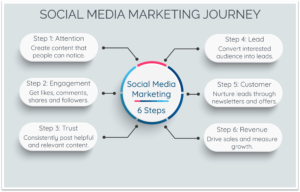
Many people assume social media marketing is simply posting content online. In reality, it follows a much deeper process. Every successful social media strategy usually follows this journey:
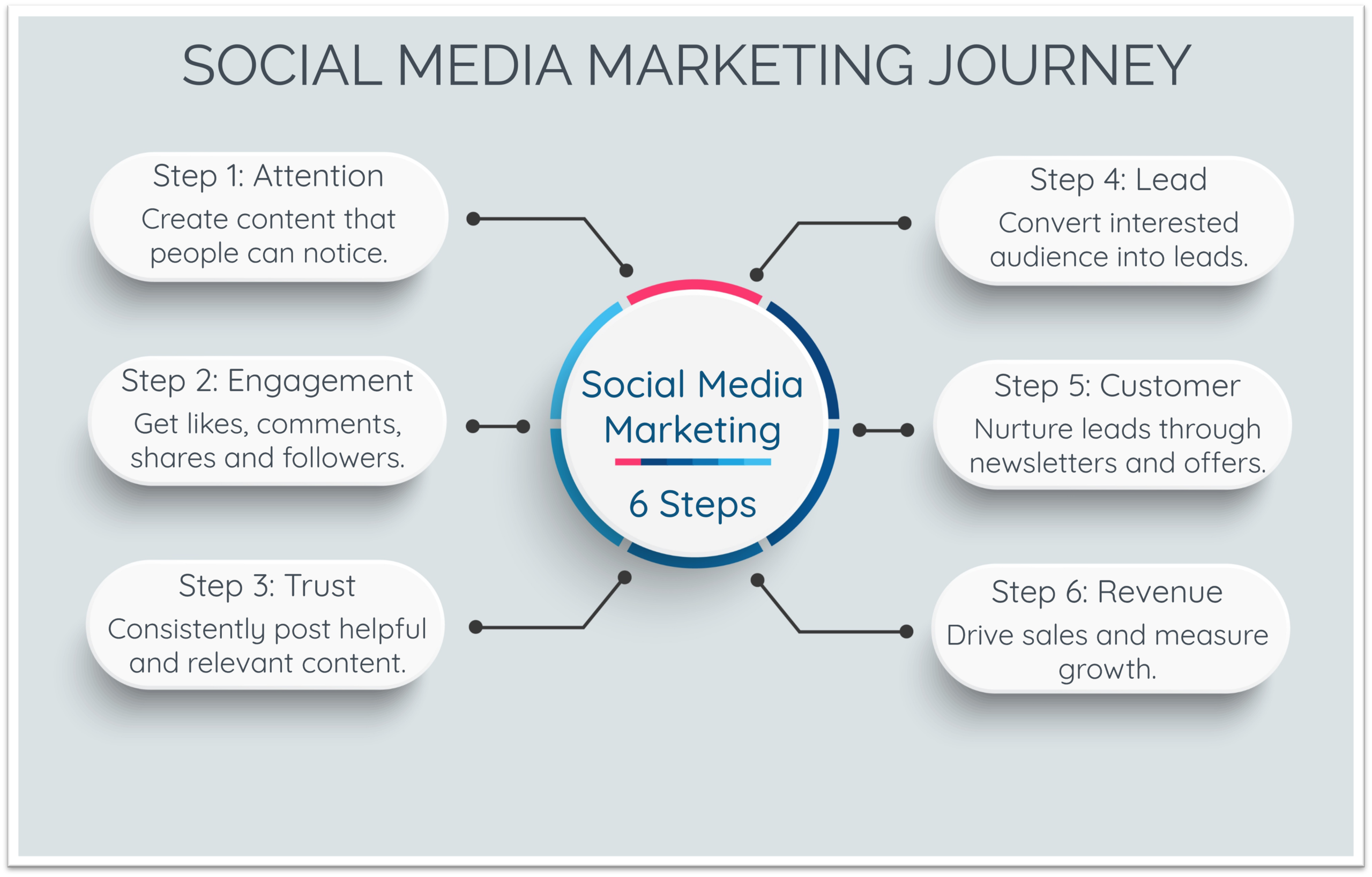
Understanding this journey explains why some businesses succeed on social media while others struggle.
Here’s a step-by-step guide to understand how social media marketing works:
Step 1: Attention
Everything begins with visibility. Every day, users are exposed to thousands of posts, videos, stories, and advertisements. Before a business can generate leads or sales, it first needs people to notice its content.
This is why businesses invest heavily in creating educational content, videos, industry insights, useful tips and eye-catching visuals.
Without attention, nothing else can happen. In the world of online marketing, no visibility means no audience. And no audience, in turn, means no sales, no customers and no revenue.
Step 2: Engagement
Once people notice your content, the next objective is engagement. Engagement happens when people like your posts, comment on your content, share your videos, save your posts, send messages, visit your company page or visit your website.
Engagement is important because it signals interest. Imagine speaking at a conference. If people start asking questions and taking notes, you know your message is resonating. Social media works in much the same way.
Platforms often show engaging content to more people, creating a positive feedback loop. Good content generates engagement. And engagement, in turn, increases reach, which ultimately brings more potential customers.
In short, businesses can leverage social engagement to generate leads and share updates related to new products, deals and offers.
Step 3: Trust
Most people do not buy immediately as they often need multiple interactions before they feel comfortable purchasing from a business.
Hence, a person may first:
- Read your article
- Watch your video
- Follow your page
- Subscribe to your newsletter
- Download a guide
Only after several interactions do they become ready to buy. Thus, trust is one of the biggest reasons social media marketing works.
People prefer buying from businesses they recognize and understand. And trust in social media is gradually built through consistent and helpful content.
Step 4: Leads and Customers
After you keep posting helpful content consistently, you can easily gain followers. Some of these followers become leads.
A lead is simply someone who has shown interest in your business. Examples include:
- Filling out a contact form
- Downloading an ebook
- Registering for a webinar
- Requesting a demo
- Joining your email list
Some of these leads eventually become customers. This process, however, is often gradual rather than immediate. This is why successful businesses first prepare a long-term plan and focus on building relationships rather than chasing instant sales.
Organic vs Paid Social Media Marketing
Social media marketing generally falls into two categories: organic and paid.
Organic Social Media Marketing
Organic social media marketing involves posting content on social platforms without paying to distribute it. Examples include educational posts, videos, articles, stories and community discussions.
Organic marketing is excellent for building trust, developing authority, growing communities and establishing brand recognition.
Paid Social Media Marketing
Paid social media marketing involves paying platforms to promote content to targeted audiences. Examples include Facebook Ads, Instagram Ads, LinkedIn Ads, YouTube Ads and TikTok Ads.
Paid advertising produces results more quickly because businesses can immediately reach large audiences.
In short, organic social media marketing is like building friendships over time. On the other hand, paid social media marketing is like renting a billboard that instantly puts your message in front of thousands of people. Most successful businesses use a combination of both.
Why Social Media Marketing Matters for Businesses
Some people still think social media is only useful for influencers or large brands. That is no longer true. In fact, social media has become one of the most powerful business tools available to companies of all sizes.
Here are some important points that explain why businesses need social media marketing:
1. Brand Awareness
Social media allows businesses to repeatedly appear in front of their target audience. This helps generate leads and revenue as many people prefer to buy from brands they recognize.
Even when people do not buy immediately, they begin to remember the brand. This familiarity often leads to trust, which eventually leads to sales.
2. Direct Relationships with Customers
Traditional advertising was largely a one-way form of communication in which businesses talked and customers listened. In this model, companies had little indication of how customers felt about their products, whether the message resonated, or what people actually liked about the content.
Social media changed this completely. Today, customers can ask questions, leave comments, share experiences, provide feedback and even recommend products. Thus, businesses now can create a genuine conversation rather than simply broadcast a message.
3. Valuable Customer Insights
One of social media’s biggest advantages is the amount of information it provides. Every interaction tells businesses something about their audience. This valuable information can improve products, marketing campaigns and customer experiences.
With active engagement, companies can learn:
- What customers like?
- What problems they face?
- What products interest them?
- Which content performs best?
- What questions people ask repeatedly?
4. Brand Loyalty
People often buy from businesses that they feel connected to. Companies can build familiarity and emotional connection through consistent social media engagement. With regular engagement, customers begin to see the brand as:
- Helpful
- Knowledgeable
- Trustworthy
- Reliable
This relationship can eventually turn customers into loyal advocates.
5. Customer Service
Many customers now expect businesses to respond through social media. They often use platforms like Facebook, Instagram and X to:
- Ask questions
- Report problems
- Seek assistance
Fast responses can improve customer satisfaction and strengthen relationships, while poor responses can damage a company’s reputation.
6. Cost Effectiveness
Compared with many traditional advertising channels, social media can be remarkably affordable. For example, a small business can publish educational content, build an audience, create brand awareness and generate leads without enormous budgets.
This is one reason why social media has become such an important growth channel for startups and small businesses.
7. It Generates Leads and Revenue
Ultimately, social media is not just about likes and followers. For businesses, the ultimate end is sales and revenue.
Hence, a social media platform’s true business value comes from its ability to generate website traffic, email subscribers, sales inquiries, product purchases and long-term customers.
When executed properly, social media becomes a complete business growth system. This way, it attracts attention, builds trust, generates leads and eventually drives revenue.
Major Social Media Platforms Explained
Social media platforms do not work in the same way. Each platform attracts different audiences and supports different types of content. Choosing the right platform often depends on customer demographics, business goals, social media platforms used by customers, and the type of business.
With billions of users worldwide, Facebook remains one of the largest social media platforms. It is particularly useful for local businesses, community building, and paid advertising.
Businesses commonly use Facebook for:
- Building communities through Groups
- Sharing updates and articles
- Running targeted advertising campaigns
- Customer support and engagement
Instagram is a highly visual platform built around images, videos, Stories, and Reels. It works particularly well for individual creators and industries such as fashion, travel, food, beauty, fitness, and ecommerce.
Businesses use Instagram to:
- Showcase products
- Build brand identity
- Collaborate with influencers
- Drive product discovery and purchases
LinkedIn is the world’s largest professional networking platform. It is especially powerful for B2B companies, consultants, agencies, and service providers.
Popular content formats include:
- Industry insights
- Thought leadership posts
- Research reports
- Professional case studies
- Company updates
Many businesses generate high-quality leads through LinkedIn because users often visit the platform with a professional mindset.
YouTube
YouTube is both a social media platform and a search engine.
People use YouTube to:
- Learn new skills
- Research products
- Compare solutions
- Watch tutorials
- Seek entertainment
Educational content can continue generating views and customers for years, making YouTube one of the strongest long-term marketing channels.
TikTok
TikTok focuses on short-form video content and powerful recommendation algorithms. Its greatest advantage is discoverability. Even accounts with small followings can reach large audiences if their content resonates with users.
Pinterest behaves more like a visual search engine than a traditional social network. For industries such as home décor, fashion, food, and DIY, Pinterest can become an important traffic source.
People often use Pinterest to find:
- Ideas
- Inspiration
- Products
- Tutorials
- Buying recommendations
Creating Content for Social Media Platforms
Many businesses fail on social media because they constantly try to sell. Social media users rarely log in hoping to see advertisements.
They visit platforms to:
- Learn
- Connect
- Be entertained
- Find inspiration
- Solve problems
The most successful brands understand this behavior and create content accordingly.
Educational Content
Educational content teaches people something useful. Educational posts, articles, infographics and videos build authority and positions a business as a trusted source. Examples include how-to guides, tutorials, industry insights, research findings and practical tips.
Entertaining Content
People naturally share content that makes them laugh, surprises them, or evokes emotions. Creating content with a good degree of entertainment value increases reach and brand recall. Examples include short videos, behind-the-scenes content, personal stories, viral trends and memes.
User-Generated Content
Customers themselves often become powerful marketers. Businesses can use customer’s reviews, testimonials, photos, videos and customer success stories on social media to promote products and services. This way, user-generated content acts as digital word-of-mouth and builds credibility.
Social Listening
One of the biggest advantages of social media is that businesses can listen as much as they speak. Social listening involves monitoring brand mentions, customer conversations, industry trends, competitor discussions and questions and feedback.
Monitoring these activities can help businesses get first-hand insights and feedback from their audience This helps them improve products and services and come up with better content ideas.
How Social Media Generates Leads and Revenue
For businesses, social media is an investment that requires time, human resources and money. As a digital marketing channel, they see social media as an avenue for generating not just likes and following, but also traffic, leads and ultimately sales and revenue.
The typical customer journey typically begins with the awareness stage. This is followed by engagement, trust, lead, conversion and revenue. If the product is the worth the promise, then the buyer can become a loyal customer or even a brand advocate.
Lead Generation
A lead is someone who has shown interest in your business. Social media generates leads by introducing people to your business and gradually building trust. Examples include:
- Downloading an ebook
- Registering for a webinar
- Subscribing to a newsletter
- Booking a consultation
- Requesting a product demo
Social Commerce
Social platforms are increasingly becoming shopping platforms. Today, users can often discover and purchase products without leaving the app. This creates enormous opportunities for ecommerce businesses. Examples include:
- Instagram Shopping
- Facebook Shops
- TikTok Shop
- Pinterest Shopping
Paid Social Advertising
Organic growth may take time, but paid advertising allows businesses to accelerate results. Paid ads allow small, new and established businesses to reach highly specific audiences. Platforms provide sophisticated targeting options based on interests, demographics, user behavior, location, and professional roles.
Social Media Tools and Metrics
As social media strategies become more sophisticated, businesses need tools to help them create content, schedule posts, monitor performance, and manage customer relationships.
However, many beginners make one mistake: they spend too much time searching for the perfect tool and too little time creating great content. Tools do not create successful social media strategies. They simply make good strategies easier to execute.
You may think of social media tools as the equipment in a professional kitchen. The equipment helps, but the quality of the meal still depends on the chef.
Social Media Management Tools
These tools help businesses manage multiple platforms from a single dashboard. Popular examples include Hootsuite, Buffer, Sprout Social, SocialPilot and Later. These platforms allow businesses to:
- Schedule posts in advance
- Monitor multiple accounts
- Reply to comments and messages
- Analyze performance
- Collaborate with team members
For businesses managing several social channels, these tools can save significant time.
Content Creation Tools
Visual content has become increasingly important because social media platforms often prioritize engaging images and videos.
Creating visually appealing content is often challenging, especially for small businesses without dedicated designers. Popular tools include Canva, Adobe Express, Figma, CapCut and Adobe Premiere Pro. These tools help businesses create:
- Social media graphics
- Videos
- Infographics
- Reels and short-form videos
- Presentations and carousels
Social Listening Tools
Social listening often uncovers opportunities that businesses would otherwise miss. Tools such as Brandwatch, Mention, Meltwater, BuzzSumo and Sprout Social help businesses monitor conversations happening across the internet. These tools can help answer questions such as:
- What are customers saying about our brand?
- Which topics are trending?
- What content is performing well?
- What are competitors doing?
Analytics and Reporting Tools
Measurement is essential because social media success should be based on business outcomes rather than assumptions. Popular analytics tools include Google Analytics, Google Search Console, Meta Business Suite, LinkedIn Analytics, YouTube Analytics and TikTok Analytics.
These platforms provide valuable insights into:
- Audience behavior
- Traffic sources
- Content performance
- Lead generation
- Revenue attribution
Customer Relationship Management (CRM) Tools
Many businesses use social media to generate leads, but those leads still need to be nurtured and managed. Popular CRM tools include HubSpot, Salesforce, Zoho CRM and Pipedrive. These tools help businesses store customer information, track interactions, manage sales pipelines and automate follow-ups.
A social media strategy becomes much more effective when it is connected to a strong CRM system.
Important Social Media Marketing Metrics
The most successful businesses usually measure social media using a simple framework:
Reach -> Engagement -> Traffic -> Leads -> Customers -> Revenue
Every metric represents a stage of the customer journey. By understanding where people drop off in this journey, businesses can identify opportunities for improvement.
In the end, tools and metrics are not the goal. They are simply instruments that help businesses understand what is working, what is not, and where future growth opportunities exist. A post with thousands of likes may generate no business results. Meanwhile, a post with modest engagement may generate dozens of high-quality leads. This is the reason why businesses need to measure the metrics that actually contribute to growth.
Here are some important social media metrics for businesses and individual creators:
Reach/Impressions: Reach or impressions measures how many people saw your content. They help answer a simple question: Are enough people seeing our content?
Engagement Rate: Engagement rate measures likes, comments, shares, saves and clicks. Engagement often indicates how useful or interesting your content is.
Website Traffic: How many people visit your website from social media? Traffic helps determine whether your content is generating genuine interest.
Leads: Leads represent how many people subscribed, downloaded, registered or requested information. This metric is often more important than follower count as leads often demonstrate buying intent.
Conversion Rate: Conversion rate measures what percentage of visitors took the desired action or became customers. A small improvement in conversion rate can significantly increase revenue.
Cost Per Lead: For businesses running advertising campaigns, this measures how much it costs to acquire a lead. Lower costs per lead generally improve profitability and allow businesses to scale more efficiently.
Return on Investment (ROI): Return on investment answers the big question: Is social media helping generate business value? A positive ROI suggests that social media is contributing meaningfully to business growth.
Social Media Strategy and Common Mistakes to Avoid
Many businesses struggle with social media because they expect immediate results. In reality, social media marketing behaves more like relationship building than advertising. Here’s a step-by-step guide for a robust social media strategy:
Step 1: Understand Your Audience
Understanding the audience should always come first. One must keep track of:
Who are your customers?
What problems do they have?
What platforms do they use?
Step 2: Choose One or Two Platforms
Trying to be everywhere often leads to poor execution. It is therefore important to start with one platform and expand gradually. Master a few platforms before expanding can help you understand the specifics of each platform.
Step 3: Create Helpful Content
It is important to focus on education, inspiration, entertainment and problem-solving. People do not come to social media for watching ads or buying products. Hence, to build trust, the focus should be on creating useful and relevant content.
Step 4: Publish Consistently
Consistency often matters more than frequency. A sustainable publishing schedule usually performs better than bursts of activity followed by long periods of silence.
Step 5: Engage With Your Audience
It is important to reply to comments respectfully, answer questions and participate in conversations.
Step 6: Measure and Improve
To make the most of social media efforts, it is vital to study your data. While at it, you must focus on identifying high-performing content, successful campaigns and audience preferences. This helps improving your content, products and marketing efforts.
Common Social Media Marketing Mistakes
Selling Too Much: People follow brands for value, not constant advertisements.
Ignoring Engagement: Social media is a conversation, not a broadcasting platform. It is important to answer questions, reply when necessary and appreciate valuable points of view.
Chasing Every Platform: You do not need to be everywhere. You need to be where your customers are.
Inconsistent Posting: Trust takes time to build. Inconsistency often slows growth.
Focusing Only on Followers: Large audiences do not automatically create revenue. The right audience matters far more than a large audience.
Frequently Asked Questions (FAQs)
1. What is Social Media Marketing (SMM)?
Social Media Marketing (SMM) is the process of using social media platforms such as Facebook, Instagram, LinkedIn, YouTube, and TikTok to promote a brand, build relationships with customers, generate leads, and increase sales. It combines content creation, community building, advertising, and analytics to achieve business goals.
2. Why is Social Media Marketing important for businesses?
Social media helps businesses:
- Increase brand awareness
- Reach new customers
- Build trust and credibility
- Generate leads and sales
- Improve customer service
- Gather customer insights and feedback
Today, many customers discover, research, and evaluate brands through social media before making purchasing decisions.
3. Which social media platform is best for marketing?
There is no single best platform. The right platform depends on your audience and business goals.
- Facebook: Local businesses, communities, advertising
- Instagram: Visual brands, ecommerce, lifestyle businesses
- LinkedIn: B2B companies, consultants, professionals
- YouTube: Education, tutorials, product demonstrations
- TikTok: Short-form videos and younger audiences
- Pinterest: Visual inspiration, ecommerce, DIY, fashion
The best strategy is usually to focus on one or two platforms where your target customers spend the most time.
4. How long does Social Media Marketing take to show results?
Organic social media marketing is a long-term strategy. Typical timelines are:
- 1-3 months: Audience growth and initial engagement
- 3-6 months: Increased website traffic and brand awareness
- 6-12 months: Consistent lead generation and business impact
Paid advertising can produce results much faster, often within days or weeks.
5. Is Social Media Marketing free?
Creating and publishing content on social media is usually free, which makes social media highly accessible to small businesses. However, businesses often invest in advertising, content creation, design tools, video production and social media management tools. Many successful businesses combine both organic and paid strategies.
6. How often should businesses post on social media?
There is no universal rule. A practical approach is:
- LinkedIn: 3-5 times per week
- Instagram: 4-7 times per week
- Facebook: 3-5 times per week
- YouTube: 1-2 videos per week
- TikTok: Daily or several times per week
For social media marketing, consistency is usually more important than posting frequency.
7. What is the difference between Organic and Paid Social Media Marketing?
Organic social media involves publishing content without paying for distribution. Examples include posts, videos, articles, stories and community engagement.
Paid social media involves paying platforms to promote content through advertisements. Examples of paid social media include Facebook Ads, Instagram Ads, LinkedIn Ads and YouTube Ads.
Organic marketing takes time to build trust, while paid marketing helps businesses reach audiences more quickly.
8. How does Social Media Marketing generate leads?
Social media generates leads by attracting attention and building trust. A typical journey looks like this: Content -> Engagement -> Website Visit -> Lead Magnet or Contact Form -> Lead -> Customer
Businesses often collect leads through:
- Newsletter sign-ups
- Webinar registrations
- Ebook downloads
- Consultation requests
- Product demonstrations
9. What metrics should businesses track?
The most important social media metrics include reach/impressions, engagement rate, website traffic, leads generated, conversion rate, cost per lead (CPL) and return on investment (ROI). These metrics provide a much clearer picture of business performance than follower count alone.
10. What is Social Listening?
Social listening is the process of monitoring online conversations about your brand, competitors, and industry. It helps businesses understand customer needs, discover trends, find content ideas, improve products and services and monitor brand reputation.
In simple terms, social listening allows businesses to hear what customers are already saying instead of guessing what they want.
11. What is the biggest mistake businesses make on social media?
The most common mistake is treating social media purely as a sales channel. People rarely follow brands because they want to see advertisements. The businesses that succeed usually educate, entertain, engage and build trust. Sales often follow naturally once trust has been established.
12. What is the future of Social Media Marketing?
Social media is becoming increasingly video-first, AI-driven, personalized, and commerce-focused. At the same time, it continues to remain community-centric. The future will likely involve AI-powered content recommendations, social shopping experiences and greater integration between content, communities, and ecommerce.
At the same, one principle will remain unchanged:
Businesses that consistently provide value and build genuine relationships will continue to succeed on social media.
Conclusion
Social media marketing is much more than posting content online. At its core, it is the process of building relationships at scale.
Businesses use social media to build awareness, educate audiences, create trust, generate leads, increase sales and strengthen customer loyalty. At the same time, the companies that succeed are rarely the ones that shout the loudest. They are the ones that consistently provide value, participate in conversations, and become trusted sources of information.
In simple terms:
Attention creates awareness. Engagement creates trust. Trust creates customers. Customers create revenue.
This is the real power of social media marketing.