What is Digital Marketing: A Complete Guide
Key Takeaways
- Digital marketing uses online channels and digital technologies to improve visibility, connect with audiences, build trust, and support business goals.
- Unlike traditional marketing, digital marketing enables targeted messaging, two-way communication, performance measurement, behavioral analysis, and automation.
- Effective digital marketing guides audiences through discovery, evaluation, action, retention, and advocacy by combining visibility, valuable content, and trust.
- SEO, social media, email, and advertising are some of the main digital marketing channels, while AI is reshaping search and content production.
Marketing connects audience needs with products, services and ideas that can provide value. Businesses use it to communicate their offerings, attract potential customers and support commercial goals.
Digital marketing applies these principles through online platforms, connected devices and measurable communication channels. It includes search engines, websites, social media, email, videos, podcasts, mobile applications and other digital technologies.
Businesses rely on different digital marketing channels to attract customers, promote new products, build brands, grow their networks and seek customer feedback. Similarly, individuals use digital marketing channels for online income, website traffic and promoting brands, content, products and websites.
At its core, digital marketing helps people find businesses and discover products online. A business may offer excellent products, and a creator may produce useful content. But they may not succeed if people do not know they exist. By solving the problem of online visibility, digital marketing helps businesses reach potential customers, communicate their value, build trust, generate sales and maintain long-term relationships.
Digital channels allow businesses to communicate with audiences during everyday online activities, including searching, watching videos, reading content and using social platforms. For example, many businesses reach out to customers through social feeds, as many people spend their time scrolling for content.
Increased internet coverage, smartphones and connected devices have contributed to the rapid growth of digital marketing. In the United States, more than 27% of business is conducted online, up from just 9% in 2002.
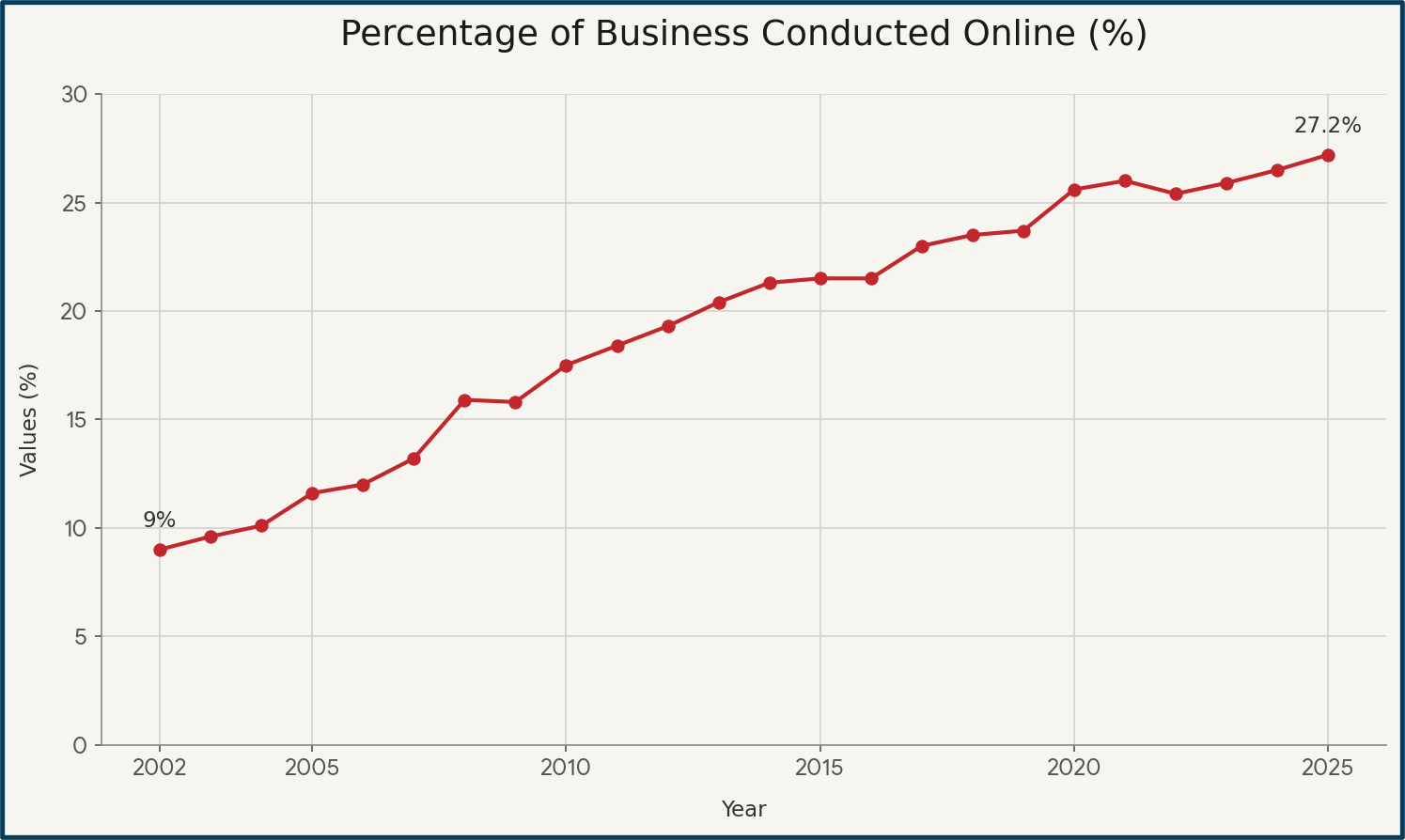
Table of Contents
What is Digital Marketing?
Digital marketing refers to the use of digital technologies and online channels to connect with people, promote products and services, and achieve business goals.
To understand digital marketing, think about how you use your laptop and smartphones. You use these digital devices to search on Google, watch videos on YouTube, scroll for content on social media, read emails, shop online or use apps for different purposes.
Every time you use your phones or laptops to do these things, you interact with different digital marketing channels used by businesses and individuals to sell or promote their content, products or services. Businesses in particular use digital marketing to increase sales, build brand awareness, reach new customers, launch products, educate audiences, generate leads, grow communities, retain customers and expand into new markets.
At the same time, individuals use digital marketing to build personal brands, create content, earn online income, promote services, find freelance work, develop careers and launch businesses.
Online Marketing vs Digital Marketing
“Digital marketing” and “online marketing” are often used interchangeably, but they are a bit different.
Online marketing, which involves the use of internet and connected devices, is a subset of digital marketing. While online marketing is limited to internet-based activities, digital marketing may also include channels such as SMS, mobile applications, connected television and digital out-of-home displays. But digital marketing, as we understand it, is primarily about the use of online marketing channels such as organic SEO, paid advertising, content marketing, social media, newsletters, affiliate marketing, videos, podcasts and influencer marketing.
Keeping the technicalities and strict terminologies aside, digital marketing usually refers to the use of internet-based marketing channels for achieving business objectives.
Why Does Digital Marketing Matter Today?
Thanks to the rapid expansion of internet and hand-held smart devices, the world has evolved rapidly in the last two decades. Now, customers no longer rely only on newspapers, television commercials or physical stores to discover new brands, products or services. Most of them begin their buying journeys online.
According to the ITU’s internet-use estimates, approximately six billion people—about 74% of the global population—used the internet in 2025.
In 2025, Google said its search engine handled over five trillion searches during the year, which works out to at least 13.7 billion queries every day. And online shopping generates trillions of dollars in sales every year.
These numbers reveal a simple fact: People are now spending a lot of time online. Digital marketers bank on this very idea. And since businesses go where people spend their time, hundreds of billions of dollars are spent each year on various online channels, making digital marketing a vital part of business planning and objectives.
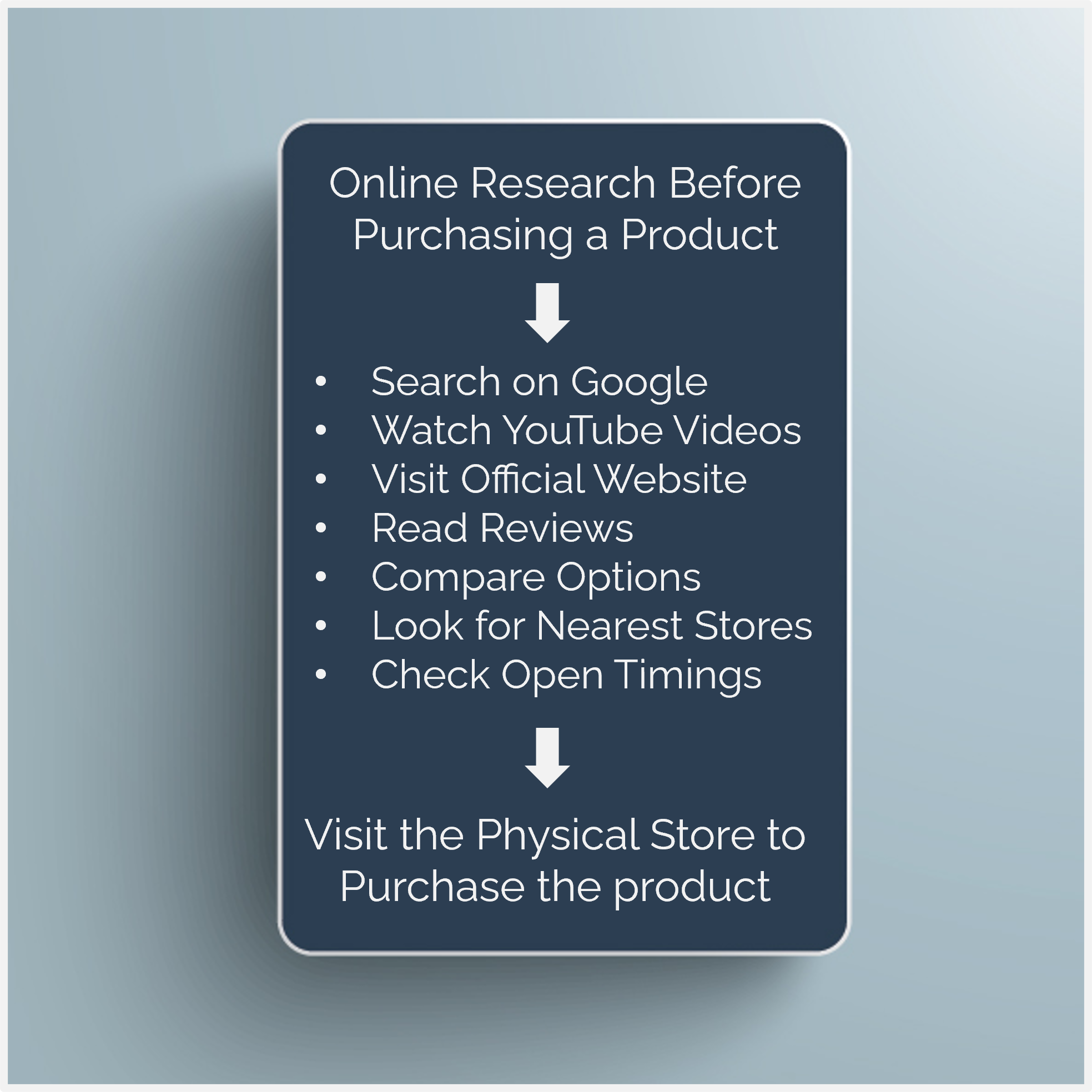
Even in cases where the final purchase takes place in a physical store, product and business research is often conducted online. For example, one may need to compare prices, look for the nearest store location and opening hours, read reviews and ratings and compare features before making the final purchase at the physical store.
How Is Digital Marketing Different from Traditional Marketing?
Businesses need ways to communicate with customers, generate sales or build awareness. Long before the advent of the internet, companies used newspapers, magazines, radio, billboards, brochures, television and direct mail to promote their products and services.
Like traditional marketing, digital marketing aims to reach people and influence their purchasing decisions. The difference lies in the manner in which they achieve these goals.
Targeted Messaging
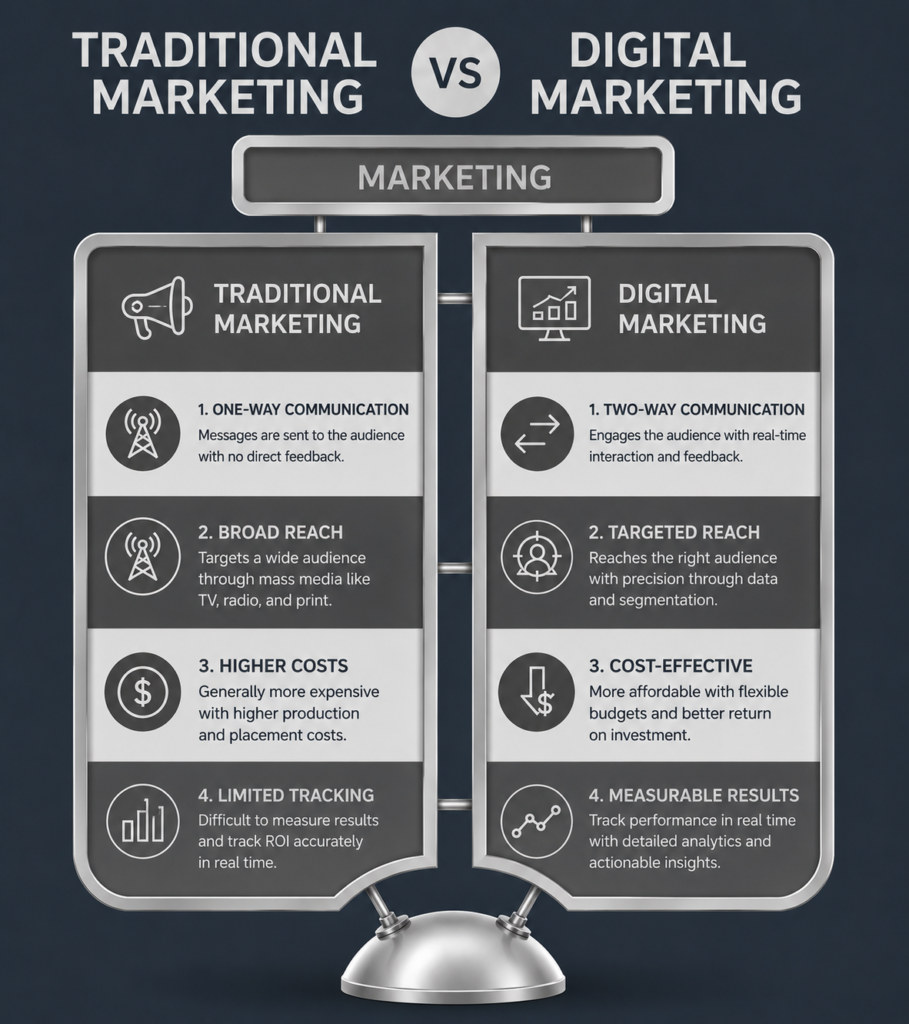
In traditional marketing, businesses broadcast a message to a large audience, hoping it reaches interested people. On the other hand, digital marketing is more targeted as it allows businesses to reach relevant audiences through personalized messages, online metrics and data analysis to continuously improve campaigns.
With modern computers, marketers can easily visualize complex data through various tools and platforms for advanced analysis. This way, digital marketing allows businesses to tailor messages to specific audiences based on budgets, preferences and demographics. For example, an online clothing store may show different recommendations to men and women, different age groups, separate locations and first-time visitors.
Two-way Communication
Traditional channels provide very limited or delayed audience interaction, while digital marketing is dynamic and allows two-way communication between buyers and sellers. In other words, businesses using a brochure, billboard or print ad can expect little or no customer engagement, whereas businesses using digital marketing channels like social media, videos and blogs have vibrant online engagements through comments, messages, forms, reviews and other online actions.
Customer Behavior and Marketing Metrics
More importantly, digital marketing involves tracking customer behavior as they interact with the company and its products through product pages, website content, social media posts and online advertising. These metrics are extremely valuable and help businesses plan tailored campaigns. This way, digital marketing serves business needs in a much more efficient manner.
Imagine a company placing a billboard on a busy highway to promote its new product. Many people see the billboard every day.
The company may get some customers because of the billboard, but it may not clearly know:
- Who saw the billboard?
- How many of those who saw it were interested?
- How many visited the store because of it?
- How much revenue was generated because of the campaign?
Now, the same company places an online ad on Google’s search results page. With the help of online tools, the company can see:
- How many people viewed the advertisement?
- How many clicked on it?
- How many actually visited the website?
- How many purchased the product?
- How much revenue did the ad campaign generate?
- What was the return on investment after one month?
By measuring and improving performance, digital marketing offers great business value, targeted marketing, customized messaging and a better understanding of marketing and sales funnel. On the other hand, traditional campaigns provide less immediate and granular performance data than digital campaigns.
Automation
With digital marketing, businesses can easily automate many activities. For example, a company that has accumulated a vast number of email subscribers can deliver newsletters automatically. Similarly, a customer can receive product recommendations on the basis of previous purchases. A business can use social media management tools to schedule weeks and months of social media content in advance.
In short, digital marketing reduces guesswork associated with traditional marketing, thereby helping businesses make much more informed decisions based on consumer behavior.
Benefits of Digital Marketing
Businesses can benefit in several ways by advertising themselves online. And even a business with a well-planned digital marketing strategy can take on larger competitors in its market. Here are some of the benefits that digital marketing offers to individuals and businesses:
Access to Global Audiences: Digital marketing allows businesses to reach a global audience through different online channels. By breaking geographic boundaries, digital marketing helps businesses remove the traditional barriers to market and sell to potential customers living in a different state or country.
Flexible Starting Costs: Apart from reaching global audiences, digital marketing offers low entry costs to small, new and startup businesses. With a small investment, new and small businesses can create a website, share timely updates on social media, and collect feedback from customers through engagements and online metrics.
Proactive Connection: It is quite common for customers to first conduct online research and evaluate reviews before making a purchase. Hence, rather than waiting for a customer to visit a store or make a purchase, SEO, social media, email and PPC strategies help connect with customers proactively at the information gathering or research stage.
Performance Measurement: Businesses use digital marketing to evaluate return on investment, which helps improve strategies and maximize profits. Measuring ROI can sometimes be difficult and even impossible to measure with traditional marketing strategies like billboards or print ads. On the other hand, online ads and SEO provide real-time data related to the effectiveness of digital campaigns. This enables business leaders to refine strategies, make well-informed decisions and maximize profits.
Customer Interaction: Social media platforms enable meaningful two-way communication with customers from diverse demographics. Furthermore, social media also enables businesses to build and engage communities meaningfully through effective SMM practices. This helps build long-term and loyal relationships and target prospective customers. Reflecting the channel’s broader importance, the 2026 CMO Survey reported that social media accounted for an average of 14.3% of marketing budgets.
Audience Segmentation: Marketing makes sense and marketing budgets can be justified when businesses are able to target very specific audiences. For this, marketers rely on digital marketing channels and online tools to target prospective buyers on the basis of demographics, interests and behaviors.
How Digital Marketing Works: From Visibility to Revenue
Digital marketing may appear complex to beginners as it involves many platforms and technologies. However, the basic idea is surprisingly simple:
Digital marketing helps people discover, evaluate, trust and eventually purchase from a business.
The process often follows a journey. First, people become aware of a product offered by a business. Then they learn more about it. After this, they begin to trust the company and begin taking action like downloading a report, attending webinars or visiting product pages. Then they eventually become customers. In some cases, they even go on to recommend the company’s products.
A simplified customer journey may move theoretically from awareness to evaluation, action, retention and advocacy. In practice, however, customers often move between stages, revisit information, compare alternatives, and use several channels before deciding.
Hence, a simple marketing flow looks like this:
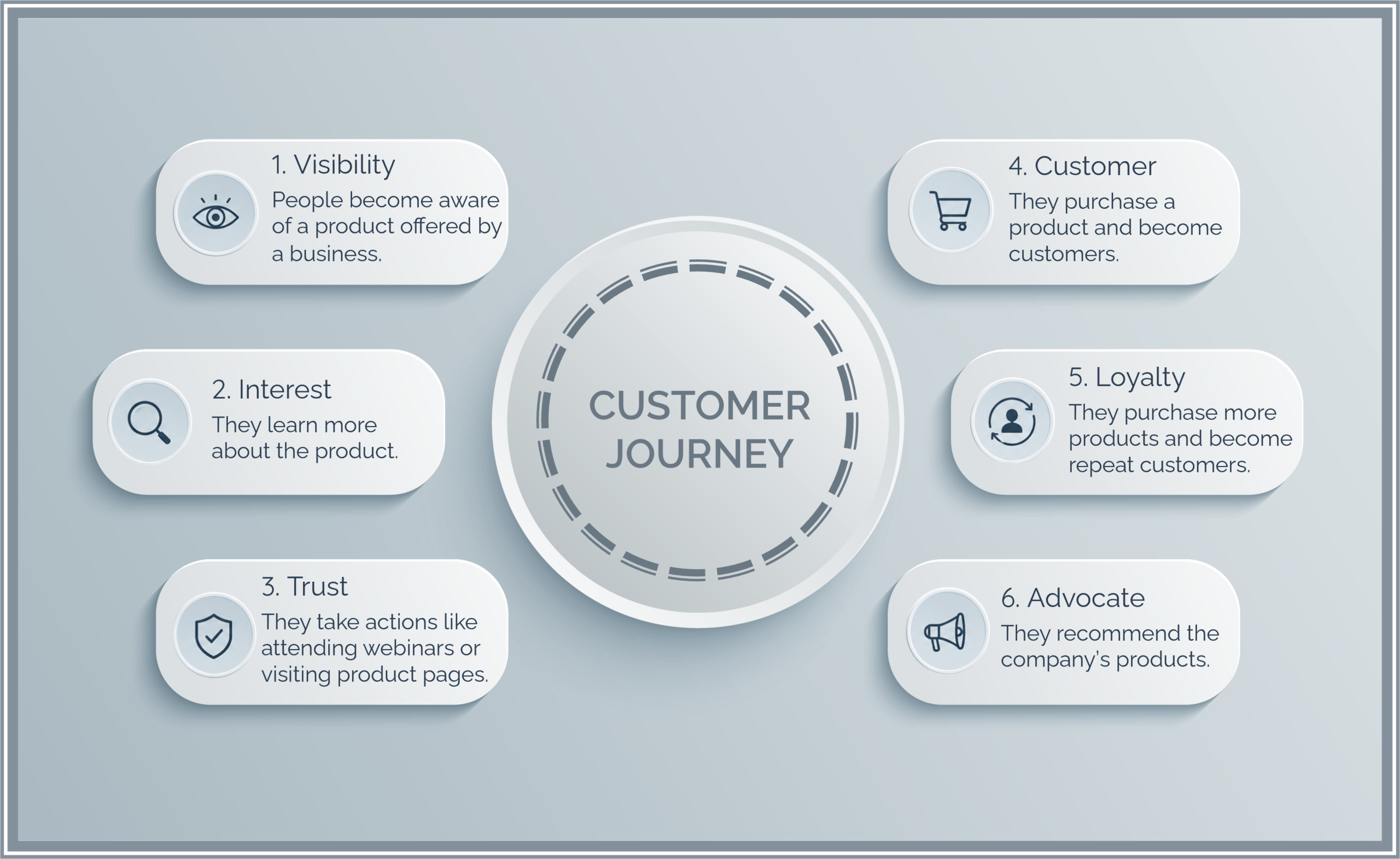
Every digital marketing channel contributes to one or more stages of this journey. Some channels help people discover a brand. Some help educate them about the problem areas, while others help maintain long-term relationships.
At the same time, while digital marketing may involve multiple channels and tactics, most successful strategies are centered around three basic ideas:
Visibility: People should be able to find you. In marketing, nothing counts if there is no visibility.
Value: Once people discover you, they must find something useful. This may be an industry report, a demo, a webinar, reviews, product features or even a funny meme.
Trust: People buy from businesses they trust. And trust develops over time through consistency, credibility, transparency, reviews, expertise and positive experiences.
Digital Marketing as a Highway System
The easiest way beginners can understand digital marketing is through a simple analogy.
You may think of the internet as a vast country connected by millions of highways. Billions of people travel on these highways every day as they look for information, entertainment, products, services and solutions. These travelers may be searching for a restaurant, new software, a laundry service provider or a plumber.
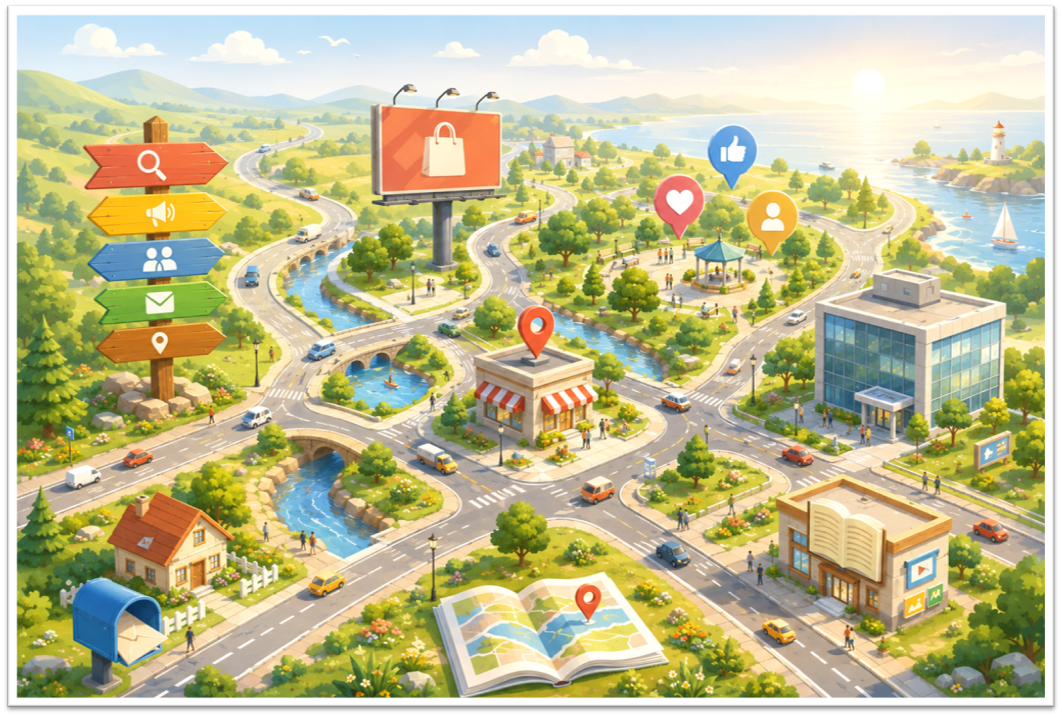
Businesses want people traveling on the digital highway, or the internet, to find them. And digital marketing helps businesses by placing signs, maps, recommendations, storefronts, and helpful guides along these highways.
At the same time, different digital marketing channels play different roles in helping people discover companies, brands and products:
- Search Engine Optimization or SEO acts like road signs that help travelers find destinations naturally.
- Paid ads are like billboards placed on busy highways.
- Social media are like public-gathering or community spaces where people meet and exchange information.
- Emails are like direct communication delivered to someone’s home.
- Influencer marketing is like a network of trusted local guides recommending places to tourists.
- Content marketing acts like useful travel guides and print handouts helping people navigate their journey.
The end is not merely to guide visitors, but to ultimately help them find the right solution in an unknown land. This simple analogy explains why digital marketing is much easier to understand than most people think. In other words, it is easy to understand because most digital marketing concepts are built on common sense.
Digital marketing, therefore, is not just about website optimization, paid ads, or social media marketing. Beyond the tools, processes and technical aspects, it is primarily a systematic process to help people discover, understand, trust and choose a business.
In simple words, digital marketing helps businesses support a person’s or a prospective buyer’s natural decision-making process. And businesses do this all the time by providing useful information, trusted recommendations and meaningful solutions to problems. These principles can help beginners understand digital marketing far more easily than memorizing technical terminology.
From a purely business point of view, digital marketing is more about having a clear understanding of marketing funnels or stages, guiding customers through their purchase journey, and increasing conversion of leads into customers. In fact, HubSpot’s 2026 survey found that lead-to-customer conversion is the second most important KPI that marketers track in digital marketing.
It involves:
- Defining broader business or campaign goals
- Understanding the audience, their pain points and problem areas
- Choosing the right digital channels based on preferences of the target audience
- Creating valuable and actionable content
- Using SEO, social media, emails and other channels to help people discover the business and its products and services
- Converting visitors into customers by guiding them toward a desired action
- Measuring results and analyzing consumer behavior based on clicks, leads, sales, engagement and many other metrics
A Simple Business Example
Sarah opens a small coffee shop in a town. The shop has very warm and welcoming interiors, her coffee is excellent and the prices are fair. Yet, the shop attracts only a few customers each day. This is because Sarah relies primarily on people walking past the store rather than making the most of digital marketing.
After understanding the problem, she immediately creates a website and publishes content about her town, coffee and things to do in her locality. She optimizes her business for local search through local SEO with photos, reviews, videos, menu, phone number and a link to her website. Then she posts photos on social media and collects email subscribers. She also encourages customers visiting her shop to leave reviews online.
Suddenly an increasing number of people begin to discover her business. Now people searching for a coffee shop nearby or places to relax and meet can find her. Her shop and products could also be discovered on social media. An optimized Business Profile can improve local visibility, while email, social media, loyalty programs and profile updates can encourage past customers to return. At the same time, reviews increase trust and sales begin to grow.
The most important thing to note in the whole process is that nothing changed about her coffee! What changed was her shop’s online visibility through digital marketing.
Now, Sarah can also track the performance of her digital marketing efforts through social media analytics reports, website traffic metrics and conversion details. She can also experiment with different marketing strategies to see what works best for her business.
Types of Digital Marketing
Digital marketing involves using multiple online marketing channels to drive traffic, generate leads and convert leads into sales. Each of these channels helps businesses connect with audiences and potential customers in a unique way. For example, some channels focus on visibility, some on trust and some on direct sales. Together, they form the pillars of modern digital marketing.
Marketers don’t rely only on one channel to target audiences. Instead, they blend multiple touchpoints to create a seamless brand or purchase experience.
Search Engine Optimization or SEO
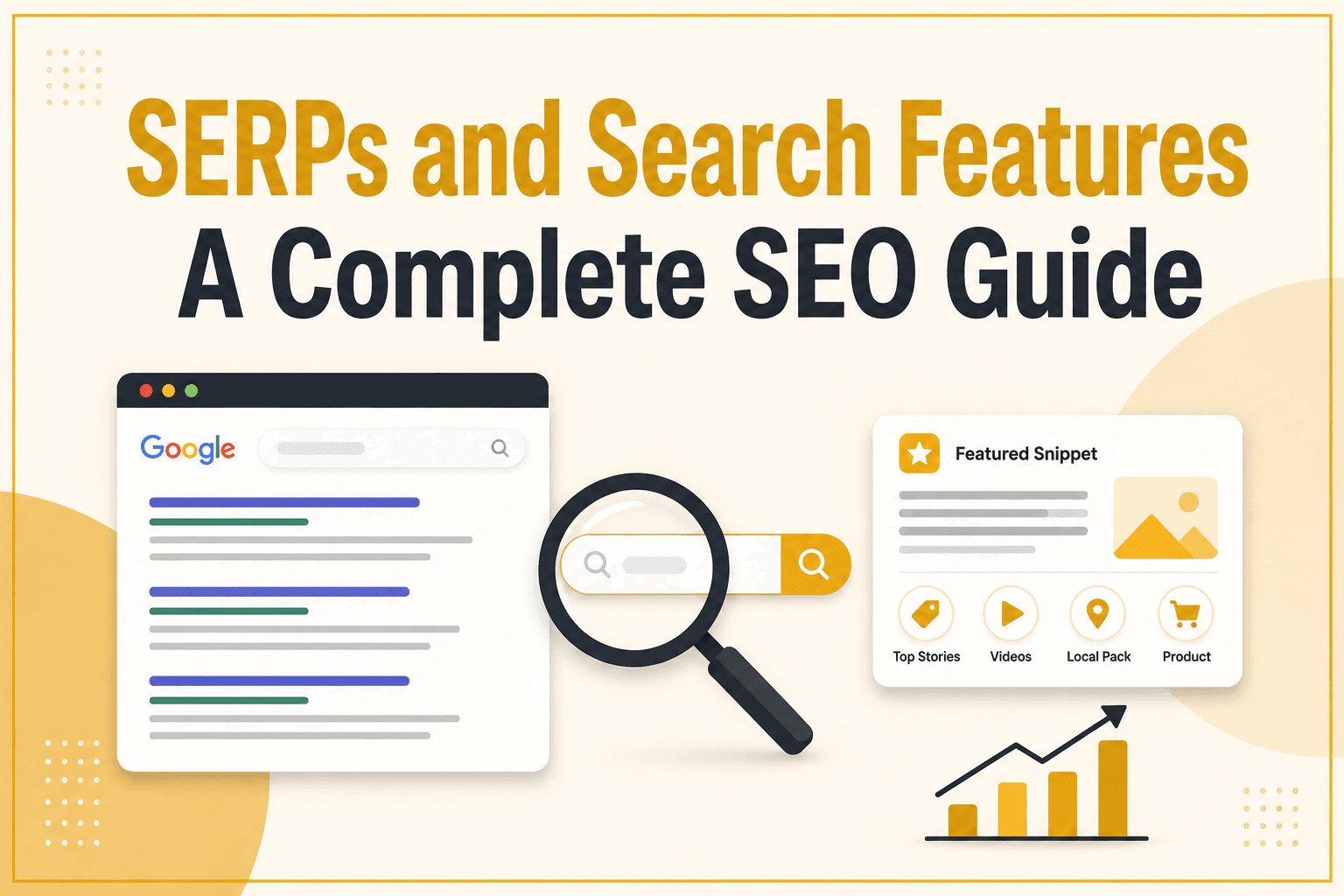
Search Engine Optimization, commonly known as SEO, is the process of improving a website and its pages so that they appear higher in search engine results. When people search for information, products, or services, they tend to click one of the first few results they see on the search engine results page. SEO helps businesses earn those positions organically without paying for every visitor.
For example, when someone searches for “best sports shoes,” search engines try to display the most relevant and useful pages. Search engine optimization helps websites rank among the top few results for those searches.
Over time, SEO can become one of the most cost-effective ways of attracting traffic to the website because visitors arrive through organic search results. In HubSpot’s 2026 survey, 27% of marketers identified website, blog and SEO activity as their highest-ROI marketing channel. More importantly, 32.9% of internet users above the age of 16 rely on search engines to discover new brands, products and services.
There are many search engines that people use to search for content, websites, ideas, products, images and videos, but Google is by far the most popular search engine across the globe. It held approximately 91% of the worldwide search-engine market in June 2026, according to StatCounter’s market-share data. Search engines like Bing, Yahoo, Yandex, DuckDuckGo and Baidu account for the remainder of the search-engine market.
Generative Engine Optimization or GEO
Artificial intelligence is changing how people search for information. Instead of relying only on traditional search engines, many people now ask questions directly to AI systems, especially the large language models (LLMs) such as Claude and ChatGPT. In fact, a 2026 survey found that about 94% of marketers planned to use AI in their content-creation processes.
Generative Engine Optimization or GEO focuses on making content easier to discover, understand, and reference in the AI-powered search and answer systems. It is emerging as an extension of traditional SEO for AI-powered search environments. Businesses that are focusing on creating helpful, trustworthy, and well-structured content are often better positioned for this AI search environment.
Paid Search and Digital Advertising
Paid advertising allows businesses and online platforms to pay for visibility. Instead of waiting for organic rankings, businesses can pay to place advertisements in front of potential customers. This way, paid advertising can generate measurable traffic and conversions quickly, but returns vary according to the platform, industry, audience, costs and campaign execution.
Common advertising platforms include Google Ads, YouTube Ads, Social Media Ads and Display Advertising Networks.
Paid advertising is highly effective for product launches, lead generation, local businesses, seasonal campaigns and rapid growth campaigns. It is important to note here that while SEO often produces results over time, paid advertising can generate traffic immediately.
Social Media Marketing
Social media marketing is all about using social platforms to grow networks, build brand and product awareness, engage audiences, and promote products or services. Social media is a highly effective digital marketing channel as billions of people use social media every day. This makes social platforms valuable environments for communication and community building.
Businesses use social media to share updates and content, interact with customers, take feedback, build communities, promote products and support customer service. The goal is often not immediate sales but long-term relationships and brand visibility.
Content Marketing
Content is frequently described as the fuel that powers digital marketing. Content marketing is primarily about focusing on creating useful, valuable and relevant content to educate audiences and drive website or social media traffic. Instead of directly promoting products, content marketing helps people solve problems and answer questions. It is a highly effective channel for accumulating marketing-qualified leads that can eventually convert to sales.
Common content formats include blog articles, guides, research reports, case studies, videos, podcasts and infographics. In 2025, blog posts were the third most popular content format among marketers after short-form video and long-form video.
Content marketing is a highly effective digital marketing strategy because it supports almost every other channel. Marketers often need content for SEO, social media, email marketing, and even advertising. They tend to repurpose one piece of content for different distribution channels for effective and coherent marketing campaigns.
Native Advertising
Native advertising is paid promotional content designed to fit the normal presentation and experience of the platform on which it appears. Examples include sponsored articles, promoted social posts and recommendation units placed alongside editorial content. The idea behind native advertising is not to trick potential customers into believing that the ad is an organic piece of content. Instead, the aim should be to offer a frictionless user experience.
Email Marketing
Email marketing is one of the most effective digital marketing channels despite fears that it has become outdated. In reality, email continues to be one of the few marketing channels businesses truly control. This is because email is a direct communication channel and one can easily communicate important updates related to product launches and industry trends to a list of email subscribers. It often leads to high conversion rates as many subscribers are sales-quality leads.
Email marketing delivers a $36 to $42 return for every dollar spent—a much higher ROI than digital advertising. Businesses use email marketing to share updates, educate customers, promote products, deliver newsletters and build long-term relationships. A well-maintained email list can become one of a business’s most valuable assets.
E-commerce Marketing
E-commerce marketing focuses on helping online stores attract visitors and generate sales. It includes optimizing product pages, positioning products effectively, building trust, answering customer questions, reducing purchase hesitation and encouraging repeat purchases. The scale of online retail makes these activities increasingly important: according to the US retail e-commerce report, e-commerce accounted for 16.9% of total US retail sales in the first quarter of 2026.
E-commerce marketing often combines multiple digital marketing channels such as SEO, paid advertising, social media and influencer partnerships. Successful online stores rarely depend on a single marketing channel.
Affiliate Marketing
Affiliate marketing is a partnership-based marketing model.
Businesses tend to reward individuals or organizations for referring customers. For example, a blogger may recommend a product and earn a commission when readers make purchases through a referral link.
The affiliate marketing model can benefit both sides. In affiliate marketing, businesses gain additional exposure and sales without upfront advertising costs, while affiliates gain an opportunity to earn income. This model has become particularly popular among creators, bloggers, educators and niche websites.
Influencer Marketing
Influencer marketing is a relatively recent phenomenon as compared to email, SEO and digital ads. It involves collaborating with influencers who already have trusted audiences and a vast follower base on social media platforms. It is based on the idea that people often trust recommendations from creators they follow regularly.
Businesses often partner with influencers to introduce products and services to relevant audiences. Influencer marketing can range from major celebrity partnerships to local collaborations with smaller niche creators.
Video and Podcast Marketing
Video and audio content are becoming increasingly popular among marketers for taking products and services to young and new audiences. Video and podcast marketing help businesses communicate expertise while creating deeper audience engagement.
Many people prefer watching or listening rather than reading. Videos can help build trust quickly through product demonstrations, explainer videos and real-life stories. Similarly, podcasts allow businesses to collaborate with creators and celebrities to connect with audiences in a more personal and conversational format.
Marketing Automation
Marketing automation refers to the use of technology to automate basic marketing tasks from marketing platforms. Marketing automation can help send confirmation and welcome emails, schedule social media posts, chat with customers and analyze and visualize marketing data. Marketing could be automated from a single platform or involve a combination of integrated tools.
Overall, it is a critical way to engage with customers while maintaining an organized and productive workflow.
How Do These Channels Work Together?
One of the biggest misconceptions about digital marketing channels is that they operate independently or in silos. In reality, digital marketing is an integrated effort in which multiple channels often work together. For example, a customer may first become aware of a brand or a business through a social media post. Later, they may choose to visit the company’s website and search more about it on Google. They may also subscribe to a newsletter.
That is why successful businesses typically combine multiple channels into a unified strategy as part of their digital marketing plan. These interconnected channels help them attract audience attention, build trust, generate leads, and increase revenue. For example,
- SEO helps people learn about a brand
- Content helps them make informed decisions
- Social media helps engage them
- Email helps maintain relationships with the customers
- Advertising helps accelerate the brand’s growth
- Affiliate and influencer marketing help expand the brand’s reach
Working in unison, these channels help make digital marketing efforts more coherent.
Digital Marketing for Business Revenue, Side Income and Career Growth
Digital marketing creates income opportunities for both businesses and individual creators. A business owner may plan a digital marketing strategy to increase sales, while a freelancer may use it to find online clients. Similarly, a content creator may use different marketing channels to build an audience, while a student may see digital marketing as a great career opportunity.
Their goals may differ, but the underlying principle remains the same: digital marketing helps audiences discover brands, products, websites, creators and entities online. More importantly, it allows local businesses and individuals to compete with established brands and large organizations.
An independent consultant, a local shop, an online store, a software startup and a globe-spanning corporate house use the same internet to help potential customers discover their products, services and businesses. The difference lies in strategy and execution rather than the size of the business.
Building a Digital Marketing Strategy
Many beginners think that digital marketing is primarily about social media posts or advertisements. In reality, it is more about strategy, plans, integrated efforts and execution.
A digital marketing strategy involves a detailed plan for achieving business goals through digital channels. The strategy often begins with identifying the target audience, selecting relevant channels, planning content and executing measurable actions. Metrics and analysis form the backbone of strategy as they bring precision to marketing efforts and help improve the return on investment.
A business selling software may focus on educational content and search engines, while a local business may prioritize local SEO, customer reviews and geography-specific ads. In both these cases, the end is to reach the right audience. In other words, marketing tactics may vary depending on the size and nature of business, but the goal remains the same: offering the right solution to the right audience.
How Does Digital Marketing Help Businesses Increase Revenue?
Every business relies on customers, as there are no sales without customers and no revenue without sales. Digital marketing focuses on attracting potential customers, educating them about products or services, encouraging them to take action, and constantly measuring and improving marketing efforts.
Take the example of a company selling home fitness equipment. Before digital marketing, the company would need to rely on newspaper advertisements, television commercials, physical retail stores or print handouts. With digital marketing channels, the same company can publish and share educational content, rank on search engines, build an email list, advertise on social media, create podcasts and videos, and partner with influencers. Each of these efforts helps the company introduce its products to new audiences.
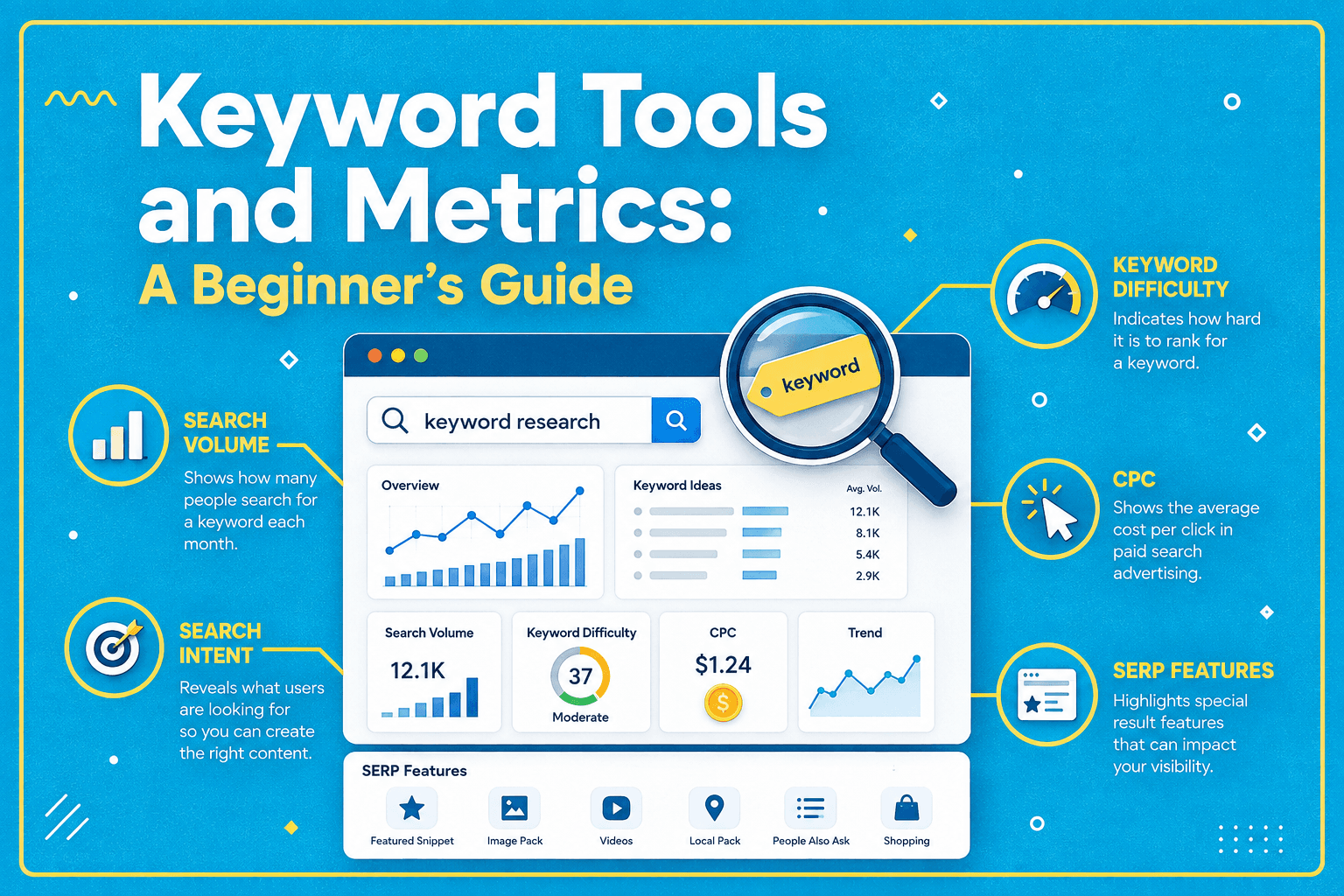
Digital marketing also allows businesses to cater to audiences already interested in a topic. For example, someone searching for “best treadmill for home use” on Google has already demonstrated interest in fitness equipment. With data on this keyword, a business has a better chance of gaining new customers than simply broadcasting a message to a random audience.
Why Small Businesses Benefit from Digital Marketing?
Small businesses often face challenges such as limited budgets, smaller teams and lower visibility. Digital marketing helps remove these hurdles and level the playing field.
This allows a local business to appear in search results alongside established businesses. All it needs to do is target niche products, rank for certain keywords with low difficulty scores, publish useful content and optimize its website and local presence for relevant searches. An online store can also drive traffic through social media and emails.
By allowing businesses to start small and scale gradually, digital marketing has become a highly accessible growth engine for local businesses and entrepreneurs.
Digital Marketing and Side Income Opportunities
Apart from business revenue, digital marketing also creates opportunities for individuals to earn income online by turning expertise, creativity and knowledge into economic opportunities. The internet offers countless opportunities for creators and individuals to share knowledge, promote products and build communities around niche topics.
With a basic understanding of one or more digital marketing channels, a person interested in fitness can start a blog, create videos on YouTube, or send newsletters to interested audiences. Similarly, someone passionate about technology can create educational content.
Over time, as one accumulates enough customers, followers or subscribers, one can explore more income opportunities through sponsorships, consulting, affiliate marketing, memberships and online courses.
At the same time, it is important to keep in mind that digital marketing is not a shortcut for quick money. In fact, most successful creators and entrepreneurs spend a lot of time creating content, making strategies, understanding markets and competitors, building trust and learning how audiences behave online.
Freelancing and Career Growth
One can also offer digital marketing skills as services. Businesses often need help with website optimization, SEO, content creation, social media management and performance analysis. Those offering freelance services can help such businesses in exchange for fees.
Many people begin their digital marketing careers with small freelance projects, managing small websites, or helping local businesses. Over time, experience, good results and client referrals help attract larger clients and better opportunities.
Some of the common career paths in digital marketing include:
- SEO Specialist
- Content Manager
- Social Media Manager
- Paid Advertising Specialist
- Marketing Analyst
- Digital Marketing Manager
- Growth Marketer
- Marketing Consultant
So long as businesses invest more money in online marketing channels, demand for these skills will continue to rise.
Important Digital Marketing Tools and Platforms
Digital marketers use a wide range of tools and platforms. They need these tools, applications and platforms to create content, share content, research audiences, build connections, analyze performance, manage campaigns, discover content ideas, and measure and improve results.
For example, marketers often rely on Google Search, Google Trends and Google’s autocomplete suggestions for basic keyword research and content planning. These Google tools give marketers a broad understanding of what people are searching for. For advanced research, features such as People Also Ask, Google’s related search and AlsoAsked are used to find common questions and content opportunities. Digital marketing professionals often supplement this research with advanced keyword tools from Semrush and Ahrefs.
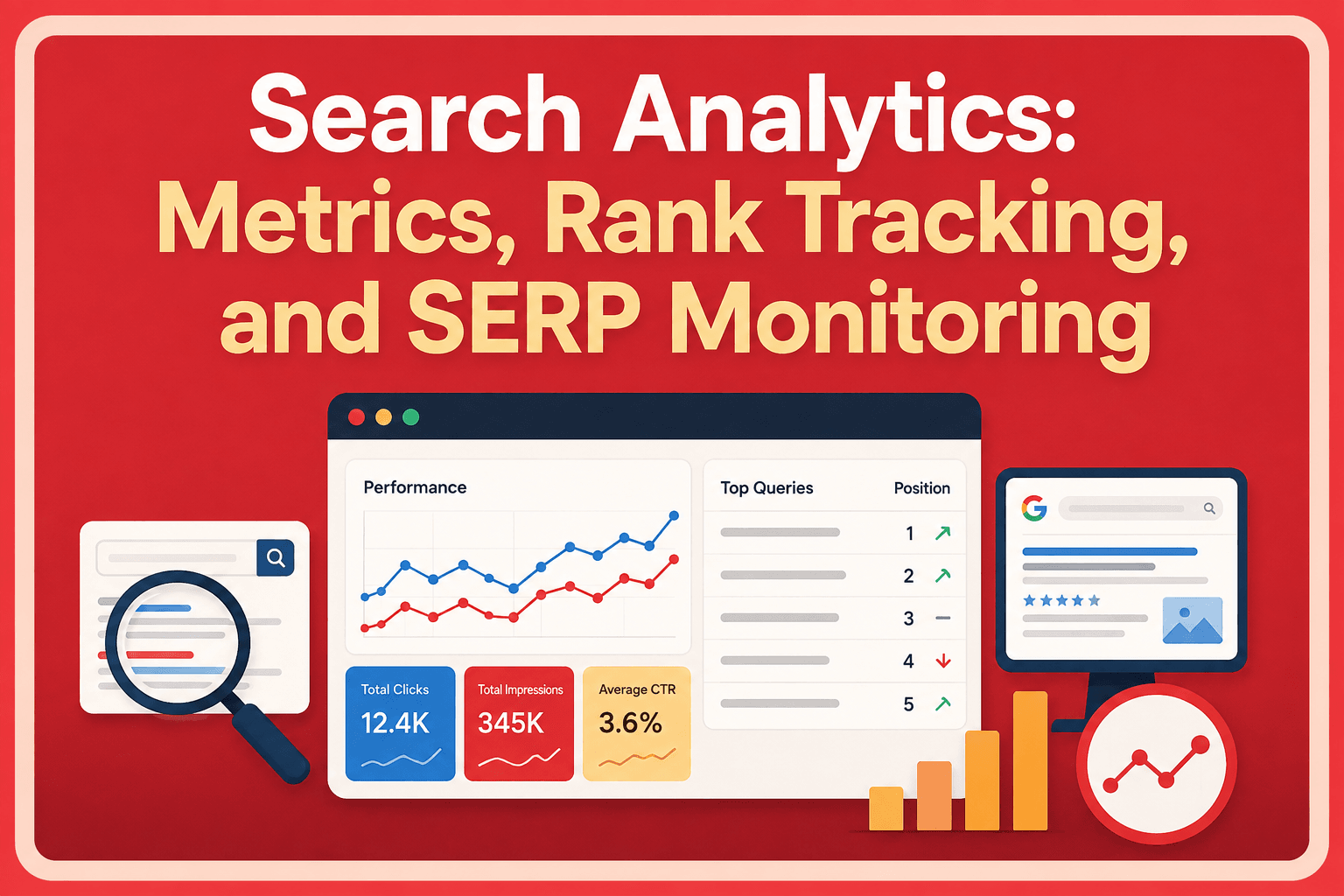
Similarly, one can check website and webpage speeds using PageSpeed Insights and visitor interactions with Google Analytics. Google Search Console is another important Google platform used by marketers to identify SEO opportunities and monitor website visibility. Google Search Console reports a website’s performance in Google Search, while Google Analytics measures on-site traffic and user interactions. Similarly, SEO platforms such as Ahrefs, Semrush and Moz provide keyword, backlink, ranking and competitive research. These insights help improve strategies and allocate resources more efficiently.
Tools such as Copyscape and Grammarly can assist with similarity checking, spelling, grammar, and editing, although they should not replace human review. For social media marketing, businesses often rely on platforms such as LinkedIn, Facebook, Instagram, X and YouTube. Businesses often use LinkedIn Ads, Meta Ads Manager and Google Ads to run paid campaigns and reach specific audiences.
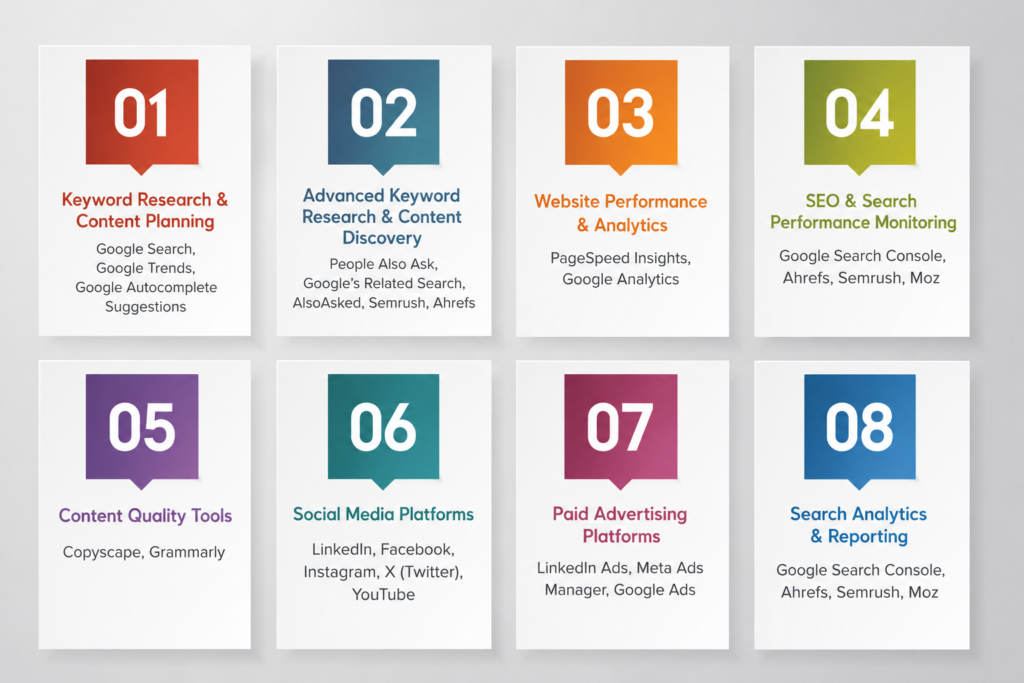
The main purpose of most of these tools is to understand audiences, create better content, measure results and improve marketing performance. This way, data generated from these tools and platforms helps make marketing decisions more effective.
Important Digital Marketing Metrics
Many beginners often feel overwhelmed by marketing terminology. Luckily, some of the most important digital marketing metrics are quite easy to understand. These include:
Website Traffic: It refers to the number of people visiting a website.
Click-Through Rate or CTR: CTR measures how often people click the website or webpage link after seeing a link or advertisement.
Cost Per Click or CPC: CPC refers to the amount paid each time someone clicks an advertisement.
Conversion Rate: It measures how many visitors complete a desired action, such as making a purchase or filling out a form.
Revenue: It measures the money generated through marketing activities.
Beginners need not memorize dozens of digital marketing metrics in the beginning. Understanding a few important ones such as CTR, CPC and Conversion Rate is enough to get started.
Digital Marketing in the Age of AI and Generative Search
Digital marketing is undergoing rapid transformation in the age of artificial intelligence. Advanced AI systems are now capable of analyzing data, generating content, assisting with research, automating repetitive tasks and improving personalization. This, in turn, is helping marketers understand audience behavior more effectively. Many AI models trained using machine learning offer advanced product recommendations based on users’ search activity.
However, AI is not replacing humans anytime soon as we need human creativity, strategy and judgment to understand human behavior and plan marketing strategies. As a human-centric discipline, marketing ultimately requires empathy, storytelling, communication and trust. These human qualities remain irreplaceable even as technology evolves.
How AI Is Changing Digital Marketing?
About 94% of marketers plan to use AI as part of their content-creation processes in 2026. HubSpot reports that 73.7% of surveyed marketers plan to maintain or increase their investment in voice-search optimization in 2026. Overall, AI is influencing many areas of digital marketing. For example:
- Content creation tools are helping marketers and creators generate ideas and draft content.
- Advertising platforms are increasingly optimizing campaigns automatically.
- Analytics tools are used to identify trends and opportunities.
- Customer service systems are taking user queries and responding through automated chatbots.
- Search experiences are also evolving as more people are relying on AI-powered answer engines.
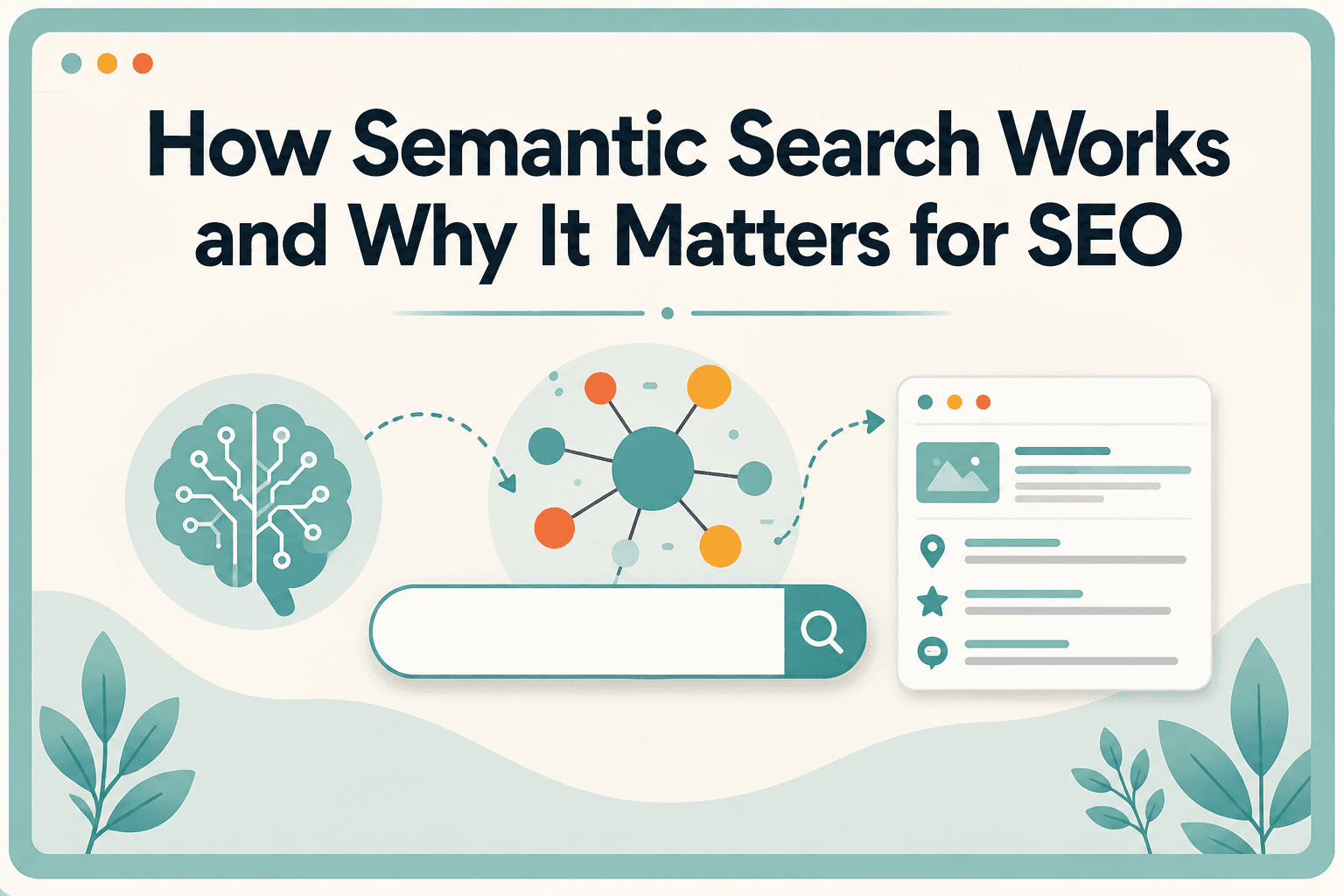
Apart from keyword-centric traditional search, AI-assisted search engines also use semantic or meaning-based search systems that focus on meanings and user intent. Moreover, more people are using voice assistants and smart devices rather than typing into a search box. In other words, they are often using natural, conversational language, which is changing the way creators and marketers optimize their content. In fact, as voice- and question-based search continue to grow, businesses will need to focus more on answering real questions directly to help users discover their content, brand or products.
The Rise of GEO
Apart from optimizing content for voice and conversation-based search, marketers are also relying on Generative Engine Optimization or GEO to remain relevant. While traditional SEO focuses on improving visibility in search results, GEO focuses on improving visibility in AI-powered search and answer systems such as ChatGPT, Claude, Google AI Mode and Perplexity.
In simple words, GEO helps make content discoverable and understandable to AI systems that generate answers directly for users. It increases the chances of getting retrieved, cited and summarized in the auto-generated answers.
Marketers and creators can optimize GEO by creating relevant, accurate, trustworthy and helpful content that directly answers the user’s questions.
Human Skills Remain Important
Human behavior changes very slowly even as technology is changing quickly. This makes human skills all the more important in marketing, which is primarily about understanding and analyzing human intent and behavior. Hence, expertise, authenticity, experience and trust still remain relevant.
The ideal strategy in the age of artificial intelligence is to combine technology with human ingenuity and strong communication skills. Hence, rather than seeing AI as a threat, businesses and professionals must adapt themselves to AI-powered tools to improve productivity and decision-making.
Conclusion
Digital marketing serves as a level playing field for businesses, entrepreneurs, startups, individuals and creators to find and target niche audiences. With adequate skills and learning, one can use it to reach customers, expand business, build trust, generate revenue and grow brands.
Even as artificial intelligence is changing the way content, brands and products are discovered online, the core marketing ideas are surprisingly simple: businesses, entities and individuals need visibility to help people discover them. They need to invest in creating valuable content that solves real problems. And then they need effective communication and user engagement to maintain trust and loyalty.
So, whether you are a student exploring career opportunities, a business owner trying to increase revenue, a freelancer looking for clients, or a full-time professional looking to upgrade your skills, digital marketing provides numerous opportunities that were thought impossible to access just a few decades ago.
With a wide range of learning materials, online tools and digital platforms, learning digital marketing has become highly accessible to anyone with a computer, smartphone and a reliable internet connection. Once you are able to gain good expertise in digital marketing, there are many earning and professional opportunities waiting for you, ranging from freelancing and consulting to full-time jobs and building your own online business.
Frequently Asked Questions
What is digital marketing in simple words?
Digital marketing is the process of improving online visibility of a brand, products, services or ideas through digital channels such as websites, search engines, social media platforms, email, podcasts, videos, affiliate content and mobile applications.
Is digital marketing a good career?
Yes. Digital marketing offers a diverse range of career and growth opportunities across various industries. Businesses are increasingly relying on digital channels to promote their brands and products. This creates demand for professionals with marketing, analytical, advertising, content creation and communication skills.
How long does it take to learn digital marketing?
One can learn the fundamentals of digital marketing within a few months. However, to become an expert, one needs practical experience, continuous learning, market awareness and relevant skills.
Does digital marketing require coding?
No, one can become a digital marketing expert without coding. Most digital marketing roles do not require coding knowledge. At the same time, understanding the basics of websites and other digital channels can be helpful in certain areas such as SEO and analytics.
Can small businesses benefit from digital marketing?
Absolutely. Digital marketing offers a level playing field for small businesses to expand into markets, reach new audiences, compete with larger organizations, increase online visibility and generate leads without massive investments.
What is the difference between SEO and digital marketing?
SEO is just a part of digital marketing. SEO is primarily about optimizing websites and specific webpages to rank better in search engine results. Apart from SEO, digital marketing also includes content marketing, social media marketing, paid advertising, influencer marketing, email marketing, affiliate marketing, and videos and podcasts.
Can I earn money online using digital marketing?
Yes. Businesses, consultants, freelancers, creators, agencies and affiliates use digital marketing to earn money. For this, one needs constant learning, skills, meticulous planning, consistency, audience building and content delivery.
Is AI replacing digital marketers?
AI is certainly changing how brands, products and content are discovered online. At the same time, it is not eliminating the need for marketers as successful marketing primarily involves strategic thinking, human creativity, communication, and understanding and analyzing human behavior.